




Impact of AI on Software Development: Key Benefits & Use Cases


The way software is created, built, and maintained is being changed by the impact of AI on software development. With ML and automation accelerating development, the global AI-driven software market is expected to reach $1,039 mil. by 2027. Software engineering and AI are no longer separate fields; they now work together to deliver faster, smarter, and more reliable systems.
This article will show how artificial intelligence is changing software development, its main advantages, realistic applications, and difficulties it presents, hence providing a clear picture of the shape coding and engineering will have going forward.
The Impact of AI on Software Development Life Cycle (SDLC)
AI enhances every stage of the SDLC, from design and coding to testing, deployment, and maintenance. It improves accuracy, automates routine work, and accelerates delivery, enabling teams to build scalable and resilient software.
Here’s how artificial intelligence is changing every phase of the SDLC:
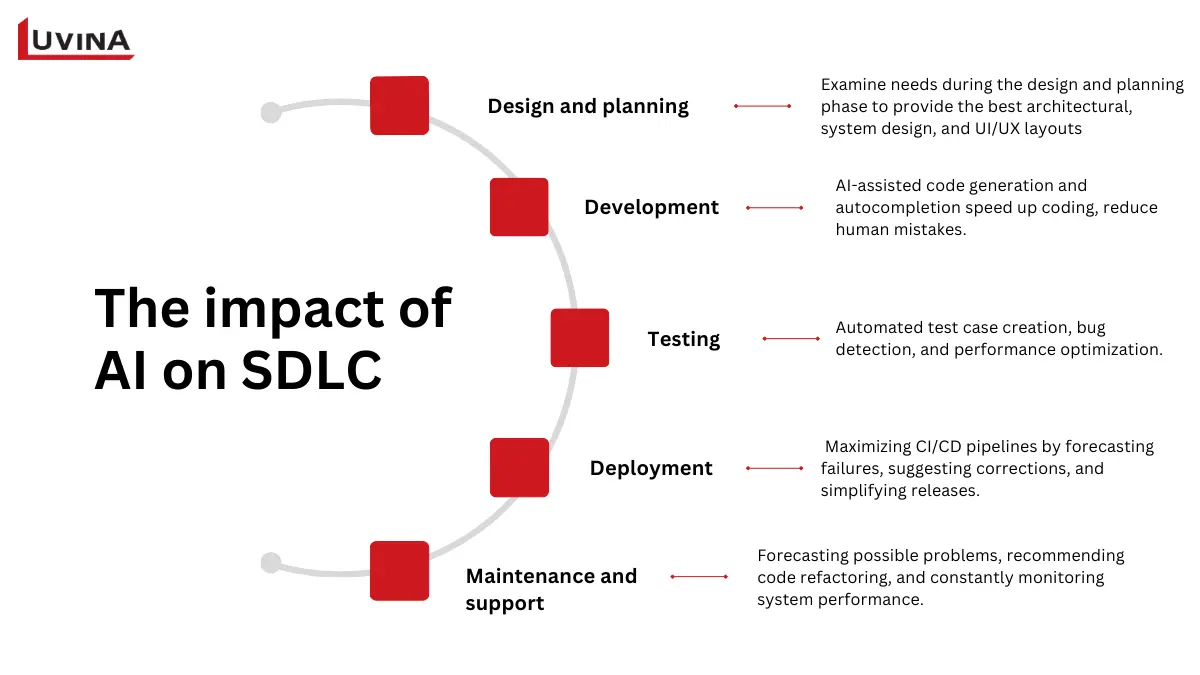
Design and planning
AI can examine needs during the design and planning phase to provide the best architectural, system design, and UI/UX layouts. Using an AI app creation tool, developers can more rapidly create mockups, diagrams, and technical specifications, hence minimizing hand effort and improving consistency over projects. These initial treatments show the impact of AI on software development, starting on day one, therefore simplifying processes and encouraging creativity.
Development
During the development phase, AI-assisted code generation and autocompletion speed up coding, reduce human mistakes, and let engineers concentrate on challenging logic instead of boring tasks. Advanced models that use applications of AI and ML interpret natural language descriptions to generate functional code, therefore delivering exact advice that progressively gets better with use.
Testing
The impact of AI on software development also helps with testing and quality assurance. Software reliability and security are guaranteed in part via automated test case creation, bug detection, and performance optimization.
Deployment
By forecasting failures, suggesting corrections, and simplifying releases, artificial intelligence maximizes CI/CD pipelines. Showing yet another aspect of the impact of AI on software development by improving efficiency and lowering downtime, this guarantees quicker deployments, smoother builds, and less downtime.
Maintenance and support
AI is essential for maintenance and support even after deployment by forecasting possible problems, recommending code refactoring, and constantly monitoring system performance. Artificial intelligence lets teams iterate more quickly and create more resilient software by automating documentation and feedback analysis.
Key Benefits of AI-Driven Software Development
The clear impact of AI on software development’s overall quality raises productivity and increases efficiency, revealing its effects on applications. Here are the main benefits of artificial intelligence software development:
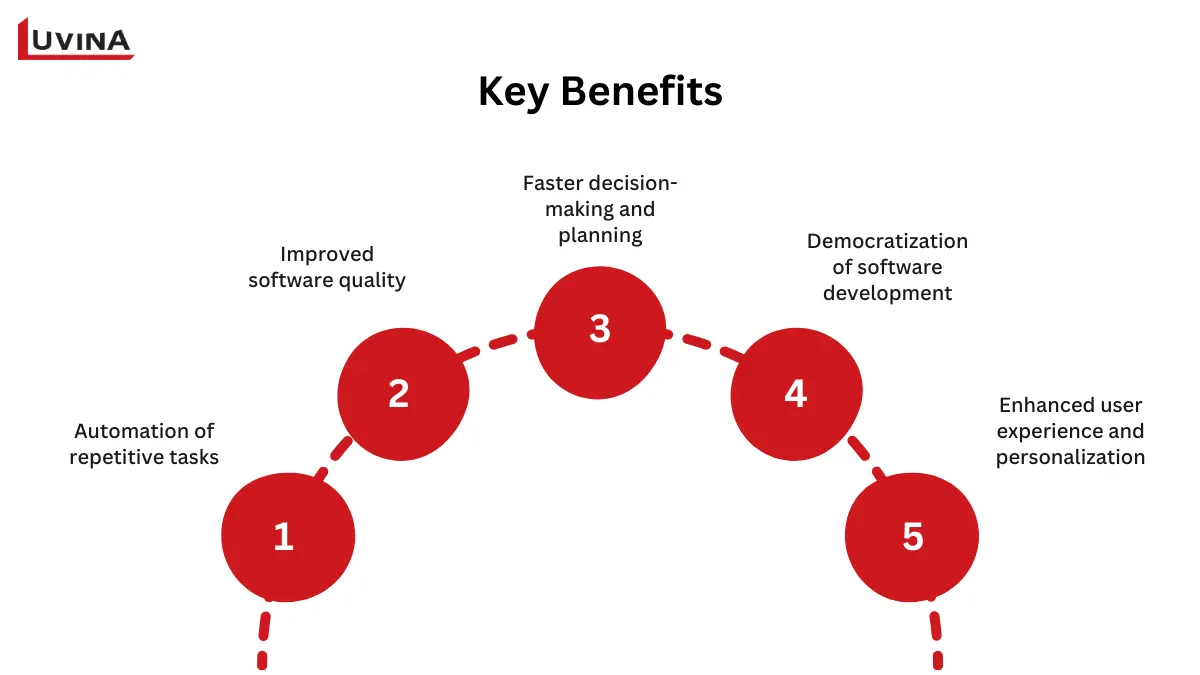
Automation of repetitive tasks
AI automates repetitive coding, reduces manual work, and helps engineers focus on higher-level design. This form of automation also allows designers to devote time and energy to higher-order tasks such as detecting bugs, designing architecture, and solving problems.
Improved software quality
Early in the development life cycle, artificial intelligence finds bugs, weaknesses, and flaws. Intelligent testing solutions speed up debugging and guarantee more dependable software by creating test cases, prioritizing crucial tests, and even running them automatically.
Faster decision-making and planning
Through the study of major datasets and historical project trends, artificial intelligence helps with more precise forecasting of feature prioritizing, resource distribution, and timelines. This results in more effective project management, streamlined processes, and quicker, data-driven judgments.
Democratization of software development
No-code and low-code AI systems enable nontechnical users to create and modify applications without a significant amount of programming knowledge. Business analysts, product managers, and others can design unique solutions while enhancing user participation and access.
Enhanced user experience and personalization
By examining user behavior and preferences, artificial intelligence provides individualized recommendations, interfaces, and functionality in real time. Another way the impact of AI on software development benefits both developers and end users is shown here, as this improves user happiness, engagement, and general software product intuitiveness.
The Impact of AI on Software Development: Use cases & tools
The many tools and applications that improve overall software quality, creativity, and efficiency show the impact of AI on software development. Knowing what AI offers to enhance application software helps developers and tech teams use AI properly to simplify processes and improve results. The following are important use cases and tools demonstrating the benefits of AI-driven software development:
Automated code generation
AI converts natural-language descriptions into usable code.
- Suggests functions and snippets
- Reduces boilerplate work
- Speeds development for complex modules
Predictive analysis for project planning
With the help of AI, which examines past project data, it can foresee timelines, resource needs, and risks that could arise. Consequently, project managers are empowered with the ability to use data for decision-making, enhancing resource utilization, and cutting down on waiting times. Besides, predictive analytics is instrumental in maintaining project schedules and giving teams enough time to anticipate the coming of resource shortages, thus revealing yet another facet of the impact of AI on software development.
Enhanced user experience
Real-time support for developers and end consumers comes from AI-driven chatbots and intelligent assistants, which also direct workflows and answer queries. AI increases user engagement and pleasure by customizing suggestions, interfaces, and function utilization according to behavioral analysis. Here, examples of how AI is used demonstrate how AI-driven software development can immediately help toward more user-friendly and intuitive products.
Software testing automation
AI will automatically generate test cases, prioritize testing, and run tests. When AI generates test cases, it will run unit tests, integration tests, and user acceptance tests. Automated testing speeds up the overall quality analysis process, enhances coverage, and reduces human errors. Additionally, by continually analyzing prior test results and patterns in the code, artificial intelligence assures and assures quality and reliability and quality – the impact of AI on software development.
Security threat detection
Among the flaws detected automatically by artificial intelligence algorithms are SQL injections, cross-site scripting (XSS), and unsafe code alterations. By means of real-time monitoring of the codebase by security-focused artificial intelligence systems, flags are raised, and mitigations are provided, hence enhancing general software application compliance and safety.
Language translation and localization
AI translation tools help software scale globally by automating localization. This ensures software programs are accessible, easy to use, and inclusive, with no manual localization process needed.
Bug detection and fixing
The applications of AI and ML help to spot inefficiencies, forecast possible mistakes, and propose solutions by looking at code patterns. Automated debugging tools can, in real-time, fix code and modify prototypes using live data, therefore lowering downtime and boosting code maintainability.
Project management automation
Scheduling, resource management, and precise project timelines are all helped by artificial intelligence. Regular project management activities are automated, hence allowing managers to concentrate on strategic planning and decision-making. Predictive resource allocation and time estimation help projects become more predictable and processes become more effective.
Documentation automation
Turning complicated code into legible manuals, artificial intelligence (AI) tools use natural language processing (NLP) to create and keep documents. They also provide technical document translation for global teams, hence enhancing knowledge sharing and cooperation.
Code refactoring and optimization
In this regard, the impact of AI on software development is to continuously evaluate code quality and offer suggestions for change, resulting in developers writing more effective, maintainable, and high-performing software. This entails recommending restructuring of code, examining bad practices, and optimizing algorithms.
DevOps and CI/CD optimization
Within CI/CD pipelines, artificial intelligence streamlines infrastructure monitoring, scaling, and distribution processes. AI greatly enhances operating efficiency and minimizes downtime by foreseeing performance problems, streamlining building processes, and guaranteeing smooth deployments.
UX and UI design automation
Using user data, an AI app development tool can automate interface creation, personalize experiences, and run A/B tests to find the best design. This ensures that software is designed around the end user so it works well, is visually appealing, and easy to use.
Architectural design assistance
Neural networks can analyze large datasets and propose scalable and efficient software architectures. For complex multidimensional systems, like those found in business applications, healthcare imaging, and recognition, AI can provide architecture to balance performance, maintainability, and reliability, thereby improving overall project outcomes.
Challenges & Risks of Implementing AI in Software Development
Though artificial intelligence brings great advantages, the impact of AI on software development also presents several problems that companies have to solve for successful integration. Applying AI-based software development solutions calls for thorough planning, risk management, and constant monitoring to guarantee projects are both efficient and responsible. The following are the major challenges and practical approaches to address them:
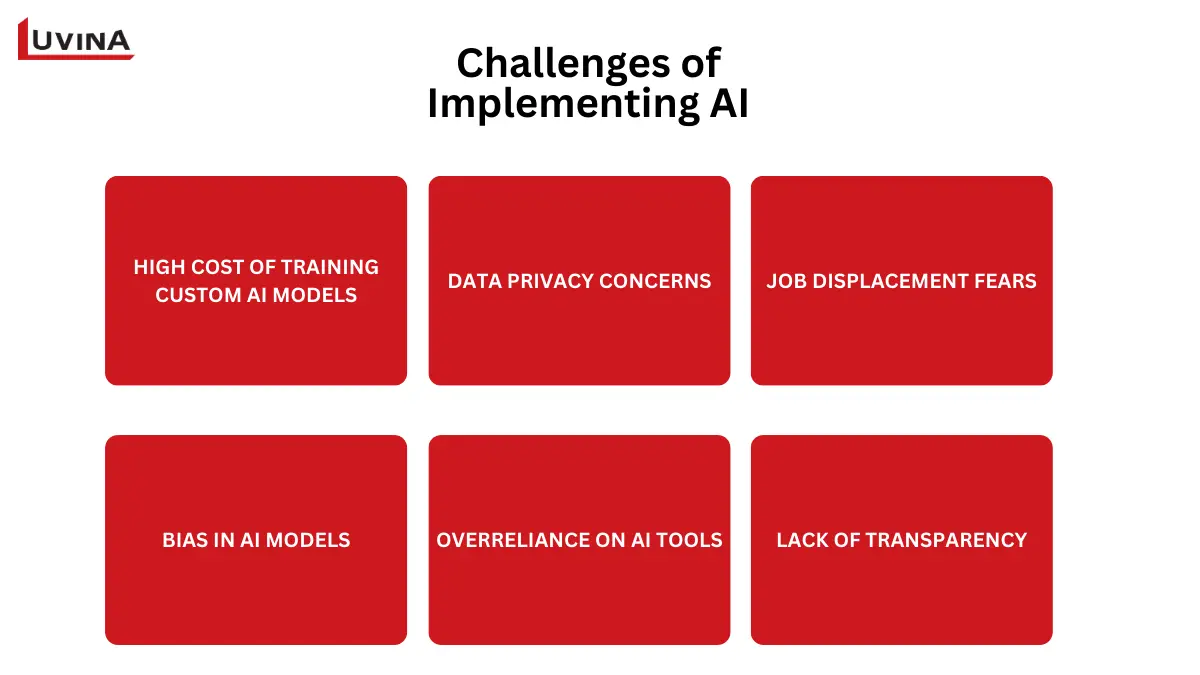
High cost of training custom AI models
The impact of AI on software development can be profound. However, because of elements like data gathering and preparation, computing capacity, experience, hyperparameter tuning, and maintenance of infrastructure, training custom artificial intelligence models may be pricey. These prices are high, yet the possible rewards might justify the expenditure.
Solution: To successfully negotiate these obstacles demands great planning, resource distribution, and cost control.
Data privacy concerns
Dealing with sensitive data for artificial intelligence development presents privacy and security challenges.
Solution: Setting strong protections, creating moral standards, and educating teams on safe data handling. Clear governance systems guarantee ethical data usage while maximizing the worth of AI software development.
Job displacement fears
This is also a major impact of AI on software development. Automation might lower demand for some development jobs, therefore raising questions about job loss.
Solution: Investing in upskilling and reskilling courses will allow staff members to work efficiently alongside artificial intelligence systems. Encouragement of ongoing education and AI-related training helps to guarantee that artificial intelligence builds on rather than replaces human labor.
Bias in AI models
AI models can also introduce bias if trained on unbalanced data. It can amplify or reproduce biases already present in training data, therefore generating unequal results.
Solution: Regularly examining AI outputs for fairness using varied, representative datasets, incorporating bias detection tools, can help guarantee more equitable outcomes.
Overreliance on AI tools
Reliance on artificial intelligence for coding, debugging, or testing could degrade basic programming abilities, therefore causing issues when AI fails or produces mistakes.
Solution: Treating AI as an assistance tool while preserving their own technical skills via ongoing training and frequent manual review.
Lack of transparency
Many artificial intelligence systems work as black boxes; therefore, their decision-making mechanism are challenging to grasp.
Solution: Where practicable, employ interpretable models; use mechanisms that justify artificial intelligence decisions; keep accurate documentation and accountability procedures.
Future Trends: The Next-Gen of Software Engineering with AI
The impact of AI on software development is rapidly changing the way software is created. Future software engineering will rely heavily on AI for predictive analytics, automated coding, adaptive systems, intelligent DevOps, and personalized user experiences. Ethical AI, transparency, and security will become mandatory as organizations scale AI adoption.
- Predictive engineering: AI enables software to anticipate issues and optimize performance using predictive analytics, allowing engineers to make proactive decisions, reducing errors, and improving system reliability.
- Autonomous coding: AI-powered tools can generate, debug, and optimize code automatically, speeding up development cycles and reducing repetitive manual work for programmers.
- AI-DevOps: Integrating AI into DevOps improves automation in testing, deployment, and monitoring.
- Hyper-Personalized UX: AI analyzes user behavior and preferences to deliver tailored experiences. Software can adapt dynamically, enhancing engagement and satisfaction.
- Ethical AI: Responsible AI practices ensure transparency, reduce bias, and protect user privacy. Ethical AI becomes important as software systems increasingly make autonomous decisions.
Organizations can fully use the impact of AI on software development by accepting these trends, promoting an AI-centric culture, and giving ongoing learning top priority, hence shaping the next generation of creative, high-performing software solutions.
Conclusion
Undoubtedly impact of AI on software development presents both great possibilities and difficulties. Approaching these problems methodically lets companies and developers transform them into more ethical software solutions as well as opportunities for creativity, efficiency, and more. Thoughtfully embracing artificial intelligence enables teams to boost quality, increase productivity, and stay ahead in the quickly changing technical environment.
Contact Luvina if you’re seeking a trustworthy partner to investigate AI-driven software development. Together, let’s come up with more creative and intelligent solutions.
Resources
- https://www.future-processing.com/blog/the-impact-of-ai-on-software-development-opportunities-and-challenges/
- https://www.ibm.com/think/topics/ai-in-software-development
- https://adevait.com/artificial-intelligence/impact-of-ai-on-software-development#h-challenges-of-ai-integration
READY TO START A PROJECT?
Our experts are eager to explore your needs.

Read More From Us?
Sign up for our newsletter
Read More From Us?
Sign up for our newsletter