




Staff Augmentation vs Outsourcing: Which Fits Your Business?


Choosing between staff augmentation vs outsourcing can be difficult when the differences are unclear. Many companies overpay or face delays simply because they choose the wrong model. This article gives you a clear comparison so you can choose the approach that fits your goals.
We will look at this article:
– The cases where every model performs best.
– A straightforward comparison of outsourcing vs. employee augmentation.
– Some advice on selecting the ideal model for your company.
You will have a clear idea of which strategy best suits your company’s needs and how to use it to best influence by the end.
Definitions: What is staff augmentation, and what is outsourcing?
Understanding staff augmentation vs outsourcing is an important part of evaluating workforce strategies to find the right structure for your organization’s needs.
What is staff augmentation?
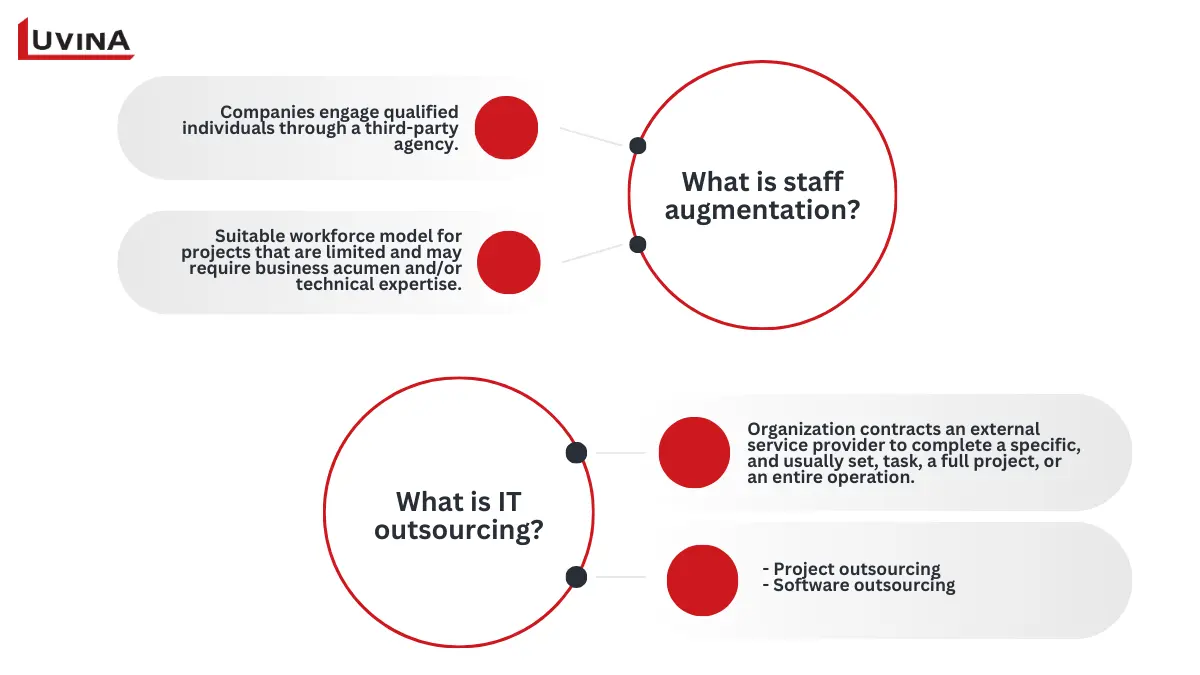
Staff augmentation is a strategy where companies bring in qualified specialists through a third-party agency. It works best for temporary needs that require quick skill coverage. This approach lets companies expand capacity and stay in control without hiring full-time staff. Staff augmentation is a suitable workforce model for projects that are limited and may require business acumen and/or technical expertise.
What is IT outsourcing?
In comparison of staff augmentation vs outsourcing, outsourcing is an approach where an organization contracts an external service provider to complete a specific, and usually set, task, a full project, or an entire operation. Unlike staff augmentation, the company staff typically does not directly manage the work. Outsourcing helps companies reduce costs, improve efficiency, and scale quickly by using external expertise.
- – Project outsourcing is often described as a subcontracting relationship between a provider to carry out the full project process through completion. Commonly known project-based outsourcing may include projects such as software development, marketing campaigns, and infrastructure build-outs.
- – Software outsourcing covers the full software lifecycle, from planning and design to development, testing, and long-term maintenance. A common example of a project-based software outsourcing may include mobile app deployment, software testing, or Software Quality Assurance (QA).
Key comparison criteria: What to evaluate
Companies need to thoughtfully consider several elements when choosing between staff augmentation vs outsourcing to make sure the adopted strategy matches their company’s needs. Important criteria include:
- – Team model: Outsourcing provides full packaged solutions like TaaS or IaaS, while staff augmentation adds short-term specialists to your in-house team. The degree of complexity and project size will determine whether to select outsourcing vs staff augmentation.
- – Team control: Staff augmentation gives you full control over integration and performance, while outsourced teams work independently. This distinction is crucial when comparing staff augmentation vs IT outsourcing.
- – Cost & performance: Staff augmentation hires only the necessary professionals temporarily, hence lowering upfront expenses. Outsourcing guarantees cost-effective results and gives full-service teams in charge of total project completion responsibility.
- – Risk considerations: With staff augmentation vs outsourcing, outsourcing can be more secure because vendors own delivery responsibility, while temporary staff may introduce data-security risks.
- – Structure of working: Staff augmentation versus outsourcing has a different organization. Augmented employees work closely with your team. Outsourced groups work independently and focus on project completion.
- – Onboarding & knowledge sharing: Staff augmentation enables quicker onboarding and knowledge sharing. Though it provides independence, outsourcing limits knowledge exchange.
- – Work culture & compatibility: When comparing staff augmentation vs outsourcing, you can see that staff augmentation requires cultural alignment, while outsourced teams work remotely, which reduces day-to-day compatibility issues.
- – Main duties & scope: Augmented personnel manage particular projects within your team. From development to infrastructure or cybersecurity, outsourced teams manage whole workflows.
- – Working location: The location of work may be distant or on-site; staff augmentation can be either way. Using worldwide talent pools for effectiveness and quality, IT outsourcing teams frequently work remotely.
Staff augmentation: Pros, cons, and use-cases
Organizations that require flexibility, rapid access to expertise, and oversight within their organization typically employ staff augmentation. When comparing staff augmentation vs outsourcing, it is useful to keep in mind that the staff augmentation model provides a more direct method for organizations to scale their teams without permanent obligations; hence, another effective model. The paragraphs ahead explore its main advantages, disadvantages, and strengths.
1. Pros of staff augmentation
Explained in easy words, the major advantages of this model will enable companies to properly assess staff augmentation vs outsourcing and decide when it offers a more flexible match.
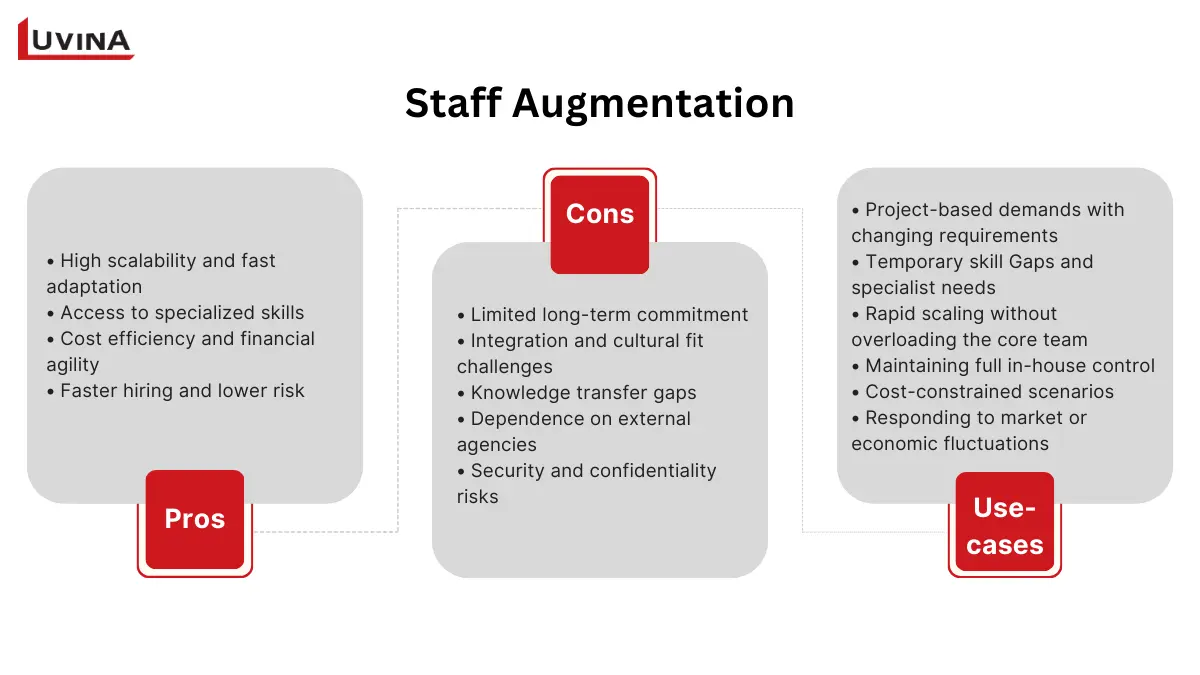
– High scalability and fast adaptation: Staff augmentation helps businesses respond quickly to changing workloads. Teams can scale up or down without disrupting ongoing projects or increasing long-term costs. This adaptability makes it a great option when comparing staff augmentation vs software outsourcing.
– Access to specialised skills: Businesses can invite in specialist talents not found within their own or locally.
– Cost efficiency and financial agility: When comparing staff augmentation vs outsourcing, staff augmentation helps organizations to only compensate for the skills required over a certain time. The model cuts expenses for benefits, training, and office space and cancels long-term salary commitments.
– Expedited hiring and reduced risk: Agencies filter and assess applicants, reducing both hiring time and the risk of a poor fit. If a worker is not a good fit, the agency can replace them quickly without lengthy HR procedures.
2. Cons of staff augmentation
These are a few advantages – also known as difficulties – which companies should take into account when evaluating staff augmentation vs outsourcing.
– Short-term commitment: Temporary workers are typically focused on their assigned position. Although they may not impact long-term initiatives or engage with your organizational culture.
– Integration and cultural fit challenges: Every organization uses internal processes, communication style, and decision-making practices. Temporary employees may struggle to adapt, resulting in delays or team friction.
– Knowledge transfer gaps: Since augmented personnel leave after finishing their jobs, knowledge might not be completely documented or passed over. This is one of the most significant differences when comparing staff augmentation vs outsourcing.
– Misallocation of external agencies: Organizations rely on the sellers’ approaches to talent management and screening. You will deal with inconsistency in quality if the seller’s standards for competence are different from your organization’s expectations for humans.
– Security and confidentiality concerns: Temporary employees might have access to confidential information or proprietary systems. If your security policies are not tight enough, you could encounter data breaches or compliance issues.
3. Staff augmentation vs outsourcing: Where staff augmentation works best?
Staff augmentation is applicable when a team needs specialized skills with flexibility or a way to add or change staffing quickly. Staff augmentation is part of larger discussions involving staff augmentation vs outsourcing, in which collaboration and degree of control are key decision points.
– Project-based needs that change: Typically very useful when workloads are variable or projects have changing scopes.
– Short-term skills gaps and specialized needs: Particularly valuable when internal teams do not have the required skills for a unique project phase or technology, or the deliverable itself.
– Quick resizing ability without overwhelming your internal team: In staff augmentation vs project outsourcing situations, staff augmentation has great value when a business is growing, or there is a temporary spike in demand in the seasons, increasing the workload quickly.
– Full in-house management: Augmented staff work as part of your team, follow your processes, and join your daily workflows.
– Cost-constrained situations: In comparing staff augmentation vs outsourcing, staff augmentation suits companies that need more talent but want to avoid full-time salary commitments.
– Responding to market or economic volatility: businesses can pivot teams up and down easily as the economy fluctuates.
For example, Google needed to accelerate software development for its cloud and AI projects, so it partnered with BairesDev to access specialized QA engineers. This collaboration allowed them to automate testing, improve scalability, and meet tight deadlines efficiently. The case illustrates how staff augmentation vs outsourcing decisions can help companies bring in expert talent without overloading internal teams.
Another example showing the importance of differentiating staff augmentation vs outsourcing is when Roblox partnered with Atlassian and Modus Create to migrate key tools to the Atlassian Cloud, aiming to streamline workflows and support rapid growth. This migration saved over $150,000 annually, improved team collaboration, and reduced administrative overhead.
Outsourcing: Pros, cons, and use-cases
Grasping IT outsourcing will help you understand the differences between staff augmentation vs outsourcing. Below, we will cover the main advantages vs disadvantages and practical examples for outsourcing while differentiating them for effectively choosing between staff augmentation vs IT outsourcing.
1. Pros of Outsourcing
As stated above, in comparison to staff augmentation vs outsourcing, outsourcing can be very beneficial, especially for companies requiring cost savings, international capabilities, and flexibility in operations.
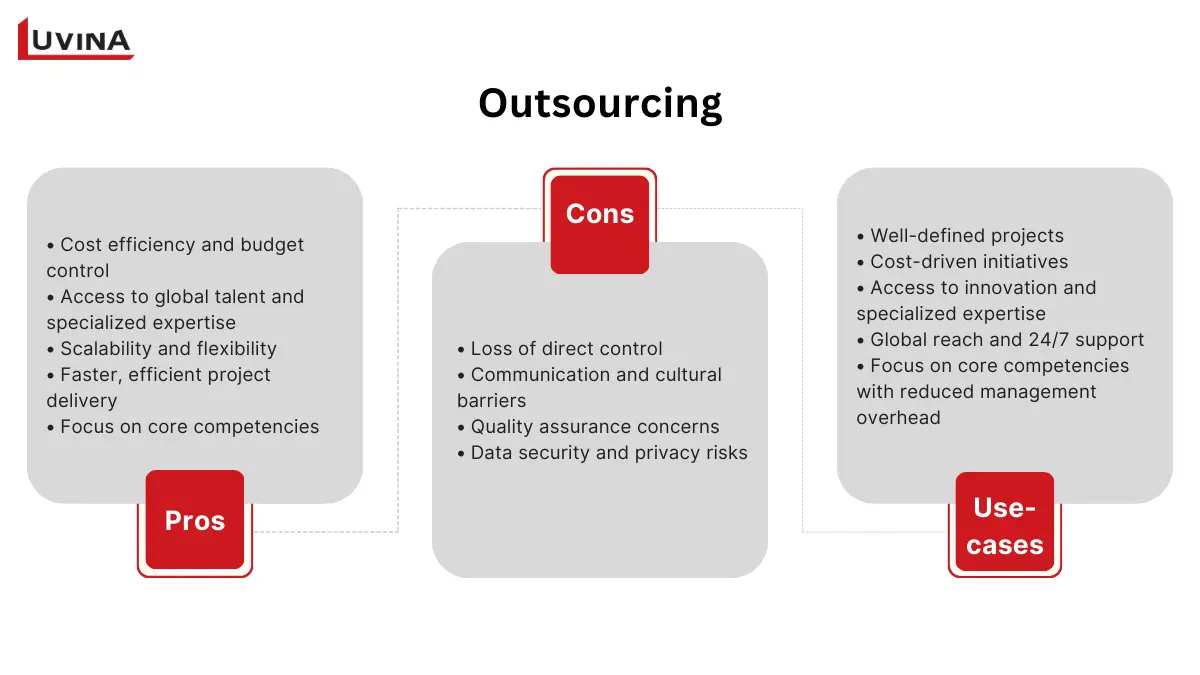
– Cost savings and budget management: Using third-party vendors for their services will usually lower operational and labor costs. Companies don’t incur costs for salaries, benefits, space, and training, so it’s often cheaper than performing the services directly.
– Global talent access and expertise specialists: In comparing staff augmentation vs outsourcing, outsourcing gives access to global talent and specialized expertise not available internally. When projects require skill sets not available in a local area, “outsourcing” becomes an important differentiation in distinguishing outsourcing vs staff augmentation for specialized or niche work.
– Scalability and flexibility: Organizations can easily ramp up or ramp down depending on organizational needs.
– Speedier project deliveries: For many projects, vendors may have process methodology, seasoned staff, or specialized equipment to increase project speed. This allows for quicker speed-to-market.
– Focus on core competencies: When comparing staff augmentation vs outsourcing, you can see that outsourcing lets your internal team focus on strategy while vendors handle non-core tasks.
2. Cons of outsourcing
While outsourcing has positive aspects, organizations need to consider the potential drawbacks – especially if contrasting staff augmentation vs outsourcing.
– Loss of direct oversight: Managing remote staff through a third-party vendor may reduce the level of oversight you have; with outsourced staff, it may be harder to manage schedules, quality, and day-to-day activities than with staff augmentation.
– Communication & cultural issues: Offshoring may present issues related to the cultural aspects of work, time zone, and languages.
– Quality consistency: Vendors may follow processes that differ from your internal standards.
– Keeping data safe: In comparison of staff augmentation vs outsourcing, outsourcing means you have to share sensitive data with vendors, increasing the risk of breaches and compliance violations. Having good steps in place can lower the risk of problems with rules or data leaks for your business.
3. Outsourcing use cases
Outsourcing is successful in situations that require an area of expertise, scalability, and/or cost advantage, some or all of which are unique between outsourcing and staff augmentation.
– Defined project: Best suited for projects with a defined scope, deliverables, and milestones to obtain results.
– Cost-based: Outsourcing works well where low-cost labor markets and flexible engagement are being utilized. This applies especially for IT maintenance work and network management, among other things, where labor costs are not a critical factor.
– Access to innovation and specialized expertise: External teams often bring specialized expertise and innovation that may not exist within your organization. An interesting difference between staff augmentation vs outsourcing approach – the external knowledge and expertise.
– Worldwide availability and full-time service: Vendors located overseas provide full-time service coverage, augmenting your operational coverage. This makes geographic sense when you want to build an organizational capability that requires the involvement of international colleagues or when you want support on-site or virtually outside of normal (U.S.) business hours.
– Focus on delivery through reduced management burden: Projects that have been sourced out must be prioritized to focus on strategy execution, while the vendor organizes and orchestrates the delivery.
When it comes to global expansion, staff augmentation vs outsourcing shows distinct advantages in flexibility and scalability. Alibaba leveraged outsourcing to develop localized websites for different regions, enabling faster market entry, culturally adapted user experiences, and efficient use of resources. This approach allowed the company to scale internationally without overloading internal teams.
Another real example of IT outsourcing is when WhatsApp outsourced its early iOS development to access skilled offshore talent and reduce costs while building a scalable messaging platform. This approach accelerated development, controlled expenses, and allowed the internal team to focus on user experience. The case highlights how staff augmentation vs outsourcing can enable startups to scale quickly and efficiently.
Direct comparison: Staff augmentation vs outsourcing vs managed services
Picking the right IT staffing model is seldom easy. Companies must balance control, cost, flexibility, and risk to match business goals. Comparing staff augmentation, outsourcing, and managed services helps companies choose the model that aligns with project scope, team capacity, and long-term strategy. To get a more vivid picture of the differences between staff augmentation vs outsourcing, vs managed services, we can view the table below:
| Staff augmentation | Outsourcing | Managed services | |
|---|---|---|---|
| Scope of work | Specific roles or skill sets added to your team | Entire projects or business processes | Ongoing responsibility for IT operations under SLAs |
| Team control | High – managed internally | Low – vendor manages execution | Medium – vendor manages operations within SLAs |
| Team integration | Augmented staff become part of your in-house team | The external team works independently | Vendor team handles operations autonomously |
| Cost structure | Pay per resource/hour | Pay per project or service agreement | Subscription-like, predictable fees |
| Flexibility and scalability | High – scale up/down as needed | Moderate – contract-based, scope-driven | Medium – flexible within SLA but changes require renegotiation |
| Risk management | You assume delivery responsibility | Vendor assumes delivery responsibility | The vendor is responsible within the agreed SLA |
| Budget | Low – Medium, depends on resource usage | High if fixed-scope; lower if scope shifts | High – SLA-based fees stabilize costs |
| Speed to start | Fast – pre-vetted specialists can join quickly | Medium – requires contract setup and scope definition | Slow – Medium – setup, migration, and onboarding required |
| Compliance and security | Works if the internal team manages compliance | Depends on vendor; sensitive projects may be risky | Strong – SLAs often include monitoring, reporting |
| Innovation potential | Medium – depends on augmented staff | Medium – vendor may not innovate beyond the scope | Low – focus on stability, not innovation |
| Best for | Filling skill gaps quickly, short-term projects, and maintaining control | Cost reduction, access to specialized expertise, and clearly defined projects | Stable, ongoing operations requiring strict uptime and SLA compliance |
| Worst for | Evolving, discovery-heavy projects | Firms without spare resources to manage external specialists | Firms without resources to manage external specialists or SLA oversight |
A detailed comparison table of outsourcing vs. staff augmentation vs. managed services
How to choose the right model for your company
It is important to select an appropriate staffing model to increase project efficiency while effectively managing costs. Choosing between staff augmentation vs outsourcing will depend on business requirements, project control, costs, skill requirements, and overall ability to utilise a larger team when needed. Here are the best practices to consider when thinking through your plans decisively:
– Clearly define your project needs: Clearly determine whether your project will require temporary specialised skills or ongoing, full-service support.
– Assess control needs: If projects are dependent on you providing operational direction on the work, staff augmentation may be the best option. If you can let the project manager manage the relationship for you, then outsourcing may be suitable.
– Determine cost: As with anything, both the short- and long-term costs need to be determined and evaluated. Staff augmentation provides predictable per-resource costs, while outsourcing provides support across economies of scale.
– Consider the skillset you need: Create a map of the skills you need and determine whether you can augment your in-house staff or find the skillsets needed externally via outsourcing.
– Consider the project time period: In urgent situations, if the use of staff augmentation is selected, be prepared to propose using augmented staff right away. While outsourcing is a great option, there will need to be time to evaluate, develop, and implement an outside firm.
FAQ
1. What is the main difference between staff augmentation and outsourcing?
Staff augmentation adds temporary talent directly to your team, while outsourcing delegates a project or function to an external provider. Both approaches solve workforce needs, but control and management differ.
2. When should a company choose staff augmentation?
Use staff augmentation when you need fast access to specific skills, cover temporary gaps, or scale your team without long-term hiring commitments.
3. Can a business combine staff augmentation and outsourcing?
Yes, many companies use a hybrid approach, leveraging staff augmentation for core teams and outsourcing for non-core tasks, balancing control and efficiency.
4. Which option is more cost-effective: staff augmentation or outsourcing?
Cost-effectiveness depends on the project. Staff augmentation works well for short-term, specialized needs, while outsourcing can reduce expenses on larger or long-term projects.
5. What are the common IT outsourcing models?
The main IT outsourcing types include Project Outsourcing, IT Outsourcing, Business Process Outsourcing (BPO), and Professional Outsourcing, each serving different levels of business needs.
Conclusion
The decision to choose between staff augmentation vs outsourcing depends entirely on your company’s objectives and requirements for the project. If you require flexibility, direct supervision, and specialized skills at short notice or when requesting temporary (critical) projects, staff augmentation would be great. Whereas outsourcing is more suited for cost-effective, global talent, freeing up internal resources from non-core functions.
For companies that find themselves navigating outsourcing and staff augmentation, Luvina– a proven software development company- can help your company implement the accurate and preferred model for your projects. Simply contact us with your project details to request a quote, and we will work with you from there!
Resources
- https://alp.consulting/staff-augmentation-vs-outsourcing-key-differences/
- https://www.linkedin.com/pulse/key-differences-between-staff-augmentation-outsourcing-vdnle/
- https://www.miquido.com/blog/staff-augmentation-vs-project-outsourcing/#Want_to_Hire_A-players_For_Your_Next_Project
- https://fieldnation.com/learn/staff-augmentation-vs-outsourcing-determining-the-best-fit#key-differences-between-staff-augmentation-vs-outsourcing
- https://invedus.com/blog/staff-augmentation-vs-outsourcing-dedicated-staff/
- https://www.aimprosoft.com/blog/staff-augmentation-vs-outsourcing-vs-managed-services/#staff-augmentation-vs-outsourcing-vs-managed-services-head-to-head-comparison
READY TO START A PROJECT?
Our experts are eager to explore your needs.

Read More From Us?
Sign up for our newsletter
Read More From Us?
Sign up for our newsletter