




Agile Methodology in Software Engineering: How It Works


Most of the time, software projects fail not because of subpar coding but rather because teams are unable to adjust to developments quickly. Modern software teams have therefore naturally adopted agile methodology over inflexible, linear development approaches by means of a more adaptable way of working. Luvina will walk you through this article, covering the Agile definition, explaining how Agile applies in software engineering, and helping you understand why Agile remains a sensible and effective option for modern digital products.
What Is Agile Methodology in Software Engineering?
In the real world, Agile methodology in software engineering breaks software development into small cycles that allow the development team to plan, design, and test software simultaneously. This approach reduces risk, increases transparency, and provides assurance that the final product will always meet user expectations.
Agile emphasizes flexibility, rapid delivery of working software, and frequent collaboration amongst the entire project team. Because of these attributes, it is a very good fit for projects with unpredictable requirements and projects that are rapidly changing.
Source:
https://www.promovre.com/what-is-agile-model-in-software-engineering/
https://www.guvi.in/blog/agile-methodology-in-software-development/
Agile Software Engineering: Core Principles & Mindset
Agile methodology in software engineering is built around a mindset that prioritizes adaptability, collaboration, and continuous value delivery. The following are the 12 fundamental tenets of agile in software engineering:
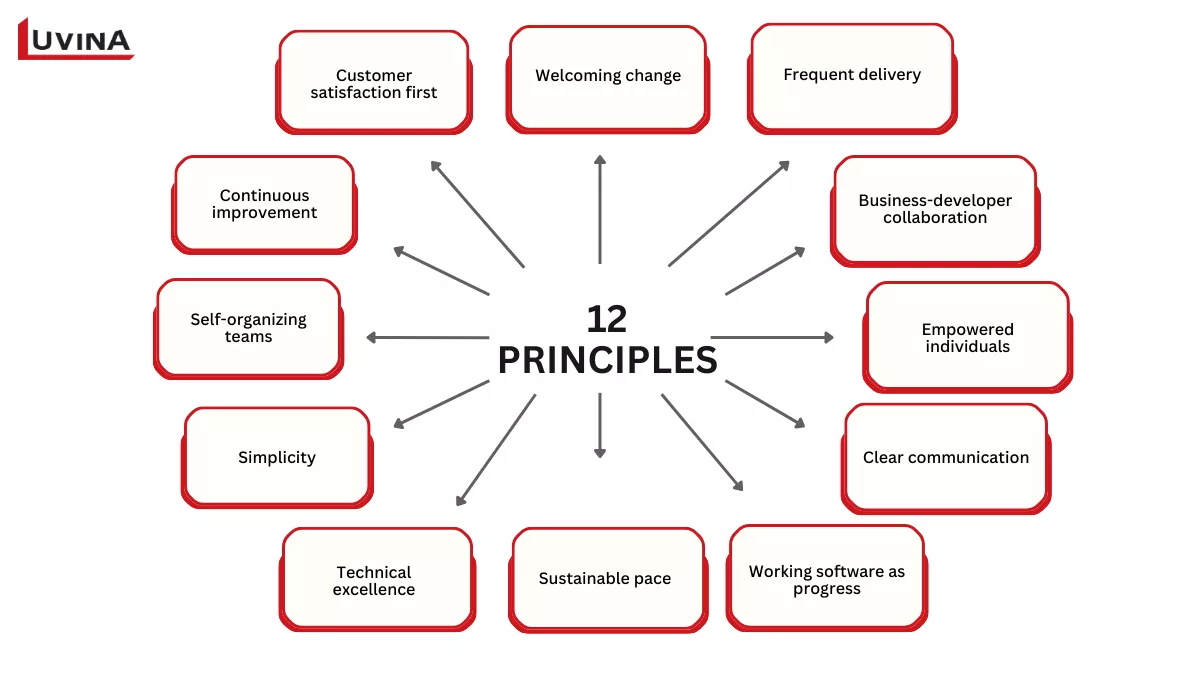
Agile software engineering is built around these 12 principles
– Customer satisfaction first: Early and constantly provide a worthwhile program to surpass client expectations.
– Welcoming change: Accept evolving requirements at any stage, reinforcing the core agile definition of adaptability and responsiveness.
– Frequent delivery: Release working software in brief cycles to allow for fast feedback and improvement.
– Business-developer collaboration: Make sure development teams and stakeholders work closely and continuously together.
– Empowered individuals: Construct driven teams with autonomy, trust, and support within agile methodology in software engineering.
– Clear communication: To keep shared knowledge, promote direct and effective communication.
– Working software as progress: Evaluate results by actual results rather than paperwork or procedure.
– Sustainable pace: Encourages teams to remain productive at a steady rate without being burned out.
– Technical excellence: Provides an ongoing means for the improvement of code quality, architecture, and long-term maintenance of the software development.
– Simplicity: Focus on core deliverables and eliminate as much extraneous complexity from those deliverables as possible.
– Self-organizing teams: Allow people within your teams to have the opportunity to plan, implement, and advance their own initiatives while working collaboratively.
– Continuous improvement: Regularly reflect and adapt to optimize results across projects using agile methodology in software engineering.
Source: https://savvycomsoftware.com/blog/agile-methodology-in-software-engineering/
Key Agile Software Development Frameworks
Agile is a set of paradigms supporting various team sizes, project scopes, and business needs rather than a single procedure. Although all of them support the same ideas, every framework uses agile methodology in software engineering differently. The most often used Agile methodologies are listed below with straightforward definitions to assist you in grasping their support of contemporary software projects and agile development in action.
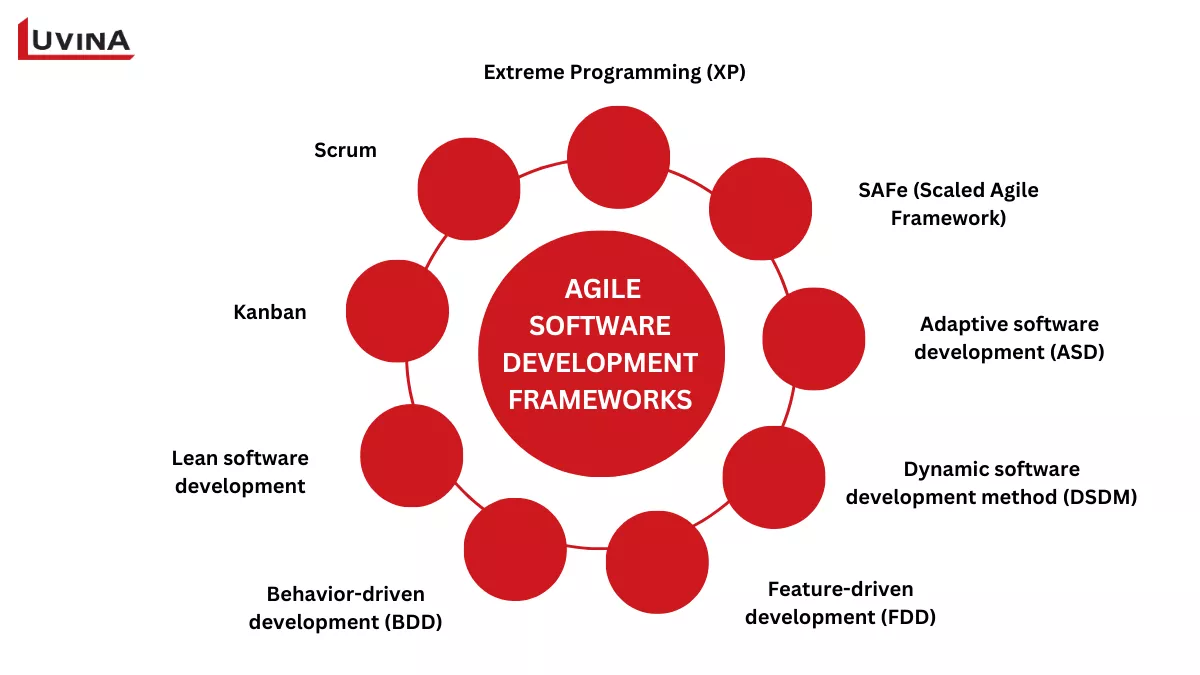
These are the most commonly used Agile development frameworks
1. Scrum
The Scrum framework is the most widely used in software engineering as part of an agile approach for teams that develop products. It organizes work into short iterations (called sprints) that last between two and four weeks, and it establishes specific roles in order to provide accountability for the product owner, scrum master, and development team members to allow them to collaborate and work together more easily and effectively.
The Product Backlog, a prioritized list of work items that evolve as business needs change through feedback and value delivery, drives the management of work. The four core events of Scrum – Sprint Planning, Daily Stand-ups, Sprint Reviews, and Retrospectives – establish an ongoing cadence. For teams requiring a formalized level of execution with an open-ended approach to flexibility, the use of Scrum provides an ideal framework.
2. Kanban
Kanban adopts a more visual and flow-based approach to agile methodology in software engineering. Teams use a Kanban board to see jobs as they go through phases like “To Do,” “In Progress,” and “Done” rather than working in time-boxed sprints. Limiting work in progress is the main priority in order to avoid overload and boost efficiency. Its lightweight fits teams needing flexibility, continuous prioritization, and constant delivery without rigid iteration boundaries.
3. Extreme Programming (XP)
Technical excellence is a key component of Extreme Programming (XP). TDD, Continuous Integration, Refactoring, and Pair Programming are examples of the types of engineering practices that XP utilises in order to achieve its goals. XP promotes collaboration, feedback, and shared ownership of code, and due to these factors, XP provides significant value where the code quality and ability to support/maintain the code over time are of considerable importance.
4. Lean software development
Lean Software Development uses lean ideas in agile methodology in software engineering, therefore emphasizing waste reduction and customer value maximization. It streamlines workflows, improves delivery speed, and asks teams to concentrate only on what really adds value. Companies trying to maximize flow and production across development projects will find lean perfectly fitting.
5. SAFe (Scaled Agile Framework)
SAFE Agile software engineering solves the difficulties of using Agile on a corporate level. SAFe offers a systematic means of organizing several Agile teams working on big, sophisticated systems. At the team level, it keeps Agile principles while arranging development, business, and operations around common objectives. Large companies needing both flexibility and control frequently employ it.
6. Adaptive software development (ASD)
Adaptive software development emphasizes constant learning and adaptation. ASD employs iterative cycles founded on speculation, cooperation, and learning instead of a straight lifecycle. Teams establish goals, try with solutions, and modify results based on input. Projects with fuzzy or rapidly changing criteria are ideal candidates for adaptive software development.
7. Dynamic software development method (DSDM)
Projects with limited time and budget can benefit from DSDM. It stresses early value realisation, frequent delivery, and strong stakeholder participation. DSDM enables businesses to move from conventional project paradigms to agile methodology in software engineering without losing control by promoting progressive development and responsive change.
8. Feature-driven development (FDD)
Feature-driven development arranges jobs around precisely specified features. Every component guarantees visibility, consistent quality, and consistent progress by means of a defined process from design to construction. For bigger teams needing great governance yet still profiting from Agile approaches, FDD is especially successful.
9. Behavior-driven development (BDD)
Development driven by behavior builds on test-driven development by concentrating on system behavior as opposed to technical execution. With a common language, BDD facilitates cooperation between non-technical stakeholders, testers, and developers.
Source:
https://www.projectmanagertemplate.com/post/agile-engineering-explained-how-it-s-transforming-software-development
https://savvycomsoftware.com/blog/agile-methodology-in-software-engineering/#ftoc-heading-5
Agile Development Lifecycle
Looking at the lifecycle behind agile will help you to grasp how it always provides value. The main phases defining the agile development lifecycle in reality are shown below.
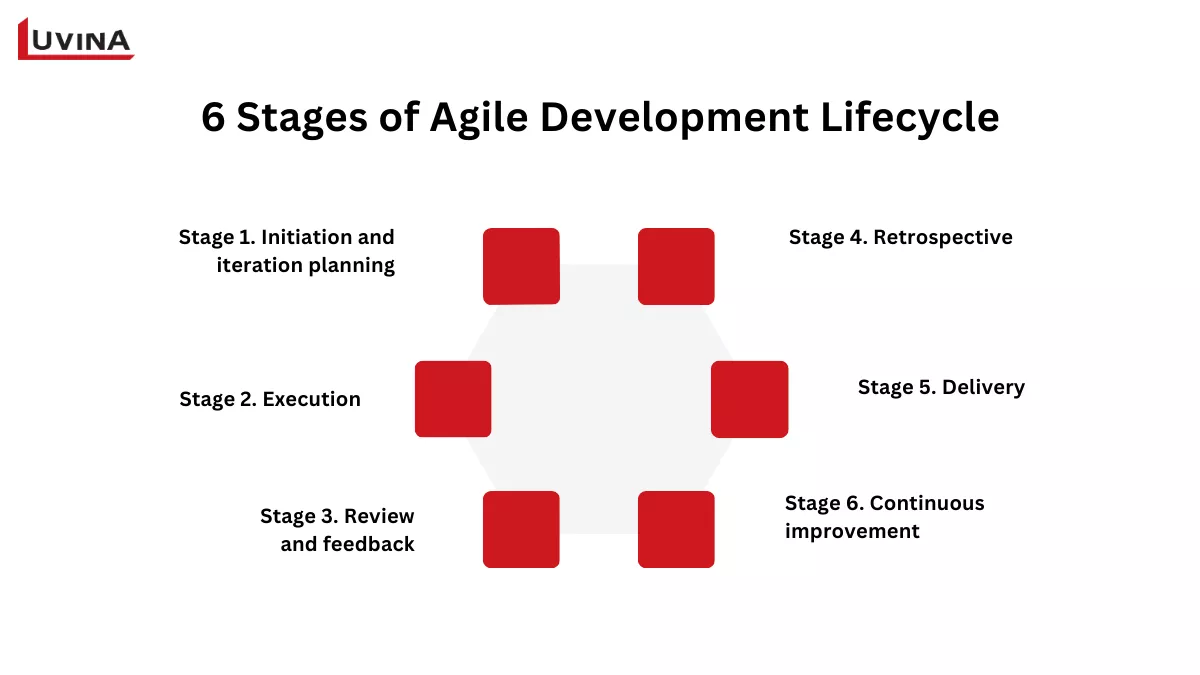
The 6-step Agile development lifecycle process
Stage 1. Initiation and iteration planning
This phase sets the strategic course as well as the short-term execution plan. Teams work with stakeholders to set project objectives, ascertain user needs, and rank requirements in the product backlog.
Typically lasting two to four weeks, labor is then broken into small, time-boxed cycles. The team chooses a particular collection of backlog items during iteration planning and sets precise goals for the next cycle.
Stage 2. Execution
Development projects happen at this phase. Supported by daily stand-up meetings to follow development and eliminate obstructions, teams work together to design, construct, and test features. A fundamental tenet in agile software engineering, constant integration and frequent testing help to preserve quality throughout the entire process.
Stage 3. Review and feedback
The team shares finished work with stakeholders at the conclusion of every loop. Immediate collection of feedback helps to change priorities for upcoming iterations.
Stage 4. Retrospective
Teams consider both the technical and process-related components of the iteration. They find challenges, pinpoint strengths, and concur on innovations for the upcoming cycle. This phase strengthens ongoing improvement and learning within agile methodology in software engineering.
Stage 5. Delivery
Rather than delaying for a last phase, the product’s shippable increments are released frequently. Early validation, stakeholder trust development, and quicker time-to-market support incremental delivery.
Stage 6. Continuous improvement
Rather than a one-time sequence, the lifecycle acts as an unending loop. At any time, new demands can be added to the backlog; teams regularly improve technical practices, teamwork, and processes.
Source:
https://savvycomsoftware.com/blog/agile-methodology-in-software-engineering/
https://www.geeksforgeeks.org/software-engineering/software-engineering-agile-software-development
Pros and Cons of Agile in Software Engineering
When applied correctly, agile methodology in software engineering offers strong advantages, but it also introduces certain limitations that teams must manage carefully. The table below presents a clear comparison of Agile’s pros and cons.
| Pros | Cons |
| Faster delivery through short iterations | Lower predictability in timelines and budgets |
| High adaptability to changing requirements | Risk of scope creep if changes are not controlled |
| Strong customer focus via continuous feedback | Heavy dependence on customer availability and clarity |
| Better collaboration and team alignment | Communication becomes harder in large or distributed teams |
| Improved quality with frequent testing | Limited documentation due to focus on working code |
| Higher team motivation and ownership | Risk of burnout from frequent sprints |
| Faster decision-making by empowered teams | Strong reliance on experienced developers |
Pros and cons of Agile methodology
Source:
https://savvycomsoftware.com/blog/agile-methodology-in-software-engineering/
https://www.geeksforgeeks.org/software-engineering/software-engineering-agile-software-development/
https://savvycomsoftware.com/blog/agile-methodology-in-software-engineering/
https://www.geeksforgeeks.org/software-engineering/software-engineering-agile-software-development
Scaled Agile & SAFe for Large Enterprise Projects
SAFe (Scaled Agile Framework) is a structured framework that enables enterprises to apply Agile principles at scale while maintaining alignment, governance, and strategic coordination across multiple teams and products, such as complex Enterprise Resource Planning implementations..
Scaled Agile and the SAFe framework were developed to enable major companies to keep Agile’s agility while also including the governance, coordination, and alignment needed for enterprise-level deployment.
SAFe modifies agile methodology in software engineering to corporate settings by adding layers for cooperation and alignment, whereas conventional Agile emphasizes giving small, independent teams power. The following table shows the range and composition of Agile versus SAFe.
| Aspect | Agile | SAFe |
| Target users | Startups and mid-sized teams | Large enterprises |
| Project scale | Small to medium projects | Large, multi-team initiatives |
| Team structure | Single, cross-functional teams | Teams of teams across the organization |
| Governance level | Lightweight, minimal oversight | Structured governance with strategic alignment |
| Core foundation | Agile Manifesto | Lean, Agile, and systems thinking |
| Principles | 4 values, 12 principles | 4 values, 9 principles |
Key differences between SAFe and traditional Agile
When organizations scale agile methodology in software engineering using SAFe, they gain enterprise-level benefits without sacrificing team autonomy. Key advantages include:
– Faster time to market
– Higher product quality
– Increased productivity
– Stronger alignment and collaboration across previously siloed teams, portfolios, and business units
– Greater employee engagement
Source:
https://www.ibm.com/think/topics/scaled-agile-framework
Agile Outsourcing in Software Engineering
In software engineering, agile outsourcing entails working with an outside development partner while maintaining the fundamental ideas of agile methodology in software engineering throughout planning, execution, and delivery. This approach mixes outside teams into the same iterative cycles, feedback loops, and cooperative rituals to guarantee speed, agility, and alignment at scale rather than isolating Agile approaches inside an in-house team.
Organizations get both operational flexibility and strategic benefits when Agile ideas are applied to outsourcing: quicker time-to-market, higher product quality, cost optimization via international talent, more scalability and flexibility, and better teamwork and openness.
Companies need a partner able to move effortlessly inside an Agile environment if they are to fully experience these advantages. These requirements guarantee that alignment:
– Proven Agile expertise: Find allies with hands-on experience in Scrum, Kanban, or XP backed by known Agile certifications and verifiable delivery results.
– Relevant portfolio and client references: Evidence of the partner’s capacity to provide difficult solutions using an agile methodology in software engineering comes from past case studies and projects.
– Strong communication and cultural fit: Agile outsourcing depends on regular interaction, explicit criticism, and shared responsibility; hence, cultural fit and good communication are critical.
– Pilot projects before scaling: Evaluate Agile maturity, responsiveness, and partnership quality before making a long-term commitment via trial engagements.
– Clear roles, metrics, and tools: Guarantee transparency and ongoing improvement throughout dispersed teams by means of well-defined responsibilities, Agile performance criteria, and cooperation systems.
For over 20 years, Luvina has worked with hundreds of international companies to provide custom software development to QA testing. This long-term exposure has given us a deep understanding of what clients really value when choosing an Agile outsource partner: reliability, transparency, and the capacity to adjust swiftly.
Luvina has developed great competence in handling linguistic, cultural, and time-zone disparities with numerous successful IT outsourcing projects, including major Agile offshore efforts. By means of 24/7 cooperation, contemporary communication methods, and clearly defined Agile rituals that keep all stakeholders in line, we support Agile delivery.
Central to our strategy is ongoing development. Following each project, we solicit client comments and invest in ongoing internal training to improve proactive communication as well as technical skills. With flexibility, process discipline, and a solid Agile attitude, Luvina enables customers to apply agile methodology in software engineering successfully without sacrificing speed, quality, or control.
Luvina is here to help you on your path if you’re seeking a reliable partner to apply Agile outsourcing at scale. Contact Luvina today to discuss your project requirements and explore a tailored Agile outsourcing model.
Case Studies
Real-world implementations demonstrate how agile methodology in software engineering provides evident worth when used appropriately across many sectors. The following case studies illustrate how worldwide companies applied Agile ideas to address speed, complexity, and scale issues, showing how the agile approach operates beyond theory into application.
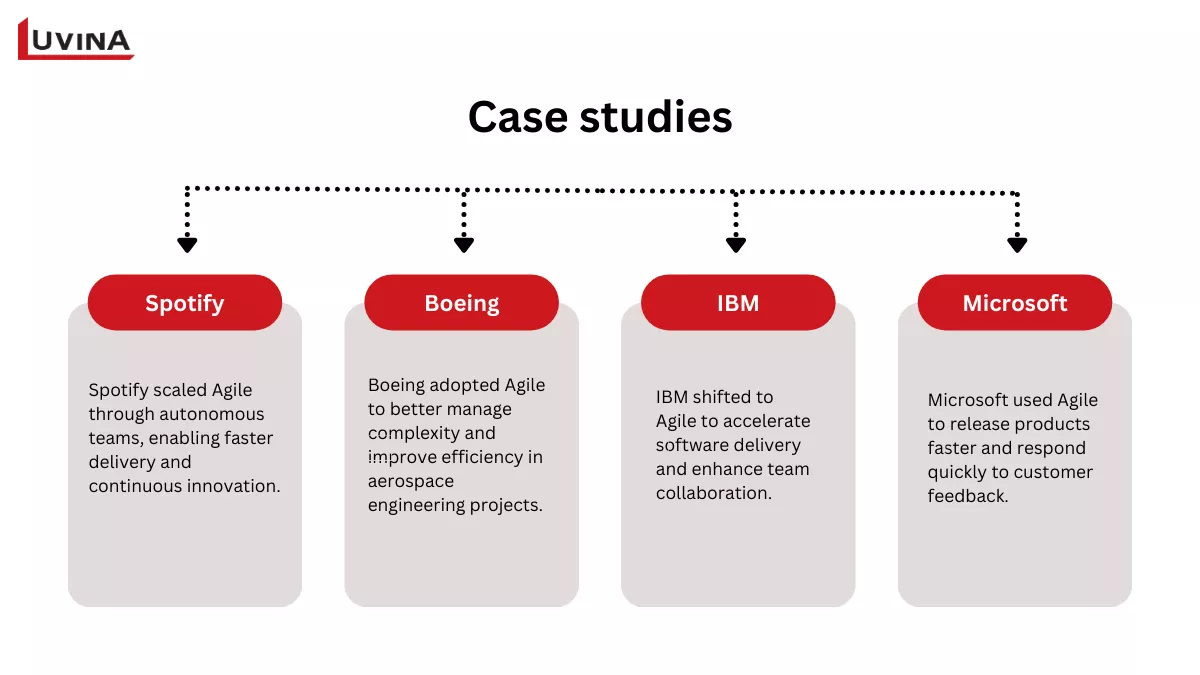
The four most notable case studies on Agile methodology adoption
1. Spotify: Scaling Agile through autonomous teams
Spotify had to maintain innovation and speed even while growing quickly. Conventional hierarchies constrained decision-making and slowed delivery, causing conflict as teams grew. Spotify adopted a decentralised Agile approach based on Squads, Tribes, Chapters, and Guilds to solve this problem. Small, independent teams had end-to-end properties; lightweight alignment systems guaranteed technical uniformity and shared learning.
This let Spotify grow agile methodology in software engineering without compromising flexibility. Teams retained excellent product quality, released new features often, and moved more quickly.
2. Boeing: Applying Agile in complex engineering environments
Boeing works in an environment characterized by stringent standards, protracted design cycles, and very sophisticated systems. Conventional project management had difficulty keeping up with changing technical dependencies and needs. Boeing added Agile software engineering and Scrum methodologies into its engineering processes to create cross-functional teams that worked in rapid cycles with frequent reviews and retrospective analysis.
Boeing increased openness and flexibility across projects by using Agile techniques in aerospace development.
FAQ
1. What is Agile methodology?
Agile is a way of building software in small, usable increments, with frequent feedback and continuous improvement, instead of delivering everything at the end of the project.
2. Is Agile always better than Waterfall?
No. Agile methodology in software engineering works best when requirements change often, while the Waterfall method is more suitable for projects with fixed and clearly defined requirements.
3. What are the most common Agile frameworks?
Scrum and Kanban are the most widely used. Scrum focuses on time-based sprints and roles. Kanban emphasizes visual workflow and continuous delivery.
Conclusion
In modern, quick-changing envỉonments, agile is a useful and efficient way of creating applications. More essentially, agile methodology in software engineering is more than just a collection of frameworks. It embodies a way of thinking that values people, interaction, and ongoing development above inflexible plans and laborious processes. Agile lets companies innovate more quickly, confidently adapt, and provide software really suited for real-world needs when used properly.
Resources
- https://www.promovre.com/what-is-agile-model-in-software-engineering/
- https://www.guvi.in/blog/agile-methodology-in-software-development/
- https://www.projectmanagertemplate.com/post/agile-engineering-explained-how-it-s-transforming-software-development
- https://www.geeksforgeeks.org/software-engineering/software-engineering-agile-software-development/
- https://savvycomsoftware.com/blog/agile-methodology-in-software-engineering/
- https://www.geeksforgeeks.org/software-engineering/software-engineering-agile-software-development/
- https://www.ibm.com/think/topics/scaled-agile-framework
- https://www.linkedin.com/pulse/case-studies-success-stories-implementing-agile-scrum-koz%C5%82owska-68blf/
READY TO START A PROJECT?
Our experts are eager to explore your needs.

Read More From Us?
Sign up for our newsletter
Read More From Us?
Sign up for our newsletter