




Mastering Digital Transformation in Retail


In 2026, digital transformation in retail is no longer about ‘going online’, it’s about Unified Commerce. Recent statistics show that 89% of retailers plan to increase investments in digital technologies over the next 3 years. Many retailers that have already invested are seeing clear results. Some have reduced operating costs by 20-30% while increasing overall sales through advanced technologies.
Retailers need to act quickly, as several large-scale sales events are scheduled soon. This article provides a guide to using digital tools, avoiding common mistakes, and creating a seamless experience that gives consumers what they want and increases the retailer’s profits.
What Is Digital Transformation in Retail
Digital transformation in retail is the use of contemporary technologies and innovative techniques to streamline processes, enhance customer experiences, and more effectively leverage data. It alters the entire retail value chain, from marketing, sales, and in-store or online customer interactions to supply chain management.
By leveraging brick-and-mortar activities and online tools through a retail digital transformation strategy, it is possible to create an integrated, customized purchase experience across multiple platforms. Automating repetitive tasks such as inventory management and logistics will increase efficiency & lower costs by using technologies such as AI, big data analytics, and the Internet of Things.
Why Digital Transformation Is Reshaping Retail
Retail is undergoing major change as customer expectations and market competition continue to rise.
As these demands grow, the industry is shifting toward new operating models. Retailers are integrating online and physical channels to create seamless omnichannel journeys, allowing customers to browse, purchase, and receive products without friction. Data is also becoming central to retail operations, enabling businesses to better understand customer behavior, personalize offers, and optimize pricing strategies. At the same time, digital tools are transforming supply chain management, helping retailers track inventory in real time and respond faster to demand changes.
These digital transformations in retail are fundamentally reshaping the retail landscape. Stores are no longer just sales locations but part of a connected ecosystem that includes e-commerce platforms, mobile apps, and digital services.
Core Pillars of Retail Digital Transformation
A mix of digital infrastructure, data capabilities, and operational improvements operating across the whole value chain is needed for retail digitalization. As outlined in a publication archive entitled “The Digital Transformation in Retail,” produced by the Orange Foundation, four major components of digital transformation (i.e., cloud computing, mobile devices, IoT, and social media) comprise the primary framework for digital transformation within retail.
These 4 components combine with composable and headless commerce – one of the most important IT trends in 2026 – to form the core pillars of digital transformation in the retail industry.
| Pillar | Role in retail |
| Cloud computing | Processes large volumes of data in real time and supports scalable digital infrastructure. |
| Mobile ecosystem | Enables flexible shopping experiences and access to services anytime, anywhere. |
| Internet of Things (IoT) | Connects devices and sensors to improve inventory visibility and supply chain efficiency. |
| Social platforms | Strengthens interaction and engagement between brands and consumers. |
| Composable and headless commerce | Build flexible, modular systems, delivering consistent experiences across channels and quickly adapting to changing customer needs and market trends. |
Core pillars of digital transformation in retail
Simultaneously, effective tech-driven retail also requires organizational skills like data-driven insights, customer-centric strategies, and agile operations.
| Pillar | Role in retail |
| Customer-centric strategy | Uses CRM, AI recommendations, and loyalty programs to personalize experiences. |
| Automation and integration | Streamlines operations through automated workflows and integrated supply chains. |
| Data-driven decision making | Uses analytics to understand customer behavior and optimize strategies. |
| Agile business models | Allows retailers to adapt quickly through flexible channels and new retail formats. |
Some other pillars of retail technology modernization
Together, these columns form the structural basis enabling companies to continually adjust to changing consumer demands, maximize operations, and incorporate technology.
Retail Digital Transformation Framework (End-to-End Model)
For many merchants, change does not happen all at once. Rather, digital transformation in retail usually follows a set route by which companies slowly progress from simple digitization to completely intelligent and data-driven activities. Retailers can use an end-to-end digital transformation framework to ascertain where they now stand and what actions are necessary to move closer toward more sophisticated features.
The phases below highlight the development of digital retail transformation along the value chain.
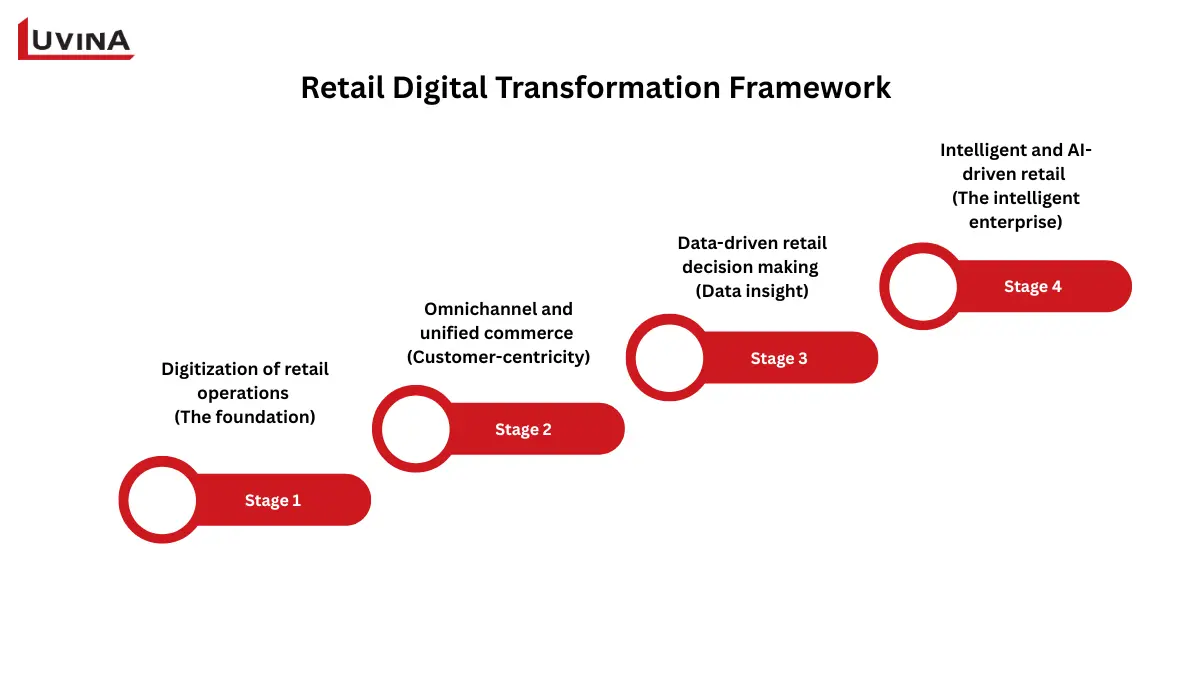
Visualize the digital transformation journey more easily with a clear framework
Stage 1: Digitization of retail operations (The foundation)
This is the beginning of digital transformation in retail. The first stage concentrates on changing conventional retail procedures into digital workflows. Most retailers will begin investing in Things Like a POS System to start digitizing their inventory by utilizing either Barcode or RFID technology and moving their older systems to a cloud-based platform.
The main objectives of the retailers will be to reduce the amount of manual input errors and increase productivity. Retailers will have a clear view of their inventory and all of the transactions that have taken place within their store, thereby enabling them to accurately track their operations and simplify their internal processes.
Stage 2: Omnichannel and unified commerce (Customer-centricity)
The following phase concentrates on linking all retail outlets once activities go online to provide a smooth client experience. Retailers coordinate their internet stores, mobile devices, and actual locations so consumers can smoothly engage with the brand across several touchpoints. This usually covers shared inventory visibility over channels as well as Buy Online, Pick Up In- Store (BOPIS).
Currently, companies are also moving towards unified commerce, using one technology stack across all systems that rely on coordinated data; that is, all businesses have the same set of data. The advantages of having cross-channel shopping experiences for consumers will enhance customer engagement, as well as provide a clear step forward to digital transformation in retail, going beyond simply digitizing operations to innovate and innovate primarily for customers.
Stage 3: Data-driven retail decision making (Data insight)
Once operational and consumer data have been combined across all channels, retailers may start using analytics to direct strategic choices. Retailers can carefully evaluate shopping habits, consumer preferences, and Operational performance using techniques including business intelligence systems and sophisticated analytics.
Instead of depending on intuition, companies may use these observations to improve pricing plans, optimize inventory replenishment, and develop more focused marketing campaigns. Data turns into a strategic asset, driving efficiency and expansion, helping companies to make wise decisions across the value chain. One of the main components of digital retail transformation is this data-centered approach.
Stage 4: Intelligent and AI-driven retail (The intelligent enterprise)
To anticipate future advancements and automate complex business processes, cutting-edge technologies (artificial intelligence [AI] and machine learning [ML]) were employed during the final implementation phase.
A growing number of retailers utilize AI to enhance customer service through AI-generated product recommendations, improve their ability to forecast customer demand, and optimize their inventory using smart inventory optimization technologies. Additionally, edge computing is employed to process data locally at stores, reducing latency and enabling real-time decision-making for inventory management, personalized offers, and operational adjustments.
Companies can anticipate how best to serve their customers, improve operational planning, and deliver extremely tailored experiences to customers as a result of the introduction of AI, machine learning, and data analytics. For merchants looking to broaden how customers interact with products, there are numerous opportunities to implement immersive technologies (augmented reality and virtual reality). Companies at this level reach a more predictive and proactive operating model, hence finishing the journey of digital transformation in retail.
Key Technologies Powering Retail Transformation
Technology plays a central role in reshaping how retailers operate and interact with customers and forms the backbone of digital transformation in retail. The key technologies powering the digital transformation retail industry are summarized below.
| Technology | Impact on retail |
| Automation (RFID, QR, robotics) | Improves inventory tracking and reduces manual operational tasks. |
| Omnichannel platforms | Connect online and offline channels for seamless shopping experiences. |
| AI and machine learning | Enables product recommendations and demand forecasting. |
| Big data and analytics | Provides insights into customer behavior and business performance. |
| Cloud computing | Supports scalable infrastructure and flexible deployment of services. |
| Internet of Things (IoT) | Uses sensors and connected devices to track inventory and supply chains in real time. |
Technologies driving change in the retail industry
Digital Transformation Use Cases in Retail
Many companies go from strategy to execution by using real-life examples that raise decision-making, customer experience, and operational enhancement. Some typical uses demonstrating how businesses carry out digital transformation in retail are presented below:
Omnichannel shopping experiences
To offer a smooth trip, merchants combine physical stores, mobile apps, and internet platforms. Doing smart retail initiatives in this manner guarantees that customers may start shopping on one channel and then finish on another without interruption.
Example: Uniqlo uses RFID and real-time inventory data to synchronize stock across online and physical stores, allowing customers to check availability online and pick up in-store seamlessly.
AI demand forecasting and inventory optimization
To forecast demand and maximize stock levels, machine learning algorithms examine sales history, advertising, and seasonal patterns.
Example: Zara leverages AI-driven demand forecasting to allocate inventory dynamically across regions and stores, reducing markdowns, minimizing overstock, and keeping inventory turnover rapid.
Mobile apps and personalized experiences
Personalized suggestions, loyalty benefits, and special offers are provided via mobile apps. Using retail digital transformation guarantees real-time personalization of inventory and customer profiles for these apps.
Example: Incorporating programs like MyFitnessPal, Under Armour built a digital environment by providing customized product recommendations and services to consumers.
In-store automation and frictionless checkout
Retailers can cut checkout lines and lower manual labor thanks to self-checkout systems and RFID monitoring, among other automatic technologies.
Example: Numerous stores use automated checkout systems and RFID-based inventory control to boost operational effectiveness.
AR/VR product visualization
AR and VR technologies enable consumers to see items in their own setting. Employing digital transformation in retail with these instruments improves participation and lowers returns.
Example: By means of mobile devices, IKEA debuted AR solutions allowing consumers to see furnishings in their homes.
Supply chain visibility with IoT
Real-time product visibility throughout logistics networks and warehouses is accomplished using connected sensors and monitoring devices.
Example: Walmart utilizes blockchain technology to increase the traceability of product movement and transparency across its entire supply chain.
Organizational Challenges Retailers Face
Executing retail modernization initiatives offers great benefits but also comes with key organizational hurdles. Understanding these challenges helps retailers plan effectively and reduce risks. Below is a summary of the main obstacles, their impacts, and practical solutions for overcoming them.
| Challenge | Impact | Solution |
| Legacy systems | Hard to integrate new tools, causing delays | Migrate gradually to cloud or modular platforms |
| Data security | Risk of breaches, legal fines | Strong encryption, access control, and regular audits |
| Change resistance | Slows adoption and ROI | Training, communication, and leadership support |
| High costs | Large upfront investment | Prioritize quick wins, phased implementation |
| Customer expectations | Pressure for seamless, personalized service | Invest in AI personalization, omnichannel experience |
Challenges are inevitable when pursuing innovation
How to Start Digital Transformation in Retail
Creating a clear roadmap is critical to digital transformation in retail. Without a structured plan, money invested in technology can easily get disorganized, which will cause a waste of time and resources.
Step 1: Define strategy and vision
The first step in this process is to clearly define the vision for digital transformation in retail organizations. After you have clearly defined your vision, articulate distinct goals (e.g., enhancing the in-store customer experience, decreasing supply chain costs, or increasing the conversion rate of online sales). Ensure that all leaders and stakeholders share this common vision so that technology projects can deliver genuine business value and support long-term objectives.
Step 2: Assess technology needs
Identify which systems would profit most from automation and assess technologies with the biggest operational influence. Think about solutions from digital transformation in manufacturing or digital transformation in finance to get ideas on tested tools for operational efficiency, cloud computing, and data management. The aim is to give investments that increase value and enhance the client experience with top priority.
Step 3: Build a data and technology foundation
By combining data from CRM, inventory management, e-commerce, and POS systems, create a strong foundation. From the outset, modernize legacy systems using scalable cloud solutions and guarantee security and compliance with rules. A solid basis turns haphazard data into insightful insights that support more informed judgments and successful implementation of digital transformation in retail plans.
Step 4: Integrate platforms and tools
On integrated systems, gather supplier, inventory, and logistics data. Making it simpler to scale solutions later, automating key operating procedures increases cost control, lowers mistakes, and lets information flow seamlessly across the company.
Step 5: Pilot projects and quick wins
Start small with projects with a great effect and show visible outcomes. AI-powered chatbots used to improve customer service or focused personalization initiatives are examples. Quick victories reinforce your method, boost confidence, and generate momentum for more general implementation of digital transformation in retail projects.
Step 6: Team training
Educate your employees on how to use the vast capabilities of today’s modern technology to enhance both customer satisfaction and the productivity of your organization, not just to utilize the new technologies. The discussion of ESG factors will ultimately lead to sustainability/efficiency solutions, creating a competitive advantage through responsible behavior in today’s market.
Phase 7: Scale and optimize
Once pilots succeed, distribute established solutions everywhere. Continuously monitor KPIs, solicit comments, and improve systems to incorporate agility and data-driven decision-making throughout the company.
Measuring ROI of Digital Transformation in Retail
Retailers must measure the impacts of their digital transformation in retail initiatives across many dimensions in order to properly evaluate the effectiveness of their efforts. Key metrics should include: revenue growth, operational efficiency, and customer satisfaction in the long term:
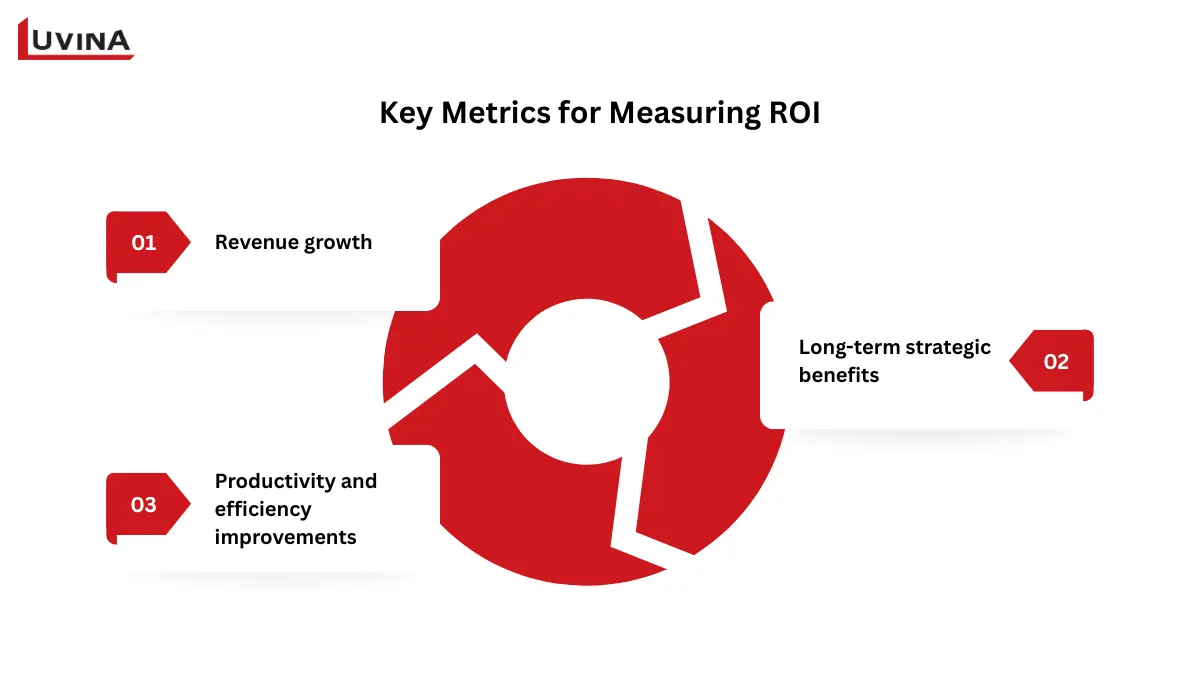
ROI can be measured using these key metrics
Revenue growth
Many retailers are finding that by streamlining their operations, utilizing automated workflow processes for repetitive tasks, and optimizing their inventory management, they can create substantial reductions in their costs and increase the performance of their sales efforts. By providing an enhanced customer journey through personalized interactions and providing a seamless and consistent experience across multiple channels, retailers are experiencing an increase in customer loyalty and repeat business, demonstrating that their retail digital transformation initiatives are working.
Productivity and efficiency improvements
Digital solutions let staff members concentrate on important tasks while reducing manual labor errors and time spent. Metrics, including order accuracy, transaction times, and service responsiveness, give a perspective on how digital programs are improving operating efficiency.
Long-term strategic benefits
Besides the improvement of the speed of introducing new products to market, ROI will also include the improvement of data-based decisions and the alignment of products with customer needs as persistent measures. By tracking these outcomes, retailers can ascertain what has actually happened due to digital transformation in retail and guide investment in innovation moving forward.
To assess the impact of digital transformation in retail, there’s a simple way to calculate ROI:
ROI (%) = (Total Investment Cost/ Net Benefits from Digital Transformation) ×100
*Net Benefits from Digital Transformation= (Revenue Increase + Cost Savings + Productivity Gains) – Implementation Costs
Common Mistakes
Many projects fall short of their potential because of preventable mistakes, despite the promise of digital transformation in retail. Here’s a concise look at the most frequent missteps and how retailers can address them:
| Mistake | Impact | Solution |
| Lack of a clear strategy | Tech investments might not coincide with company aims, therefore causing disjointed projects. | Create a digital transformation for the retail roadmap in line with business objectives. |
| Siloed data and systems | Disconnected customer, inventory, and POS systems inhibit practical insights. | Combine information and systems to produce practical insights. |
| Poor staff training | Adoption and return on investment suffer as staff struggle to use the latest equipment. | Provide comprehensive training and change management support. |
| Weak customer journey mapping | Reduced loyalty and involvement come from disconnected experiences. | Use AI and analytics to maximize client contacts. |
| Ignoring AI and automation | Missed chances for innovation and efficiency improvements | Adopt AI tools and automation to improve efficiency and customer engagement |
Common mistakes that can occur when implementing digital transformation for retail
Security & Compliance
Protecting customer data and ensuring regulatory compliance is important in digital transformation in retail. AI, ML, and blockchain technologies allow retailers to proactively manage risks, prevent fraud, and maintain supply chain transparency. Automated compliance systems further streamline adherence to evolving regulations, reducing administrative burden and improving operational integrity.
Key approaches include:
– AI & ML monitoring: Detect anomalies, flag unusual transactions, and predict potential security threats in real time.
– Fraud prevention: Analyze purchasing patterns and employee behavior to prevent unauthorized or suspicious activities.
– Blockchain traceability: Secure transactions and track products from origin to shelf, ensuring authenticity and transparency.
– Automated compliance: Continuous monitoring, instant alerts, and audit trails simplify regulatory reporting and adaptation to new standards.
These measures collectively create a robust security and compliance framework, enabling retailers to safely leverage digital innovations while protecting customer trust in a digital transformation in retail journey.
Future Trends: AI, Autonomous Stores & Phygital Retail
Remaining ahead necessitates accepting inventions that define digital change in retail, as the retail scene is changing quickly. Important patterns defining the future are:
| Trend | What will be changed? |
| AI and machine learning | Incorporating AI and machine learning technology to deliver personalized recommendations, predictive analytics, and intelligent customer support through automated chatbots, and automated inventory management to drive retailers’ digital transformation. |
| Autonomous and phygital stores | Incorporating autonomous and phygital (physical/digital) stores, such as cashier-less or self-checkout stores, and AR/VR to support product try-ons, to help retailers create a seamless online-offline experience. |
| Sustainability and green retailing | Incorporating sustainability and eco-friendly practices, such as using renewable energy, using eco-friendly packaging for consumers, developing sustainable product lines, and using digital technology to track how products impact the environment. |
| Voice commerce | Providing a method for people to purchase products (using their voice) without having to have any physical interaction with the product or be in physical proximity to it, by using their voice through voice technology. |
| Blockchain for supply chain | Using blockchain technology to track the whole supply chain process, from the point of production to the final point of delivery, allows customers to have confidence in the authenticity of the product and helps retailers to reduce fraud. |
| New business models and partnerships | Using new business models and forming new types of partnerships, including subscription services and experiential retail concepts, and creating new technology partnerships, to provide new customer experiences to consumers. |
| AI-driven retail insight | Using AI technology to help retailers with their ongoing digital transformation by reducing manual labor and automating daily tasks, improving their forecasting capabilities, and using data to inform their marketing efforts. |
Key trends in retail digital transformation
Conclusion
The retail environment is evolving more quickly than ever; thus, staying ahead requires accepting innovation at every tier. Companies that use technology, simplify procedures, and give customer experience top priority will enjoy real expansion and continuous benefits. Applying digital transformation in retail enables companies to forecast market changes, streamline operations, and provide customized experiences that really connect with customers.
Retail digital transformation requires the right architecture, integration strategy, and execution roadmap.
Luvina helps retailers design scalable digital platforms, integrate legacy systems, and accelerate transformation initiatives.
Talk to our experts to explore how your retail organization can modernize operations and deliver better customer experiences.e the gap between vision and reality.
Resources
READY TO START A PROJECT?
Our experts are eager to explore your needs.

Read More From Us?
Sign up for our newsletter
Read More From Us?
Sign up for our newsletter