




Black Box Testing: Definition, Types, Techniques, and Examples


Black box testing in software engineering is a software testing method that evaluates how an application behaves without requiring any knowledge of its internal code, architecture, or implementation. Instead, testers provide inputs and verify whether the outputs match the expected results defined in the software requirements.
This approach is also known as behavioral testing, opaque box testing, specification-based testing, and closed box testing.
The core principle of black box testing is straightforward. Inputs go into the system, outputs come out, and testers evaluate whether those outputs match the expected results. As a fundamental part of software testing, black box testing helps teams validate software quality from an end-user perspective throughout the software development lifecycle.
What Is Black Box Testing in Software Engineering?
Black box testing is a software testing method that evaluates whether an application behaves as expected based on its requirements, without requiring access to its internal code or implementation.
Black box testing validates software by checking whether it behaves as expected based on its requirements. Testers evaluate inputs and outputs instead of the source code. It is also known as behavioral testing.
Unlike white box testing, which requires full code visibility, and grey box testing, which provides partial knowledge of the system, black box testing focuses only on external behavior. It is commonly performed by QA engineers, business analysts, and end-user acceptance testers during integration, system, and user acceptance testing (UAT).
Types of Black Box Testing in Software Engineering
Black box testing is commonly associated with functional testing, but it is not limited to validating software features. Depending on the testing objective, it can also be applied to non-functional testing and regression testing, all without requiring visibility into the application’s internal code.
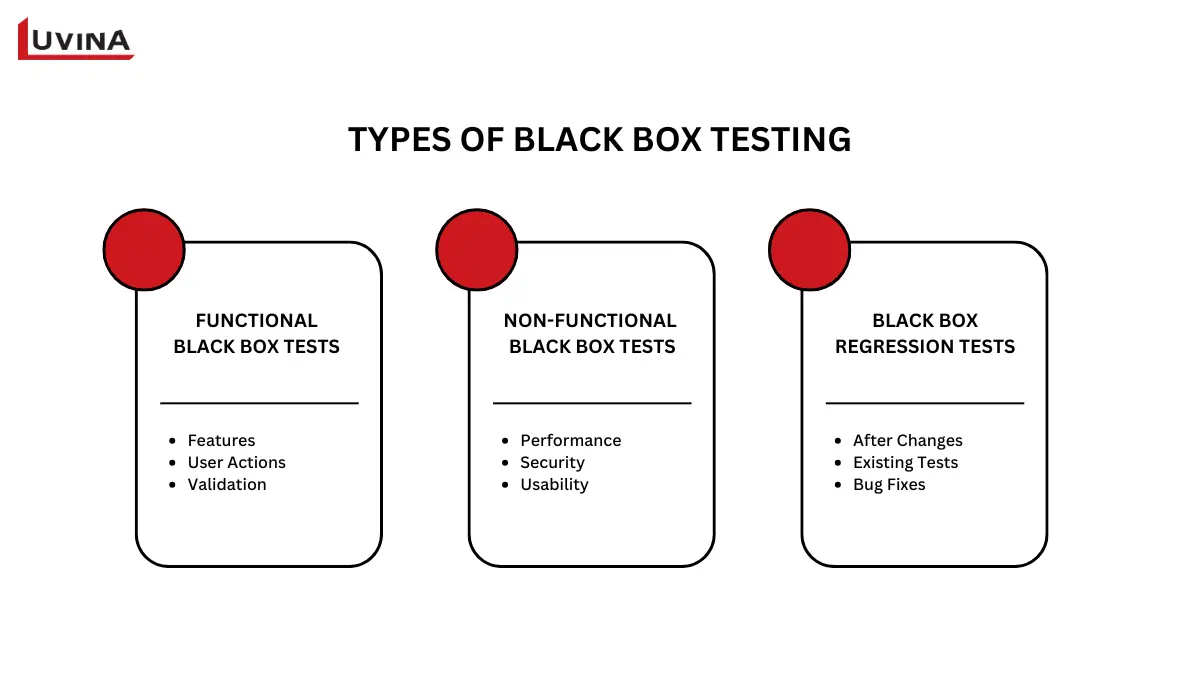
Main types of black box testing
Functional Black Box Tests
Functional testing verifies that software features work as specified in the requirements. Testers focus on inputs, outputs, and expected behavior from the user’s perspective without examining the underlying implementation.
Common examples include:
- Validating login credentials
- Testing form submission
- Verifying search functionality
Non-Functional Black box Tests
Black box testing can also evaluate non-functional requirements such as performance, security, usability, and reliability. Testers assess how the application behaves under different conditions without accessing the source code.
Common examples include:
- Load testing
- Penetration testing
- Accessibility testing
Black box regression tests
Regression testing ensures that previously working functionality continues to operate correctly after code changes, bug fixes, or new feature releases. Existing test cases are re-executed from the user’s perspective to identify unintended side effects. Learn more in our regression testing guide.
Black Box Testing Techniques in Software Engineering
Black box testing relies on several test design techniques to validate software behavior without examining the source code. Each technique helps QA teams create effective test cases for different scenarios, from simple input validation to complex business workflows. According to the ISTQB Foundation Level Syllabus, these specification-based techniques improve test coverage while reducing unnecessary test cases.
Black Box Testing Workflow
Although test cases vary by project, most black box testing follows the same basic workflow:
- Requirements: Review the software requirements and expected behavior.
- Design Test Cases: Create test cases based on the requirements without referring to the source code.
- Execute Tests: Run the test cases and compare the actual results with the expected outcomes.
- Report Defects: Record any issues found during testing and share them with the development team.
- Retest: Verify that reported defects have been fixed correctly.
- Regression Testing: Re-run related test cases to ensure recent changes have not introduced new defects.
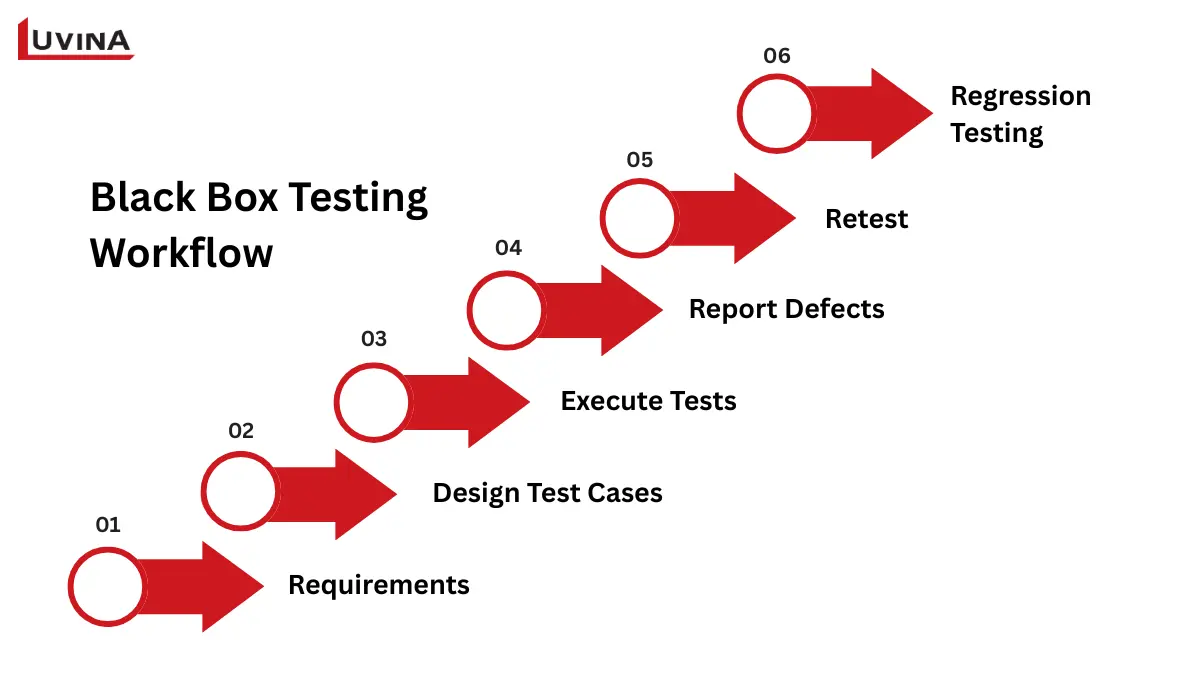
Black box testing process from input to evaluation
This simple process allows testers to verify software behavior from an end-user perspective without understanding the internal implementation.
Can Black Box Testing Be Automated?
Black box testing can be performed using both manual and automated testing. Manual testing is commonly used for exploratory testing, usability testing, and user acceptance testing, where human observation is important. Automated testing is better suited for repetitive tasks such as regression testing, API testing, and cross-browser testing. In practice, many QA teams combine both approaches to improve testing efficiency and achieve broader test coverage.
Black Box Testing Techniques
Different testing scenarios require different test design techniques. The following table summarizes the most common black box testing techniques, their purposes, and practical examples.
| Technique | Purpose | Example |
| Equivalence Partitioning | Divides input data into groups with the same expected behavior. One representative value is tested from each group. | Age input (18–65): Below 18 (invalid), 18–65 (valid), Above 65 (invalid). Three partitions require only three test cases. |
| Boundary Value Analysis | Tests values at the edges of valid input ranges where defects are most likely to occur. | Password length (8–20 characters): Test 7, 8, 9, 19, 20, and 21 characters. |
| Decision Table Testing | Tests all possible combinations of input conditions and expected outcomes. Best suited for complex business rules. | Verify insurance eligibility based on age, income, and driving history. |
| State Transition Testing | Verifies how the system behaves when moving between different states. | Test login behavior when a user is logged out, logged in, or locked after multiple failed attempts. |
| Use Case Testing | Creates test cases from user stories or business scenarios to validate complete user journeys. | Test an online shopping flow from browsing products to order confirmation. |
| Error Guessing | Uses the tester’s experience to identify areas that are likely to contain defects. | Enter blank values, special characters, or extremely long text into input fields. |
| Graph-Based Testing | Represents application workflows as a graph and tests different execution paths. Suitable for complex workflows and transaction flows. | Validate different money transfer paths in an online banking system, including successful transfers, insufficient balance, and invalid accounts. |
Overview of common black box testing techniques.
Each black box testing technique serves a different purpose. To better understand where black box testing fits, it is helpful to compare it with white box testing and grey box testing.
Black Box Testing vs. White Box Testing vs. Grey Box Testing
Black box, white box, and grey box testing all play important roles in software quality assurance. The main difference lies in how much testers know about the application’s internal implementation. Choosing the right approach depends on the testing objective, the development stage, and the level of access to the source code.
Key Differences Between Black Box, White Box, and Grey Box Testing
Although all three approaches aim to improve software quality. They differ in code visibility, testing techniques, and the testing phases where they are most effective. The table below summarizes these key differences to help you choose the right approach for different testing scenarios.
| Criteria | Black Box Testing | White Box Testing | Grey Box Testing |
| Approach | Tests software from the user’s perspective | Tests the internal structure and code | Combines external testing with partial knowledge of the system |
| Knowledge of Code | No source code knowledge required | Full access to source code | Partial knowledge of the system or architecture |
| Who Performs It | QA engineers, business analysts, end users | Developers, software engineers | QA engineers, developers, security testers |
| Common Testing Phases | System testing, integration testing, acceptance testing | Unit testing, integration testing | Integration testing, system validation |
| Common Techniques | Equivalence Partitioning, Boundary Value Analysis, Decision Table Testing | Code coverage, control flow testing, branch testing | Risk-based testing, data flow validation, API testing |
| Coverage Focus | Functional behavior and user experience | Internal logic, code paths, and program structure | Interaction between internal components and external behavior |
Comparison of Black Box, White Box, and Grey Box Testing
When Should You Use Each Approach?
Each testing approach serves a different purpose, and many software projects use all three to achieve comprehensive test coverage.
- Black box testing is best for validating software from the user’s perspective. It is commonly used during system testing and user acceptance testing.
- White box testing is ideal for verifying internal code quality, logic, and execution paths. Developers typically use it during unit testing and integration testing.
- Grey box testing works well when testers have partial knowledge of the system. It is often used to validate APIs, integrations, databases, and interactions between different components.
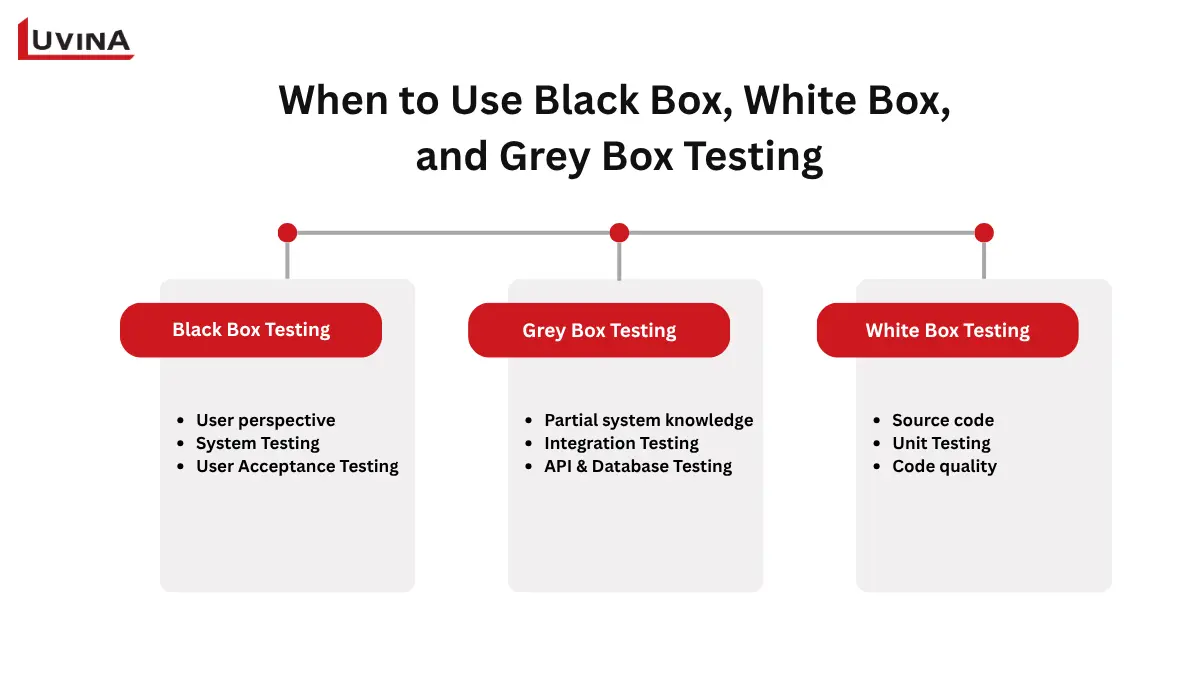
Recommended use cases for black box, white box, and grey box testing
In practice, these approaches complement each other rather than compete. Combining them helps teams identify both user-facing issues and hidden implementation defects earlier in the development lifecycle.
Industry Applications
Black box testing is widely used across industries to verify software from the end user’s perspective. Some common applications include:
- Finance and Banking: Validate online payments, fund transfers, and account management.
- Healthcare: Test patient portals, appointment scheduling, and electronic health record systems.
- E-commerce: Verify product search, shopping carts, checkout, and payment workflows.
- Telecommunications: Test customer portals, billing systems, and service activation.
- Enterprise Software: Validate business workflows, user permissions, and system integrations.
At Luvina, black box testing is part of our end-to-end QA services for clients across finance, healthcare, retail, manufacturing, and other industries. Our QA engineers combine proven testing practices with Japanese quality standards to help businesses deliver reliable, high-quality software.
When Should You Avoid Using Black Box Testing?
Black box testing is not the best choice when you need to examine the application’s internal logic, code structure, or execution paths. It is also less effective for validating complex algorithms or measuring code coverage. In these situations, white box testing or a combination of testing approaches can provide more comprehensive results.
Advantages and Disadvantages of Black Box Testing
Like any software testing approach, black box testing has both strengths and limitations. Understanding these advantages and disadvantages helps QA teams choose the right testing strategy and combine it with other methods when necessary.
Before deciding whether to use black box testing, it is important to understand its key strengths and limitations.
| Advantages | Disadvantages |
| No programming or source code knowledge is required, making it suitable for QA engineers, business analysts, and end users. | Testers cannot verify the internal logic or code paths of the application. |
| Tests software from an end-user perspective, helping identify real-world usability and functional issues. | Test cases may become redundant because testers do not know which code paths have already been covered. |
| Provides business benefit because testers are not influenced by the implementation. | Some defects, such as hidden logic errors or unreachable code, require white box testing to detect. |
| Can be applied at different testing levels, including integration, system, and acceptance testing. | Less effective for validating complex algorithms or highly logic-driven components. |
Key Benefits and Limitations of Black Box Testing
Black box testing delivers the greatest value when it is part of a well-planned QA strategy. For engineering leaders and technical managers, choosing the right testing approach and the right QA partner can improve software quality, reduce release risks, and accelerate delivery. If your team is evaluating external QA support, read about the benefits of QA outsourcing to understand how experienced testing partners can strengthen your software development process.
FAQs
1. What is black box testing in software testing?
Black box testing is a software testing method that checks how an application works without looking at its source code. Testers provide inputs, observe the outputs, and verify whether the results match the expected behavior.
2. What are the main black box testing techniques?
The main black box testing techniques include equivalence partitioning, boundary value analysis, decision table testing, state transition testing, use case testing, error guessing, and graph-based testing.
3. What is the difference between black box testing and white box testing?
Black box testing checks how software behaves from the outside. White box testing examines the application’s internal code and logic. Together, they provide more complete test coverage.
4. Is black box testing manual or automated?
Black box testing can be both manual and automated.
5. Can black box testing detect security issues?
Yes. Black box testing can identify some security vulnerabilities, such as authentication and input validation issues. However, it cannot directly verify the security of the underlying source code.
6. Who performs black box testing?
Black box testing is typically performed by QA engineers, business analysts, end user acceptance testers, and security testers, depending on the testing objectives.
7. When should black box testing start?
Black box testing usually starts during integration testing and continues through system testing, user acceptance testing, and regression testing as the software evolves.
Conclusion
Black box testing helps QA teams verify software from the end user’s perspective without requiring access to the source code. It supports both functional and non-functional testing, making it an essential part of modern software quality assurance.
Contact Luvina to learn how our software testing services can help you improve software quality and accelerate delivery.
Resources
- https://owasp.org/www-project-web-security-testing-guide/
- https://www.browserstack.com/guide/black-box-testing
READY TO START A PROJECT?
Our experts are eager to explore your needs.

Read More From Us?
Sign up for our newsletter
Read More From Us?
Sign up for our newsletter