




Aras PLM Review: User Feedback, Case Studies & Comparisons


Aras PLM has become a popular choice for companies looking to modernize their product development systems, which is why many teams now search for honest, practical user feedback before making a decision.
In this article, we’ll walk through an overall ARAS PLM review, including user feedback, real-world case studies, and side-by-side comparisons, to give you a clear, practical view of what ARAS PLM truly delivers. Let’s begin.
Aras PLM Reviews: What Users Really Think
Aras software solutions engineer is often viewed as a flexible platform for managing complex product data, and many organizations rely on an Aras PLM review to understand how it performs in real operational environments.
Aras Innovator is built on a flexible framework that supports PLM, APQP, lean development, and NPI. A major turning point came in 2007 when the platform moved to an open-source model. One of the most significant aspects of Aras since its transition to the open source model (in 2007). Companies use Aras as a central repository to monitor documentation related to engineering, manage bill of material (BOM) structures, maintain parts inventory and ensure accurate end-to-end traceability. As the single source of truth, Aras reduces the problem of data integrity as well as supports digital transformation.
If you’re evaluating Aras implementaion for your organization, you should consider identifying the key metrics that are commonly included in analyst evaluations, as well as internal performance evaluations. As a certified Aras Innovator partner and consultant with extensive deployment experience, we recommend reviewing these metrics one-by-one to ensure full clarity.
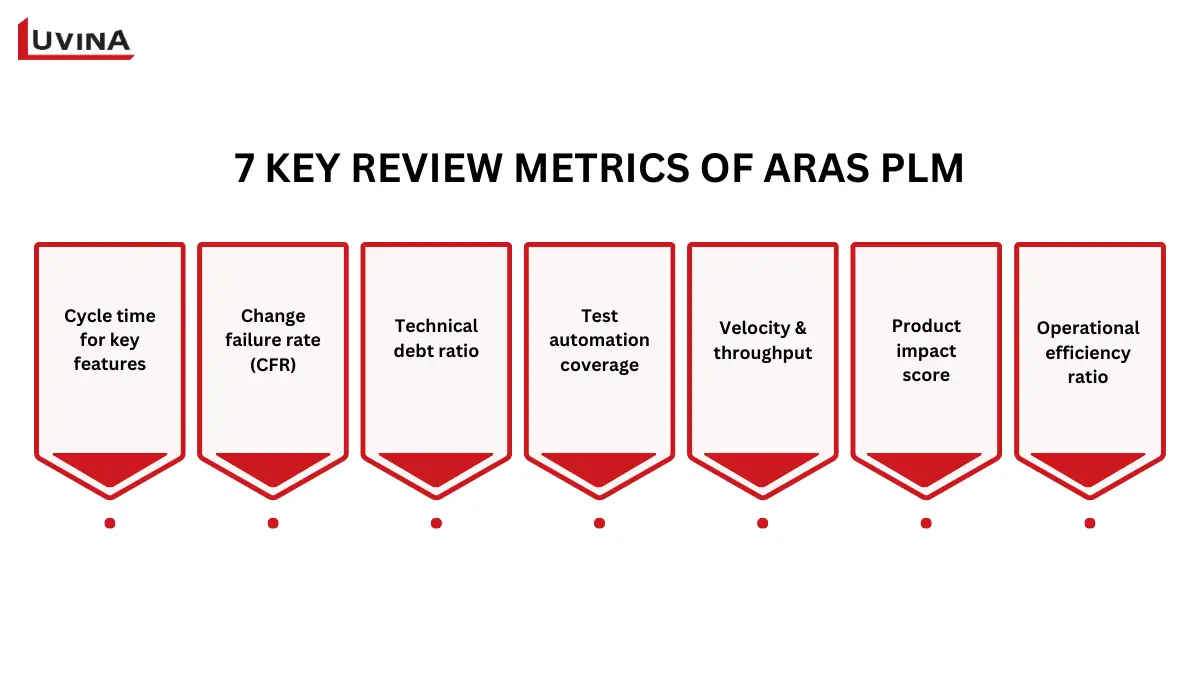
– Cycle time for key features: Measures speed across design, testing, and integration.
– Change failure rate (CFR): Tracks errors caused by engineering changes.
– Technical debt ratio: Shows how much cleanup is needed from past shortcuts.
– Test automation coverage: Evaluates code quality and validation.
– Velocity & throughput: Measures team output and efficiency.
– Product impact score: Assesses alignment between features and customer needs.
– Operational efficiency ratio: Evaluates how effectively resources are used.
User feedback
Real user feedback provides visibility into how these metrics are applied daily, through shared insights from multiple industry reports, community discussions, and verified Aras Innovator reviews .where Aras continues to receive consistent acknowledgement of its strengths in the areas of document control, parts management, and as a single source of truth.
However, user commentary also reveals challenges related to implementation complexity and usability. Here are representative examples that reflect both sides:
“I get a complete PLM solution from Aras Innovator in the product development environment for giving me a complete and enhanced view of the lifecycle of the products.”
“It keeps everything organized, and it is also structured the way costing and pricing are done.”
————–
“In the implementation process, I found myself with the most hurdles. This includes the lack of data mapping consistency and synchronization problems in real-time data.”
“Updates are slow to improve and add functionality, and I don’t feel better off since my company moved to Aras.”
Overall, to review Aras PLM, users all agreed that Aras Corporation software solutions engineer LinkedIn performs strongly in data management, lifecycle visibility, and collaboration, while also presenting challenges in customization and implementation. These combined insights create a balanced and realistic understanding of the platform’s effectiveness – one that organizations often seek when evaluating its role through a dedicated Gartner ARAS PLM or similar analyst review.
Case Studies: How Organisations Implemented Aras PLM
To understand Aras PLM’s real impact, you need to look at actual case studies. These examples show how companies apply the platform in real operations. These cases provide valuable insights for teams conducting an ARAS PLM review or evaluating its adoption for their own processes.
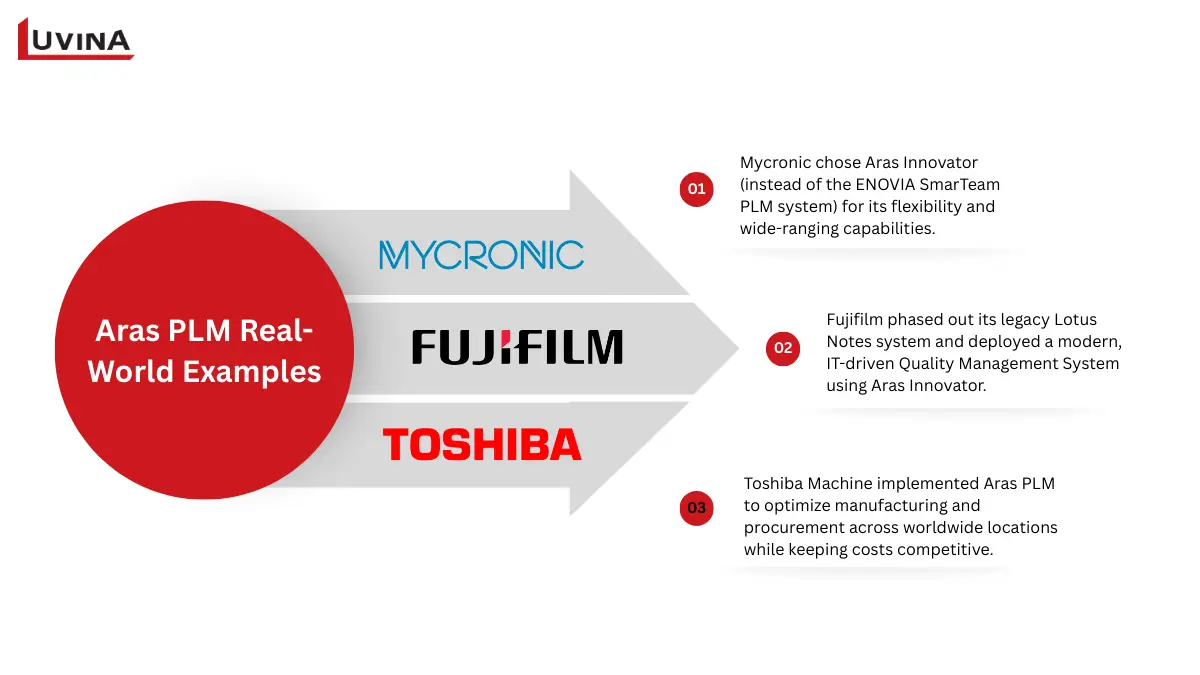
Mycronic – Building a flexible data backbone
Mycronic, a leading Swedish company, designs advanced solutions for high-tech industries, ranging from flat-screen displays and medical implants to interplanetary technology. Facing the end-of-life of their ENOVIA SmarTeam PLM system and high costs from traditional vendors, they chose Aras Innovator for its flexibility and wide-ranging capabilities.
Mycronic replaced its aging SmarTeam PLM with Aras Innovator to gain flexibility and reduce vendor cost. Aras now serves as their engineering data backbone and supports cross-team collaboration.
Fujifilm – Implementing a modern digital quality management system
Fujifilm phased out its legacy Lotus Notes system and deployed a modern, IT-driven Quality Management System using Aras Innovator. The project not only modernized their processes but also paved the way for extending PLM across additional business areas.
Users highlighted that the system improved traceability, ensured process consistency, and enhanced cross-team collaboration. Reports and reviews of Aras 360 software emphasize how such transformations can increase operational efficiency while providing a clear roadmap for future PLM adoption.
Toshiba – Streamlining global product development
Toshiba Machine sought to optimize manufacturing and procurement across worldwide locations while keeping costs competitive. Implementing Aras PLM allowed seamless integration of product information across the entire lifecycle – from design to manufacturing, sales, and service.
This case is a strong example of how the platform supports global product development. It’s a prime example for anyone examining ARAS PLM case studies, showing how centralised PLM can support global operational goals.
An case from Luvina Software’s client
Luvina has customized features for BOM, document, and asset management with Aras, that helped the client significantly decrease in material mix-ups during production, applied quick and effective management of machinery information within factories.
Read more about the case: BOM & Document Management with ARAS Innovator.
You can also visit the offical website to find more specific case studies from ARAS.
Pros & Cons: What Works and What Doesn’t
When evaluating Aras PLM, it’s essential to look at both its strengths and limitations. When looking at several sources of ARAS PLM review and real-world ARAS PLM case studies, you will see that ARAS PLM users regularly point out both what works well with the application and what the problems are related to ARAS PLM. Information found in Aras Software reviews and user experiences will also help teams who are considering using Aras Software by giving them a real-life context.
Below are some of the most significant benefits and downsides associated with using Aras PLM.
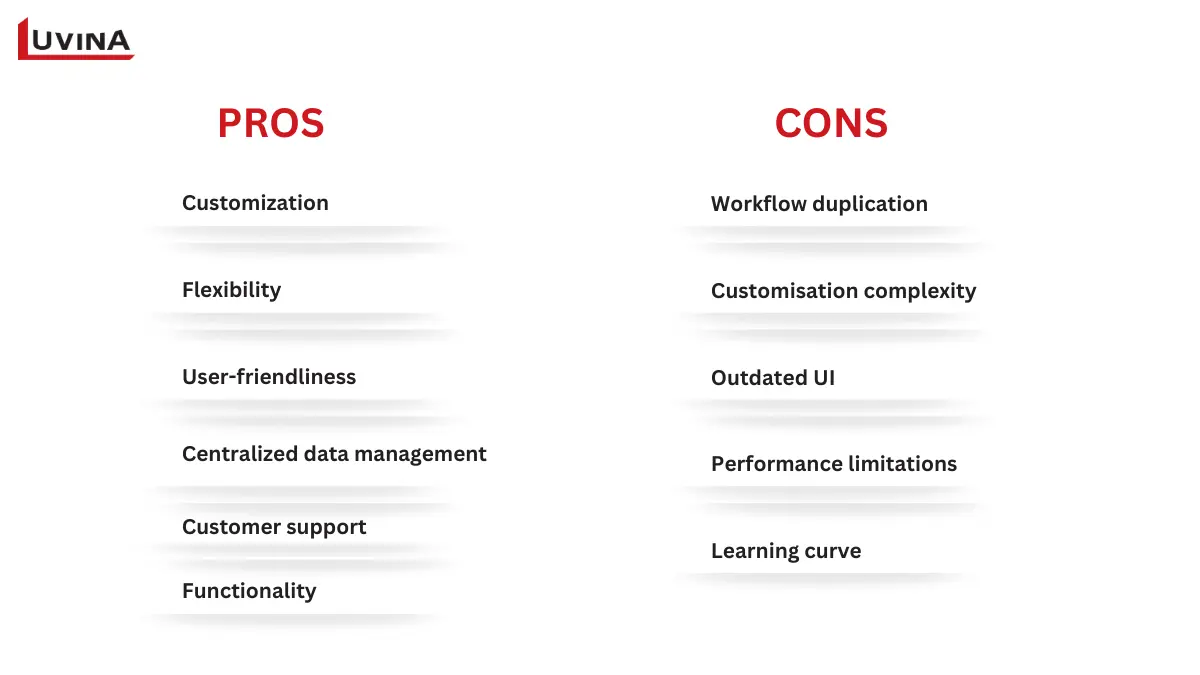
Pros
– Customization: It is relatively easy to customize documents, processes, parts, etc., and have them reflect the needs of your business.
– Flexibility: Aras PLM has a great deal of flexibility and the ability to encompass a large number of different types of processes, as well as its open architecture and open licensing.
– User-friendliness: Unlike many other PLM solutions, the interface is very intuitive, and it allows for a straightforward process of creating data.
– Centralized data management: Provides a single source view of cost, price, tooling, and quote in one application.
– Customer support: The support team is very helpful and responsive whenever you need assistance.
– Functionality: The full scope of PLM, BOM, document control, and quality management items can be handled with great ease using Aras PLM.
Cons
– Workflow duplication: Configuring multiple branches or routes can be repetitive.
– Customisation complexity: Some setups require training and technical expertise.
– Outdated UI: The Interface looks dated compared to modern alternatives.
– Performance limitations: Older versions may run slowly depending on the network. Take a look at Aras PLM server requirements checklist to have the best preparation before starting your deployment.
– Learning curve: New users may need time to become proficient, as noted in the ARAS PLM review.
Analyst Insights & Industry Recognition
Across multiple ARAS PLM review reports, ARAS PLM has consistently mentioned its flexibility, scalability, and innovative approach to Product Lifecycle Management (PLM) for a wide variety of product types across many industries. The ARAS PLM analyst event has also given me a much clearer understanding of the company’s direction, strategy, roadmap, and current adoption trends within the different verticals.
Leading firms like Forrester, Gartner, and CIMdata consistently rank Aras Innovator as a top solution. The platform is praised for real-time digital thread connectivity, predictive analytics, and composable workflows – features often cited in ARAS PLM reviews. According to Forrester, the products available from Aras provide full digital thread connectivity, or, in other words, the capability to trace from a requirements perspective, through design, to verification and finally to certification of a product.
As a result of its impact on the PLM market over the years, Aras has been awarded numerous accolades:
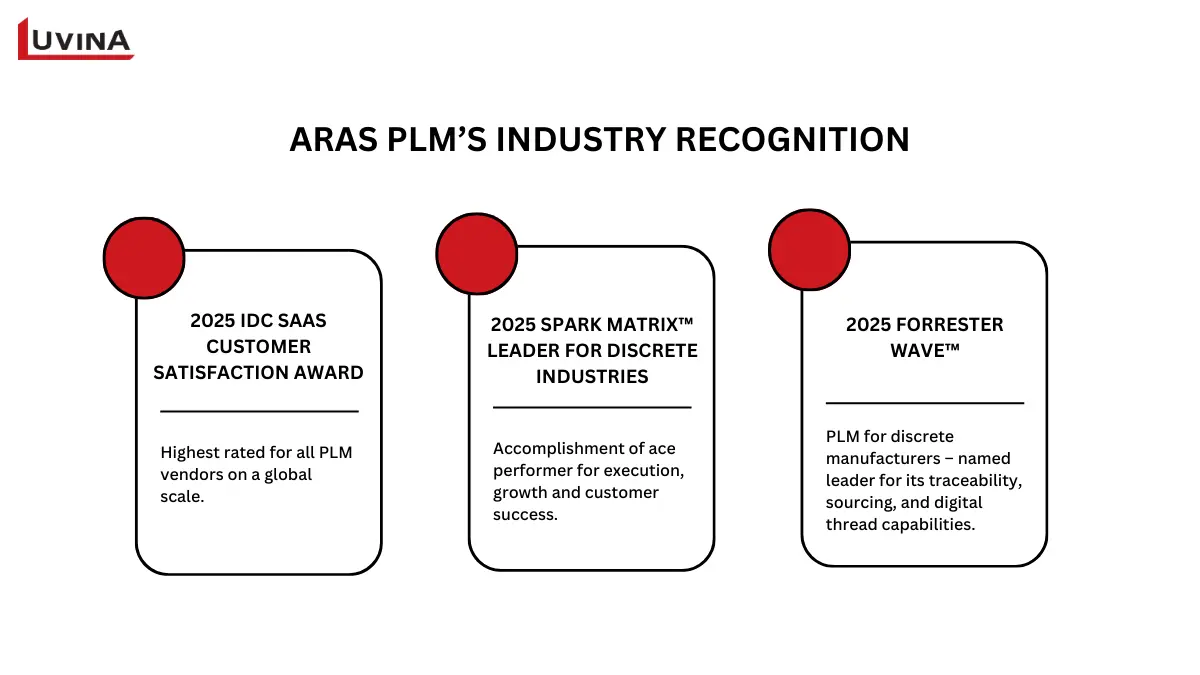
– 2025 IDC SaaS Customer Satisfaction Award – Highest rated for all PLM vendors on a global scale.
– 2025 SPARK Matrix™ Leader for Discrete Industries – Accomplishment of ace performer for execution, growth, and customer success.
– 2025 Forrester Wave™: PLM for discrete manufacturers – named leader for its traceability, sourcing, and digital thread capabilities.
The above awards and recognitions illustrate the roots of Aras’ strengths and advantages regarding its capabilities to enable a unified digital thread, advanced lifecycle management, low-code configuration, and predictive analytics.
By combining analyst insights, industry recognition, and real-world success, a comprehensive Aras PLM review shows that Aras continues to lead in flexible, scalable, and innovative PLM solutions.
Comparison: Aras PLM vs Other PLM Solutions
In the PLM space, when comparing the major PLM Systems against Aras Innovator, several benefactors have consistently listed the flexibility, modular architecture, and low-code development features as differentiators. Multiple ARAS PLM review reports reflect this, with a few additional factors that directly contribute to the overall value proposition that ARAS provides. Below you will find an overview of several leading PLM systems along with a concise comparison to Aras Innovator.
| PLM solution | Flexibility and customisation | Deployment and integration | Strengths | Limitations |
| ARAS PLM | Highly flexible, modular, low-code platform; easy to tailor to unique workflows; highlighted in many ARAS PLM reviews | Cloud, on-premises, hybrid; integrates with multiple systems | Digital continuity, full traceability, broad API support, active user community | Smaller market share; less out-of-the-box functionality |
| Teamcenter | Strong but rigid; configured for manufacturing processes | Cloud & on-premises; extensive enterprise integration | Comprehensive CAD & ERP integration; strong manufacturing process planning | Complex deployment; higher cost; less flexible for customization |
| Windchill | Moderate customization; IoT & digital twin focused | SaaS/cloud-native; CAD integration | Advanced IoT integration; good CAD data management | Integration with non-PTC systems can be challenging |
| Autodesk Vault | Minimal customization; designed for Autodesk tools | Cloud or on-premises; tight Autodesk integration | User-friendly, quick deployment, cost-effective for small/medium teams | Limited scalability; poor integration outside the Autodesk ecosystem |
| SAP PLM | Standard SAP workflows; limited low-code options | Deep ERP integration, mainly on-premises | Strong compliance, analytics, and end-to-end business process support | High total cost; requires SAP expertise |
| Oracle PLM | Moderate customization; AI insights for planning | Cloud-based; integrates with Oracle ERP & SCM | Real-time dashboards, predictive analytics, and AI-driven anomaly detection | Complexity: higher cost for smaller organizations |
| Aletig | SaaS-based, some workflow automation; new market | Cloud/SaaS; fast integration | Centralized data, automated processes, and real-time dashboards | Smaller user base; less proven at enterprise scale |
Aras PLM in comparison with other PLM solutions
When Is Aras PLM the Right Choice for Your Business?
You will have to determine whether or not Aras Innovator meets your needs based on the specific nature of your processes and the vision for your organisation. According to numerous ARAS PLM reviews about its ability to provide flexibility, deep customisation, and a comprehensive digital thread, these are some scenarios where Aras PLM has proven to be successful:
– Organisations with very complex or highly specialised processes that standard PLM applications cannot address fully.
– Businesses requiring complete control over their data structure and system operation.
– Teams planning to build advanced capabilities around the digital thread and systems engineering.
– Companies where there are internal technical resources (in-house administrators/developers) who can maintain and enhance the Aras platform.
– Agencies seeking a PLM as a platform for future integration and expansion, rather than simply as a stand-alone solution.
FAQ
1. What is Aras PLM used for?
Aras PLM is used to manage the entire product lifecycle, from design and engineering to manufacturing and maintenance, helping teams collaborate efficiently.
2. How flexible is Aras Innovator?
Aras Innovator offers high flexibility, allowing companies to customize workflows, data models, and applications to meet specific business needs.
3. Is Aras PLM suitable for small businesses?
Yes, small businesses with simpler processes can benefit, but the ARAS PLM review suggests it excels for companies with complex or unique workflows.
4. Can Aras integrate with other systems?
Yes, it supports integration with ERP, CAD, and other enterprise tools, ensuring smooth data flow across the organization.
Conclusion
The Aras PLM reviews reflect the wide-ranging capability of its Aras Innovator as a highly adaptable and customisable tool that represents a PLM solution for all types of businesses with lifecycle management needs that includes advanced customisation and collaboration without barriers. From key metrics and user feedback to case studies, pros and cons, analyst insights, and comparisons with other PLM systems, we hope this Aras PLM review helps you understand how Aras Innovator can optimize your product lifecycle and drive business growth.
For businesses looking to implement a tailored PLM solution, Luvina provides expert guidance. With over 20 years of experience in custom software development, Luvina utilises its industry experience to provide its customers with innovative PLM solutions (both on-premise and cloud) that can be fully customised whilst providing secure and scalable solutions.
– Experienced teams: Luvina has deep and broad experience in providing extensive technical expertise across multiple technologies and industries to create innovative PLM solutions for its customers.
– Proven track record of success: Luvina has completed hundreds of successful projects in delivering PLM and custom solutions to its clients.
– Open lines of communication: Luvina is committed to continually listening to and understanding the needs of its clients in future meetings and providing clear and candid updates to them.
– Cost-effective development: Luvina has finely-tuned its processes to maximise quality, minimise timelines, and maximise budgets in the development of PLM and customised solutions.
For expert guidance and custom PLM solutions, contact Luvina today!
Resources
- https://www.trustradius.com/products/aras-plm/reviews#product-details
- https://helixbeat.com/product-lifecycle-management-key-metrics/#:~:text=Higher%20automation%20coverage%20leads%20to,performance%20indicators%20for%20better%20efficiency.
- https://aras.com/en/resources/page/3?format=case-study
- https://aras.com/en/resources?format=analyst-report
- https://www.clevr.com/blog/teamcenter-vs-other-plm-tools-top-plm-solutions-compared-2025
- https://www.appvizer.co.uk/magazine/operations/plm/plm-software
READY TO START A PROJECT?
Our experts are eager to explore your needs.


Read More From Us?
Sign up for our newsletter
Read More From Us?
Sign up for our newsletter