




Automotive Digital Transformation: What Leaders Need to Know


Automotive digital transformation is changing the way cars are created, made, and experienced. Technologies are turning automobiles into connected platforms and changing manufacturing into a data-driven environment. Rising customer expectations for frictionless digital experiences are also driving manufacturers to reconsider conventional business models and quick digital adoption at the same time.
In this setting, digital transformation goes beyond mere improvement of IT systems. It demands leaders to create fresh digital capabilities, update production, and reengineer value chains. This guide examines what leaders should understand about the changing environment of digital transformation in automotive industry, including the main causes behind it, the advantages it offers, the problems businesses encounter, and the tactics organizations can use to get ready for the future.
What Is Automotive Digital Transformation?
Digital transformation in the automotive industry is all about bringing in new tech – AI, machine learning, cloud computing, and IoT – to shake up the way cars get made, sold, and taken care of. Companies aren’t sticking with old-school methods anymore. Now, they’re building digital platforms and connecting everything: vehicles, factories, even the people buying the cars. This move lets them run things more smoothly, cut waste, and offer smarter products and services. In strategic terms, digital transformation strategy touches almost every part of the automotive world, from start to finish.
Key Drivers Behind Digital Transformation in Automotive
Automakers have to adjust fast to stay competitive as expectations evolve and technologies develop. These forces are speeding digital transformation in the automotive industry. Consequently, automotive digital transformation has become a major concern for companies.
Below are the key drivers of this transformation:
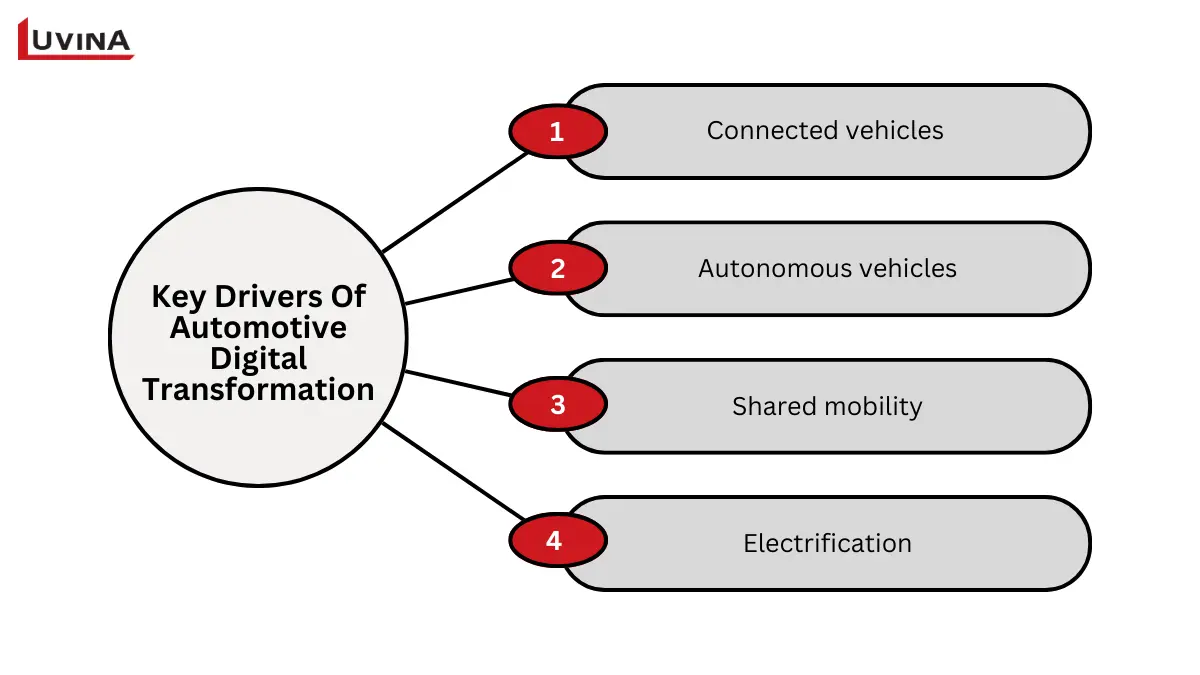
The broader market landscape makes automotive digital transformation an inevitable process
Connected vehicles
Drivers now want vehicles to offer smartphone-like connectivity – from assisted driving capabilities to entertainment systems. This need calls for digital skills across manufacturing and engineering as well as greater software complexity.
Autonomous vehicles
Driverless technology centers on passenger experience, safety, and constant vehicle performance. It also opens doors for fresh service models like field maintenance and remote diagnostics.
Shared mobility
Because of ride-sharing and car-sharing companies, people’s thoughts on owning cars are changing. Car companies have to stay in the game by either making their own online transportation services or working with tech companies.
Electrification
More electric cars require new factories and smarter ways to build them using data. This change pushes car companies to further accelerate automotive digital transformation and use car data to work more efficiently.
How Digital Transformation Is Reshaping Automotive Value Chains
The way businesses function, create goods, and interact with customers at every step of the vehicle lifecycle will change in the digital transformation in the automotive industry.
The application of cloud-based factory systems, linked sensors, and real-time analysis to enable real-time tracking of equipment and predictive maintenance is driving the most far-reaching digital transformation in manufacturing. Automotive digital transformation also improves vehicle design and functionality. By means of consumer consumption and data gathered from connected cars, producers will have access to driver behavior and product performance data to support innovation creation and product development cycle reduction, as well as more consumer adoption of new technologies developed with artificial intelligence (AI) installed in cars.
Digital transformation beyond production supports new mobility options including connected ecosystems, vehicle memberships, and ride-sharing systems. It helps sustainability objectives by increasing resource efficiency and speeding the shift toward electric and autonomous cars at the same time.
Benefits of Automotive Digital Transformation
Companies may develop more efficient, consumer-focused, data-driven operations by adopting digital transformation in automotive industry.
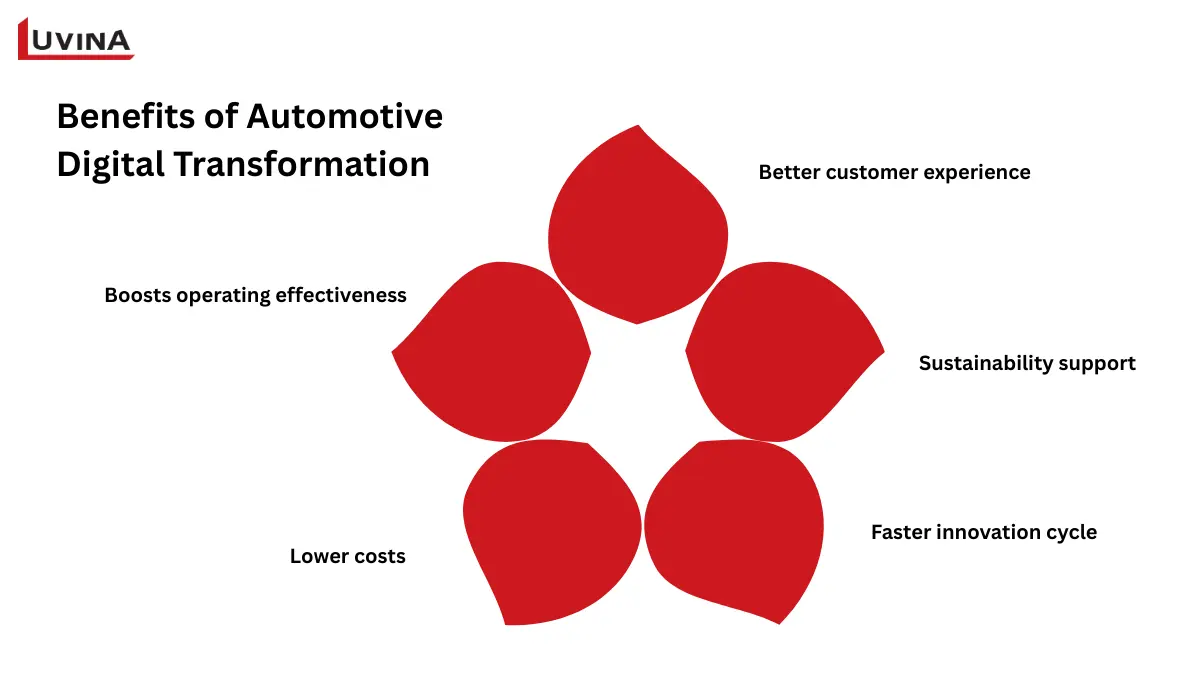
Both manufacturers and customers benefit from digital transformation
– Digital transformation automotive industry boosts operating effectiveness: Automation and smart production methods reduce operational errors, increase manufacturing speed, and cut on human labor.
– Lower costs driven by automotive digital transformation: Predictive maintenance and real-time observation can detect issues with assets early and lower maintenance costs; this creates less downtime and less repair cost on assets.
– Better customer experience: AI-connected automobile products will provide the consumer with improved experiences because of personalized services, remote upgrades, and smarter interaction inside the vehicle.
– Sustainability support: Utilizing digital tools will provide increased energy efficiency, waste elimination and the design of electric or low-emissions vehicles.
– Faster innovation cycle in digital transformation in automotive industry: Digital simulation and development tools help produce products at a much quicker rate than before.
Challenges & Risks for Automotive Digital Transformation
Companies face great opportunities for business through the adoption of digital transformation automotive industry, but there are also many risks associated with the operations and strategies of these companies, which need to be managed very carefully. Digital technologies may help improve innovation and increase operational efficiency; however, without effective governance, the investment strategy used to fund this transformation and the preparation of employees will not produce the necessary results.
The table below provides a list of key issues, consequences, and potential solutions for reducing the risks associated with transformational change.
| Challenge | Impact | Mitigation |
| High implementation cost | Infrastructure, software, and talent investment can strain budgets | Apply phased transformation and prioritize high-value use cases |
| Cybersecurity and data risk | Connected systems and smart vehicles increase vulnerability to attacks | Strengthen encryption, monitoring, and data governance |
| Legacy system integration | Difficulty connecting old and new technologies reduces efficiency | Build a unified architecture for automotive digital transformation |
| Talent shortage | Lack of skilled technical workforce slows innovation | Invest in reskilling and digital talent recruitment |
| Strategy misalignment | Technology adoption without business alignment reduces ROI | Develop a clear long-term transformation roadmap |
Common challenges and how to overcome them
Apart from logistical problems, businesses have to handle strategic hazards, including overstressing technology devoid of customer-centric design. Sometimes, corporations believe that upgrading internal procedures automatically enhances customer experience in automotive digital transformation, which is not always correct. Leaders should make sure that digital projects support client needs, business models, and long-term mobility patterns.
Another danger stems from the complexity of ecosystems within the digital transformation automotive industry road. Manufacturers, software suppliers, regulatory agencies, and mobility service partners all make up contemporary automotive value chains. Bad data normalization or bad system connections can cause operational bottlenecks and limit scalability.
Real-World Examples & Case Studies
Leading automotive and mobility firms are already using automotive digital transformation. Many worldwide groups are using AI, IoT, and digital platforms to revamp production methods and client engagement plans. The following cases show how actual digital transformation in the automotive industry is being implemented.
| Company | Application | Outcome |
| Tesla, Inc. | AI-driven autonomous driving systems and big data collection from vehicle sensors | Enabled continuous software improvement through over-the-air updates |
| Volvo Cars | Online-first retail strategy through the Polestar brand | Improved digital sales experience and expanded direct-to-consumer channels |
| BMW | IoT platform deployment at the Regensburg manufacturing plant | Reduced application deployment time by 80% and improved quality control |
| Volkswagen AG | AR-based maintenance guidance system for automotive parts | Increased service efficiency for technicians |
| TruPar | Integrated eCommerce, CRM, and ERP systems | Modernized supply chain and wholesale parts distribution |
Real-world examples of digital transformation in the automotive industry
How to Develop a Digital Transformation Strategy
A methodical strategy linking technology with corporate objectives and creating scalable, data-driven operations is necessary for a successful automotive digital transformation. A step-by-step digital transformation framework for creating a good strategy is given below.
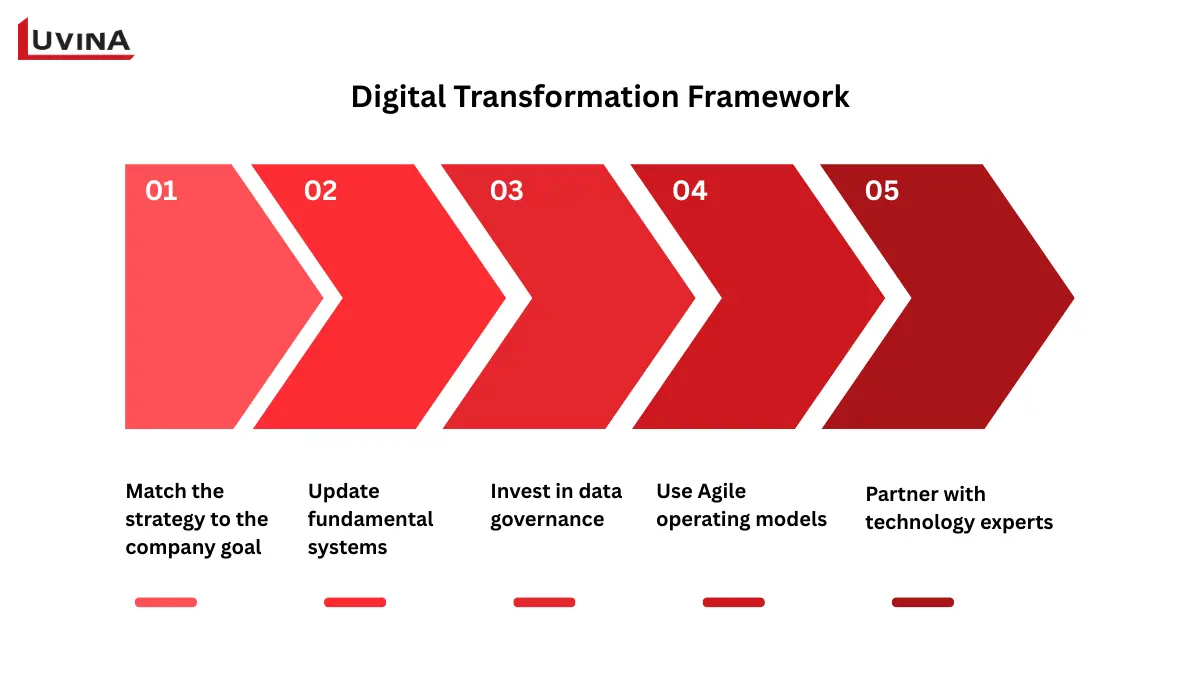
Steps to implement a digital transformation strategy for automotive companies
Step 1: Match the strategy to the company goal
Investments in technology have to support the company’s goals in customer satisfaction, innovation, sustainability, and efficiency. Define specific KPIs, establish measurable goals, and connect every digital project to general strategic company objectives. This helps to guarantee that resources are directed at initiatives producing actual influence.
Step 2: Update fundamental systems
Modernizing data platforms, manufacturing execution systems, and ERP establishes a solid basis for all digital efforts. Critical for every automotive digital transformation project, modern, integrated systems enable more efficient automation, better data flow, and more seamless workflows.
Step 3: Invest in data governance
AI, analysis, and automation initiatives depend on trustworthy, clean, and safe data. To maximize insights and operational efficiency, normalize data management procedures, put in place security measures, and guarantee compliance.
Step 4: Use Agile operating models
Agile techniques enable teams to constantly experiment, deploy, and refine. Cross-functional cooperation and iterative development cycles enable businesses to react promptly to market shifts and new technology potential.
Step 5: Partner with technology experts
Working with expert technology partners offers proven best practices, implementation knowledge, and industry knowledge. We at Luvina are experts in creating custom digital solutions matching your company’s objectives. Partnering with experts like Luvina helps companies minimize risks and accelerate their digital transformation in the automotive industry journey.
Future Trends for the Automotive Industry
Keeping up with the latest trends in automotive digital transformation is essential for companies that want to remain competitive and meet evolving customer expectations. The following key trends highlight how digital transformation in the automotive industry is shaping the future of production, customer experience, and sustainability.
– Digital twins: Virtual replicas of vehicles and factories use real-time data to optimize design, predict maintenance, and test sustainable solutions, improving efficiency and reliability.
– Electrification and sustainability: Electric vehicles (EVs) and eco-friendly manufacturing processes reduce emissions, improve energy efficiency, and integrate with smart power grids.
– AI-powered autonomous driving: AI enhances self-driving capabilities, safety, and navigation through predictive analytics and real-time decision-making.
– Connected vehicles and data monetization: IoT-enabled cars provide real-time insights, support predictive maintenance, and create opportunities for subscription services and mobility ecosystems, a key part of automotive digital transformation.
– Predictive analytics in manufacturing: Data from IoT devices helps optimize production workflows, minimize downtime, and lower operational costs.
– Immersive AR/VR experiences: Augmented and virtual reality transform car buying, virtual showrooms, and product design, boosting customer engagement and personalization.
– Digital-first automotive retail: Online configurators, virtual test drives, and e-commerce integration shift sales models away from traditional dealerships.
– Personalized customer experiences: AI-driven marketing and adaptive in-car systems raise loyalty and lifetime value by means of tailored experiences.
– Digitized supply chains: Use of IoT and blockchain for transparent, resilient, and affordable logistics is driven by EV adoption and sustainability targets.
Conclusion
By incorporating smart technologies into production, supply networks, and customer experience systems, automotive digital transformation is transforming the vehicle business. Basically, digital transformation is about designing smarter, more imaginative automotive processes able to change with future market needs. We hope this essay clarifies the main facets of digital transformation in the automotive sector and how it will help shape the future.other statistic. Partner with Luvina to bridge the gap between vision and reality.
Resources
- https://www.g-co.agency/insights/automotive-digital-transformation-trends
- https://oroinc.com/b2b-ecommerce/blog/digital-transformation-in-automotive-industry/
- https://www.walkme.com/blog/automative-digital-transformation/
READY TO START A PROJECT?
Our experts are eager to explore your needs.


Read More From Us?
Sign up for our newsletter
Read More From Us?
Sign up for our newsletter