




Digital Supply Chain Transformation: A Strategic Roadmap


Supply chains are becoming more complex, global, and vulnerable to disruption. As a result, digital supply chain transformation is no longer a long-term modernization initiative but a strategic priority. However, many companies still struggle to translate digital investments into measurable operational outcomes. Successful transformation requires aligning technology, processes, and business strategy rather than simply deploying new tools.
In this article, we examine the technologies driving digital transformation in the supply chain, its advantages and drawbacks, a realistic digital transformation strategy to begin, and what it implies.
What Is Digital Supply Chain Transformation?
Digital supply chain transformation is the process of redesigning supply chain operations using digital technologies, real-time data, and automation.
It enables companies to improve visibility, accelerate decision-making, and coordinate activities across suppliers, logistics partners, and internal teams.
| Aspect | Traditional supply chain | Digital supply chain |
| Data access | Delayed, fragmented, often manual | Real-time, centralized, accessible anywhere |
| Decision making | Reactive, based on outdated snapshots | Predictive, data-driven, automated where possible |
| Visibility | Limited across partners | End-to-end visibility across the network |
| Automation | Minimal manual tasks dominate | High, repetitive tasks handled by RPA/AI |
| Responsiveness | Slow to disruptions | Rapid response to changes in demand or logistics |
Traditional vs Digital Supply Chain Comparison
In 2026, the importance of digital supply chain transformation continues to grow as supply networks become more complex and unpredictable. Recent research shows that 91% of companies have adjusted their supply chain strategies due to changing trade policies, while 92% report that their technology investments have not yet delivered the expected results. These findings highlight a key reality: adopting digital tools alone is not enough. True transformation requires aligning technology, data, and processes to create a supply chain that is more agile, transparent, and resilient.
The Core Technologies Driving the Shift
Using technologies that convert data into faster, more intelligent, and more robust activities is at the heart of digital supply chain transformation. Key technologies are:
| Technology | Purpose and impact |
| AI and predictive analytics | Vast data is examined by AI agents and machine learning to forecast interruptions, maximize inventory, and assist proactive decision-making. KPI-centered analytics guarantee real actions, not only reports. |
| IoT and real-time visibility | Real-time tracking of location, state, and performance of sensors in goods, equipment, and warehouses. Provides proactive maintenance, lowers blind areas, and allows immediate monitoring. |
| Cloud platforms and ERP modernization | Centralize data and operations, enabling analytics and connectivity for digital transformation of supply chains, allowing stakeholders to access information anytime, anywhere, and supporting integration of advanced analytics, AI, and IoT. |
| Blockchain for traceability | Offers safe, permanent records for transactions and products, therefore increasing openness and trust between buyers and suppliers. |
| Digital twins and simulation | Test interruptions, stress restrictions, and run “what-if” scenarios without actual-world hazards by building digital duplicates of supply chain processes to improve digital supply chain transformation efficiency. |
Key technologies in the digital transformation of supply chains
Key Benefits of Digital Supply Chain Transformation
Faster judgments, fewer manual corrections, and better supply network coordination define the real value of digital supply chain transformation in daily operations. Connected systems and real-time data enable teams to work more control and efficiency as businesses embrace a digital transformation supply chain strategy. Among the main advantages are:
– End-to-end visibility and better decisions: Real-time data on inventory, shipments, and operations provides your team with the ability to react quickly while offering the ability to make informed decisions.
– Higher efficiency through automation: Through the use of robotics, automated workflow automation, and supply chain transformation, increased levels of operational efficiency by automating repetitive work, minimising manual errors, and speeding up routine processes will be achieved.
– Stronger insights and forecasting: With advanced analytics, stronger insights into demand trends, the earlier detection of supply disruptions, and more accurate planning can all be achieved
– Greater agility and scalability: Connected platforms let businesses rapidly modify supply chain planning and scale operations as demand changes.
– Cost optimization and improved service: better inventory management, efficient logistics, and fewer operational errors. Delivery dependability also improves.
– Improved collaboration and quality control: Digital platforms that foster collaborative communication between manufacturers, suppliers, and distributors are key to driving quality control and improving operational oversight.
Evaluate Organization Digital Transformation Maturity
Organizations have to know where they presently stand before continuing with digital supply chain transformation. Assessing digital maturity makes it possible to spot deficiencies in data integration, technologies, and procedures throughout the supply chain. A typical framework charts 4 maturity levels depending on the degree to which digital capabilities are integrated into supply chain activities.
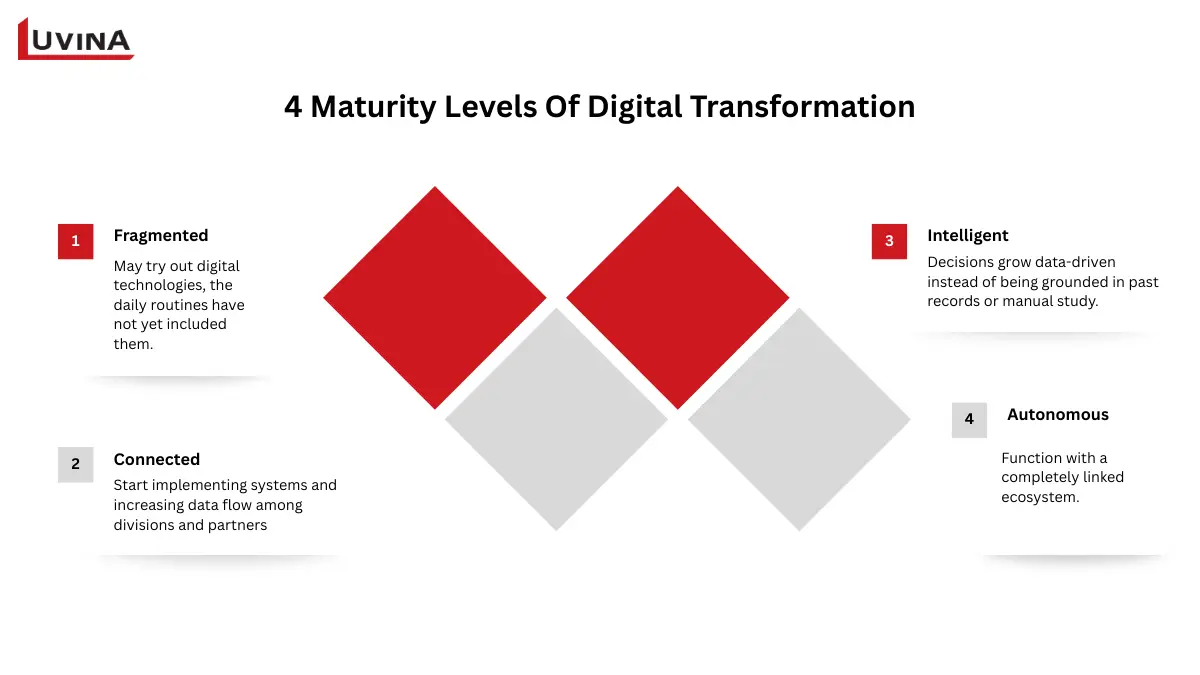
Four stages to evaluate an organization’s digital maturity
Stage 1: Fragmented
When it comes to supply chain activities right now, manual processes, spreadsheets, and isolated systems are extremely important. There are times when the data for the supply chain is stored in different systems (e.g., procurement, logistics, inventory systems). Therefore, there are times when it’s difficult to obtain a complete view of activities and decision-making. Additionally, most of the decision-making that occurs is reactive and based on incomplete or delayed information. Although many businesses at this point may try out digital technologies, the daily routines have not yet included them.
Stage 2: Connected
Companies start implementing systems and increasing data flow among divisions and partners. Teams may access constant data over procurement, manufacturing, and distribution thanks to cloud platforms and main databases. Real-time data availability enhances visibility, which helps with better coordination and faster responses to operating problems. Companies start establishing the technical groundwork needed for digital supply chain transformation at this point.
Stage 3: Intelligent
Central to supply chain management at the intelligent level are sophisticated analytics and automation. Predictive analytics helps businesses forecast demand, maximize inventory levels, and identify possible disturbances ahead of time. Machine learning systems produce practical insights by means of analysis of huge amounts of data from various sources. Decisions grow data-driven instead of being grounded in past records or manual study.
Stage 4: Autonomous
The most developed level comprises highly automated and self-optimizing supply chain processes. Real-time signals are constantly watched by AI-driven systems, which automatically change planning, route choices, and inventory decisions in reaction to shifting circumstances. Rather than just respond to events, the supply chain can foresee disturbances and act proactively. Companies at this level function with a completely linked ecosystem where digital supply chain transformation’s full value is provided by technology, data, and processes working together.
The Biggest Challenges and How to Overcome Them
Although the advantages are evident, putting digital supply chain transformation into action is not always simple. Organizational obstacles, legacy systems, and data-related problems hamper many companies’ development. The table below shows the most typical obstacles businesses encounter during digital transformation in supply chain projects, together with realistic solutions to beat them.
| Challenge | Impact | Solution |
| Cultural and organizational resistance | Because of a lack of understanding, training, or confidence, employees may reject new systems, hence stalling digital transformation in supply chain projects. | Offer training sessions, leadership support, and unambiguous communication to foster acceptance and self-confidence. |
| Legacy system integration | Modern digital technology integration is made difficult by obsolete ERP systems and manual operations. | Use phase integration techniques and progressively modernize core systems. |
| Data quality and governance | Effective use of artificial intelligence and analytics tools depends on dependable or correct data. | Develop tight data governance systems and uphold data standards. |
| Investment and resource constraints | Digital projects can be delayed by tight budgets and conflicting priorities. | Set priorities for high-impact initiatives, define distinct business value, and scale slowly. |
| Cybersecurity risks | More linked systems raise data breach exposure and cyber threat contact. | Use strong cybersecurity measures and ongoing monitoring. |
Challenges to overcome during transformation
Roadmap for Getting Started
Starting digital transformation needs a planned strategy that matches people, procedures, and strategy with the appropriate digital capabilities. These belowstages present a sensible plan for launching and progressively extending the digital supply chain transformation.
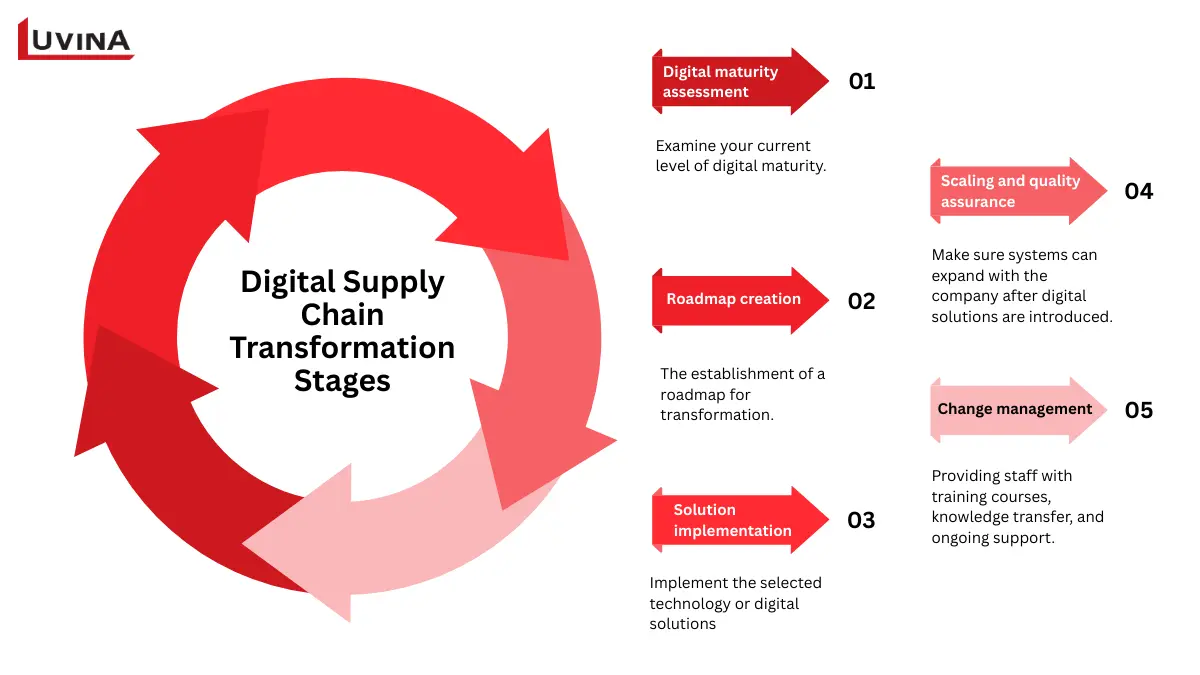
Roadmap for implementing digital supply chain transformation
Step 1: Digital maturity assessment
Supply chains must first be examined for their current level of digital maturity. This means assessing the processes, systems, data infrastructure, and workforce capabilities that are currently in place. Once businesses understand what exists today – their operations and how they operate – they will be able to identify any gaps and establish the highest priority areas for improvement, providing a strong foundation for any digital solutions that will be deployed as they develop and implement a digital supply chain transformation initiative to meet their strategic goals.
Companies can use the previously described maturity stages to assess where their organization is currently positioned with respect to digital maturity.
Step 2: Roadmap creation
This stage is the establishment of a roadmap for transformation. A roadmap is developed after determining current levels of maturity and will consist of the technologies, processes, and timeline required to achieve desired results. The roadmap creates alignment between stakeholders, establishes reasonable expectations, and allows for the effective use of resources.
Step 3: Solution implementation
The next element in the digital supply chain transformation is to implement the selected technology or digital solutions, which might include: integrating cloud-based supply chain management systems; employing IoT (Internet of Things) sensors for real-time monitoring; using artificial intelligence (AI)-based analytics; and business process automation of the major operational processes within each organization.
Step 4: Scaling and quality assurance
Companies have to make sure systems can expand with the company after digital solutions are introduced. Constant monitoring and quality control systems support operational reliability and data correctness. Many businesses also coordinate their systems with well-known standards, including ISO 27001, ISO 9001, GDPR, or PCI DSS to improve security and operational control.
Step 5: Change management and knowledge transfer
Successful digital supply chain transformation is equally reliant on both technology and humans. Providing staff with training courses, knowledge transfer, and ongoing support will allow employees to feel comfortable adopting new tools and processes. By developing in-house capabilities, teams will be able to take full advantage of digital systems and continue to improve long-term supply chain performance.
Real-World Examples
Usually, the effects of digital supply chain transformation in companies show in quantifiable gains like quicker planning, improved inventory accuracy, and easier daily activities.
Starbucks – AI-powered inventory management
Starbucks debuted an AI-based inventory counting solution in thousands of North American outlets in 2025. By September 2025, the business hoped to install the system in more than 11,000 company-owned locations. Reports indicate that the new technology boosted inventory counting capacity eight times, therefore enabling store crews to cut manual labor and keep more precise stock levels.
Dell Technologies and Lowe’s – Computer vision and advanced analytics
Dell Technologies partnered with Lowe’s to update supply chain operations at more than 1,700 Lowe’s outlets. Enhancement of inventory management and computer vision employing sophisticated analytics built on Dell infrastructure were the aims of the digital supply chain transformation project. Reducing shrinkage, improving stock accuracy, and providing store personnel more time to concentrate on customer service were all targets.
SAP – Connected supply chain planning
SAP keeps creating supply chain management systems that enable more linked and speedier planning methods. Its solutions highlight a harmonized data model and unified scene simulation, enabling companies to coordinate sales and operations planning and swiftly react to shifting circumstances.
FAQ
1. What is the difference between supply chain digitization and digital transformation?
Supply chain digitization focuses on converting manual processes and paper-based data into digital formats, while digital transformation redesigns the entire supply chain using connected technologies, automation, and data-driven decision-making.
2. What technologies are used in digital supply chain transformation?
Key technologies include artificial intelligence, predictive analytics, Internet of Things (IoT), cloud platforms, blockchain, and digital twins.
3. What are the biggest challenges in supply chain digital transformation?
Common challenges include integrating legacy systems, ensuring data quality, managing organizational resistance, securing sufficient investment, and addressing cybersecurity risks.
4. How long does a supply chain digital transformation take?
The timeline varies by organization but typically takes several months to multiple years, depending on complexity, scale, and digital maturity.
5. What is a digital supply chain maturity model?
A digital supply chain maturity model is a framework that helps organizations assess their progress from fragmented systems to fully connected, intelligent, and autonomous supply chain operations.
Conclusion
Adopt digital supply chain transformation if your company wants to be competitive, agile, and resilient in today’s rapid-paced world. Using artificial intelligence, Internet of Things, cloud solutions, and sophisticated analytics, businesses may increase visibility, streamline activities, and make data-driven decisions while cutting expenses and hazards.
Contact Luvina right now for professional advice on carrying out digital supply chain change and start creating a more intelligent and more reactive supply chain.
Resources
- https://innovecs.com/blog/digital-supply-chain-transformation/
- https://www.planview.com/resources/articles/navigating-the-digital-supply-chain-revolution
READY TO START A PROJECT?
Our experts are eager to explore your needs.


Read More From Us?
Sign up for our newsletter
Read More From Us?
Sign up for our newsletter