




Digital Transformation for Government: How to Succeed


Digital transformation for government often begins with a simple frustration: a citizen trying to complete a basic task online… and giving up halfway. Not because the service doesn’t exist, but because it’s slow, confusing, or still stuck in an offline-first mindset. In an era where people can open a bank account or order essentials in minutes, this gap in public services is no longer acceptable.
The scale of the problem is hard to ignore. According to the State of Digital Government Review, 47% of government services still remain non-digitized, while 25% of them still seem “outdated.” These statistics show a system fighting to meet current expectations.
Digital transformation for government focuses on modernizing public services, improving efficiency, and delivering better citizen experiences through digital technologies.
This article explores how governments can successfully implement digital transformation to deliver efficient, transparent, and citizen-centric services.
What Is Digital Transformation for Government?
Digital transformation for government is the strategic redesign of public services, operations, and citizen interactions using digital technologies to improve efficiency, transparency, and accessibility.
Understanding digital transformation government clearly requires differentiation of it from 2 frequently mistaken terms:
Digitization: Converting physical information into digital formats
Digitalization: Using digital tools to improve existing processes
* Digital transformation: Redesigning end-to-end services and operations
And then, here comes the digital transformation in government (a.k.a E-Government) – A much broader and deeper shift, involving redesigning entire workflows and services.
Why Digital Transformation in the Public Sector Is No Longer Optional
The growing demands of citizens on government and their performance require a more effective digital transformation strategy than what was used previously. Digital transformation in the public sector is becoming essential due to several key drivers:
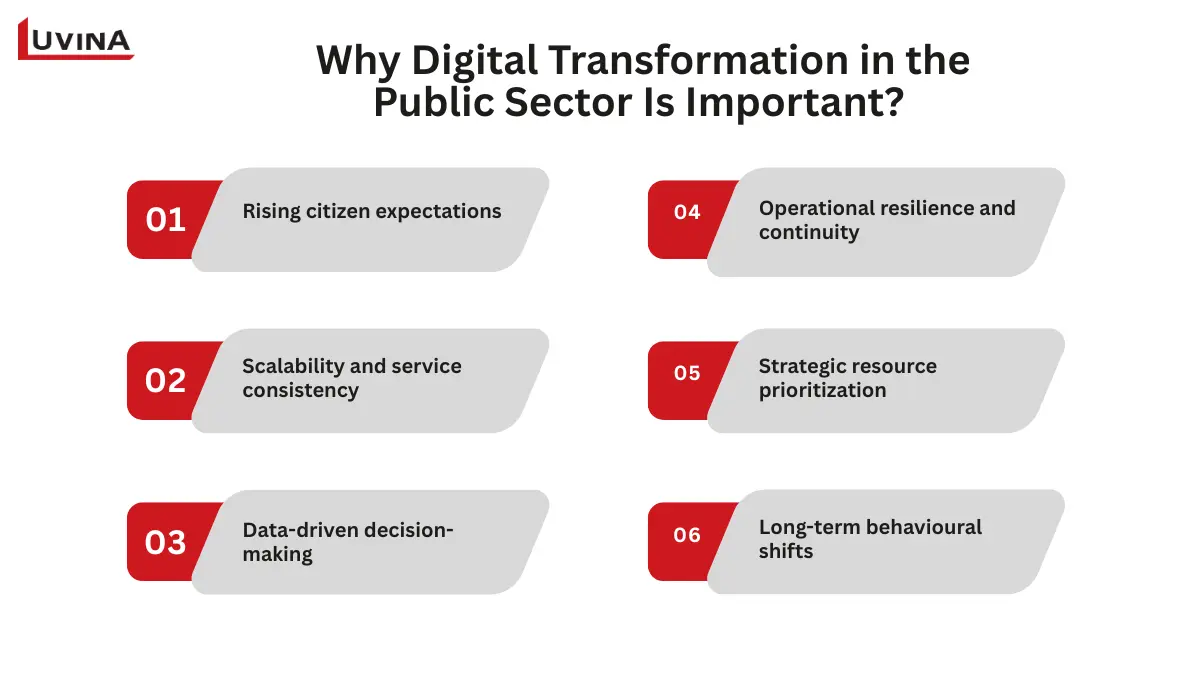
Drivers of digital transformation for government
– Rising citizen expectations: Citizens (and businesses) have high expectations for effortless and fast digital interactions with government services via multiple platforms (websites and applications), providing secure access to information for citizens to utilize.
– Scalability and service consistency: Governments support a large volume of customers through their many government services while managing vast amounts of information; with today’s technological advances, scaling service delivery becomes almost impossible unless there is modern technology to allow it.
– Data-driven decision-making: Digital transformation for government with tools allows real-time data to support superior decision-making, hence driving data-driven decision-making.
– Operational resilience and continuity: Keeping government operations running depends on remote work, automation, and digital service delivery nowadays.
– Strategic resource prioritization: Governments have to rethink how they distribute funds by concentrating on important digital projects. This covers phased-out low-value projects, solving system flaws, and scaling long-run solutions.
– Long-term behavioural shifts: Expectations of companies as well as citizens are changing toward more aggressive, forecasting services. Digital transformation for government lets organizations adjust to these developments and offer more sensitive, future-ready public services.
Key Benefits of Government Digital Transformation
Digital transformation for government delivers value across efficiency, citizen experience, transparency, and cost optimization.
The main advantages of this change include:
Improved efficiency and operational speed
Digital technology allows us all to synchronize the data we use into a single source of truth, making it much easier to access, update, manage and analyze data that is automatically generated by digital workflows. An automated process will also produce less human error through processes such as data entry and make workers more productive because they can spend more time on tasks requiring higher levels of intelligence and/or skills. Overall, organizations delivering public services are able to provide services to their customers faster and more efficiently.
Better citizen services and engagement
Digital technology and digital transformation allow the delivery of improved services to citizens. Online portals, mobile access and guided workflows will provide a better way for citizens to access government services and interact with government agencies. Like the impact of digital transformation on education, this change will require a combination of technology and organisational change to ensure the organisations can better serve their customers.
Enhanced transparency and accountability
A large portion of what we do is held in a digital system, making the information more available to be shared and viewed than ever before. By allowing the public to monitor their service requests in real-time and giving government agencies the ability to enhance their oversight and accountability to the public, this absolute level of transparency increases trust and builds stronger relationships between institutions and the people they serve.
Cost reduction and resource optimization
When services are migrated online and the processes to deliver these services are automated, governments can greatly reduce their operational costs. The use of automated processes and workflows will decrease errors, increase the efficiency of resources and provide more precise and predictable budgets. Lastly, the use of cloud services will allow for the flexibility of scaling resources as needed. As a result, governments will be able to create more accurate budgets and have an overall increased level of efficiency in their operations and budget processes.
Scalability and resilience across sectors
Modern digital infrastructure will allow governments to meet their growing service demands while maintaining the quality of their services. This is especially relevant for the critical aspect of digital transformation in healthcare, as having timely access to data and services influences the outcomes of patients. Overall, digital transformation in the public sector creates more resilient and flexible operations.
Long-term value and innovation
In addition to providing immediate benefits, digital transformation for government provides a platform for ongoing and continuous innovation. Because of that, the government can develop new service offerings and use new technologies as well as better meet the long-term changes in the way that citizens behave and what they expect from government.
Core Technologies Driving Digital Government Transformation
Choosing the appropriate technology is really important for a successful digital transformation for government. Below is the table that highlights the main technologies propelling the digital transformation of government:
| Technology | Role in government transformation |
| Artificial intelligence (AI) and automation | Automates routine operations, examines big datasets, and offers workflow suggestions to help to boost efficiency and minimize human mistakes. |
| Cloud infrastructure and multi-cloud strategy | Offers hybrid cloud solutions as well as scalable, adaptable computing resources. Link on-site IT with internet services for effortless citizen access. |
| Data analytics and open data | Allows transparent, educated public policies and evidence-based decision-making by means of the capture and interpretation of great volumes of data. |
| Cybersecurity and zero-trust architecture | Encryption, firewalls, and intrusion detection help to protect sensitive government and citizen information, therefore averting breaches and upholding confidence. |
Digital transformation cannot happen without technology
Challenges of Digital Transformation in Government (and solutions)
For the government, putting a digital transformation strategy into action is a difficult voyage. Despite its benefits, digital transformation in government faces several structural and operational challenges.
Common problems, their effects, and suggested remedies are shown in the table:
| Challenge | Impact | Solution |
| Legacy system complexity | Modern technologies are blocked by outdated systems, which also raise maintenance expenses and delay digital transformation for government programs. | Plan phased updates, replace mismatched systems, and invest in scalable, interoperable infrastructure. |
| Budget constraints and procurement rules | Limited financing restricts investment in personnel development, infrastructure, and digital technologies. | High-value projects should come first; use cloud solutions for cost efficiency; and coordinate projects with strategic objectives. |
| Resistance to change (employees and citizens) | Resistance to embracing new technology slows implementation and lowers adoption numbers. | Give strong leadership, training courses, and open communication to help cultural change. |
| Digital skills gap | Lack of knowledge in cybersecurity, analytics, cloud, and digital design restricts program success and the progress of digital transformation in the public sector. | Create talent programs, collaborate with technologists, and upskill current staff. |
| Cybersecurity risks | Other cyber dangers, ransomware and breaches, could expose sensitive citizen information. | Apply strong encryption, access restrictions, continuous monitoring, and security systems. |
Challenges in the transformation process can be addressed
How to Build a Digital Transformation Strategy for Government
Modernizing public services, raising efficiency, and satisfying citizen expectations call for the development and management of an effective digital transformation roadmap
A structured approach is critical. Most governments follow a five-step roadmap to implement digital transformation successfully:
Step 1: Assess the current state
Begin by assessing the digital maturity of government organizations and current systems. Determine strengths, flaws, technical gaps, and ways to improve user experiences. This first evaluation guides priority in where to concentrate first and guarantees that digital transformation for government initiatives satisfies the most important needs without interfering with service delivery.
Step 2: Define a vision aligned to public value
Create a distinct vision reflecting the expected results for the community and its residents. This perspective should direct every project, guaranteeing that technology investments result in real advantages, including speedier services, more accessibility, and greater transparency.
Step 3: Prioritize high-impact use cases
Not every project provides the same worth. Find initiatives with the best possible effect on cost savings, citizen happiness, or efficiency. For instance:
– Digital identity and authentication systems
– Online licensing and permit platforms
– Predictive public health monitoring
– Smart transportation management
– Automated citizen support portals
Giving these use cases top priority guarantees that digital transformation for government projects produces quick, obvious results.
Step 4: Build capabilities and partner strategically
To advance the plan, invest in the appropriate skills, resources, and alliances. This could entail bringing in experts, training employees, or working with technology companies to execute sophisticated ideas. Strong capacity and strategic alliances make it more probable for good results.
Step 5: Measure progress with clear KPIs
To measure the effectiveness of your digital transformation for government initiatives, establish KPIs to help you determine if you’re experiencing success, find issues early on, and to help you make data-driven adjustments. Measuring your initiatives regularly will ensure that your initiatives continue to align with your strategy and that your digital transformation for government initiatives will provide long-term value.
Real-World Examples
Countries globally are demonstrating how governments can have a significant impact through digital transformation for government projects that drive efficiency, transparency, and citizen participation. In many instances, these public sector digital transformation examples will reinvent public service delivery and set new global standards for excellence.
The following examples highlight how leading countries are implementing digital transformation in government at scale:
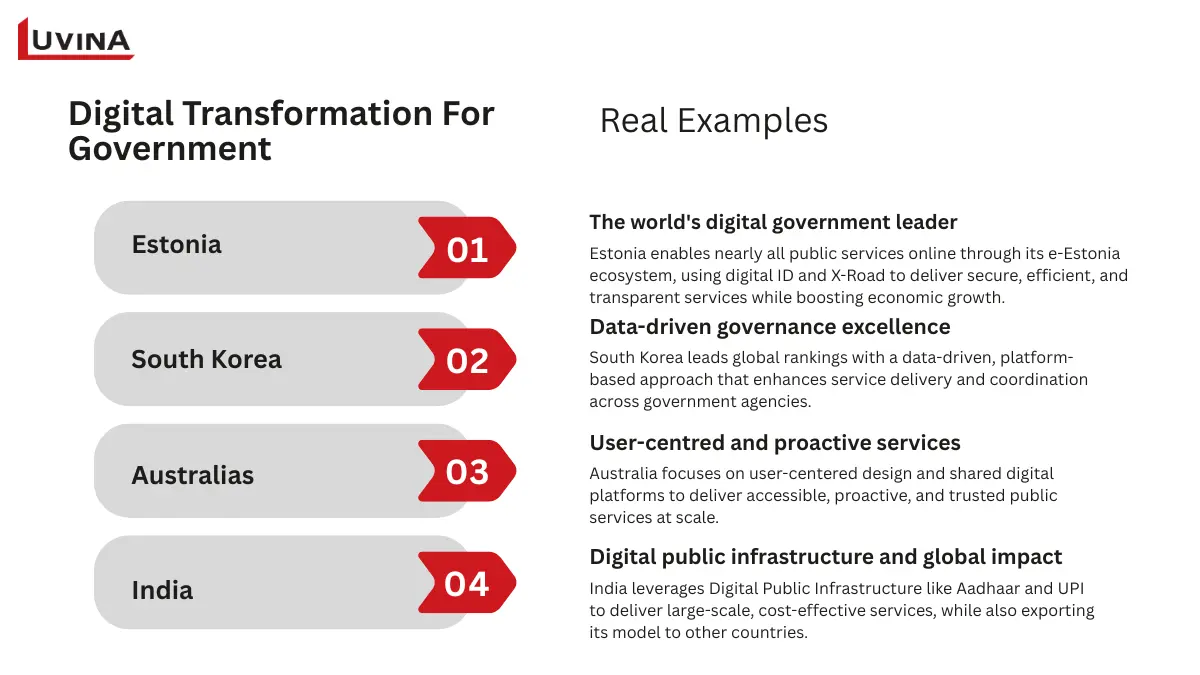
Digital government transformation is being led by many major countries
Estonia: The world’s digital government leader
Through its e-Estonia platform, Estonia has emerged as a global leader in digital transformation for government, providing practically all public services online. Secure access to voting, healthcare, taxes, and company management is provided via digital ID cards. Secure data sharing over agencies made possible by the X-Road platform enhances transparency, lowers administrative obstacles, and promotes economic development by way of projects including e-Residency. By lowering paper use and needless travel, Estonia’s digital economy also aids in environmental sustainability.
South Korea: Data-driven governance excellence
With a score of 0.935/1, South Korea tops the OECD Digital Government Index, therefore emphasizing its devotion to digital transformation for government. Data governance, open data sharing, and the development of digital platforms enabling public sector organisations to run effectively and address citizen needs come first in the country.
Australia: User-centred and proactive services
Australia has achieved a second-place ranking in the OECD 2025 Digital Government Index, which shows the continued investment in governance, shared digital platforms, and user-centric services. Australia’s government has established myGov and has implemented a Data and Digital Strategy as part of its overall digital transformation strategy. These strategic investments in digital transformation have laid the foundation for the delivery of digital government service to its citizens in the context of promoting trust and accountability, improving user experience, and enhancing the accessibility, usability and proactive utilisation of AI digital transformation for government.
India: Digital public infrastructure and global impact
Large-scale digital service distribution is shown by India’s ambitious digital governance model based on Aadhaar (biometric ID), UPI (payments), and CoWIN (vaccine certification). While these systems let governments monitor and make data-driven decisions, they also offer people easy, effective services. Originally developed in India, the Digital Public Infrastructure (DPI) approach is now being shared with other nations as it provides a scalable paradigm for developing economies; however, it raises issues of inclusion, privacy, and governance in various institutional settings.
The Role of Technology Partners in Government Transformation
Selecting the right technology partner is very important in any digital transformation for government. A powerful partner guarantees regulatory compliance, offers knowledge, and supports agencies in modernizing IT effectively.
– Bridging technical expertise with government needs: Partners assist companies in implementing cloud solutions, automating processes, improving cybersecurity, and integrating legacy systems while guaranteeing compliance with public sector rules.
– Prioritizing people and process: Strong partners give equal importance to citizens and government employees, creating systems meant to improve usability, lower mistakes, and simplify service delivery.
– Strategic advisory and measurable outcomes: Outstanding technology partners lead custom application development, cloud migration, and infrastructure planning via strategic advisory.
Technology partners play a critical role in enabling successful government transformation by providing expertise in system integration, cloud adoption, and secure digital infrastructure.
Luvina supports public sector organizations with end-to-end consulting and implementation services, helping modernize systems while ensuring compliance and operational continuity.
FAQ
1. What are the key challenges of digital transformation in the public sector?
Limited budgets, legacy systems, a lack of digital skills, resistance to change, complex leadership structures, and fragmented communication across departments can hinder digital government transformation.
2. How does digital transformation improve government services?
It streamlines processes, reduces paperwork, enhances citizen access, increases transparency, and enables faster, data-driven decision-making.
3. What technologies are driving digital government transformation?
Key technologies include AI-powered solutions, automation tools, cloud platforms, data analytics, and queue management systems.
4. What are examples of successful digital government transformation?
Estonia’s e-Estonia platform, South Korea’s data-driven governance, Australia’s myGov and Digital Strategy, and India’s Aadhaar, UPI, and CoWIN systems.
Conclusion
Adopt diDigital transformation for government is no longer optional; it is essential for delivering efficient, transparent, and citizen-centric services.
Organizations that adopt a structured, technology-driven approach are better positioned to meet rising expectations and future challenges.
Contact Luvina to build a scalable and secure digital transformation roadmap for your public sector organization.
Resources
- https://www.salesforce.com/ap/blog/digital-transformation-in-government/
- https://www.coursera.org/enterprise/articles/government-digital-transformation
- https://www.gartner.com/en/industries/government-public-sector/topics/digital-government
- https://www.salesforce.com/government/digital-transformation/
- https://www.dta.gov.au/articles/australia-rises-second-globally-oecd-digital-government-index
- https://mjmsear.com/south-korea-has-topped-the-oecd-digital-government-index-for-the-second-time/
- https://www.techpolicy.press/indias-digital-infrastructure-is-going-global-what-kind-of-power-is-it-building/
READY TO START A PROJECT?
Our experts are eager to explore your needs.


Read More From Us?
Sign up for our newsletter
Read More From Us?
Sign up for our newsletter