




Digital Transformation Risks: Types and Management Guide


Digital transformation promises speed, innovation, and competitive advantage, but it also introduces hidden risks that can derail entire initiatives.
While organizations rush to adopt new technologies and redesign operations, many overlook a critical question: what could go wrong?
“Why most transformations fail” (2021) – McKinsey & Company’s often referenced study showed that around 70% of digital transformation projects failed, mostly because of poorly handled risks. This number emphasizes a bitter reality: successful digital transformation requires not only speed and innovation, but also strong risk management and strategic control.
This article explores the most common digital transformation risks and provides a practical framework to help organizations identify, prioritize, and mitigate them effectively.
Key Challenges of Digital Transformation
Before understanding digital transformation risks, it is important to recognize the most common challenges organizations face during transformation.
Despite its benefits, organizations still face several challenges of digital transformation that can slow down progress if not addressed properly. The most common issues include:
– Security risks: As systems become more connected, cyberattacks are easier to execute while harder to defend against. Even a small vulnerability can expose the entire network.
– Legacy integration issues: Many organizations struggle to connect new technologies with outdated systems, leading to data silos, incompatibility, and wasted investment.
– Talent and cultural gaps: A lack of skilled professionals, combined with misalignment between leadership and employees, can reduce adoption and slow transformation efforts.
These challenges not only impact performance but also contribute to broader digital transformation risks, which will be explored in the next section.
What Are Digital Transformation Risks?
Digital transformation risks refer to the potential challenges and uncertainties that arise when organizations adopt new technologies, modernize systems, and redesign business processes.
Usually present during the change path, these hazards come especially when companies move too quickly without a clearly defined digital transformation strategy.
These risks are closely linked to technology adoption, operational efficiency, organizational change, and data security.
Without proper controls, organizations may face compliance issues, operational disruptions, and increased cybersecurity exposure.
Categorizing Digital Transformation Risks
Digital transformation risks typically fall into three main categories: strategic, technical, and organizational. Each category impacts a different aspect of the organization.
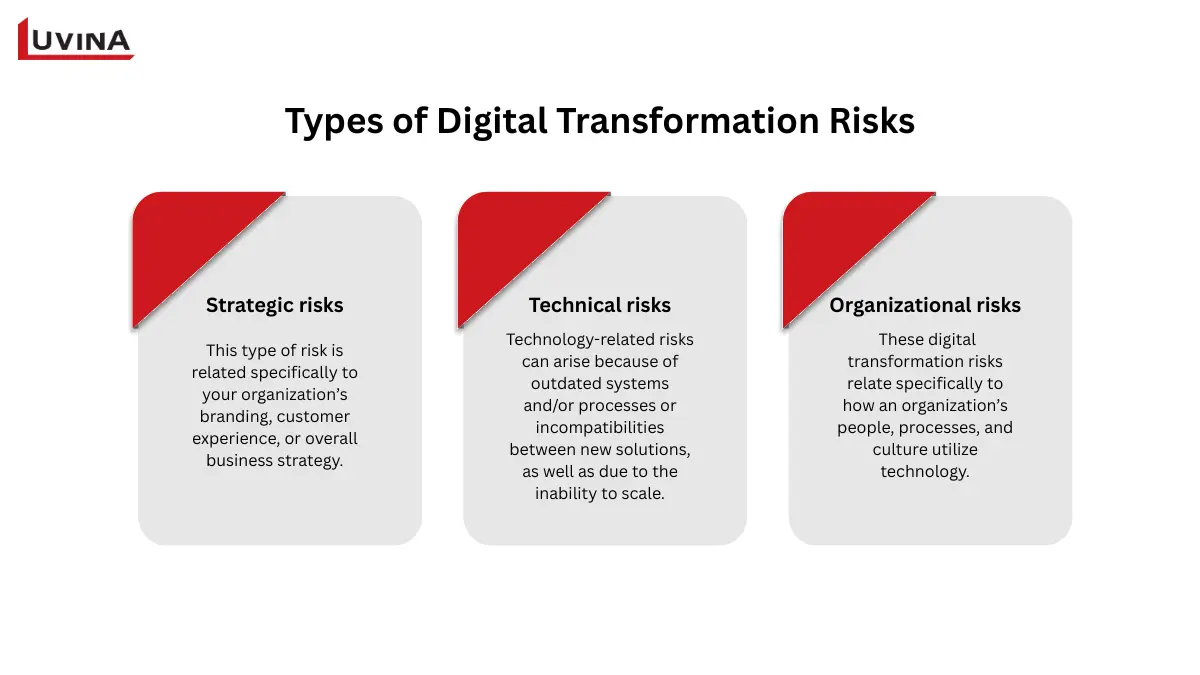
Each type of digital transformation risk impacts a different aspect of the business
– Strategic risks: This type of risk is related specifically to your organization’s branding, customer experience, or overall business strategy. While RPA might enhance efficiency, implementing RPA may also alter the way in which customers engage with your organization, thereby impacting their perception and trust in your organization.
– Technical risks: Technology-related risks can arise because of outdated systems and/or processes or incompatibilities between new solutions, as well as due to the inability to scale. Technical risks are typically related to operational continuity and reliability.
– Organizational risks: These digital transformation risks relate specifically to how an organization’s people, processes, and culture utilize technology. Misconfiguration of systems, lack of employee training, and/or events such as cyberattacks or server outages may disrupt an organization’s operation(s), supply chain(s), and/or service delivery.
Strategic Risks in Digital Transformation
Strategic-level digital transformation risk can happen when technology initiatives aren’t aligned with business goals. Misalignment may lead to wasted resources, missed opportunities, and project failure. Some major risks are:
| Risk | Description | Impact |
| Lack of clear strategy and alignment | Digital transformation is viewed as an IT project as opposed to an organization-wide initiative. | Solutions may not address real business needs, thus wasting time and effort. |
| Scope creep and budget overruns | Projects grow without well-defined priorities, therefore exposing a regular challenge of digital transformation. | Costs grow while timelines lapse and projects lose focus. |
| Regulatory and compliance exposure | Neglecting implementation rules in the industry. | Non-compliance can lead to fines and lost reputation. |
Some common strategic risks
Technical Risks in Digital Transformation
A significant source of digital transformation risks, technical problems might impede progress, compromise data, and disturb operations. Key technical risks are given here:
| Risk | Description | Impact |
| Cybersecurity and data breaches | New techniques can leave companies vulnerable to cyberattacks and sensitive data loss, therefore posing a frequent digital transformation barrier. | Operational interruption, financial losses, reputational damage, and loss of sensitive data are all possible outcomes. |
| Legacy system integration failures | Older, modified systems sometimes clash with current technologies, therefore complicating migration and upgrades. | Operational inefficiency, budget tension, and project delays. |
| AI and emerging technology risks | Failures or erroneous results can come from insufficient data governance, bad-quality inputs, or untested artificial intelligence solutions. | Decision-making mistakes, compliance concerns, and diminished technology trust. |
| Data quality and governance failures | Digital projects suffer from inadequate data governance or low-quality inputs. | Non-compliance, wrong insights, and bad technology adoption. |
How do technical risks impact digital transformation?
Organizational Risks in Digital Transformation
Many digital transformation initiatives fail not because of technology, but because organizations are not prepared to adopt it.
Organizational risks are related to people, processes, and culture, and they often determine whether transformation succeeds or fails.
The following are some of the most common forms of organizational risks in digital transformation:
| Risk | Description | Impact |
| Employee resistance and cultural barriers | Staff may resist adopting new technologies or processes because of fear, misunderstanding, or concern about their job security. | Slower adoption, lower engagement levels, and not achieving the planned outcomes of the project are frequent challenges of digital transformation. |
| Talent and skills gaps | If the organization does not have the needed skills, its project can be delayed and be much more expensive due to the additional costs associated with either hiring or training a resource. | Delayed projects, increased project costs, inadequate implementations, and potential project failure. |
| Vendor and third-party dependency | A high level of dependency on external vendors to provide technologies or services increases the vulnerability of those services. | Service interruptions, loss of control, previously stated delays in delivery, and an increase in risk exposure. |
Organizational risks often stem from people, culture, and processes
Digital Transformation Risk Management: A Practical Framework
To guarantee technological projects provide true corporate value, it’s crucial to properly manage digital transformation risks.
A structured risk management approach is essential. Most successful organizations follow a four-step framework to manage digital transformation risks:
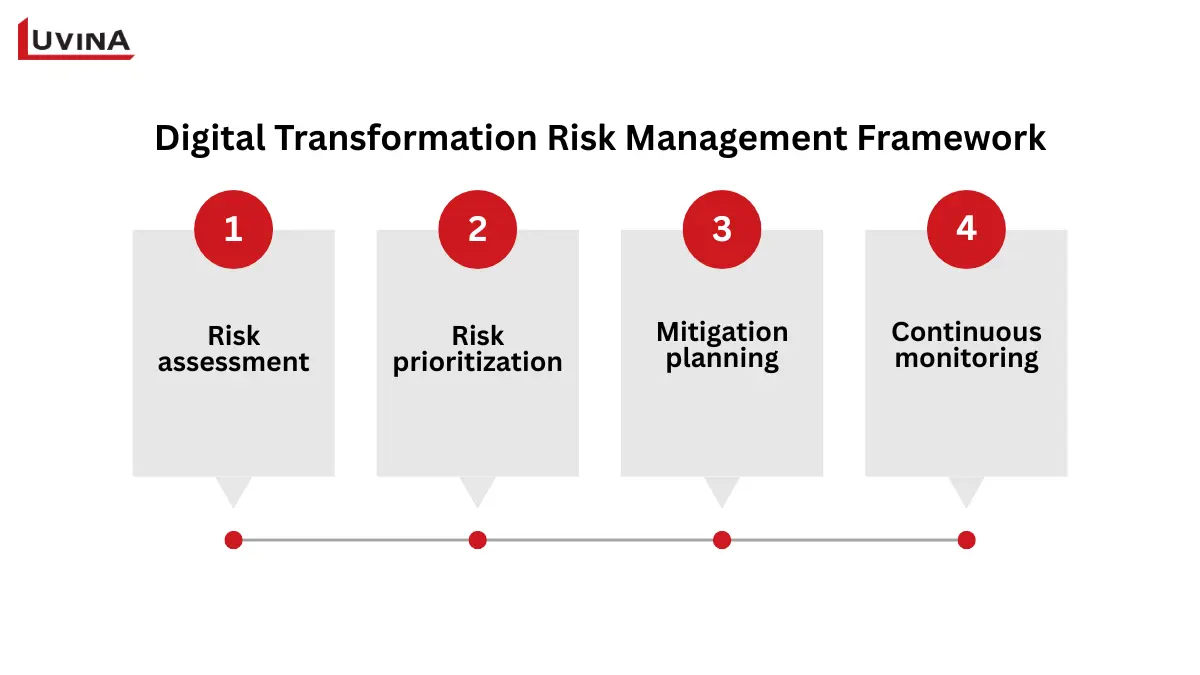
4 steps to control digital transformation risks
Step 1: Risk assessment
Identifying possible weaknesses across the company is the basis of digital transformation risk management. Companies should take into account several sources of risk, including market, financial, technical, human, and process-related problems.
Important factors include:
– Market risk: Delays or failures in providing fresh digital products can harm reputation, lower sales, and undermine competitive position.
– Financial risk: Large projects may exceed budgets or timelines, affecting ROI and placing financial pressure on the company.
– Technology risk: Quick technological change and integration problems with current systems could lead to operational interruptions.
– People risk: Resistance from personnel or subpar training may lower adoption and efficacy.
– Structure/process risk: Failures to change current processes and workflows for new systems can cause mistakes and waste.
Organizations should map processes, identify dependencies, and review system architecture to detect potential integration, scalability, and security risks.
Step 2: Risk prioritization
Once risks are identified, organizations must evaluate their likelihood and impact to prioritize mitigation efforts. These are some methods for determining which digital transformation risks have to be a top priority:
– Quantitative assessments: Scoring depending on the probability and seriousness of each risk guarantees that resources first address the most important dangers.
– Scenario planning: By investigating various potential results, scenario planning enables them to predict interrelated risks and develop all-encompassing reactions.
– Risk heat mapping: Giving a visual depiction of corporate exposure helps to clarify communication and drive wise decision-making by means of risk heat mapping.
Step 3: Mitigation planning
After identifying digital transformation risks and establishing priorities, mitigation planning should follow to ensure the identified risks are effectively managed. There are several options available to implement technical solutions, which may include a phase-in of new systems (i.e., a gradual implementation), implementing backup/recovery plans for business continuity, and implementing additional security solutions to protect against cyber threats.
It is equally important to implement non-technical solutions by developing a structured change management plan to help employees transition to new ways of working, to decrease employee resistance, and to increase employee adoption. Additionally, implementing structured vendor control will limit dependency risk, and governance will provide the necessary oversight to ensure initiatives remain aligned with the strategic direction of the business.
Step 4: Continuous monitoring
Continuous monitoring ensures that risks remain under control throughout the transformation lifecycle.
Organizations should regularly review risk controls, gather stakeholder feedback, and adjust strategies based on performance and industry best practices.
Ongoing supervision also allows companies to react quickly to problems, reduce interruptions, and stay on track with their strategic goals, thus reducing the digital transformation risk of the company overall and providing long-term benefits from their digital investments.
Expert insight:
The biggest risk in digital transformation is not technology failure, but misalignment between business strategy, execution, and people.
Industry-Specific Risk Considerations
Digital transformation risks vary significantly across industries due to differences in systems, regulations, and customer expectations.
The following is a list of important industry-specific dangers and real approaches to handling them.
BFSI
Financial organizations typically have distinct digital transformation risks stemming from old infrastructure, stringent regulatory requirements, and highly sensitive consumer information.
| Challenge | Description | Solution |
| Legacy system integration | Many banks still operate on ancient mainframes, which introduces delays and breakdowns when introducing new platforms. | Improve infrastructure progressively using API-first design and clean data models. |
| Data privacy and compliance | Exposure to GDPR, CCPA, and AI Act penalties rises with cloud migrations and AI adoption. | To provide end-to-end visibility, implement federated data governance. |
| Cultural resistance | Multiple, overlapping digital campaigns present challenges for employees and cause transformation fatigue. | Celebrate little victories; frame change as empowerment; communicate early. |
| Regulatory pressure | Adoption of artificial intelligence calls for openness, equity, and auditability across decisions. | Set up boards for artificial intelligence ethics and record responsibility. |
| Technical debt | Integration, workflows, and collected code slow advancement. | Overcome the challenges of digital transformation by tracking, lowering, and rewarding technical debt prevention. |
BFSI faces unique challenges in digital transformation
>> Read more: digital transformation for government
Manufacturing
For manufacturing, the need to digitize sometimes presents a challenging trade-off between cost, capacity, and operational continuity. Many companies run into digital transformation risks as they attempt to modernize without upsetting output or overstretching assets.
| Challenge | Description | Solution |
| High upfront costs | Capital for sophisticated technologies might be difficult for smaller companies. | Control expenses using modular cloud solutions and stepwise investments. |
| Skill gaps | Trained staff is needed for AI, IoT, digital twins, and 3D modeling. | Design upskilling and training initiatives to address skill shortages. |
| IT challenges | Maintaining security, ensuring data integrity, and connecting old systems to cloud platforms. | Include cloud adoption, process mapping, and safe IT architecture planning. |
| Cultural shift | Interactive screens, tablets, and human-machine interfaces call for instruction for manual operators. | Encourage adoption by means of efficient workflow redefinition and open communication. |
| Data security | Cyberattacks expose connected devices and IoT gadgets. | Establish stringent cybersecurity rules, ongoing surveillance, and network security procedures. |
The challenges in manufacturing digital transformation can be addressed
Digital Transformation Risks in Healthcare
System changes in the healthcare industry can be vital; dealing with the barriers to the digital transformation of healthcare must be considered through the lens of patient safety, data protection, and system reliability at each point in time.
| Challenge | Description | Solution |
| Cyberattacks and data breaches | Sensitive, private patient data is an excellent target. | Implement encryption, firewalls, intrusion detection systems (IDS), and antivirus software. |
| Slow law vs fast tech | Rapid innovation may exceed the regulatory approval rate for new technology. | Train staff on cybersecurity and digital hygiene. |
| System outages | A malfunctioning system will disrupt patient care, lead to delayed treatment, and/or delay accurate diagnoses. | Regularly maintain and monitor systems and install backup systems and infrastructure. |
| Unauthorized access | Weak access controls and poor password management can lead to a greater probability of unauthorized access. | Create strong access control, require multi-factor authentication, and role-based access. |
| HIPAA and compliance violations | Failure to follow HIPAA rules can lead to significant financial, legal, and reputational damages to the healthcare organization. | Regular audit of compliance and file reports to the appropriate regulatory agencies. |
Healthcare is one of the industries with the most challenges of digital transformation
eCommerce
Speed and scalability propel expansion in e-commerce, yet they also expose one to digital transformation risks. Companies need to negotiate growing complexity in security, compliance, and brand trust as digital transformation in retail speeds across channels and consumer touchpoints.
| Challenge | Description | Solution |
| Security risks | Customer data is under threat from cyberattacks, ransomware, phishing, and account takeovers. | Make sure your servers are secure; utilize strong passwords, two-factor authentication, and SSL certificates. |
| Fraud | Loss of income might result from phony orders, chargebacks, and identity theft. | Real-time monitoring and leveraging fraud detection systems. |
| Legal risks | GDPR, CCPA, and other rules demand ongoing compliance. | Partner with legal professionals to guarantee compliance and safeguard intellectual property. |
| Reputation risks | Brand dilution, phony goods, and negative reviews all have an impact on trust. | Review monitors, respond quickly, and maintain coherent branding. |
| Dependence on marketplaces | Too much reliance on Amazon or other platforms risks technical failures or policy modifications. | Direct websites and an omnichannel approach let you vary sales channels. |
Challenges and solutions in e-commerce digital transformation
>> Read more: Digital transformation in educational continuity.
FAQ
1. What are the biggest risks of digital transformation?
Common risks include operational disruptions, cybersecurity vulnerabilities, budget overruns, compliance violations, and workforce resistance to change.
2. Why do most digital transformation projects fail?
Most projects fail due to unclear strategy, poor change management, lack of skilled talent, and misalignment between technology and business goals.
3. What is digital transformation risk management?
Digital transformation risk management is the systematic process of identifying, assessing, and mitigating risks associated with organizational technology modernization initiatives.
4. How can companies reduce the risk of digital transformation failure?
Companies can reduce risks by setting clear goals, investing in the right talent, adopting phased implementation, and ensuring strong governance and communication.
5. What are the main barriers to digital transformation?
Legacy systems, limited budgets, skill gaps, organizational resistance, and regulatory constraints are the key barriers.
Conclusion
Adopt diDigital transformation for government is no longer optiDigital transformation risks can determine whether your initiatives succeed or fail. Organizations that take a structured, proactive approach are far more likely to achieve sustainable results.
Luvina provides end-to-end consulting and implementation support to help businesses manage risks and scale transformation effectively.
Contact Luvina to build a secure, scalable, and risk-aware digital transformation strategy tailored to your business.
Resources
- https://www.eiu.com/n/the-three-challenges-of-digital-transformation/
- https://www.cflowapps.com/digital-transformation-risks/
- https://www.iiot-world.com/industrial-iot/connected-industry/managing-the-risks-of-digital-transformation/
- https://www.iiot-world.com/industrial-iot/connected-industry/five-challenges-of-digital-transformation-in-manufacturing/
READY TO START A PROJECT?
Our experts are eager to explore your needs.


Read More From Us?
Sign up for our newsletter
Read More From Us?
Sign up for our newsletter