




Digital Transformation Stages: Frameworks and Implementation Guide


Digital transformation stages describe how organizations move from basic digitization to fully digital-first operations. This guide explains the most common frameworks and execution models used to plan, implement, and scale digital transformation effectively.
Why Digital Transformation Happens in Stages
Digital transformation is not a one-time technology upgrade. It is a structured digital transformation journey where people, processes, and technology evolve together over time. According to Gartner, 87% of senior executives consider digital transformation a top priority, and 91% of organizations are already investing in digital initiatives.
Each stage requires clear goals, suitable frameworks, and disciplined execution to deliver measurable business value.
Common Frameworks for Digital Transformation Stages
A digital transformation framework provides a shared structure for aligning strategy, people, processes, and technology. Without a framework, digital initiatives often become fragmented and fail to scale.
The 5 often-used frameworks listed below provide a practical comparison of how they enable companies to prepare for, carry out, and maintain change across various digital transformation phases.
| Framework | Core focus | Key components | Why does it work in digital process transformation? |
| McKinsey 7S Framework | Organizational alignment | Strategy, structure, systems, shared values, skills, style, staff | Aligns people, culture, and systems |
| Gartner Digital Business Transformation Framework | Business-led transformation | Vision and strategy, customer experience, operating model, technology core, metrics, and value | Connects strategy with measurable outcomes |
| MIT Digital Transformation Framework | Structural and cultural readiness | Organizational structure, data and analytics, technology infrastructure, culture and change | Balances technology and culture change |
| Capgemini Digital Transformation Framework | Assessment-driven transformation | Business process effectiveness, customer experience, employee engagement, and data-driven decisions | Creates clear roadmaps from the current to the target state |
| DXC Technology Digital Transformation Framework | Enterprise operational alignment | Strategy, people, process, technology | Keeps core pillars aligned throughout change |
The 5 often-used frameworks for digital transformation stages
Let’s look at how digital transformation stages are executed via three main models – the 3-stage model, 6-stage model, and 10-step process – in the following paragraphs to better grasp how these frameworks are used over digital transformation processes.
3-Stage Digital Transformation Model
The 3-stage digital transformation model simplifies transformation into three clear phases: digitize, optimize, and transform. It is best suited for organizations starting their digital transformation process.
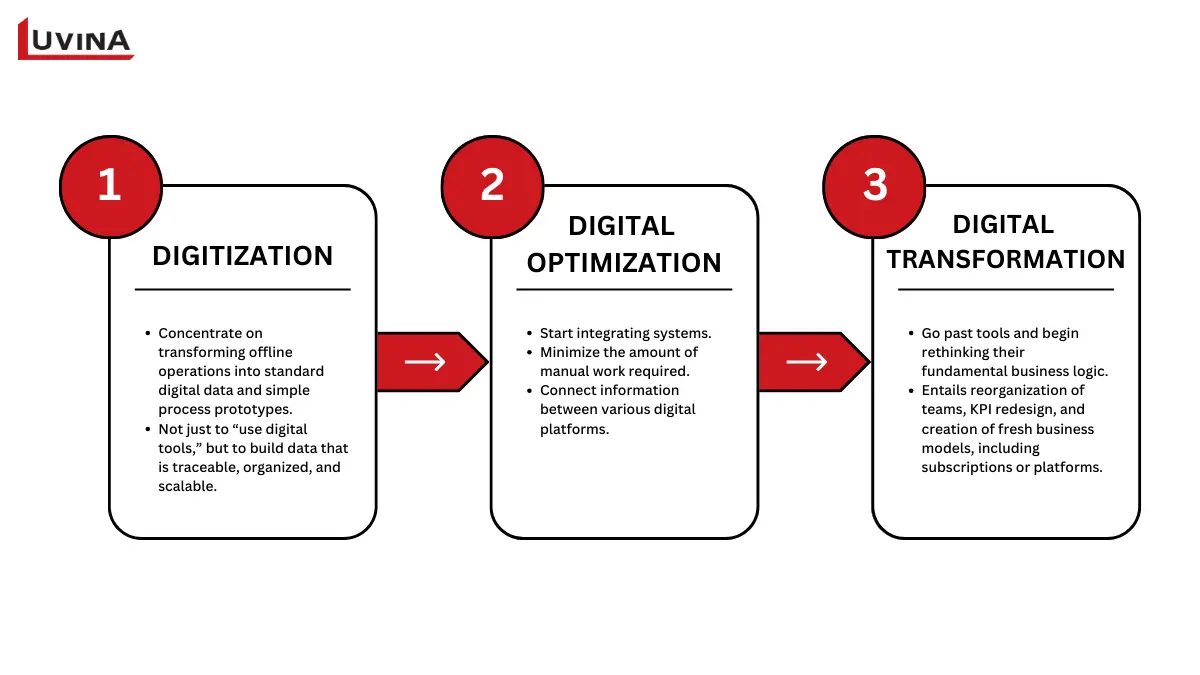
The 3-stage model of digital transformation stages covers digitize, optimize, and transform
1. Digitization – Building the digital foundation
Digitization focuses on converting manual or paper-based processes into structured digital formats. This stage ensures information is standardized, accessible, and ready for further optimization.
Examples: online forms, e-invoices, cloud document storage.
2. Digital optimization – Improving efficiency with tools
Digital optimization enhances efficiency by integrating systems, reducing manual tasks, and enabling real-time visibility across operations. The goal of this stage in the digital transformation stages is to streamline workflows, lower operational costs, and improve customer response times.
Examples: ERP/CRM integration, automated approvals, and real-time dashboards.
3. Digital transformation – Redefining the business model
Digital transformation stages shift the business model toward digital-first operations and innovation, using technology to create new value and long-term competitive advantage. This stage focuses on reimagining offerings, processes, and decision-making.
Examples: data-driven services, subscription models, digital KPIs.
6 Stages of Digital Transformation
The 6-stage model builds on the same foundation as the 3-stage framework of digital transformation stages. Both describe a journey that moves from initial digital adoption to optimization and long-term transformation. These shared digital transformation stages include early digitization, operational improvement, and enterprise-wide reinvention.
However, the 6-stage model of the digital transformation journey adds several intermediate stages. It provides more control for organizations with complex operations or legacy systems.
Key Additional Stages
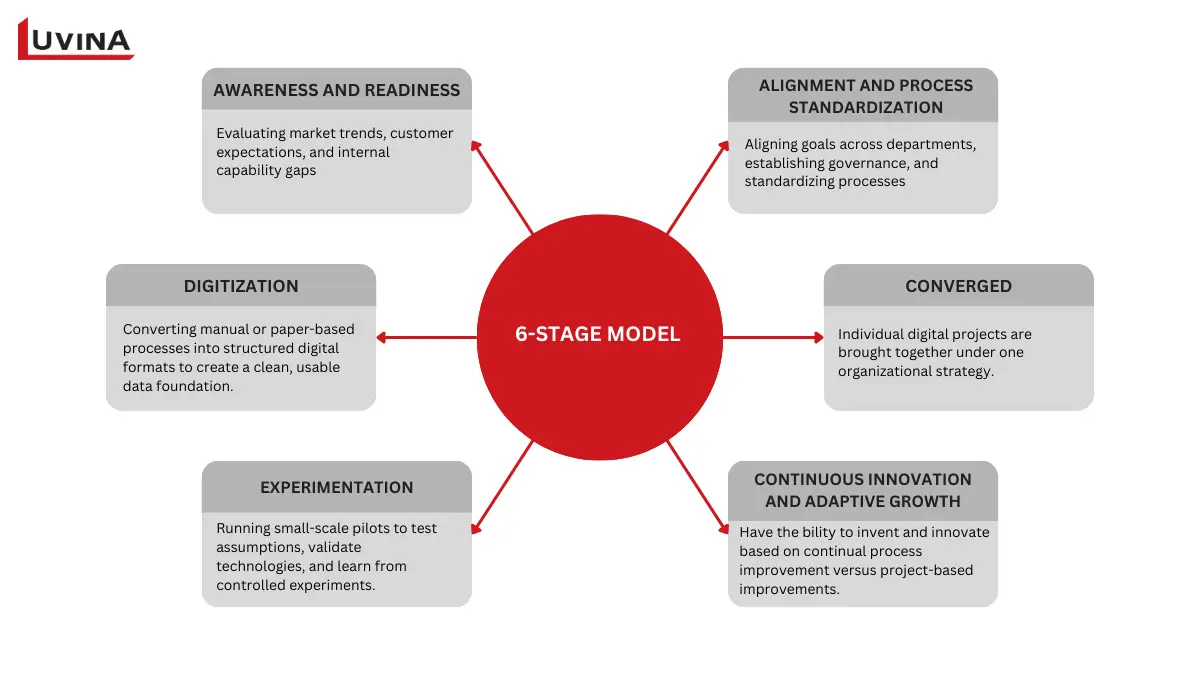
The 6-stage model maps the path from traditional to innovative operations
1. Awareness and digital readiness
This stage comes before Stage 1 (Digitization) of the 3-stage model. It acts as a preparatory layer that the 3-stage model does not explicitly include.
In digital transformation implementation, this stage evaluates market trends, customer expectations, and internal capability gaps. Organizations identify whether they have the skills, infrastructure, and culture needed to begin meaningful digital initiatives. It provides a clearer starting point.
Examples: Digital maturity assessments, technology audits, readiness checklists, leadership alignment workshops.
2. Experimentation
This stage sits between stage 1 (Digitization) and stage 2 (Optimization) of the 3-stage model. Instead of moving straight into optimization, the 6-stage model inserts a structured testing phase.
In digital transformation stages, this is when organizations run small-scale pilots to test assumptions, validate technologies, and learn from controlled experiments. Skills training and capability building occur in parallel to ensure teams can support the next stages.
3. Alignment and process standardization
This stage is placed at the beginning of the optimization phase, but is more detailed than stage 2 of the 3-stage model.
The organization aligns goals across departments, establishes governance, and standardizes processes before optimization fully accelerates. This ensures all teams follow the same direction, reducing duplicated efforts and misalignment.
For example: Process mapping, governance design, cross-department alignment sessions, unified KPI frameworks.
4. Converged
This stage sits between the optimization and transformation phases of the 3-stage model. In this stage of the digital transformation process, digital initiatives that started small are now scaled across the enterprise. Systems converge into shared platforms, data becomes interconnected, and cross-functional workflows mature. This resolves the fragmentation that often prevents organizations from achieving true transformation. It’s a transitional stage that prepares the organization to operate as a digitally integrated entity.
5. Continuous innovation and adaptive growth
This stage expands the 3-stage model’s final transformation phase, turning it into an ongoing cycle rather than a finish line.
Organizations embed innovation into everyday operations. Teams adopt a mindset of continuous experimentation, monitor market shifts, and integrate new technologies as they emerge. This ensures the business remains competitive even as customer expectations and industry standards evolve.
10-Step Process of Digital Transformation Stages
The 10-step digital transformation process breaks down execution into manageable actions across the various digital transformation stages. It helps leaders control risk, speed, and outcomes across digital transformation stages.
This model is especially suitable for large enterprises, regulated industries, and organizations requiring strong leadership oversight.
Core Execution Steps in the 10-Step Digital Transformation Process
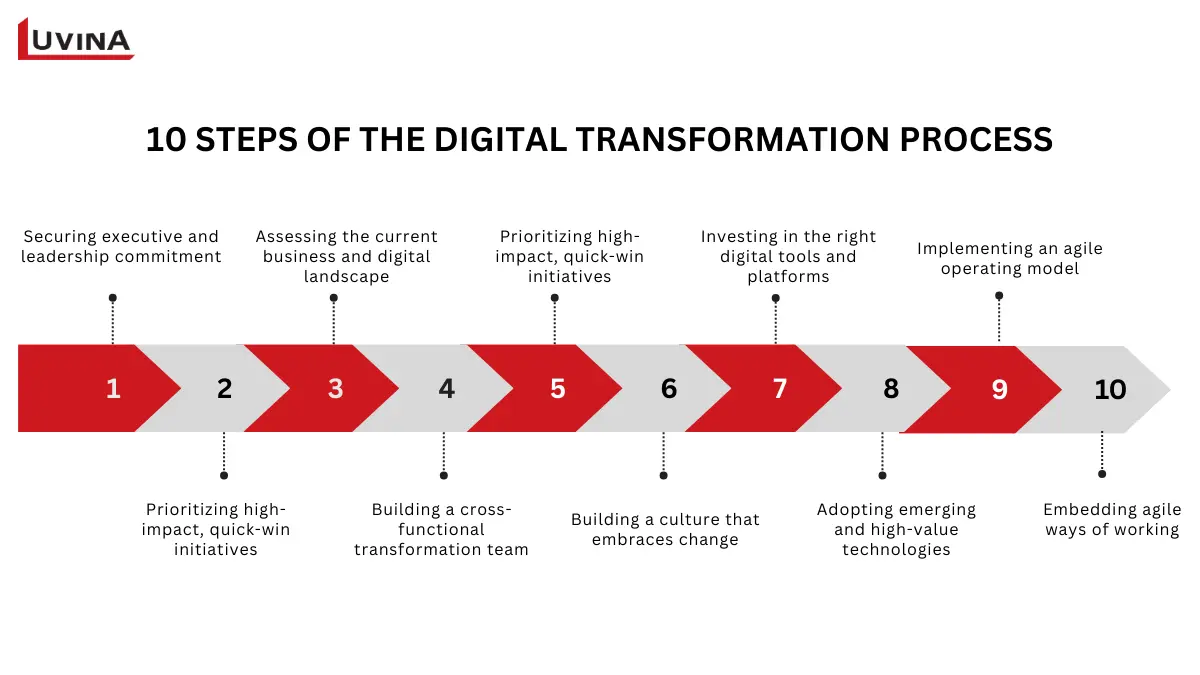
The 10-step process of digital transformation stages defines ten actions for transformation
1. Securing executive and leadership commitment
When the vision for transformation is communicated with clarity by the CEO and other senior leaders, it creates trust, provides clarity, and direction for Teams.
This step involves more than just approving a project. Leaders must actively remove structural barriers, reinforce priorities, and sustain momentum across every digital transformation stage.
2. Defining clear and measurable objectives
Organisations have to create actual, precise, measurable targets that fit with company priorities. Rather than viewing change as a one-time occurrence, these aims ought to serve as milestones so teams may monitor development.
Clear goals reduce uncertainty, limit resistance to change, and strengthen accountability during digital process transformation.
3. Assessing the current business and digital landscape
A structured assessment of systems, processes, and performance defines what is realistically achievable. This step identifies strengths, weaknesses, and improvement opportunities before building a transformation roadmap.
Frameworks such as SWOT, STEEP, or STEEPLE analysis help align strategic decisions with long-term digital transformation goals.
4. Building a cross-functional transformation team
A high-performing transformation team draws together design, business, and technical knowledge. Transformation teams typically include developers, data analysts, UX designers, and agile leaders who connect strategy with implementation. This phase emphasizes building inside capabilities rather than dismantling current systems, therefore enabling more natural progression across digital transformation stages.
5. Prioritizing high-impact, quick-win initiatives
Organizations start with projects that are manageable and provide quick results rather than trying to transform the whole at once. These initial successes support continuous investment and create internal confidence.
Furthermore, quick-win projects set off a beneficial feedback cycle that promotes more general use across the next stages of digital transformation.
6. Building a culture that embraces change
A successful transformation requires employees to understand and accept change from the start. When teams see how new digital systems reduce manual work and simplify daily tasks, resistance decreases, and adoption becomes more natural. Open communication helps employees feel supported and confident during change.
Furthermore, concentrating on creating a strong, forward-looking culture at work is this stage. Investing in contemporary technologies like AI-powered tools and secure cloud solutions helps automate regular chores, boost output, and strengthen alignment across digital transformation stages.
7. Execution and continuous improvement
The final step consolidates execution into a continuous improvement cycle, shifting organizations from pilots to sustainable digital capability.
Key execution focus areas include:
- Digital platforms and enablement tools: Adoption platforms, training systems, workflow automation, and feedback mechanisms
- Advanced technologies: AI, analytics, cloud platforms, and enterprise systems
- Agile operating models: Cross-functional teams, shorter decision cycles, outcome-driven structures
- Agile ways of working: Continuous iteration, rapid feedback, and collaborative problem-solving
By embedding these practices, organizations complete critical digital transformation stages and establish long-term adaptability.
Key Challenges Across Digital Transformation Stages
Across digital transformation stages, businesses run across technical, cultural, and structural obstacles that might delay development or even cause projects to fail. Every step of the digital transformation journey presents these problems differently. The most frequent problems are listed below under a consolidated perspective.
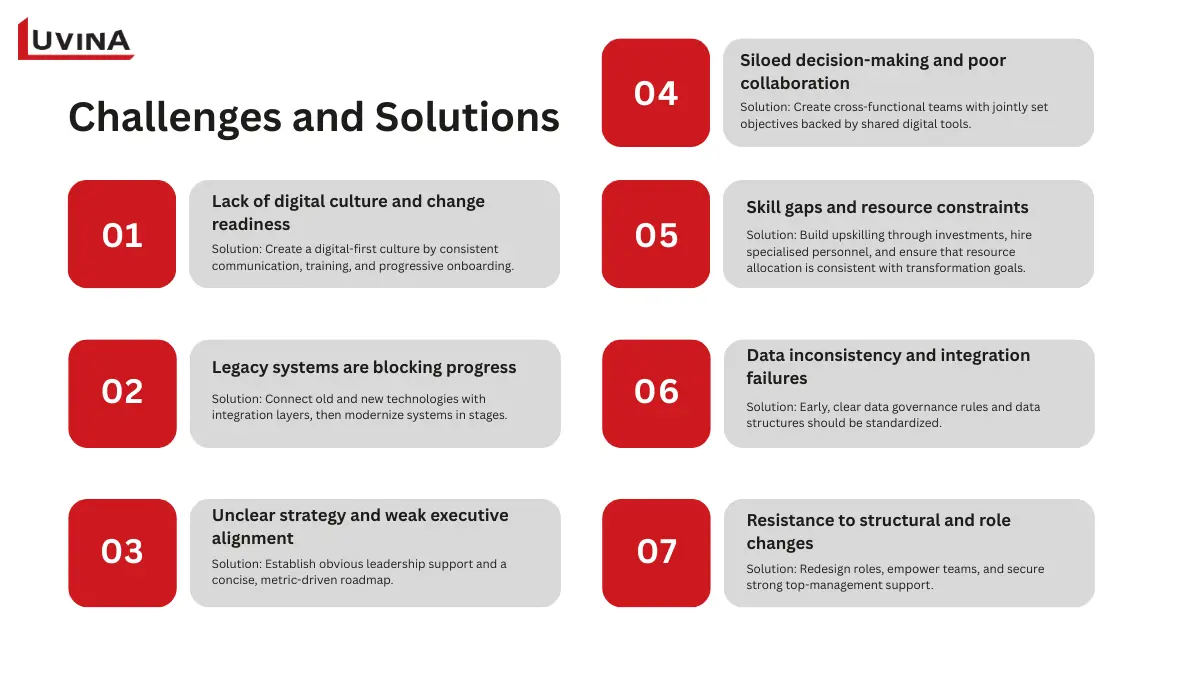
Common challenges include resistance to change, legacy systems, and unclear strategy
1. Lack of digital culture and change readiness
Employees are sometimes unprepared for new tools and processes in early digital transformation stages, which causes change anxiety, decreased engagement, and erratic implementation. Even well-designed projects fail without a common digital mindset because teams keep using ancient habits and hands-on solutions.
Solution: Create a digital-first culture by consistent communication, training, and progressive onboarding.
2. Legacy systems are blocking progress
Lots of companies are experiencing that as they move from basic digitisation to the next step of optimisation, they will run into roadblocks with their older technology (i.e., legacy systems). Many of these older systems are demanding a lot of time and attention to maintain; they lack flexibility and are often very expensive to maintain.
Most importantly, they create security risks for the organisation, produce inaccurate information, and create issues with integrating systems. This usually causes duplicated processes and delayed transformation results across digital transformation stages.
Solution: Connect old and new technologies with integration layers, then modernize systems in stages.
3. Unclear strategy and weak executive alignment
Teams get confused regarding priorities without a well-defined scope. Various divisions could interpret transformational objectives differently, therefore creating misaligned projects. As projects lose direction and authority, a dearth of executive buy-in also undermines development.
Solution: Establish obvious leadership support and a concise, metric-driven roadmap.
4. Siloed decision-making and poor collaboration
Mid-to-late digital transformation stages often show organizational silos. Teams make separate decisions, work alone, and safeguard their own objectives instead of concentrating on overall results. This causes repeated labor, slows invention, and interrupts data flow across divisions and systems.
Solution: Create cross-functional teams with jointly set objectives backed by shared digital tools.
5. Skill gaps and resource constraints
In many cases, during periods of accelerating change, it is common for some organizations to discover the reality of insufficient internal capabilities, budget limitations, and a lack of sufficient time to drive growth/ achieve scale. The results of poor resource planning can include overdue projects, overstressed resources, and unsatisfactory performance levels.
Solution: Build upskilling through investments, hire specialised personnel, and ensure that resource allocation is consistent with transformation goals.
6. Data inconsistency and integration failures
In the digital transformation stages, mismatched data formats and linked systems pose a significant threat. Various departments gather and store information differently, which results in inaccurate results and automation failures.
Solution: Early, clear data governance rules and data structures should be standardized.
7. Resistance to structural and role changes
In later digital transformation stages, resistance shifts from tools to structure. Employees and even middle management may resist new roles, faster decision cycles, and new accountability models. Long approval chains slow innovation and prevent the organization from becoming truly agile.
Solution: Redesign roles, empower teams, and secure strong top-management support.
How to Choose the Right Stage Model for Your Organization
Selecting the appropriate model becomes difficult with so many frameworks at hand. The important thing is to pick a framework that fits your strategy, maturity, and people rather than to try for the “best” choice.
Recommendations to guide your choice of model:
Pick the right model by aligning it with your goals and current maturity
– Begin with clear business goals: Decide if operational efficiency, improved customer experience, or new business models are your primary objective so that the framework helps actual results throughout your digital transformation stages.
– Honest digital maturity evaluation: While more sophisticated frameworks are more suited for companies ready to scale and systemize transformation, early-stage companies benefit from simpler models.
– Assess leadership preparedness and organizational culture: Pick a model matching your team’s readiness to change and your leaders’ capacity to lead continuous transformation.
– Consider beyond technology: Give business model development, customer centricity, and long-term resiliency priority in frameworks – not just tools and systems.
– Think about a hybrid approach when appropriate: Create a realistic, adaptable road of stages of digital transformation by combining strategic features from one model with operating strengths from another.
With these practices in place, the next step is choosing a model that truly fits how your organization operates.
| Digital transformation model | Best suited for | Key characteristics | Why this model works |
| 3-stage digital transformation model | Small and medium-sized enterprises (SMEs) | Fast, lightweight, and easy to execute with limited resources | Helps SMEs start digital transformation quickly without heavy investment or complex governance |
| 6-stage digital transformation model | Large enterprises with legacy systems | Structured enough to manage complexity while maintaining execution momentum | Provides intermediate stages to reduce risk and ensure alignment across departments and systems |
| 10-step digital transformation process | Highly regulated or governance-driven organizations | Comprehensive, controlled, and execution-focused approach | Enables strong oversight, risk management, and accountability throughout the entire digital transformation journey |
Comparison of Digital Transformation Stage Models by Organization Type
Conclusion
The use of machine learning in combination with predictive analysis is changing the manner in which businesses analyze and apply their data. By employing machine learning for predictive analysis, businesses can identify trends and hidden patterns, and thereby, leverage data to help make decisions based on factual data and results to enhance productivity and improve overall success.
Mastering machine learning prediction prepares companies to stay competitive, maximize operations, and leverage their data’s entire potential as data gets volume and complexity.
Resources
- https://twjoin.com/en/article/digital-transformation-3-steps
- https://www.digital-adoption.com/digital-transformation-roadmap/#content
- https://www.cflowapps.com/digital-transformation-best-practices/
READY TO START A PROJECT?
Our experts are eager to explore your needs.


Read More From Us?
Sign up for our newsletter
Read More From Us?
Sign up for our newsletter