




Digital Transformation Strategy: Complete Guide


McKinsey claims that 70% of the software utilized by Fortune 500 fModern software seldom breaks because of missing features; rather, it Google research reveals that 53% of mobile users leave a wWhat distinguishes industry leaders from businesses that battle to keep up? Often, the solution is found in a straightforward digital transformation strategy. In 2026, digital transformation is no longer a future ambition, but a present-day requirement. Companies have to reevaluate not just the tools they utilize but also their operations and value delivery in light of changing markets and increasing consumer expectations. Still, change is far from simple – about 60 – 70% of business change projects fail (McKinsey & Company), therefore showing the distance between desire and reality.
Companies need strategic digital transformation, not only digital tools, to close that divide. Therefore, how can businesses create the appropriate roadmap, operating model, and leadership base to flourish? This thorough manual examines the main frameworks, obstacles, trends, and case studies driving a successful digital revolution.
Digital Transformation Roadmap
Having direction is required to accomplish a successful digital transformation. A robust digital transformation framework can help keep all teams moving together in unison, developing key milestones along the way, and helping to guide critical decisions. The following terms provide a description of the major milestones that will facilitate your long-term transformational journey.
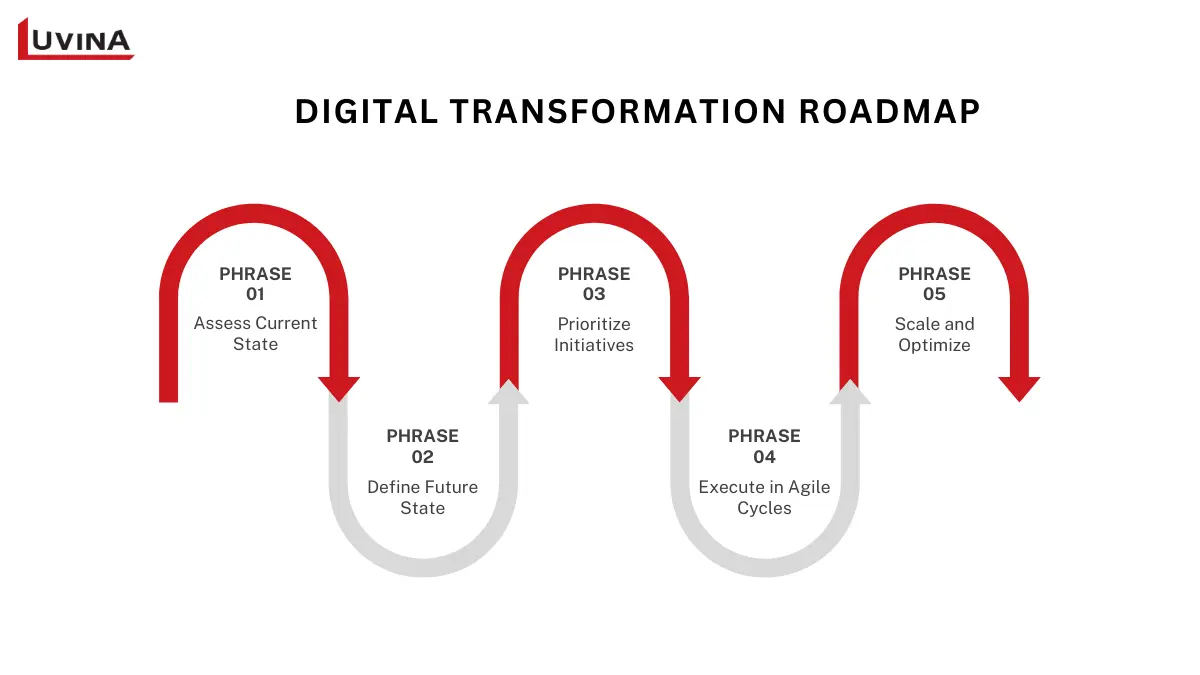
A digital transformation roadmap typically includes 5 key phrases
Phase 1: Assess Current State
The first step is assessing current systems, processes, and digital maturity. Organisations should determine what is successful, what requires change, and what might need total reconstruction.
In our experience at Luvina, you should perform a readiness assessment, which needs to include looking at their market share(s), competitors, emerging trends, and potential risks, while also evaluating internal capabilities and skill gaps of their employees. A disciplined SWOT analysis helps companies identify critical opportunities and internal gaps.
Phase 2: Define Future State
Businesses specify the desired future condition they want to reach by setting out specific, quantifiable business goals in this phase of a digital-first approach. This comprises defining the target operating model and recognizing the digital skills necessary to enable internal operations, data management, and customer experience support.
KPIs play a key role in taking a strategy from concept to delivery. The establishment of realistic targets, having multi-departmental involvement, and considering the experiences of other companies will all contribute to the creation of a robust digital transformation roadmap that provides for the development of a plan that is realistic, unified, and doable.
Phase 3: Prioritize Initiatives
Prioritization of initiatives is an essential part of any digital transformation strategy. This could be related to technology upgrades (i.e., cloud, infrastructure), product innovation, or customer experience. Choosing projects requires one to strike a balance between implementation difficulty and corporate value.
Every project should be assessed on projected impact, needed resources, and possible return on investment. Often beginning with little, doable projects that provide fast wins and aid in verifying the transformational strategy before growing to bigger efforts, a practical digital transformation roadmap usually helps.
Phase 4: Execute in Agile Cycles
Executing a digital program brings it to life. At this stage, an organisation moves from developing the plan to actually implementing the plan with the use of an agile transformation approach, where ideas will be operationalised through small, iterative cycles, allowing for ongoing testing, feedback, and development instead of making large-scale, complex changes all at once.
Adopting DevOps practices and CI/CD pipelines can further accelerate delivery, enabling faster releases while maintaining system reliability. A digital transformation plan should include cross-functional execution teams to ensure there is alignment across the business, technical, and operational areas/functions of an organisation.
Using KPIs, performance, and results should be closely tracked. Maintaining system stability, continuous delivery models combined with a fail-fast culture enable companies to more quickly implement changes. Regularly gathering employee, client, and partner feedback should help to perfect the change strategy and, as necessary, modify priorities.
Phase 5: Scale and Optimize
The last phase in your digital transformation journey is expanding successful projects throughout the entire company. After verifying the solution in prior stages, your organization should seek enterprise-wide application of digital tools, processes, and operating models. This ensures that the value of transformation efforts is consistent across divisions instead of being limited to individual project results.
Focus on monitoring performance to evaluate their operational effectiveness, performance of systems, and the results of the company. The company can be more agile, competitive, and resilient in the future by continuing to improve through employee training, process improvement, and technology implementation as a result of digital transformation.
Digital Transformation Operating Model
An important component of a digital transformation strategy is a digital transformation operating model, which specifies how an enterprise arranges its personnel, systems, and technology to provide digital value. Different operating models may be required depending on corporate goals, sector context, and maturity level among various digital transformation strategies.
| Model | Description | Use case |
| Customer-centric model | Focuses on customer needs and experience across all touchpoints | Improving customer satisfaction and personalization |
| Agile model | Emphasizes flexibility, iteration, and fast delivery | Accelerating product and technology development |
| Platform model | Builds digital ecosystems connecting users and partners | Scaling services and creating new revenue opportunities |
| Data-driven model | Uses analytics and AI to support decision-making | Optimizing operations and business insights |
| Digital-first model | Prioritizes digital channels and workflows | Transitioning from traditional to digital operations |
| Hybrid model | Combines multiple operating model approaches | Adapting to complex organizational contexts |
Some digital transformation operating models and their use cases
Agile and Lean Digital Transformation
Combining agile and lean principles in a digital transformation strategy helps businesses stay flexible, efficient, and customer-focused. Lean transformation emphasizes waste reduction and process optimization, while agile transformation focuses on adaptability, collaboration, and iterative delivery. The table below summarizes the key differences between these 2 methodologies:
| Agile approach | Lean approach | |
| Main goal | Enhance adaptability and delivery speed | Improve efficiency and remove waste |
| Execution style | Iterative development and feedback loops | Process optimization and structured improvement |
| Key tools | Scrum, Kanban, user stories | Value stream mapping, root cause analysis |
| Cultural focus | Collaboration and flexibility | Continuous improvement mindset |
| Transformation role | Innovation and responsiveness | Operational excellence |
Quick comparison between agile and lean approaches
A solid strategy for digital transformation will use agile and lean together to foster an environment of ongoing innovation. Using agile methods allows for quick product development cycles through rapid revision and collaboration, while lean methods allow an organization to improve operations by means of value stream maps, process optimizations, and removing non-value-added processes.
Digital Transformation Maturity Model
Measuring how thoroughly digital technologies are embedded into company operations helps businesses assess their advancement in a digital transformation strategy using a maturity model. Most businesses pass through many phases of digital development before getting to a completely optimized digital environment:
– Level 1: Digitization – Elementary digitalization of documents and workflows. Many times, systems are segregated; data is kept in different tools.
– Level 2: Process Digitalization – Digitalization of processes will help to enhance the consistency and operational efficiencies of business operations by utilising a level of automation and standardisation.
– Level 3: Data-Driven Organization – Employing data governance and analytics will help to inform decision-making between departments.
– Level 4: Platform-Based Enterprise – By using integrated digital platforms, automated operations, real-time business operations, and cross-functional collaboration will be achieved.
– Level 5: AI-Driven Enterprise – Using the advanced technologies of AI and predictive analytics as part of your digital transformation will continue to support innovation and further optimization of your organisation through a modernization blueprint.
Leadership in Digital Transformation
Strong leadership underpins a successful digital transformation strategy. Defining vision, establishing priorities, and making certain that digital initiatives complement company goals depend mostly on executive leaders.
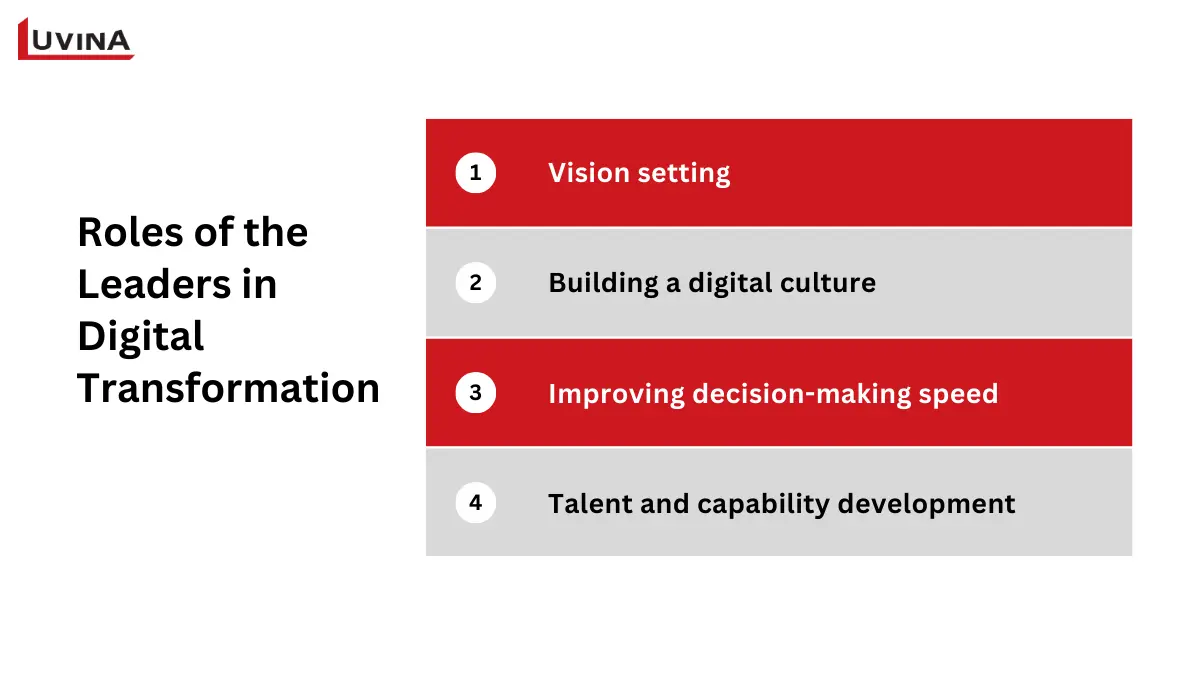
Why is leadership important in digital transformation?
Vision setting
Executive leaders must specify how digital and artificial intelligence (AI) technologies generate long-term company value. Without a clearly defined strategy, digital projects might get disjointed and reactive.
Building a digital culture
To back the digital business transformation strategy, leadership must lead cultural change. According to a Gartner study, digital transformation sometimes fails when businesses confront change aversion, slow decision-making, or siloed working practices.
Improving decision-making speed
Companies need to move more quickly and flexibly to undergo digital transformation. Boston Consulting Group study suggests that digital maturity increases when teams are empowered to make decisions within defined limits, governance is simplified, and bottlenecks are removed.
Talent and capability development
Leaders have to invest in employee upskilling and digital literacy. People, culture, and technology grow along to produce sustainable change.
Key Challenges in Digital Transformation
A well-structured transformation initiative should anticipate risks and include practical solutions. The table below summarizes common challenges, their impacts, and possible approaches to manage them.
| Challenge | Impact | Solution |
| Legacy systems | Limits integration and increases maintenance costs | Gradual modernization and cloud adoption |
| Organizational resistance | Slows technology adoption and workflow change | Change management and clear communication |
| Data integration complexity | Creates fragmented and unreliable insights | Build a unified data architecture |
| Talent and skill gaps | Reduces transformation execution capability | Invest in training and digital hiring |
| ROI measurement | Makes it difficult to prove business value | Define KPIs and success metrics early |
Challenges and how to address them
Digital Transformation Trends
As technology and business models keep changing, businesses have to have a forward-thinking digital transformation strategy. Important trends in digital transformation include:
– AI-native enterprise: Incorporating machine learning and artificial intelligence into company operations to help decision-making and customer service.
– Data platform modernization: Modernizing the data platform entails real-time analysis and business insights obtained from centralized data systems.
– Automation-first operations: Using hyperautomation tools like RPA and AI workflow orchestration for first automation operations.
– Composable architecture: For more flexibility, composable design is stepping toward modular systems created with microservices and APIs.
– Hyper-personalized customer experience: Providing customized contacts using artificial intelligence analysis and real-time data.
Digital Transformation Examples
Many organizations have successfully applied a digital transformation strategy to improve customer experience, operational efficiency, and business competitiveness. For example, digital transformation in finance focuses on mobile services, automation, and secure data processing to improve customer convenience. Meanwhile, digital transformation in manufacturing emphasizes smart production systems, predictive maintenance, and industrial IoT integration to optimize operational performance. These cases demonstrate that transformation success depends on aligning technology with business goals.
Key real-world digital transformation examples include:
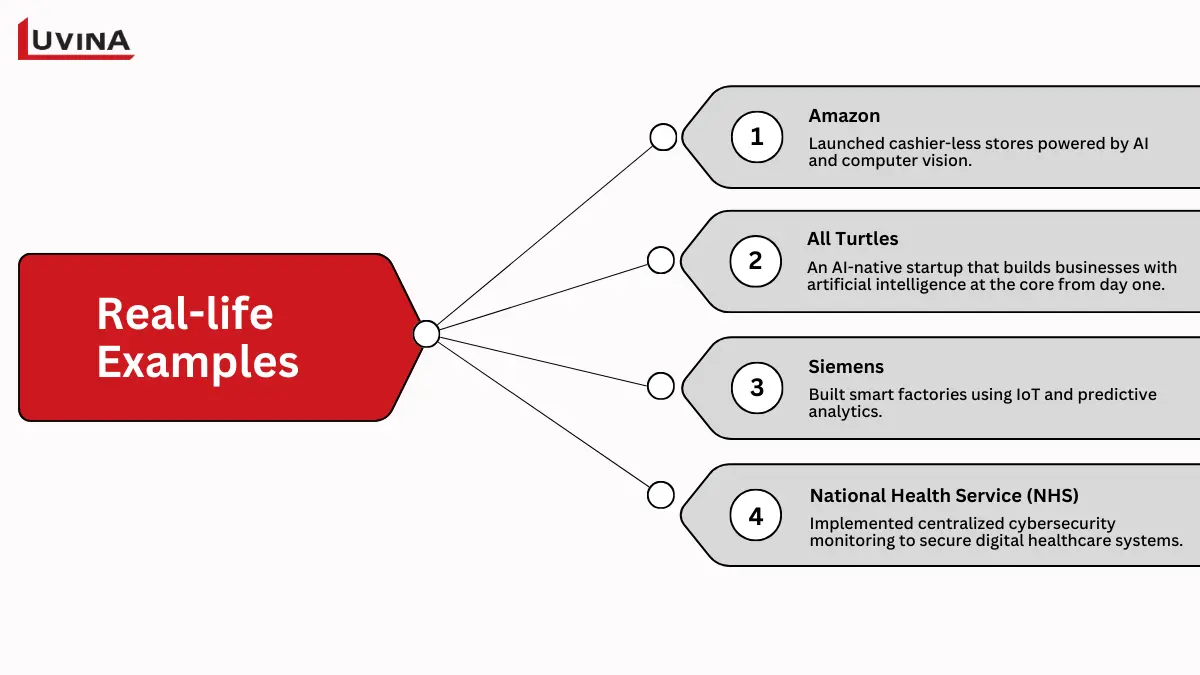
A well-designed digital transformation strategy can bring significant changes
Amazon – Retail transformation
Using computer vision, sensor fusion, and artificial intelligence algorithms, the business rolled out cashier-less shopping technologies in its physical stores. While the system automatically records purchases and bills their accounts, consumers may just grab things and go. This model lowers checkout friction and increases shopping ease.
Siemens – Manufacturing transformation
Integrating Internet of Things sensors, predictive analysis, and automation systems, the firm created smart factory solutions. In digital transformation strategy implementation within industrial settings, these solutions improve operational visibility, minimize equipment downtime, and help to maximize production efficiency.
National Health Service (NHS) – Healthcare digital security
Millions of medical devices and digital communication channels were protected by the healthcare organisation by means of centralised cybersecurity monitoring. Demonstrating how technology may help resilient tech-driven business overhaul in public service sectors, the system blocks great volumes of harmful emails and promotes safe digital healthcare delivery.
All Turtles – AI-native startup transformation
Built from the ground up around practical artificial intelligence, the company creates AI-powered products and spin-out ventures that solve real business problems, positioning AI as the core business model rather than an added technology layer.
How to Start Your Digital Transformation Journey
Beginning a transformation path doesn’t call for a complicated or big-scale scheme. Organizations should concentrate on concrete results, solving particular operational or consumer pain points, rather than considering digital transformation strategy to be a broad and abstract project.
The first step is to establish for your organization what “digital” signifies. Different businesses have different requirements depending on market rivalry, maturity level, and industry. Performing a basic process audit assists in highlighting the most pressing problems. Ask practical queries like what is causing operational inefficiency, where clients are experiencing friction, and which company processes need enhancement. Build a simple workflow, create a prototype, and examine it using real data before scaling once the issue is known.
Starting a digital transformation strategy requires executive alignment and stakeholder engagement. Smooth execution depends on leadership support, workforce preparedness, and technology alliances. Companies should clearly define transformation objectives, ready workers for change, and work with technology providers.
Starting small, moving rapidly, and always improving instead of waiting for a perfect solution before acting is the most crucial advice.
Conclusion
For companies wanting to stay competitive in the digital era, developing a robust digital transformation strategy is key. Companies that view change as an ongoing process rather than a one-time initiative are better able to reach long-term expansion and operational resilience.
Contact Luvina if your company wants a reliable partner to help your digital transformation path. We treat transformation as a continuous capability, not a one-off project, and outperform peers in resilience and innovation.rformance testing plan and get more accurate results from your statistics.
Resources
- https://www.mckinsey.com/featured-insights/leadership/changing-change-management
- https://www.sap.com/resources/digital-transformation-strategy-road-map
- https://www.prosci.com/blog/steps-to-execute-digital-transformation-strategy
- https://digitaltransformation.org.au/guides/it-management/10-steps-create-digital-transformation-strategy-roadmap
- https://www.ibm.com/think/topics/digital-transformation
- https://bakkah.com/knowledge-center/digital-transformation-operating-model
- https://www.larksuite.com/en_us/topics/digital-transformation-glossary/lean-vs-agile
- https://www.atlassian.com/agile/project-management/lean-vs-agile
- https://www.zoho.com/creator/decode/digital-transformation-maturity-model
- https://www.linkedin.com/pulse/leadership-digital-transformation-how-drive-jason-battye-kdehc/
- https://www.bcg.com/capabilities/digital-technology-data/digital-maturity
- https://www.ibm.com/think/insights/digital-transformation-trends
- https://www.prosci.com/blog/digital-transformation-trends-in-2025-and-beyond
- https://www.zoho.com/creator/decode/digital-transformation-trends
- https://governance.com/how-to-start-your-digital-transformation-journey-with-quick-results/
- https://www.iotforall.com/how-to-begin-digital-transformation-journey
READY TO START A PROJECT?
Our experts are eager to explore your needs.


Read More From Us?
Sign up for our newsletter
Read More From Us?
Sign up for our newsletter