




Energy Management System Explained for Businesses


Energy costs are no longer a fixed expense; they are a strategic variable that directly impacts profitability and competitiveness.
An Energy Management System (EMS) gives businesses the ability to monitor, control, and optimize energy usage in real time. For manufacturing companies in particular, even small improvements in energy efficiency can translate into significant cost savings and operational gains.
That silent impact is driving rapid adoption worldwide. The global EMS market was valued at USD 40.79 billion in 2025. The market is projected to grow from USD 46.58 billion in 2026 to USD 141.64 billion by 2034, exhibiting a CAGR of 14.90%.
However, understanding EMS isn’t as straightforward as it sounds.
In this guide, we break down how an energy management system works, its architecture, key types, real-world examples, and how to implement it effectively in modern industrial environments.
What Is an Energy Management System (EMS)?
An energy management system is a combination of software and hardware designed to monitor, control, and optimize energy generation, storage, and consumption within an organization.
An EMS collects and analyzes energy usage data in real time. For example, manufacturing companies can track power peaks, adjust energy consumption during high-demand periods, and better balance different energy sources to improve overall efficiency. Beyond monitoring, an EMS also supports optimization and planning. It can forecast future energy needs, helping businesses prepare for demand fluctuations while reducing operational costs and carbon emissions.
You typically need an energy management system when energy usage becomes difficult to track, control, or optimize manually. This often happens when businesses face rising energy costs, stricter compliance requirements, a lack of usage data to identify waste, or challenges in managing multiple sites and systems.
An EMS is also needed when setting energy-saving targets, but lacking a clear way to monitor progress, or when manual operations (like scheduling heating or lighting) lead to inefficiencies and unnecessary costs.
How Does an Energy Management System Work?
An energy management system acts like the “brain” of energy operations, collecting real-time data, analyzing it, and automatically adjusting how energy is used across a building, factory, or larger site.
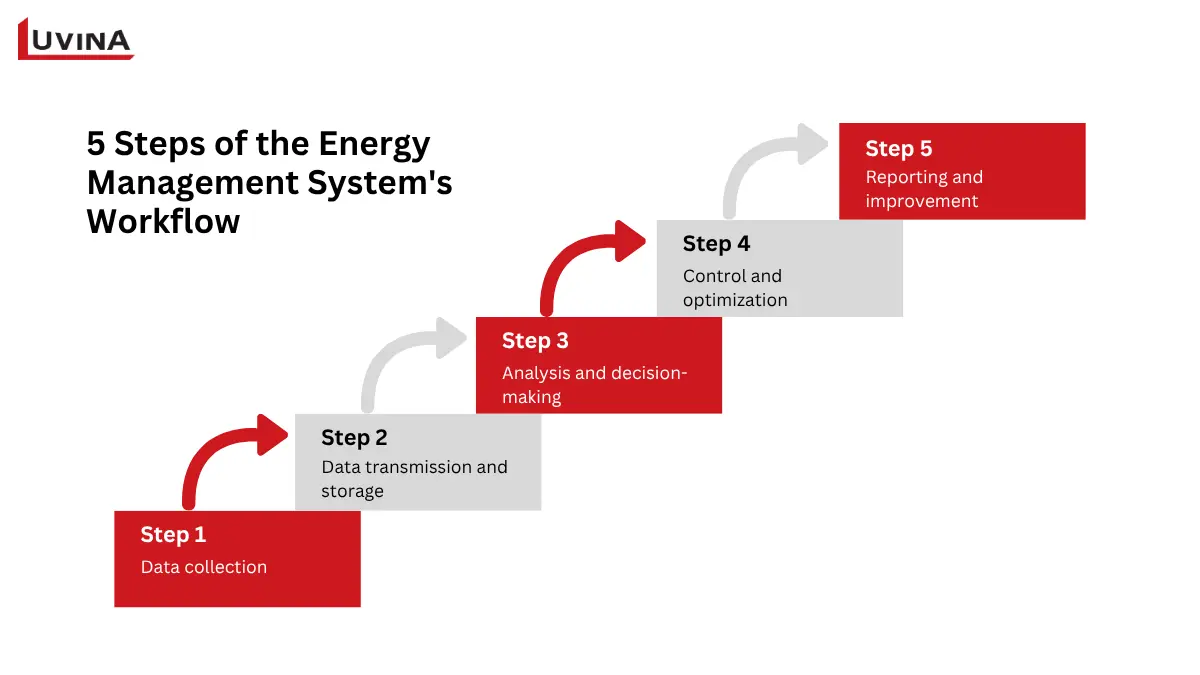
A typical EMS usually operates according to this process
Step 1: Data collection
The process begins with gathering data from a network of sensors, meters, and connected devices. These tools monitor parameters such as energy consumption, voltage, power factor, and usage patterns across different systems and equipment in real time.
Step 2: Data transmission and storage
Once collected, the data is transmitted to a central platform where it is securely stored. This creates a unified data source that allows businesses to track energy performance over time and across multiple assets or locations.
Step 3: Analysis and decision-making
The system then processes this data to identify patterns, detect inefficiencies, and forecast future energy demand. By using real-time insights and predictive analysis, the energy management system can support smarter decisions, such as when to reduce consumption or how to better allocate energy resources.
Step 4: Control and optimization
Based on these insights, the EMS actively controls energy flows. It can automatically adjust equipment loads, manage lighting systems, or optimize the charging and discharging of battery energy storage systems (BESS). This enables strategies like peak shaving and better integration of renewable energy sources.
Step 5: Reporting and continuous improvement
Finally, the system generates detailed reports on energy usage, cost savings, and reduced CO₂ emissions. These insights help businesses continuously refine their energy strategies, improving efficiency and sustainability over time.
From a business perspective, this process transforms energy from a fixed cost into a controllable variable. Instead of reacting to energy bills, companies can actively manage when, where, and how energy is consumed.
Energy Management System Architecture
Energy management system architecture is typically designed in layers, each responsible for a specific function in collecting, processing, and presenting energy data.
Layer 1: Data collection layer (Field layer)
This is the foundation of the system, where data is gathered from physical assets such as sensors, meters, and equipment. A key component in this layer is the gateway – a device or system that collects and preprocesses data from different sources. Ideally, the gateway operates independently of manufacturers, allowing it to integrate various devices into a unified system without compatibility issues.
Layer 2: Business logic/ Processing layer
In this layer, software and algorithms process the collected data and turn it into meaningful insights. The system applies predefined rules and constraints to control energy assets based on specific business goals. For example, it can prioritize which devices should be powered first, set limits on energy consumption, or optimize energy use to increase self-sufficiency and meet local grid requirements.
Layer 3: Presentation/ Interface layer
The final layer of the energy management system focuses on user interaction. It provides a platform where businesses can visualize both real-time and historical data, monitor key performance indicators (KPIs), and manage energy flows. Through this interface, users can also configure system parameters and make informed decisions to improve overall energy performance.
This layered architecture ensures scalability, allowing businesses to expand from a single facility to multi-site operations without redesigning the entire system.
Types of Energy Management Systems
Not all EMS deliver the same capabilities. Each type can be designed to handle different levels of complexity. Below is a concise overview of common types of energy management systems, organized by control strategy and application context. Choosing the right type of EMS depends on your operational complexity, energy usage patterns, and business goals.
| Category | Type | Description |
|---|---|---|
| By the control strategy | Rule-based EMS | Uses predefined rules to control energy flows across connected assets. Simple, reliable, ideal for predictable energy patterns. |
| Forecast-based (predictive) EMS | Analyzes real-time data (like PV production, battery status, load) and external factors (electricity price, weather) to optimize energy use. Helps improve efficiency and reduce costs. | |
| AI/ML-powered EMS | Uses AI/ML to manage complex energy scenarios, grid congestion, and energy storage. EMS can adjust energy usage and create financial benefits by leveraging market opportunities. | |
| Cloud-based EMS | Cloud-enabled EMS allows remote monitoring, analytics, and reporting across multiple sites. Scalable and accessible anywhere. | |
| By application context | Building energy management system (BEMS/BAS) | Automatically manages lighting, heating, and cooling in commercial buildings. Reduces energy waste and meets sustainability goals. |
| Industrial EMS (IEMS) | Optimizes energy use in factories, shifting heavy processes to off-peak times and balancing equipment loads. EMS reduces costs and improves efficiency. | |
| Home energy management system (HEMS) | Manages household assets like EVs, solar panels, heat pumps, and batteries for smarter energy use. | |
| Microgrid EMS | Coordinates energy across multiple sites, controlling distributed storage and generation. Supports virtual power plants and grid integration. | |
| Grid-level EMS | Monitors and controls large-scale generation, transmission, and storage. Optimizes renewable integration, peak shaving, and market participation. |
Table of types of energy management systems
Energy Management System Examples
To better understand how an EMS works in practice, it helps to look at real-world applications across industries. These energy management system examples show how organizations use EMS to optimize energy consumption, reduce costs, and support sustainability goals, especially as part of broader digital transformation in manufacturing and other sectors.
Manufacturing
In manufacturing, EMS plays a critical role in monitoring heavy machinery, optimizing production schedules, and avoiding peak demand penalties.
For example, 3M Company implemented an EMS across 56 global sites, enabling continuous tracking of energy usage and improving overall efficiency. Similarly, HARBEC Inc. used an EMS to gain real-time visibility into energy consumption, allowing better decision-making and cost reduction. These use cases show how EMS supports more efficient and sustainable production processes.
Aviation and critical infrastructure
Airports and other critical facilities require stable and efficient energy systems. Beijing Capital International Airport Co., Ltd. adopted an EMS to reduce energy consumption while improving overall energy management practices. In environments where power interruptions are not an option, EMS ensures reliable operations while optimizing energy use.
Data centers
Data centers rely on a continuous power supply to maintain IT operations. An energy management system helps monitor energy usage in real time, ensuring efficiency while preventing downtime. By optimizing power distribution, EMS supports both performance and cost control in energy-intensive digital environments.
Healthcare
Hospitals and medical facilities use EMS to manage energy across critical systems. This ensures that essential equipment operates efficiently while keeping operational costs under control, especially in settings where reliability is crucial.
Retail and commercial buildings
For businesses operating across multiple locations, EMS provides centralized control over lighting, HVAC, and other systems. This helps reduce energy waste and maintain consistent performance across stores and office spaces.
Microgrid and multi-site operations
In more complex setups, such as microgrids, an energy management system coordinates multiple energy sources and locations. It can manage distributed storage, balance loads, and optimize energy flow across sites, ensuring both efficiency and stability.
These examples show that EMS is no longer a niche solution, but a core component of digital transformation strategies across industries.
Benefits of an Energy Management System
An energy management system delivers value by turning energy data into actionable insights and automated control. To better understand its impact, the benefits of an EMS can be clearly seen across both business operations and everyday energy usage:
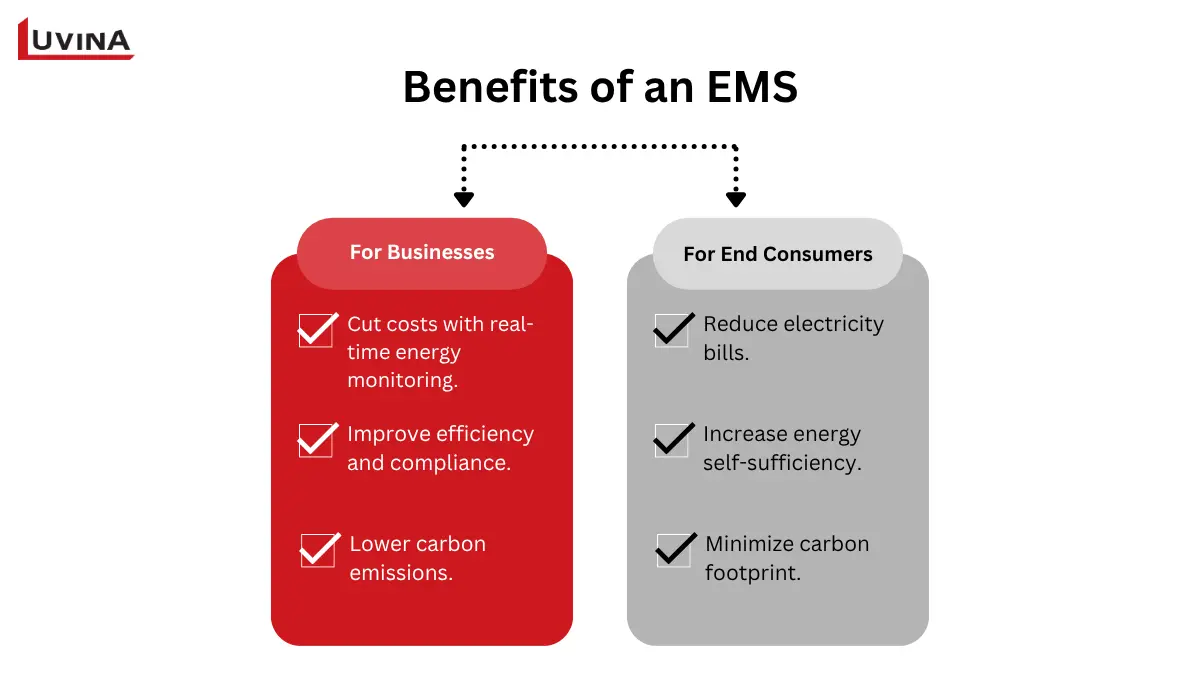
Energy control brings many benefits
For businesses
For businesses, the value of an EMS lies in its ability to provide control, visibility, and flexibility across complex energy operations:
- Cost optimization
- Reduce energy bills through smarter usage and peak management
- Minimize waste with real-time monitoring and data insights
- Operational efficiency
- Gain visibility across sites and assets in one platform
- Automate control of systems like HVAC, lighting, and equipment
- Sustainability and compliance
- Lower carbon emissions and support ESG goals
- Meet regulatory requirements with better tracking and reporting
- Competitive advantage
- Integrate renewables and adapt to market changes
- Unlock new energy models and scale with flexibility
For end consumers
For end consumers, an EMS makes it easier to manage everyday energy usage more smartly and cost-effectively:
- Cost savings
- Lower electricity bills by using energy more efficiently
- Shift usage to off-peak times or when prices are lower
- Energy independence
- Maximize the use of self-generated energy like solar
- Reduce reliance on the grid with better energy coordination
- Sustainability
- Reduce carbon footprint through smarter energy usage
- Prioritize renewable energy whenever available
EMS vs. BMS vs. SCADA: What’s the Difference?
EMS, BMS, and SCADA are often used together but serve very different purposes. An energy management system focuses on optimizing energy usage and costs, a BMS manages building operations like HVAC and lighting, while SCADA supervises and controls industrial processes in real time. The table below highlights how each system compares across key aspects:
| BMS (Building management system) | EMS | SCADA (Supervisory control and data acquisition) | |
|---|---|---|---|
| Primary goal | Maintain comfort and safety in buildings | Optimize energy usage, cost, and emissions | Monitor and control industrial processes |
| Focus | HVAC, lighting, security systems | Electricity, energy flows, carbon footprint | Equipment, production lines, utility systems |
| Time horizon | Real-time, rule-based control | Predictive, forecast-driven optimization | Real-time, high-frequency monitoring |
| Data scope | Internal (temperature, occupancy) | Internal + external (prices, weather, grid signals) | Operational data from machines and systems |
| Control capability | Direct control of building systems | The optimization layer may not directly control all assets | Full supervisory control via PLC systems |
| Deployment | Typically on-site | Often cloud-based or hybrid | Mostly on-premises for reliability |
| Business impact | Reduces operating costs, ensures compliance | Impacts profit, sustainability, and long-term efficiency | Ensures operational continuity and safety |
Comparison of differences between EMS, BMS, and SCADA
In a manufacturing facility, SCADA monitors and controls production lines in real time, ensuring machines operate safely and efficiently. A BMS manages supporting systems like ventilation and lighting across the plant. On top of that, an energy management system analyzes energy consumption across all systems, forecasts demand, and optimizes when and how energy is used to reduce costs and emissions.
– Use BMS when you need to control and automate building systems such as HVAC, lighting, and safety.
– Use SCADA when your operations require real-time monitoring and control of industrial processes and equipment.
– Use EMS when your goal is to optimize energy consumption, reduce costs, and align with sustainability targets.
In many cases, the best approach is not choosing one over another but combining them. SCADA handles operational control, BMS manages building-level systems, and EMS acts as the intelligence layer that optimizes energy across all assets.
In modern smart factories, EMS acts as the optimization layer on top of BMS and SCADA, connecting operational data with energy strategy.
How to Implement an Energy Management System: Step-by-Step Guide
Many EMS projects fail not because of technology, but because they are not aligned with actual business operations. A structured implementation approach is critical to achieving measurable ROI.
Whether it’s a manufacturing plant dealing with unpredictable energy costs or a business trying to meet stricter carbon reporting standards, success comes down to following a clear, structured approach that turns data into action.
Below is a practical step-by-step guide to help you implement it effectively:
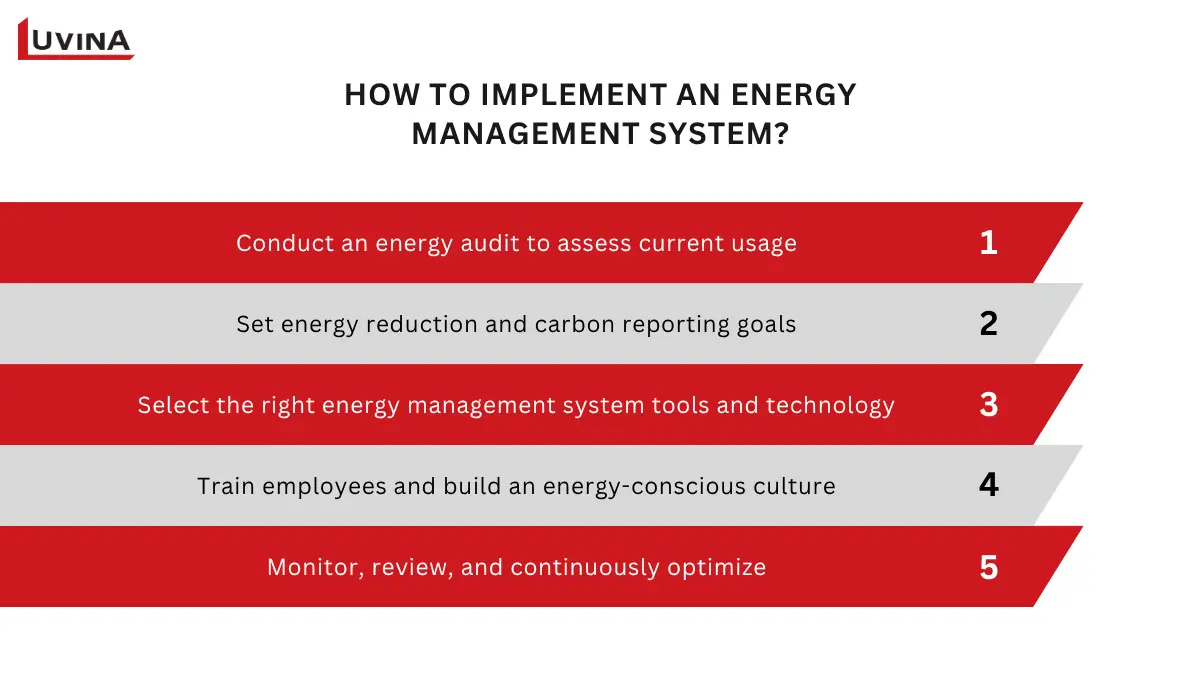
5-step process to implement an EMS
Step 1: Conduct an energy audit to assess current usage
Start by understanding how energy is currently used across your operations. This means reviewing equipment, processes, and daily practices to identify inefficiencies and establish a clear baseline.
In a manufacturing setting, for example, an audit might reveal that certain machines consume excessive energy during idle time or that peak usage happens at costly hours. These insights create a strong foundation for any energy management system, ensuring that future actions are data-driven rather than assumption-based.
Step 2: Set energy reduction and carbon reporting goals
Once you have visibility, define clear and measurable goals. These can include reducing overall energy consumption, lowering peak demand, or improving carbon reporting accuracy.
Goals should align with both internal priorities and external frameworks such as emissions reporting standards or sustainability targets. For example, a factory may aim to cut energy costs by shifting operations to off-peak hours while also tracking Scope 1 and Scope 2 emissions more accurately.
Step 3: Select the right energy management system tools and technology
Choosing the right tools is critical to long-term success. Modern solutions often combine IoT devices, real-time monitoring, and advanced analytics to support better decision-making.
For manufacturers already using systems like a custom manufacturing execution system, integration becomes especially important. A well-connected setup allows production data and energy data to work together, helping optimize both operational efficiency and energy consumption within a unified workflow.
Step 4: Train employees and build an energy-conscious culture
Technology alone is not enough – people play a key role in making the system effective. Employees need to understand how to use the system and why it matters.
Training helps teams identify inefficiencies, respond to alerts, and follow optimized processes. Over time, this builds a culture where energy efficiency becomes part of everyday decision-making rather than a separate initiative.
Step 5: Monitor, review, and continuously optimize
An energy management system should evolve with your operations. Regularly track performance, compare results against your initial goals, and adjust strategies when needed.
For example, if energy prices fluctuate or production demand changes, the system should be updated to reflect new priorities. Continuous monitoring and optimization ensure that the energy management system remains effective, relevant, and aligned with both business and sustainability objectives.
Energy Management Systems and ISO 50001
Energy management is closely linked to ISO 50001, the international standard for improving energy performance through a structured and continuous approach. For many businesses, especially in manufacturing, aligning with this standard helps ensure both operational efficiency and regulatory compliance.
An energy management system supports this process by providing real-time monitoring, data analysis, and clear visibility into energy usage. For example, a factory can use an EMS to track consumption across machines, identify inefficiencies, and demonstrate measurable improvements – one of the key requirements of ISO 50001.
To obtain certification, companies must be audited by an accredited third-party organization that evaluates whether all requirements are met, particularly the focus on continuous improvement. While implementing an EMS does not automatically guarantee certification, it is a critical step that helps businesses build the foundation needed to qualify for ISO 50001.
The Future of Energy Management: AI, IoT, and Smart Grid Integration
Energy management is entering a new era where systems do more than monitor. They predict, optimize, and adapt in real time. Key trends shaping the future of an energy management system include:
| Trends | How will it be applied? |
|---|---|
| AI-powered optimization | Uses predictive algorithms to forecast energy demand and automatically adjust operations, reducing costs and emissions. |
| IoT and advanced sensors | Collects real-time, high-accuracy data from all assets, enabling precise monitoring and quick response to inefficiencies. |
| Renewable energy management | Handles variable sources like solar and wind efficiently, combined with energy storage systems to balance supply and demand. |
| Simulation with digital twins | Creates virtual replicas of operations to test and optimize energy strategies without disrupting real processes. |
| Regulatory compliance and sustainability | Supports adherence to stricter energy efficiency and carbon reporting standards while enabling proactive decarbonization initiatives. |
| Smart grid integration | An energy management system interacts with electricity prices, grid capacity, and carbon intensity, allowing dynamic energy management across multiple sites. |
New EMS will become increasingly advanced with emerging technology trends
FAQs
1. What is an energy management system in simple terms?
An EMS is software and hardware (sensors, smart meters) that monitors and optimizes energy use in buildings or factories, cutting costs and waste while improving efficiency.
2. How much can an EMS reduce energy costs?
Typically 10-20% on utility bills.
3. What is the difference between an EMS and a BMS?
A BMS controls infrastructure like HVAC and lighting (“muscles”), while an EMS analyzes and optimizes energy use (“brain”).
4. Is ISO 50001 certification required to use an EMS?
No, it’s not required, but it can demonstrate regulatory compliance or support sustainability goals.
5. What types of facilities benefit most from an EMS?
High-energy users like industrial plants, data centers, hospitals, large offices, retail chains, schools, warehouses, and multi-use/residential buildings.
6. Can a small business use an energy management system?
Yes, small businesses can benefit from implementing an EMS.
Conclusion
IThe growing complexity of energy demands makes an energy management system necessary for businesses aiming to improve efficiency, reduce costs, and lower their environmental impact. By adopting advanced technologies and staying aligned with regulations, organizations can lead in energy optimization and sustainability.
Implementing an Energy Management System is not just a technical project. It requires deep integration with your operations, data systems, and business goals.
Luvina helps manufacturing enterprises design and implement EMS solutions that are scalable, secure, and aligned with real-world production environments.
Contact our experts to explore how your business can reduce energy costs and improve operational efficiency with a tailored EMS strategy.
Resources
READY TO START A PROJECT?
Our experts are eager to explore your needs.

Read More From Us?
Sign up for our newsletter
Read More From Us?
Sign up for our newsletter