




Getting Started with AI in Retail Stores: A Beginner’s Guide


For contemporary companies, AI in retail stores is a necessary resource. Recent research indicates that generative AI could deliver USD 240 billion to USD 390 billion in economic value for retailers, which represents an outstanding opportunity for businesses of all sizes. Retailers who leverage AI solutions for retail can improve inventory management, improve forecasting capabilities, and engage with customers.
Retailers and IT partners will learn how to start with AI in retail stores by means of this guide, which will reveal actual uses, implementation techniques, and best practices that enable technology to operate smoothly for both companies and clients.
AI Technologies in Retail Environments
AI is changing how consumers experience shopping and how stores run, hence making AI in retail stores establishments a fundamental component of the contemporary retail approach. Using artificial intelligence in retail, companies can not only customize customer interactions but also maximize back-end processes for efficiency and correctness. Retailers are increasingly combining retail AI solutions with systems like ERP software for logistics and looking at AI in retail industry applications to align online and offline operations.
The following are the key technologies that are driving AI implementation in retail spaces:
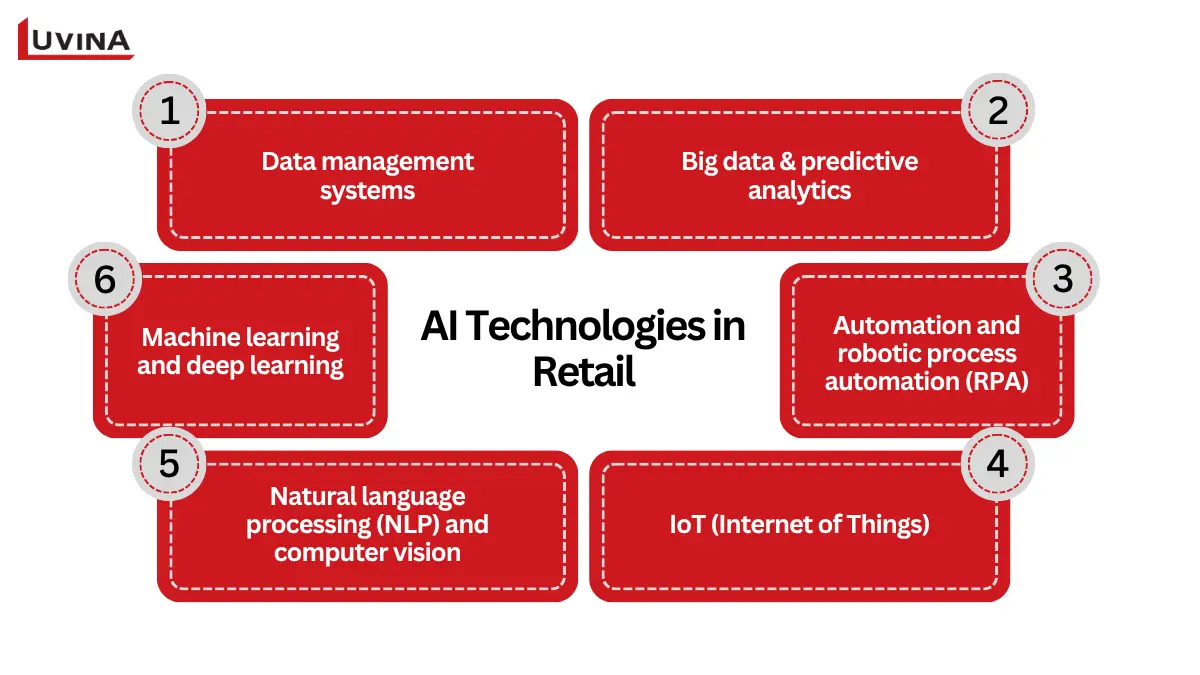
Data management systems: Centralized repositories, including data warehouses, data lakes, and cloud solutions, house lots of information obtained from sales, customer behavior, and supply chain activities. These data management systems are the backbone of all AI use cases in the retail space.
Big data & predictive analytics: This AI technology analyzes customer habits and preferences, sales history, and market landscape to provide predictive insights into demand forecasting and inventory optimization, and to facilitate better decision-making.
Machine learning and deep learning: The core of AI in retail stores is best known as machine learning (ML), which powers recommendation engines, dynamic pricing, and demand forecasting.
Natural language processing (NLP) and computer vision: The NLP AI in retail stores allows chatbot and virtual assistance interactions with customers, while computer vision aids the retail environment by enabling use cases for automated inventory stocking, visual search, and in-store analytics as it relates to customer behavior, which blurs the lines between digital and physical shopping.
Automation and robotic process automation (RPA): In essence, most retail use cases automate routine processes (price updates, inventory management, multi-variant checks…). Intelligent automation, which is a combination of AI and RPA, facilitates complex customer interactions while streamlining operational processes.
IoT (Internet of Things): Sensors and other smart devices embedded in stores provide real-time data with respect to surveillance of customer behavior in stores, monitoring of deliveries, and usage data for supply chain visibility, providing frictionless experiences for customers that integrate with AI in retail stores.
Benefits of Implementing AI Solutions for Retail Stores
AI in retail stores is changing the way retail stores look. Clearly, how artificial intelligence is transforming the retail sector goes beyond automation as more companies investigate AI in retail commerce. It centers on developing more customer-focused, more rapid, and more intelligent operations. From back-end logistics to in-store experience, AI in retail helps every department.
Here’s how the artificial intelligence in retail industry offers genuine worth to retail businesses:
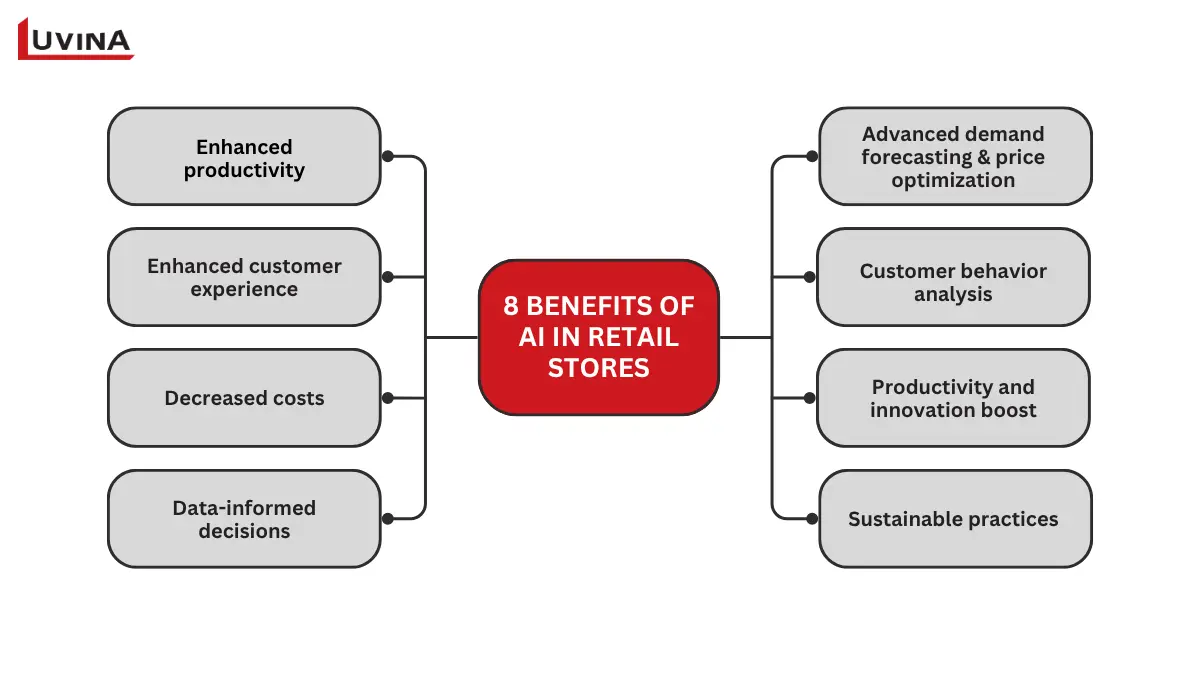
Enhanced productivity
Retail stores leverage AI in retail stores to automate routine processes – including inventory management, order fulfilment, and customer support – allowing employees to focus on higher-value work. As a result, retail stores will become faster and more resilient, leading to an optimized supply chain.
Enhanced customer experience
Highly engrossing shopping experiences fueled by artificial intelligence’s customized marketing messages, individualized recommendations, and real-time assistance raise average spend, loyalty, and customer happiness.
Decreased costs
AI for stores-driven operations eliminates waste, reduces operational costs, and increases overall profit for retailers, from supply chain optimization to dynamic pricing.
Data-informed decisions
Through the power of real-time analytics and predictive insights, AI revolutionizes the ability to make better pricing, better inventory management, and better marketing decisions – ultimately enabling retail teams to make a decision with confidence.
Advanced demand forecasting & price optimization
Demand predictions, inventory level optimization, and dynamic pricing changes to preserve competitiveness depend on historical as well as real-time data analysis by AI in retail stores.
Customer behavior analysis
AI technologies track and analyze customer behavior across channels to provide practical insights for enhancing corporate performance and engagement plans.
Productivity and innovation boost
Automating monotonous activities lets staff concentrate on inventiveness and problem-solving, whereas AI technologies speed innovation to enable new services like virtual shopping assistants or smart search capabilities.
Sustainable practices
AI in retail stores provides retailers a way to track and reduce environmental impact, create better supply chains, and become more sustainable overall, in a time period where customer expectations are steadily increasing.
Use Cases of AI in Retail Stores
Knowing how can AI be used in retail enables merchants to unlock real-world advantages; artificial intelligence in retail examples show noticeable gains in productivity, consumer happiness, and revenue. Major applications illustrating the use of AI in retail in retail and how companies are exploiting it are:
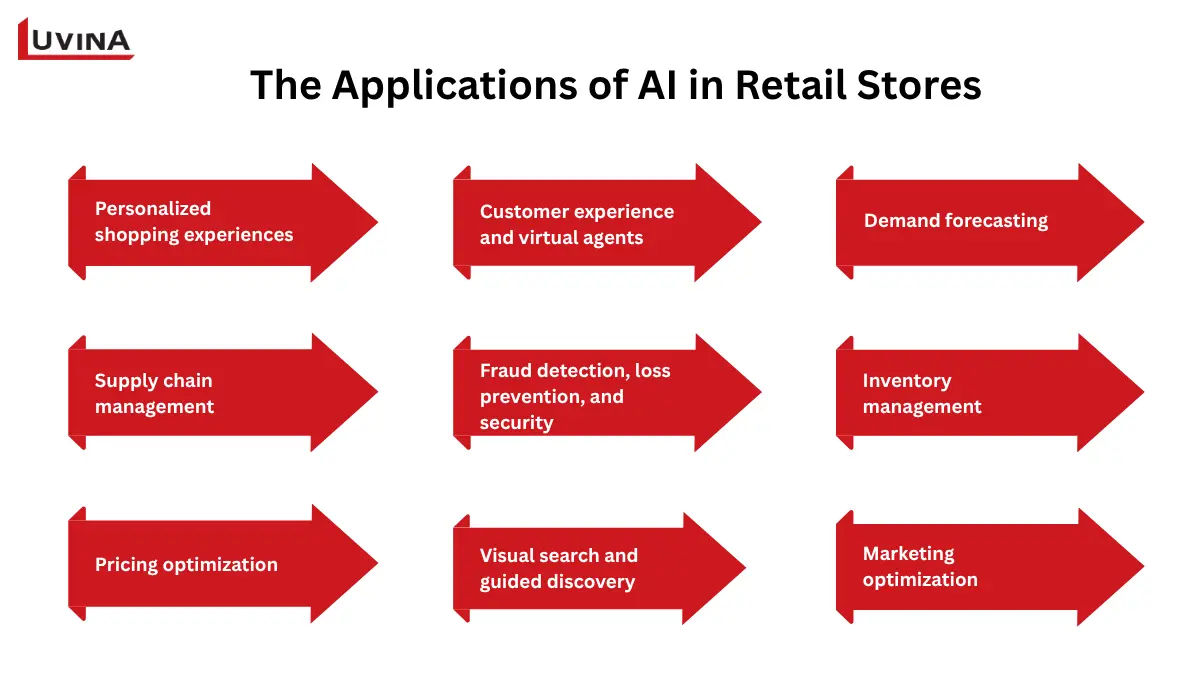
Personalized shopping experiences
Personalization is the most visible impact of AI in retail stores. AI algorithms analyze customer behavior, preferences, and past purchases in order to provide personalized recommendations and changing prices. Retailers utilize such insight in order to create hyper-personalized experiences that drive conversion rates, loyalty rates, and engagement.
Companies such as Amazon and Netflix are perfect AI in retail examples in which products are suggested based on browsing and purchase history and dynamic pricing delivers discounts/percentage off prices targeted for individual customers’ preferences.
Customer experience and virtual agents
AI-supported chatbots and virtual assistants provide instant solutions and guidance to shoppers, as well as arranging orders quickly and efficiently. Natural language processing provides conversations that resemble human discourse. Generative AI allows customers to problem-solve through complex issues and encourages a more interactive experience. In the context of AI in retail stores, virtual assistants support omnichannel interaction with customers when moderating online and in-store customer experiences.
Demand forecasting
Machine learning and predictive analytics are allowing retailers to forecast demand at high levels of accuracy. AI in retail stores can take sales data, insights into customer behavior and perceptions, and apply current market trends to drive precise inventory optimization, reduce redundant spending from excessive inventory, and enhance the speed to adjust quickly to fluctuations in the marketplace. Grocery store chains, for instance, automate daily ordering-loop functions to maximize available shelf space while minimizing spoilage is a practical artificial intelligence in retail examples.
Supply chain management
AI optimizes backend operations, such as inventory management, supplier management, and logistics. AI in retail stores can automatically reorder low-stock items, schedule a transportation route, and reschedule their plans based on data in real time. A company like Walmart will use AI algorithms to determine efficient routing and delivery for customers while accounting for potential disruption in their supply chain or stock delivery to customers. These are all great use of AI in retail, improving operational resilience.
Fraud detection, loss prevention, and security
Security and loss prevention in retail are particularly important. AI-based systems monitor transactions, looking for deviations to prevent fraud and improve cybersecurity. In AI in retail stores, they act as a layer of protection for the retailer and customer, analyzing deviations and patterns to study the activity that is or could be illegal. Online marketplaces and any financial platform will similarly use AI in retail examples by monitoring data risk reduction and transaction monitoring plays a key role in such platforms.
Inventory management
Optimized inventory guarantees goods are ready when clients demand them. Predictive analytics helps AI in retail stores anticipate inventory needs, automate replenishment, and lower holding expenses. A real example of the use of AI in retail, merchants such as Harrods and COOP Group use AI-based systems to keep ideal inventory levels, reducing excess expenses by around 25% and cutting stockouts by up to 30%.
Pricing optimization
Retailers may dynamically price products in real-time depending on demand, competition, and purchasing behavior, thanks to artificial intelligence-driven pricing. This enables maximum revenue and customer interaction in AI in retail stores. Automated promotions, seasonality, and loyalty-based pricing created a competitive advantage and improved the shopping experience.
Visual search and guided discovery
AI-powered visual search lets customers upload photos and discover products with comparable qualities. Guided discovery proactively suggests products by tracking browsing patterns. These technologies allow AI in retail stores to increase cross-selling opportunities, improve engagement, and enable customers to discover products.
For example, fashion and interior design companies have implemented AI in retail examples to drive sales through visual search and real-time recommendations.
Marketing optimization
AI assists retailers in improving programs by employing predictive analytics, multichannel targeting, and automated A/B experimentations. Through the assessments of customer behavior and contributions, AI allows for hyper-personalized marketing strategies in AI in retail stores, resulting in enhanced rates of customer conversion and retention. Brands like Michaels have used generative AI to personalize in excess of 95% of their campaigns.
How AI integration aligns with retail system integration & development services
I in retail stores succeeds when integrated naturally into a retailer’s system architecture. This ensures seamless alignment with ERP, CRM, and e-commerce platforms. Retailers may guarantee automation, predictive analytics, and personalization operate without a hitch across all channels by matching artificial intelligence distribution with system integration and development services.
Usually involving evaluation of existing systems, design of artificial intelligence (AI) to fit workflows, and synchronized testing and deployment, the integration process helps AI to:
– Automatically maximize stock levels by linking inventory and ERP systems.
– Connect CRM systems to produce customized promotions based on consumer data.
– From physical stores to online systems, support multi-channel operations.
– Enable iterative improvement of artificial intelligence models and continuous monitoring.
This method guarantees that artificial intelligence improves rather than interferes with already established processes when done via AI solutions for retail. AI in retail stores is a primary feature with enhanced operational efficiencies, consumer experiences, and business impact decision-making. Such integration services enable companies to scale their artificial intelligence adoption with confidence, to utilize predictive insights, feasibility, and profitability into actionable business improvements while maximizing system coherence and maintainability.
Challenges, risks & best practices for AI in retail stores
There is enormous promise associated with implementing AI in retail stores, but also challenges to overcome. In order to experience the potential benefits of retail AI, retailers will have to tread carefully through operational, technical, and organizational challenges. The next section identifies the main challenges and risks in terms of organizations’ commitment when deploying AI in retail stores, along with solutions.
1. Key challenges and risks of AI in retail stores
Applying AI in retail stores offers great rewards, yet it also presents difficulties that merchants have to negotiate with care.
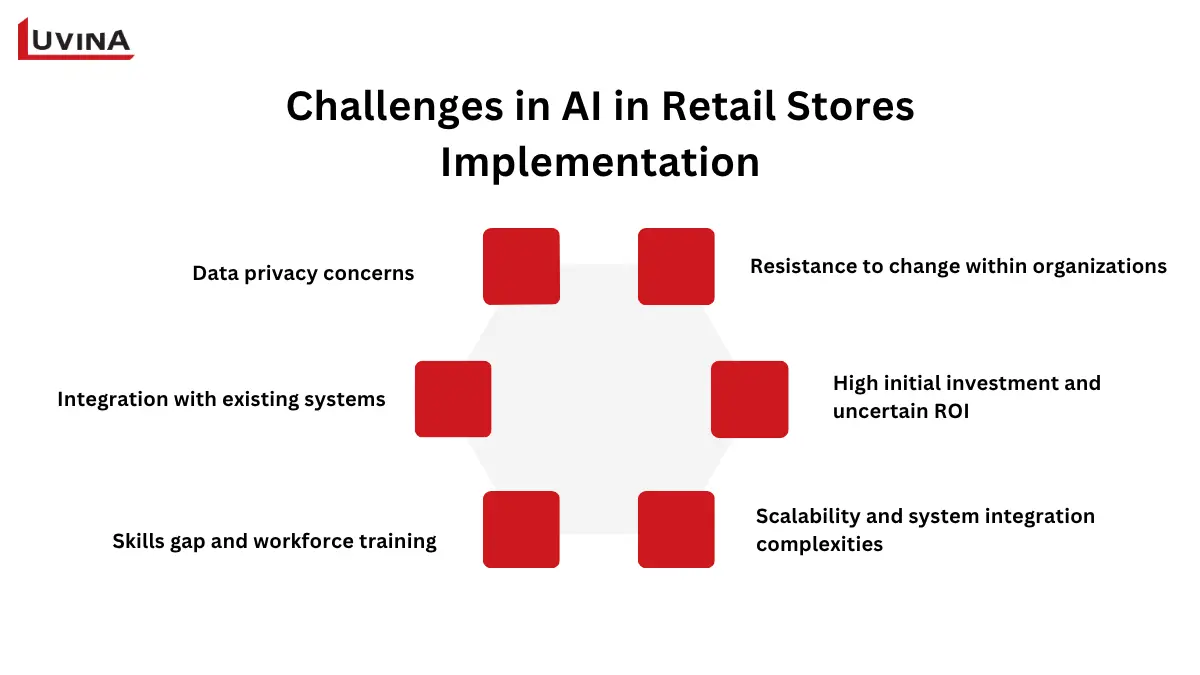
Data privacy concerns
Retailers create huge volumes of data about customers, from browsing behavior and purchase history to social media interactions. Although regulations, such as GDPR and CCPA, increase the complexity of compliance, poor performance with customers’ data could lead to privacy violations and erode trust.
Solution: Construct retail artificial intelligence systems centered on transparency and regulatory compliance. Centralize, cleanse, and organize data by means of integrated data management systems. Encourage data literacy within the company to guarantee top-notch input for artificial intelligence systems.
Integration with existing systems
Many retail stores operate on legacy systems, including outdated point-of-sale systems, disparate CRMs, and isolated data storage. Integrating AI in retail stores in a legacy system can create erratic flows of data that disappoint.
Solution: Make data readiness a priority and implement customized AI models to take existing legacy systems into account. Encourage design that focuses on interoperability and data exchange through a phased rollout. With intentional integration practices, implementing AI in retail stores can elevate customer experience (CX) instead of becoming disruptive.
Skills gap and workforce training
Effective use of artificial intelligence calls for particular expertise in retail operations, information technology, and data science. Many stores’ lack of internal expertise restricts their capacity to create, distribute, and upkeep AI in retail stores solutions.
Solution: Collaboration between departments and development of the workforce are about investments. Collaborate with AI solution providers (or consultants) to fill experience and/or knowledge gaps. Upskill front-line employees to harness the potential of AI systems. Understand that the operational and customer-facing teams will need to trust and understand the outcome and capability of AI.
Resistance to change within organizations
The introduction of artificial intelligence tends to spark fears about job loss, loss of power, and simply due to complexity. Cultural resistance may slow down implementation and limit ROI for the organization.
Solution: Use empathy and communication wherever possible. Messaging should focus on how AI in retail stores improves the role of a retail employee instead of replacing them. Ask employees to engage in the AI system onboarding projects and provide aspects of reskilling.
High initial investment and uncertain ROI
Incorporating AI in retail stores calls for significant initial expenditures in talent, hardware, and software. Particularly for small and medium businesses, justifying return on investment (ROI) is challenging because immediate returns may not be apparent.
Solution: Set reasonable expectations and track small advantages, including increased efficiency, better client experiences, and more informed decision-making. To lower initial capital expenditure, phase investments purposefully use cloud-based or modular AI in retail industry solutions.
Scalability and system integration complexities
Often exposed by scaling artificial intelligence pilots for company-wide implementation presents challenges, including inconsistent data standards, incompatible legacy systems, and limited internal knowledge. About 75% of merchants have trouble when going from pilot to full-scale deployment.
Solution: Plan from the start for scalability. Develop design artificial intelligence solutions that help departments standardize data procedures and fit in with current infrastructure. Work with seasoned system integrators to guarantee that AI in retail stores can be developed quickly without interfering with operations.
2. Best practices for AI implementation in retail stores
Strategically and deliberately introducing AI in retail stores gives the best results. Following industry best practices enables retailers to use AI solutions for retail effectively and stay clear of typical errors.
– Start with a precise plan by selecting a few core sectors – personalized marketing or automated inventory, for example – to produce actual results.
– Organized, accurate, and clean data helps AI in retail stores to learn and make wiser choices.
– Choose the correct artificial intelligence tools and collaborators to guarantee the technology works seamlessly with your existing systems.
– By utilizing artificial intelligence to provide useful suggestions and assistance, keep human contact when necessary to focus on customer experience.
– Regular monitoring of AI in retail stores models guarantees their accuracy and fulfillment of company objectives.
– Follow privacy regulations and retain strict data policies to guard consumer information.
– Train workers so they can use AI in retail stores correctly in their everyday tasks.
The future of AI in retail: What’s next for store experiences
AI in retail is shaking up this sector in a big way. As AI in retail stores develops, stores aren’t just running the same old way anymore, and shopping is getting a serious upgrade. With smarter tech in their hands, retailers can make everything faster, smoother, and way more personal for each shopper.
Hyper-personalization: Stores use AI to dig into your browsing history, what you’ve bought before, and even what you like on social media. All that data helps them figure out what you actually want. Thanks to the AI in retail stores, the product recommendations get spot-on, and the deals and promotions start to feel like they’re made just for you.
Cashier-less stores: No more lines. You just grab what you want and walk out. Cameras and sensors track what you take and charge you automatically. It’s shopping without the hassle.
Smart shelves combined with AI in retail stores, IoT sensors, and RFID technology: Real-time stock information for retailers to help maintain inventory more efficiently, as well as avoid stockouts.
Augmented reality (AR): Enhanced AI in shopping because customers could virtually try things on, such as clothes, visualize what furniture would look like, or engage with products directly from home.
Robotics: Continue to expand in stores and warehouses to assist with tasks such as restocking products, cleaning, and order fulfillment.
Advancements in machine learning: Facilitate AI systems taking on autonomous functions that will help optimize supply chains, model customer shopping behavior, and provide proactive solutions for retail store challenges.
Ethical AI frameworks: Ensure fairness, transparency, and privacy, which will be critical as customers and regulators increasingly scrutinize how AI in retail stores uses data.
How to get started: Steps for retailers & IT outsourcing partners
Bringing AI in retail stores into reality isn’t something you just jump into – you need to actually dig in and plan it out. First, companies have to get a clear picture of what they already have. That means checking out their current systems, making sure their data’s in good shape, and pulling together the right people to make sure AI sticks around and works well.
If you’re a retailer – or working with one as an IT partner – here’s how to get started with AI solutions for retail, step by step.
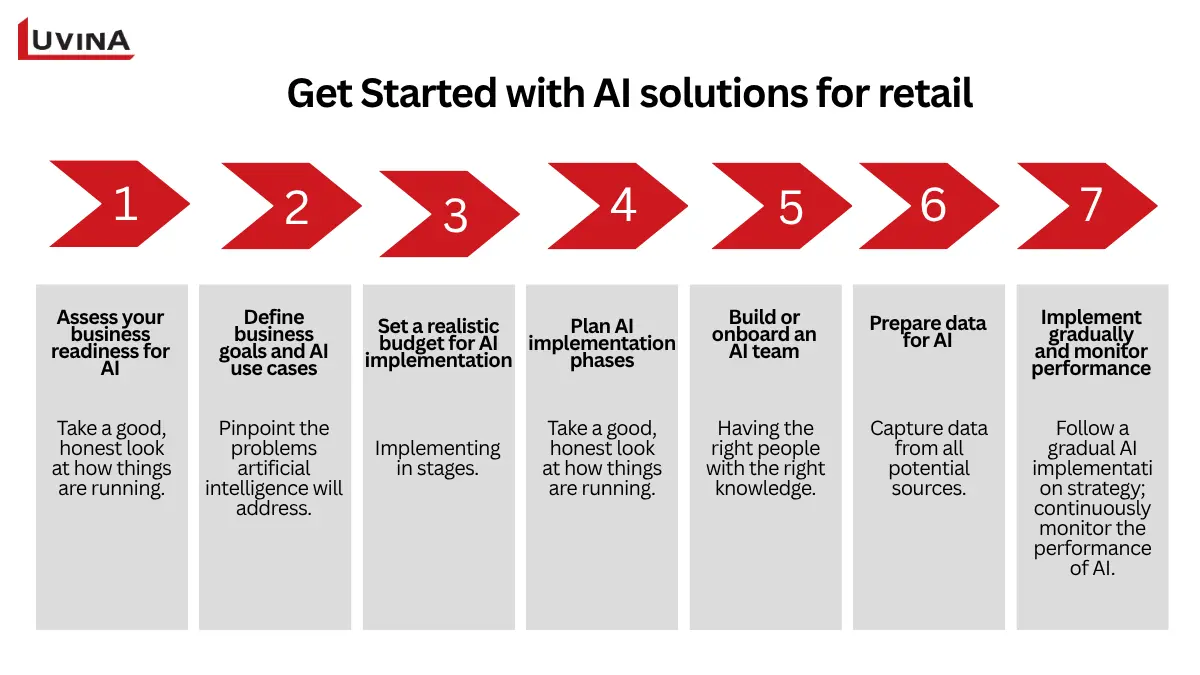
Step 1: Assess your business readiness for AI
Take a good, honest look at how things are running. Is your infrastructure solid? Are your team and processes actually working the way you want? Check your data systems – POS, CRM, inventory – make sure everything’s easy to get to and in order. If anything’s a mess, fix it. And look at your digital sales channels too. How online are you, really? Your store, digital marketing, everything – figure out what’s working and where you need to pick up the slack.
Employee abilities and receptiveness to using new technology have to be taken into account together with the efficacy of present workflows and customer interaction methods. Assessing preparedness enables the company to identify shortcomings and get ready to effectively include AI in retail stores.
Step 2: Define business goals and AI use cases
Choosing the best AI in retail commerce solutions requires clear company objectives. Retailers should pinpoint the problems artificial intelligence will address, including operational efficiency improvement, inventory optimization, or customer experience enhancement.
Stuff like demand forecasting, personalized product recommendations, inventory optimization, or fraud detection – these are just some ways you can use AI. It helps to set clear goals, like cutting service response times or getting more sales from personalized offers. That way, you can actually track what’s happening and prove that AI is making a difference.
Step 3: Set a realistic budget for AI implementation
Including AI in retail stores calls for sensible financial planning, including technology, infrastructure, expert personnel, and continuous maintenance. Companies should balance spending with projected profits, keeping software, hardware, training, and operational support expenses in mind. Retailers must give spending on areas offering the most value top priority and guarantee that artificial intelligence projects are economically viable both short and long run.
Step 4: Plan AI implementation phases
To lower risk and maximize effectiveness, artificial intelligence adoption should be done in stages. To assess the technology and get input, merchants should begin with a pilot project in one particular department or store. Workers ought to learn how to properly use innovative instruments.
Keep an eye on the results. When you see what’s working (and what’s not), you can tweak things before rolling them out everywhere. Going slow makes sure the AI in retail stores fits in smoothly and doesn’t mess up the way your stores already work.
Step 5: Build or onboard an AI team
An important factor that makes AI successful is having the right people with the right knowledge. Retailers can hire AI specialists or partner with IT outsourcing experts who provide both technical and strategic guidance.
Besides, the team should also train the employees internally so that they can manage AI tools efficiently. Building expertise inside the company is a way of guaranteeing the long-term survival, and it also enables the business to have the full use of AI in retail stores capabilities and still retain control over the AI-driven processes.
Step 6: Prepare data for AI
Without a doubt, data stands at the center of any AI venture and its preparation mandates utmost care. Retailers should capture data from all potential sources. These could be sales transactions, customer interactions, inventory records, loyalty programs, or even market trends and competitor pricing coming from external sources.
First, cleanse and standardize data to remove errors and duplicates. Furthermore, having data centrally and securely stored will not only allow AI tools to access the data but will also keep the data safe. The right labeling and formatting enable AI models to detect patterns and make correct predictions.
Step 7: Implement gradually and monitor performance
AI systems, in general, require time to learn and get better. Hence, retailers should follow a gradual AI implementation strategy, beginning with a small-scale application and then moving on to larger areas. Besides that, it is very important to continuously monitor the performance of AI, make necessary changes in the algorithms, and get the feedback of employees and customers. With this method, companies have the opportunity to perfect their AI models, gauge them, and then take them to a wider audience in a safe way. At the same time, it ensures that AI in retail stores brings real value not only in one department but throughout the organization.
FAQ
1. How is AI being used in retail stores?
AI in retail stores helps personalize shopping experiences, optimize inventory, and speed up checkout processes, making store visits smoother and more engaging for customers.
2. Will AI replace retail jobs?
AI in retail stores will mostly enhance employee roles rather than replace them. Staff may need to learn new skills, and retailers will create positions to manage and improve AI systems.
3. How do retailers use generative AI?
Retailers use generative AI to analyze trends, create product descriptions, and power chatbots that interact naturally with customers.
4. How can AI improve inventory and store management?
AI helps retailers predict demand, reduce waste, replenish shelves efficiently, and optimize product placement to boost sales and minimize losses.
5. How are big stores using AI in customer interactions?
Large retail chains use AI to enhance mobile searches, offer personalized recommendations, and provide faster, smarter assistance during the shopping journey.
Conclusion
AI in retail stores is instrumental in creating personalized experiences for customers, optimizing operational efficiency, and enabling data-driven decisions. Incorporating AI in your retail business is undoubtedly a step forward towards the future in a competitive market.
Luvina can provide full support to retailers who want to incorporate AI in their operations by supplying them with expert consulting, customized software development, and integration services. Our team collaborates with clients to conceive and execute AI solutions that not only blend with present systems but can also be used to coordinate completely new retail applications. With a lot of experience and history in supporting retail partners, Luvina is facilitating retailers in making substantial gains while at the same time ensuring the smooth implementation of AI technologies.
Take the next step toward smarter retail operations with AI in retail stores. Connect with Luvina’s experts today.
Resources
- https://www.ibm.com/think/topics/ai-in-retail
https://www.sap.com/resources/ai-in-retail - https://mobidev.biz/blog/artificial-intelligence-ai-in-retail-use-cases-challenges-best-practices#h12
- https://www.leewayhertz.com/ai-in-retail/
- https://www.linkedin.com/pulse/ai-integration-retail-navigating-challenges-opportunities-workmaple-2jbse
- https://euristiq.com/ai-in-retail/
- https://www.mindinventory.com/blog/ai-in-retail/#Steps_to_Successfully_Implement_AI_in_Retail_Operations
READY TO START A PROJECT?
Our experts are eager to explore your needs.


Read More From Us?
Sign up for our newsletter
Read More From Us?
Sign up for our newsletter