




NemoClaw vs OpenClaw: Key Differences and When to Use Each


TL;DR: NemoClaw and OpenClaw are not direct competitors.
OpenClaw is an open-source AI agent framework designed for fast experimentation and local workflows.
NemoClaw, developed by NVIDIA, extends OpenClaw with a secure, sandboxed execution layer, making it suitable for enterprise and production environments.
In practice, teams often use OpenClaw for prototyping and NemoClaw for deploying controlled, production-grade AI systems.
The debate around NemoClaw vs OpenClaw often starts from the wrong assumption that they are direct competitors. In reality, they represent two different stages of how autonomous AI agents are evolving. While OpenClaw focuses on enabling fast experimentation and local agent workflows, NemoClaw is built to bring structure, security, and production-grade control on top of that foundation.
So instead of asking which one is “better”, a more useful question is: what role does each play in the AI stack of 2026? This article breaks down NemoClaw vs OpenClaw to help you understand when to use each and why they are more complementary than competitive.
What Is OpenClaw?
OpenClaw is an open-source AI agent framework designed for rapid experimentation and local deployment. It enables autonomous agents to execute multi-step workflows, integrate with external tools, and operate continuously with minimal setup.
From a business perspective, OpenClaw is typically used in early-stage development, where speed, flexibility, and iteration matter more than strict governance or security controls.
However, in practice, one of the key limitations of OpenClaw is its relatively limited built-in security model, especially for production environments.:
– Prompt injection can manipulate agents into unsafe actions
– Third-party skills may introduce malware or vulnerabilities
– Sensitive data (files, API keys) can be exposed
– No built-in sandboxing or strict access control
– Autonomous actions can run without human oversight
What Is NemoClaw?
NemoClaw is an AI agent orchestration stack developed within the NVIDIA ecosystem, built on top of OpenClaw to address enterprise requirements such as security, governance, and controlled execution.
Instead of replacing OpenClaw, NemoClaw introduces a sandboxed runtime environment, policy enforcement, and auditability, enabling organizations to run autonomous agents safely in production.
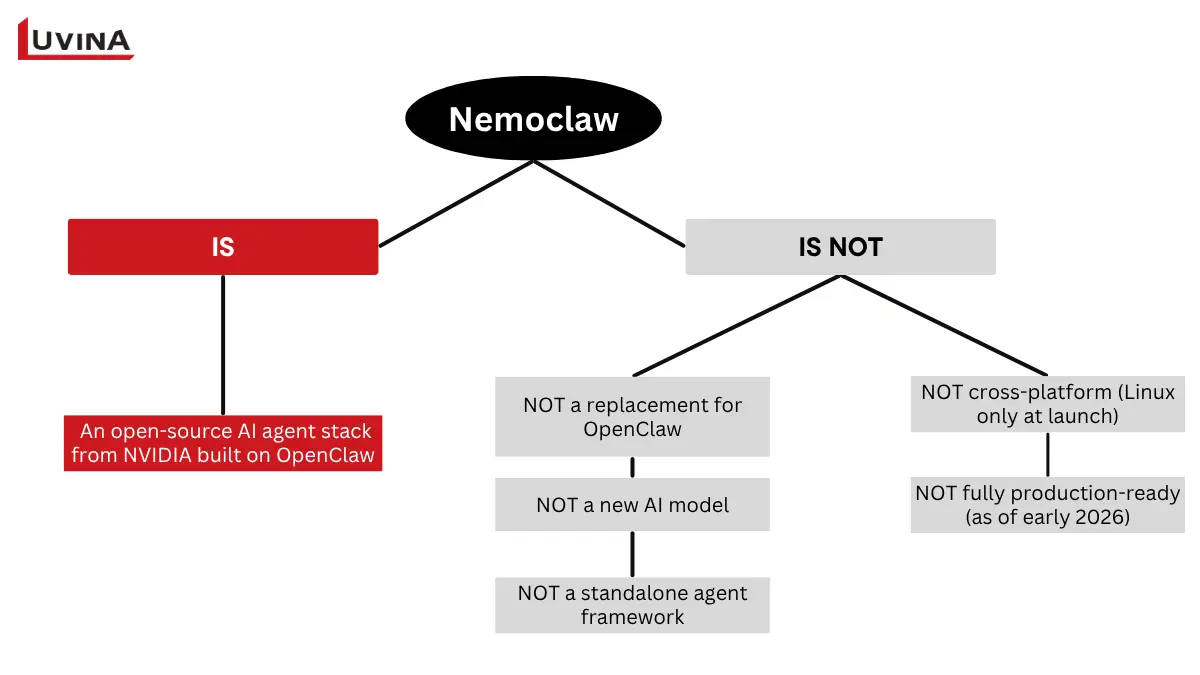
NemoClaw is not a replacement for OpenClaw at all
When comparing Nemoclaw vs Openclaw, it’s also important to clarify what Nemoclaw Nvidia is NOT. It is:
– NOT a replacement for OpenClaw
– NOT a new AI model
– NOT a standalone agent framework
– NOT cross-platform (Linux only at launch)
– NOT fully production-ready (as of early 2026).
NemoClaw vs OpenClaw
At first glance, comparing NemoClaw and OpenClaw can feel confusing. They both enable autonomous AI agents and solve similar problems. Understanding the differences is key to evaluating Nemoclaw vs Openclaw in practice.
OpenClaw prioritizes flexibility and fast iteration. It allows agents to run freely with minimal restrictions, making it ideal for testing ideas, building prototypes, and exploring workflows.
NemoClaw AI, on the other hand, introduces structure. It runs the same type of agents inside a sandboxed environment, where policies define what actions are allowed, what data can be accessed, and when human approval is required. This difference becomes critical when moving from personal projects to business-critical systems – one of the main reasons why Nemoclaw vs Openclaw is increasingly discussed in enterprise contexts. Here’s a concise comparison:
| Openclaw | Nemoclaw | |
| Purpose | Experimentation, prototyping | Production, enterprise use |
| Execution model | Unrestricted agent execution, minimal restrictions | Policy-defined, controlled execution |
| Security and control | Limited built-in safeguards require custom security implementation | Sandbox + policy engine + access control |
| Production readiness | Not production-ready by default, local-first | Designed for structured, long-running systems |
| Infrastructure | Developer-friendly setup | Containerized, integrated environments |
| Tech stack | TypeScript, Node.js | Python, NeMo ecosystem |
| Performance | CPU-friendly, flexible | GPU-optimized (NVIDIA ecosystem) |
| Ecosystem | Large community skills, extensions | Governance and enterprise-grade controls |
Comparison table of differences between NemoClaw vs OpenClaw
Looking deeper into Nemoclaw vs Openclaw, the biggest gap is in execution and security. OpenClaw’s open-ended design allows agents to act with broad autonomy, which is powerful for creativity but risky in sensitive environments. NemoClaw addresses this by enforcing boundaries (through sandboxing, policy controls, and auditability), making it more aligned with enterprise requirements like compliance and data protection.
Another key difference is the deployment mindset. OpenClaw is often used locally or in self-hosted setups, where a single developer has full control. NemoClaw Github is built for scale, supporting structured deployments across cloud or on-prem systems with governance layers in place. This reflects a broader industry shift: from individual experimentation to organization-wide AI systems.
Security Deep Dive: Why NemoClaw Exists
As AI systems evolve, we are moving from simple, stateless model interactions to persistent, agent-based execution. OpenClaw showed that autonomous agents can run tasks continuously and connect to tools, but it has major limitations: no enforced security boundaries, minimal control, and unpredictable behavior in sensitive or shared environments. For personal experiments, this is fine, but in production, it poses serious risks. In real-world enterprise environments, these risks are not theoretical. Unrestricted agents can accidentally expose internal data, trigger unauthorized actions, or interact with external systems in unintended ways.
NemoClaw Nvidia addresses these gaps by wrapping OpenClaw in a controlled, sandboxed environment. Agents can only access defined resources, and policy-based rules govern what actions they can take and when human approval is needed. This makes them safe, auditable, and suitable for real-world deployments.
Nemoclaw vs Openclaw highlights a shift from experimentation to secure, production-ready AI. NemoClaw exists not to replace OpenClaw, but to make autonomous agents usable in environments where control, security, and reliability matter.
In enterprise environments, these risks translate directly into business impact — including data breaches, compliance violations, and operational disruption.
Without enforced boundaries, autonomous agents can unintentionally access sensitive systems, trigger unauthorized actions, or expose proprietary data. This is why security and governance are becoming critical factors in AI adoption decisions.
When to Use: OpenClaw or Nemoclaw
OpenClaw is best suited for situations where flexibility, experimentation, and rapid iteration are more important than strict security or production readiness. When comparing Nemoclaw vs. Openclaw, it is the ideal choice for personal projects, learning, and early-stage development. OpenClaw allows developers to iterate fast and explore creative workflows in a controlled, low-stakes environment.
NemoClaw is ideal for situations where security, control, and reliability are critical. Unlike OpenClaw, it is built for production environments where agents need to run continuously, follow strict policies, and handle sensitive data. NemoClaw is the go-to choice for teams moving from experimentation to real-world deployment.
To choose between NemoClaw vs OpenClaw, it helps to map your specific needs to the right solution:
| Demand/ Use case | Solution |
| Experiment, learn, prototype quickly | OpenClaw |
| Run locally and test integrations | OpenClaw |
| Build simple, low-risk automation | OpenClaw |
| Need security, control, policy enforcement | NemoClaw |
| Run production systems & scale teams | NemoClaw |
| Handle sensitive data, compliance, and high performance | NemoClaw |
When to choose NemoClaw and OpenClaw
Many teams follow a sequential approach: prototype quickly with OpenClaw, then move validated agent behaviors into NemoClaw to run safely and reliably in production.
>>> Read more: Applications of Generative AI
Should You Migrate from OpenClaw to NemoClaw?
After comparing Nemoclaw vs Openclaw, you must want to know if you should migrate to Nemoclaw. Deciding whether to move from OpenClaw to NemoClaw depends on your priorities. If you need security, controlled execution, and production readiness, migration makes sense.
Migration requires a fresh OpenClaw installation. You cannot simply layer NemoClaw on an existing setup. Skills, configurations, and memory files from OpenClaw can be copied into NemoClaw’s sandbox, but they will now operate under policy restrictions. Any previously unrestricted actions, like network calls, may be blocked until explicitly allowed.
The goal is not to replicate your old environment exactly, but to run the same agents safely. Migration involves:
– Writing YAML policies
– Defining filesystem and network boundaries
– Configuring inference routing.
NemoClaw Nvidia also enforces a rigid blueprint system with 5 stages: resolve, verify, plan, apply, and status to ensure secure and verifiable deployments.
If your workflow demands enterprise-grade security and controlled production environments, migrating to NemoClaw is the practical step. For experimental or local projects, OpenClaw remains sufficient.
The Knowledge Transfer Advantage
One key benefit of NemoClaw AI is that it builds directly on OpenClaw, so everything you learn about OpenClaw agents applies seamlessly. In the discussion of Nemoclaw vs Openclaw, this means your existing skills, memory setups, and scheduling workflows remain relevant.
Skills in both environments are simple text files, and the core agent behavior hasn’t changed. NemoClaw adds a sandbox and policy engine on top, rather than rebuilding the system from scratch. This makes it easier to transition from experimentation to controlled production.
Practically, this means that investing time in learning OpenClaw today lays the groundwork for NemoClaw tomorrow. Your expertise transfers, and your agents can move into secure, policy-enforced environments without starting over.
FAQ
1. Is NemoClaw a replacement for OpenClaw?
No. NemoClaw is a secure, enterprise-grade wrapper built on top of OpenClaw, not a replacement.
2. What is the difference between NemoClaw and OpenClaw?
OpenClaw is flexible, model-agnostic, and runs on any hardware. NemoClaw is GPU-optimized via NVIDIA NeMo, prioritizing secure, high-performance execution.
3. Does NemoClaw work on Windows or macOS?
No. NemoClaw runs on Linux only (Ubuntu 22.04+)
4. What security problems does NemoClaw solve that OpenClaw has?
It prevents unrestricted agent access to files, networks, and sensitive data, addressing OpenClaw’s default “allow-all” behavior.
5. Can I use Claude or GPT-4o with NemoClaw?
Yes, both Claude and GPT-4o are compatible.
6. Is NemoClaw production-ready?
Not yet. As of March 2026, it is still alpha software.
7. How do I install NemoClaw?
Set up a containerized Linux environment (Ubuntu 22.04+), install dependencies, run the automated script, and follow the onboard configuration wizard.
8. Who should use NemoClaw vs OpenClaw?
OpenClaw suits solo developers and experimentation; NemoClaw is aimed at enterprises needing security and controlled production environments.
Conclusion
In the debate of Nemoclaw vs Openclaw, it’s clear that these tools serve different purposes rather than replacing each other. For most teams, a sequential approach works best: start with OpenClaw to validate ideas quickly, then migrate to NemoClaw when you need safe, scalable, policy-driven deployments.
For personal projects or experimentation, OpenClaw remains sufficient, but for anything involving production systems, sensitive data, or regulated workflows, NemoClaw is the safer choice. Its alpha-stage release may have rough edges, but its security architecture addresses critical risks effectively.
As AI agents move from experimentation to production, the challenge is no longer just building them, but deploying them securely and at scale.
Luvina helps enterprises design, develop, and implement AI agent systems with a focus on security, integration, and long-term scalability.
Contact our experts to explore how your business can adopt agentic AI safely and effectively.
Resources
- https://www.blockchain-council.org/agentic-ai/how-nemoclaws-different-from-openclaw-detailed-guide/
- https://ai-muninn.com/en/blog/nemoclaw-what-it-is-why-it-exists
READY TO START A PROJECT?
Our experts are eager to explore your needs.


Read More From Us?
Sign up for our newsletter
Read More From Us?
Sign up for our newsletter