



Software Re Engineering and Modernisation Explained


57% percent of companies have weekly disturbances brought on by flaws in their core IT systems, according to the KPMG Global Tech Report 2024. Right now, even high-performing software can silently become a company bottleneck. Software re engineering and modernisation now go beyond just patching dated code. It’s about making sure your systems can meet market demands, security regulations, and new technologies.
This comprehensive guide unpacks the concepts of software re-engineering and modernisation, touching on their differences, respective occasions for use, and the risks involved if the wrong decision is made. Understanding is enhanced by illustrations of practical scenarios and lucid explanations. You will be equipped with the wisdom to make your software ready for the future long before legacy systems become a barrier to your business growth.
What are Software Re engineering and Modernisation?
Software re engineering and modernisation is the set of techniques used to modify already developed software systems so they maintain their capacity to meet evolving corporate demands, user expectations, and technological requirements. Although often cited together, these two terms tackle various degrees of change and fulfill different tactical needs.
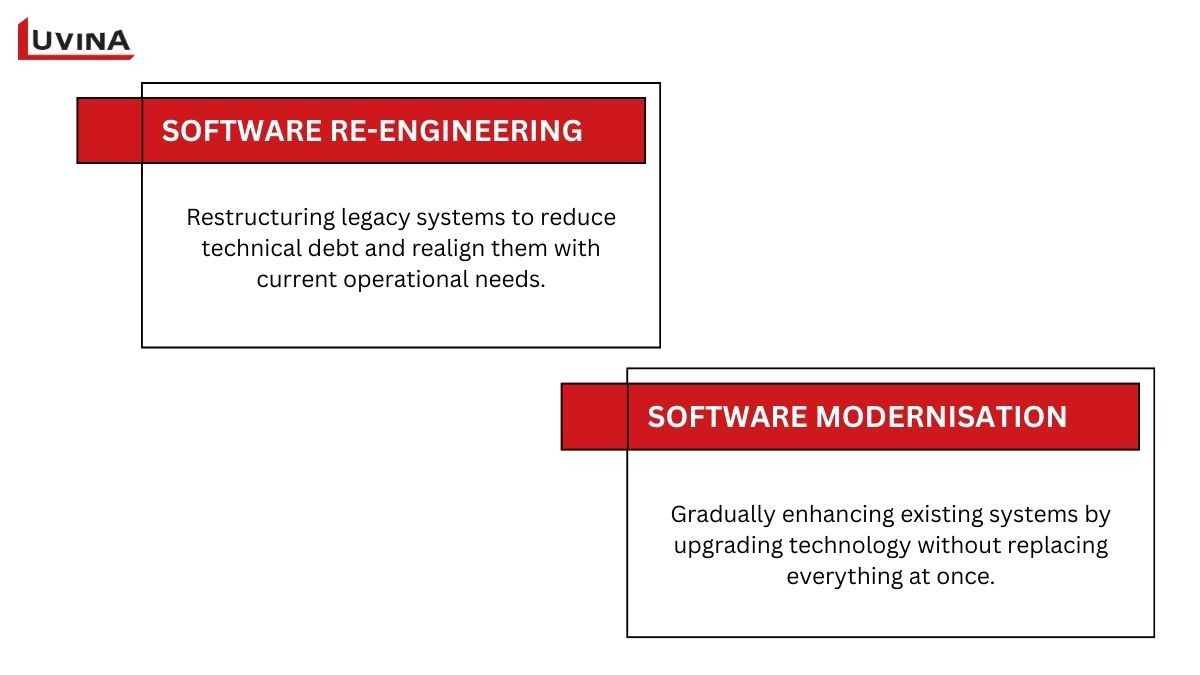
Software re-engineering and modernisation differ in their degree of change and tactical objectives
– Software re-engineering centers on thorough examination and reorganization of a current system. Re-engineering is often thought about when legacy systems have racked up large technical debt or when their original design no longer matches current operating needs.
– Software modernisation follows a more gradual and realistic course. Modernisation rather enhances and builds upon what already exists rather than changing everything all at once.
Software re engineering and modernisation are rather intertwined rather than mutually exclusive. Many transformation paths start with modernity to stabilise systems, lower technical debt, and offer fast wins without upsetting operations. Selectively, then re-engineering is used where a more significant structural adjustment is needed.
Why Businesses Need Re-engineering and Modernisation
Many organisations will reach a point where they can no longer compete with the market demands, regulations, and user expectations due to outdated systems, and software engineering is a strategy to adjust their technology to the current and future objectives of the organisation.
Some of the most common reasons organisations invest in software modernization include:
– Ability to grow and change: Modern architectures allow for expanded workloads, improved data management, and growing company demands as they arise and develop over time, without needing continuous changes to the way things are done.
– Possessing fewer long-term costs: A reliance on old-school systems, plus having few people skilled or knowledgeable in that area, will mean lower costs to maintain the systems and less chance of system failure.
– Quicker time to market: Using efficient methods of development combined with modern software will permit a fast release cycle of feature sets, bug fixes, and enhancement releases.
– Improve risk management and compliance: Upgrading software will help to meet changing legal obligations and reduce reputational, cyber, and legal risks.
– Stronger security attitude: Fixing inherited flaws reduces data loss and breach defense.
– Higher developer productivity: More developer output results from current technologies and cleaner codebases, which let teams operate more confidently and effectively.
– Business process optimisation: Refactoring and focused re-engineering eliminate waste, hence increasing the agility and response of company operations.
– Sustainable competitiveness: Combining stability with innovation, software re engineering and modernisation keeps companies relevant, flexible, and ready for expansion in the future.
Software Re-engineering Explained
Software re-engineering focuses on upgrading a current system without altering its underlying business logic, within the context of software re-engineering. While maintaining existing processes and capabilities, the goal is to create a program more secure, simpler to maintain, and better suited for modern technologies. Re-engineering targets more extensive structural and architectural changes, but refactoring emphasizes mostly enhancing code quality without changing the general design of the system, to explain the differences between software reengineering and refactoring.
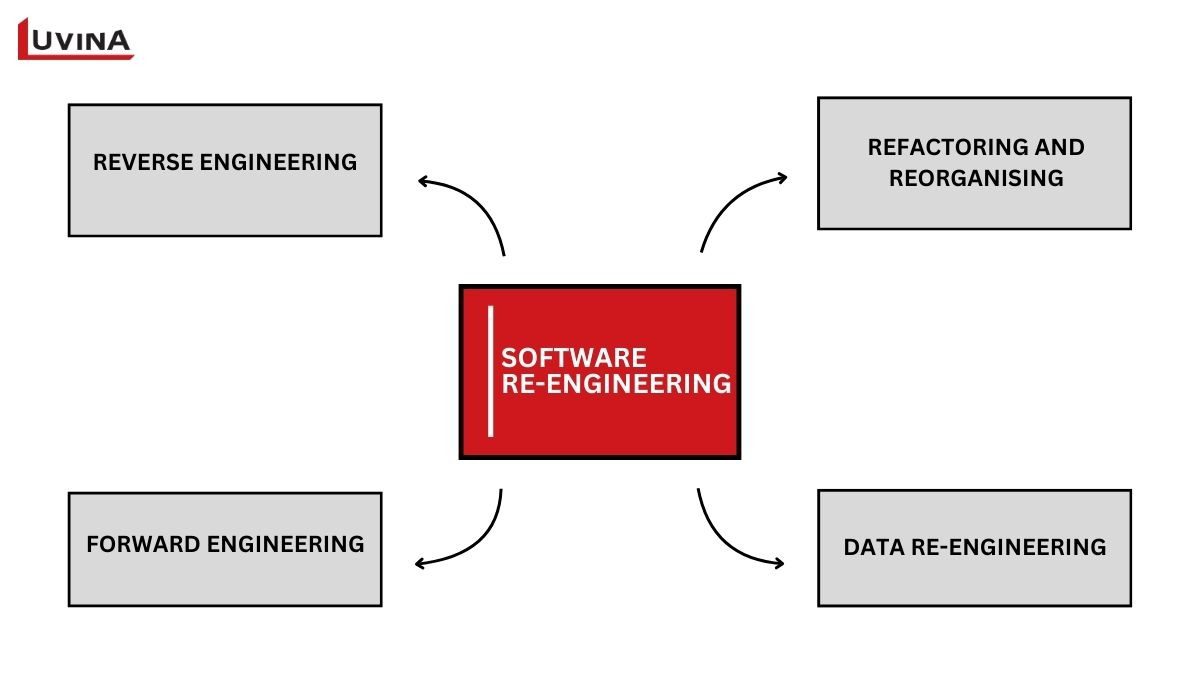
Some processes in software engineering
It is generally accepted that a company will engage in the process of software re-engineering when its system continues to deliver value to the company but is experiencing issues, such as performance problems, increased costs associated with maintenance, outdated architecture, or a lack of ability to integrate with other systems, limiting its ability to grow.
This process will help to enhance the key technology elements of the system while limiting the impact on the business day-to-day operation of the company, rather than completely rebuilding the system. As a result, the majority of businesses are performing software re-engineering and modernization as this type of initiative balances risks, costs, and impact.
In software re-engineering and modernisation, software re-engineering aims to:
– Increase the reliability, scalability, and performance of the system.
– Cut long-term maintenance expenditures and technical debt.
– Enhance compatibility with current platforms and security.
– Extend the life of legacy systems without changing governing rules
Re-engineering’s ordered and well-defined procedure helps one to reach these objectives:
– Reverse engineering: Studying the current system to get architecture, data flows, and unsorted logic back.
– Refactoring and reorganising: Removing duplication, cleaning up code, and upgrading internal structure without affecting conduct
– Forward engineering: Applying contemporary design ideas, adding APIs, or enhancing architectural patterns.
– Data re-engineering: Rearranging and cleaning data structures to enhance consistency and support future expansion.
>> Learn more from an example, what Luvina did for a re-engineering project: Re-engineering legacy file storage and security systems
Software Modernization Explained
In the area of software re engineering and modernisation, the focus of software modernisation is placing an emphasis on the technology and operation models that power an application while ensuring that any existing business logic that remains relevant is retained. Similar to renovation, the structural framework for the software remains the same; however, all portions of the software located behind the walls, such as architecture, platforms and interfaces, are modernised to meet current demands for performance, security and scalability of all types of applications.
Legacy software modernization addresses outdated technologies, including frameworks, programming languages, infrastructure, and databases. Most projects include changing workloads to more adaptable platforms, cleaning integrations, refreshing user interfaces, and refactoring code. By matching systems with current technological criteria, modernization raises adaptability and efficiency instead of requiring a complete overhaul.
Depending on corporate objectives and technological limits, modernizing can assume many guises:
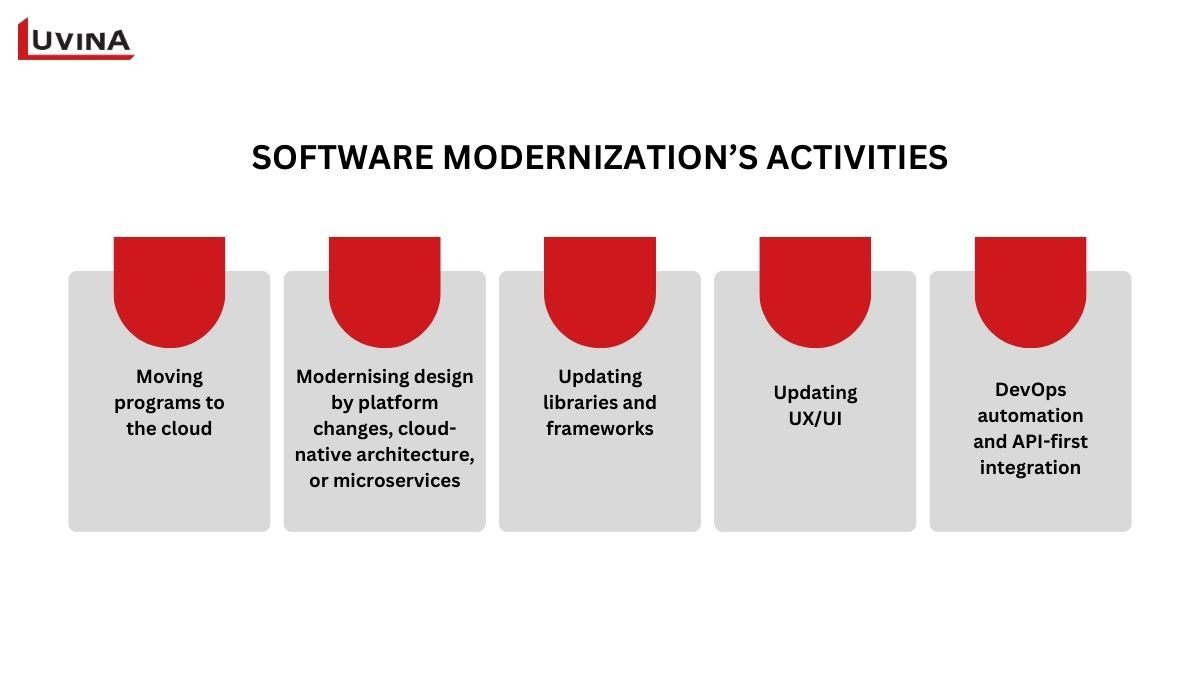
Key activities in software modernization
– Moving programs to the cloud helps to maximize cost effectiveness, availability, and scalability.
– Modernising design by platform changes, cloud-native architecture, or microservices.
– Updating libraries and frameworks to increase performance and sustainability.
– Updating UX/UI to improve user experience and usability.
– Introduction of DevOps automation and API-first integration to help with faster delivery.
In software re engineering and modernisation, some legacy systems are too inflexible to change via successive improvements. Modernization may then include replacing components of the system or developing a new remedy beside the ancient one to allow for a phased change.
>> Another real-life example, this time on modernization, a core type of job Luvina has become expert in: Modernising a 30-year-old legacy asset management system
How to Choose the Right Approach
The best method in a legacy system modernization plan depends on how much value your current system still provides, how adaptable its technological basis is, and how much risk your company can take during transition.
Before making their decision, companies should consider some critical elements directly impacting the result:
– The stability and usefulness of current commercial logic
– The present codebase’s maintainability, complexity, and age
– Integration requirements with current platforms and technology
– Restrictions on performance, scalability, and reliability
– Security, compliance, and operational risk exposure
– budget, deadlines, and internal technical capacity
These elements assist in deciding whether more profound change is needed or if just little changes will suffice.
Below is a simplified comparison to guide the choice of software re engineering and modernisation:
| Re-engineering | Modernization | Combined |
| – Business logic needs to change- Architecture is outdated or unmaintainable- Legacy tech is no longer supported- Deep structural change is unavoidable- Long-term redesign is the priority | – Business logic is still valid- Technology stack is outdated- UI/UX or performance needs improvement- Cloud or platform upgrade is needed- Fast ROI with low disruption | – Mixed system maturity- Some parts are stable, others are obsolete- Gradual change is required- Modernize first, re-engineer selectively- Balance speed, risk, and depth |
Appropriate use cases for each approach
In reality, many companies use a mixed approach. While they strategically rebuild elements that can no longer grow, they update fixed sections of the system to minimise risk and boost performance. This integrated strategy helps companies balance long-run value, cost, and speed. Software re engineering and modernisation become a controlled, context-driven metamorphosis instead of a one-size-fits-all choice when used carefully.
Risks of Choosing the Wrong Approach
Choosing the wrong approach in software re-engineering and modernization often increases cost and risk instead of creating value. Businesses face disruption, wasted investment, and long-term technical debt.
| Risk | Impact |
| Cost waste | Spending heavily on unnecessary rebuilds or ineffective upgrades |
| Operational disruption | System instability, downtime, and delayed delivery |
| Data and security issues | Higher risk of data loss and security gaps |
| Integration complexity | New silos and poor system interoperability |
| Low adoption | Teams struggle to adapt to sudden or misaligned changes |
| Technical debt | Legacy problems remain hidden and harder to fix later |
Choosing the wrong approach can introduce significant risks
Particularly prevalent when judgments are taken without a thorough evaluation of system condition, corporate goals, and team skills, these hazards are especially present. Legacy application transformation should thus be done in stages, with an evidence-based approach: where feasible, modernization should be done gradually; only when required should re-engineering be done. This helps to manage cost, lower disturbance, and keep transformation in line with overall corporate value.
Use cases of software re engineering and modernisation
In actual transformational initiatives, software re engineering and modernisation are seldom used in theory. Based on business criticality, technical complexity, and user expectations, various types of applications call for different methods. Common usage scenarios across sectors are presented below:
Legacy ERP systems
Many companies depend on ERP solutions that are stable but challenging to integrate or scale. While selective re-engineering targets tightly linked modules or obsolete customisations, modernization is sometimes employed to update infrastructure, boost performance, and allow cloud or API connection.
Core banking and financial systems
These systems have crucial business logic and have to be very dependable. With modernizing legacy software, re-engineering is used sparingly on particular elements that prevent innovation or legislative change. On the other hand, modernisation aids compliance, scalability, and security improvement.
Internal business tools
Applications created years ago for in-house use sometimes have poor usability and high maintenance expenses. Re-engineering modernises user interfaces, platforms, and delivery pipelines, and simplifies architecture and cleans code.
Customer-facing applications
Modernization is often used for apps straight influencing user experience to enhance responsiveness, performance, and UX/UI. Re-engineering becomes essential to enable long-term expansion when the backend restricts feature delivery.
Software re engineering and modernisation help businesses to increase system lifespan, lower risk, and match technology with changing needs in all of these situations..
FAQ
1. What is the difference between re-engineering and modernization?
Re-engineering focuses on improving or restructuring existing code and architecture, while modernization upgrades platforms, technologies, and user experience without fully rebuilding the system.
2. When should a system be modernized instead of rebuilt?
Modernization fits systems that are stable in function but limited by outdated technology, scalability, or operating models.
3. Can re-engineering and modernization be done together?
Yes, many organizations combine both to reduce risk, modernize incrementally, and align technology changes with business priorities.
4. Does modernization always involve high risk or long downtime?
Not necessarily. When done incrementally, it helps reduce disruption while gradually improving system stability and performance.
Conclusion
SQL and NoSQL are complementary, not competing technologies.
ThSoftware re engineering and modernisation enable companies to increase the lifespan of important systems, enhance performance, and lower risk without the need for interruption – especially when core corporate logic still provides worth.
Whether the goal is platform upgrade, architecture refinement, or a phased software migration, success depends on clear assessment, realistic scope, and a balanced operating model that supports both current operations and future growth. When done thoughtfully, these initiatives turn legacy constraints into a stable foundation for scalability, security, and long-term innovation.
Resources
- https://www.codurance.com/publications/software-modernization-boost-business-agility
- https://codesuite.org/blogs/re-engineer-vs-replace-choosing-the-right-path-for-your-legacy-applications/
- https://mwdn.com/blog/all-you-need-to-know-about-software-reengineering-in-2025/
- https://www.softacom.com/blog/modernization/legacy-software-re-engineering/
- https://www.softacom.com/blog/modernization/software-modernization-when-why-and-how/
- https://www.sanciti.ai/blog/legacy-modernization-vs-re-engineering/
READY TO START A PROJECT?
Our experts are eager to explore your needs.


Read More From Us?
Sign up for our newsletter
Read More From Us?
Sign up for our newsletter