




Tech Trends Q1/2026: 5 Strategic Shifts Businesses Must Act on Now


2026 opens with a wave of major changes across the tech industry, pushing technology to become a direct driver of business competitiveness. From the rise of Agentic AI to increasingly complex security and compliance pressures, business leaders are facing one pressing question:
Which shifts are truly urgent right now?
Below, Luvina Software breaks down 5 strategic trends businesses should prioritize and act on in 2026.
1. AI Evolution: From “Q&A” to “Execution”
AI is no longer limited to answering questions or analyzing information. Businesses are entering the era of Agentic AI, where systems can plan and execute complete workflows from start to finish.
Alongside this shift, Agentic Mesh is emerging as a new architecture that enables multiple AI agents to collaborate within the same system. Rather than operating in silos, these agents share data, distribute tasks, and execute entire business processes from end to end.
For B2B organizations, this expands the scope of automation. Instead of optimizing individual tasks, businesses can automate full workflows across teams and functions. AI is no longer a personal productivity tool. It is becoming a digital workforce that can coordinate at scale, improve operational efficiency, and reduce reliance on manual processes.
2. Microsoft Integrates Claude 4.6 into Microsoft 365 Copilot
As execution capabilities expand, AI is being embedded more deeply into core work platforms. A clear example is Microsoft extending Microsoft 365 Copilot to support multi-step workflows across teams and functions.
By integrating advanced agent models like Claude 4.6 directly into the Microsoft 365 ecosystem, AI is shifting from a passive tool to an active digital colleague. Users can now delegate complex, multi-step tasks that run across Outlook, Word, and Excel without constant input.
This is changing how organizations think about the workforce and resource management. Companies are no longer just investing in software. They are building a digital workforce that can support day-to-day operations and execute real work.
In this environment, competitive advantage comes from how well businesses connect and orchestrate these systems. The focus is no longer on using individual tools, but on integrating them into a unified workflow that delivers consistent results.
3. High-Tech Becomes the #1 Target for Cyberattacks
As automation expands and systems become more connected, cybersecurity risk is increasing in both scale and complexity. Greater reliance on interconnected ecosystems is also creating new points of vulnerability.
The technology sector has now overtaken financial services as the top cyberattack target globally, accounting for 17% of all investigations. At the same time, attackers’ dwell time inside compromised systems have reached a record high of 14 days.
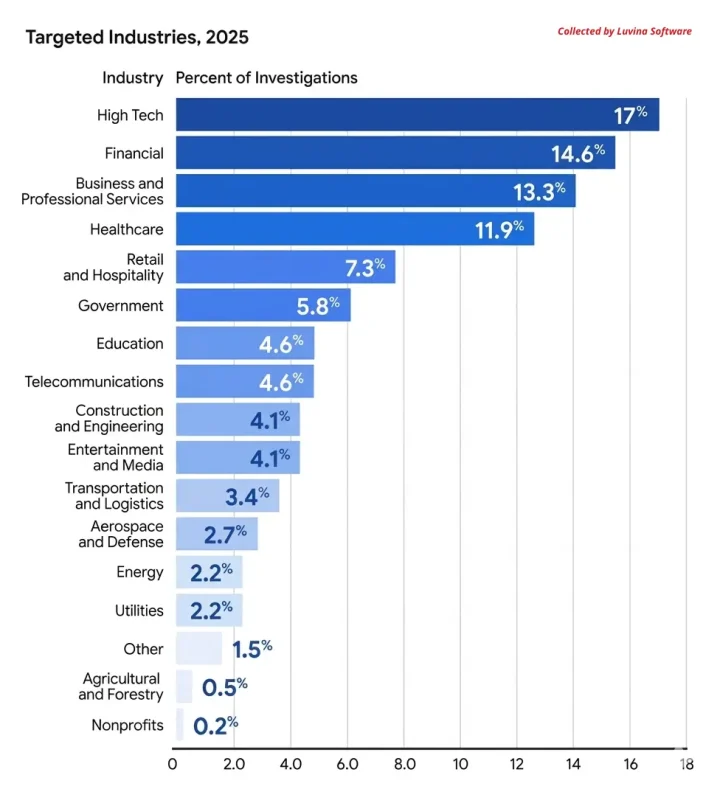
Source: M-Trends 2026, Mandiant, Google Cloud
Cybercriminals are shifting their strategy. By targeting technology providers, they can access entire supply chains and expose the data of thousands of enterprise clients in a single breach.
For businesses, this raises the need to balance technology adoption with strong security governance. Partner selection can no longer be based on cost alone. Security capability must be a core decision factor.
At Luvina Software, security is embedded into every stage of development. From system design to deployment, we focus on delivering reliable and secure solutions that protect business operations in real-world environments.
4. Singapore Releases a New AI Governance Framework
AI is advancing faster than most businesses can govern it. Singapore is among the first to take concrete steps to close that gap.
The government has introduced the 2026 Model AI Governance Framework, with a focus on sectors such as financial services and logistics. The framework directly addresses the risks associated with AI systems capable of autonomous planning and execution.
Human-in-the-loop controls are no longer optional. They are now a required part of system design, ensuring that human oversight remains in place even as systems become more autonomous.
This sends a clear signal. AI deployment is not just a technology decision. It is a governance responsibility.
Before integrating AI into critical processes, businesses need to build control layers that ensure systems operate safely, transparently, and in line with regulatory expectations.
5. Vietnam’s AI Law Takes Effect
Businesses previously had the flexibility to experiment with AI under minimal constraints. That environment changed on March 1, 2026.
Vietnam’s AI Law is now in force, marking a turning point that brings AI under formal national regulation.
The focus of the law is not to restrict innovation. It is to ensure that AI systems are deployed with transparency, fairness, and accountability, especially as they play a larger role in decisions that directly affect users and business outcomes.
With the law now in effect, every AI system in operation carries defined legal exposure. Businesses need to proactively review, assess, and adjust their systems to meet the new requirements and reduce compliance risk.
Looking across these five shifts, one thing becomes clear. Technology in 2026 is the launchpad that defines business strength. The strategic decisions made today will shape where a business stands in the market tomorrow.
Follow Luvina for ongoing updates on the trends and technology solutions shaping the market ahead.
READY TO START A PROJECT?
Our experts are eager to explore your needs.


Read More From Us?
Sign up for our newsletter
Read More From Us?
Sign up for our newsletter