




Airline Digital Transformation: From Strategy to Execution


Airlines today face a simple yet urgent expectation from digital-native passengers: “Why isn’t flying as seamless as using a mobile app?” This shift is reshaping the industry at its core.
In 2023 alone, airlines invested $34.5B in IT modernization. This is a clear sign that airline digital transformation is now mission-critical, not exploratory.
This article explains how airlines turn digital strategy into operational value, from key drivers and transformation areas to real-world case studies and execution roadmaps.
What is Airline Digital Transformation?
Airline digital transformation refers to the use of digital technologies, data, and modern operating models to improve airline operations, passenger experience, and revenue management.
It focuses on:
- Modernizing legacy systems
- Enabling real-time, data-driven decision-making
- Delivering personalized and connected passenger journeys across all touchpoints
In practice, digital transformation modernizes how airlines sell, operate, and serve passengers, while improving efficiency, resilience, and scalability.
Key Drivers Pushing Airlines Toward Digital Transformation
Airlines are accelerating digital transformation due to both technological advancements and market pressures. The demand to update processes, enhance passenger experiences, and remain competitive in a rapidly changing sector is what propels airlines’ digital transformation drive.
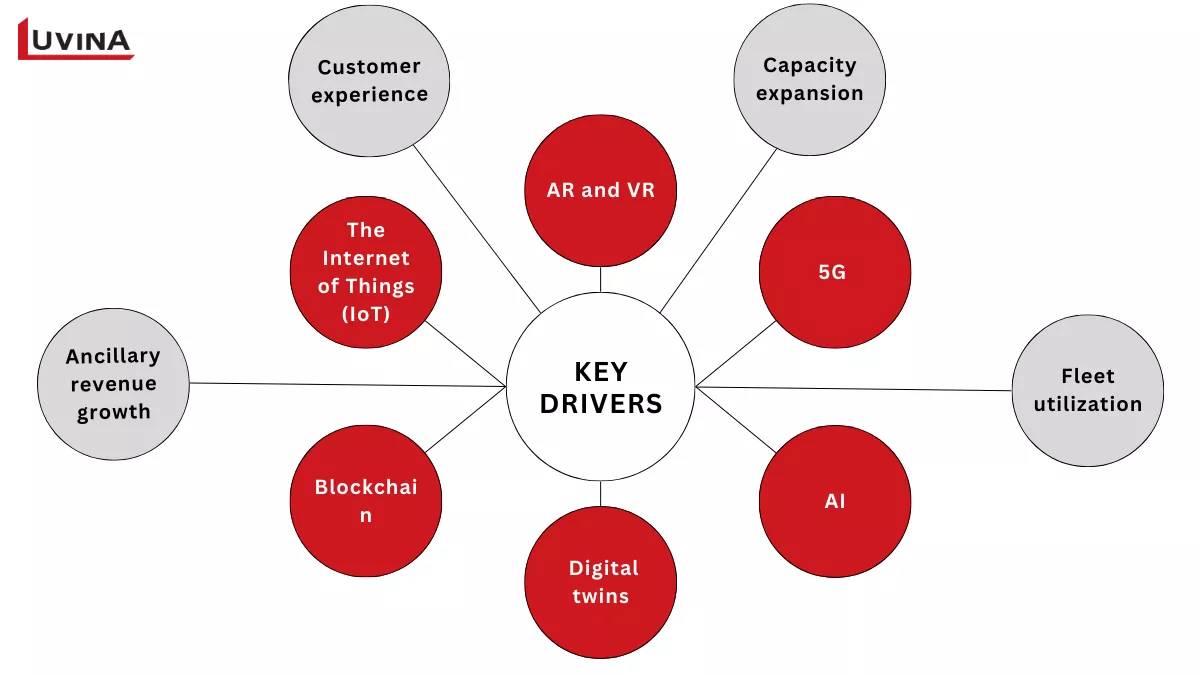
Key drivers of airline digital transformation are IoT, blockchain, AR/VR, digital twins, 5G, and AI technologies
1. Technology-driven factors
Key technologies enabling airline digital transformation include AI, IoT, cloud platforms, digital twins, and 5G connectivity. Together, they allow airlines to shift from reactive operations to predictive and data-driven models.
– AI & machine learning: predictive maintenance, demand forecasting, flight optimization
– IoT: real-time aircraft and baggage monitoring
– Cloud platforms: scalable passenger systems and faster service deployment
– Digital twins: simulation-based maintenance and performance optimization
– 5G: low-latency connectivity for real-time operations and in-flight services
| Technology | Airline Use Case | Business Impact |
| AI/ML | Predictive maintenance, crew optimization | Reduce delays, lower MRO costs |
| IoT | Real-time aircraft monitoring | Improve safety, reduce downtime |
| Cloud | Scalable ops & passenger systems | Faster deployment, lower IT cost |
| RPA | Ticketing, refund automation | Reduce manual workload |
Technology vs Business Impact Overview
2. Market-driven factors
Market forces also push airline digital transformation for revenue growth, customer engagement, and operational efficiency:
– Ancillary revenue growth: Digital platforms enable dynamic bundles, loyalty programs, and partnerships.
– Customer experience and personalization: Data-driven insights enable personalized offers and services on websites and mobile apps to compete with online travel agencies.
– Capacity expansion: Digital tools support route growth, airport operations, crew coordination, and baggage management amid rising seat capacity.
– Fleet utilization challenges: Predictive maintenance and digital MRO solutions help airlines maximize aircraft usage and maintain safety despite fleet shortages.
Major Areas of Transformation in Airlines & Airports
The route of airline digital transformation includes several strategic, technical, and operational adjustments. Focus on e-commerce, consumer engagement, and some other are helps airlines to reimagine the whole travel experience is critical in this transition. The main areas of emphasis are under these components:
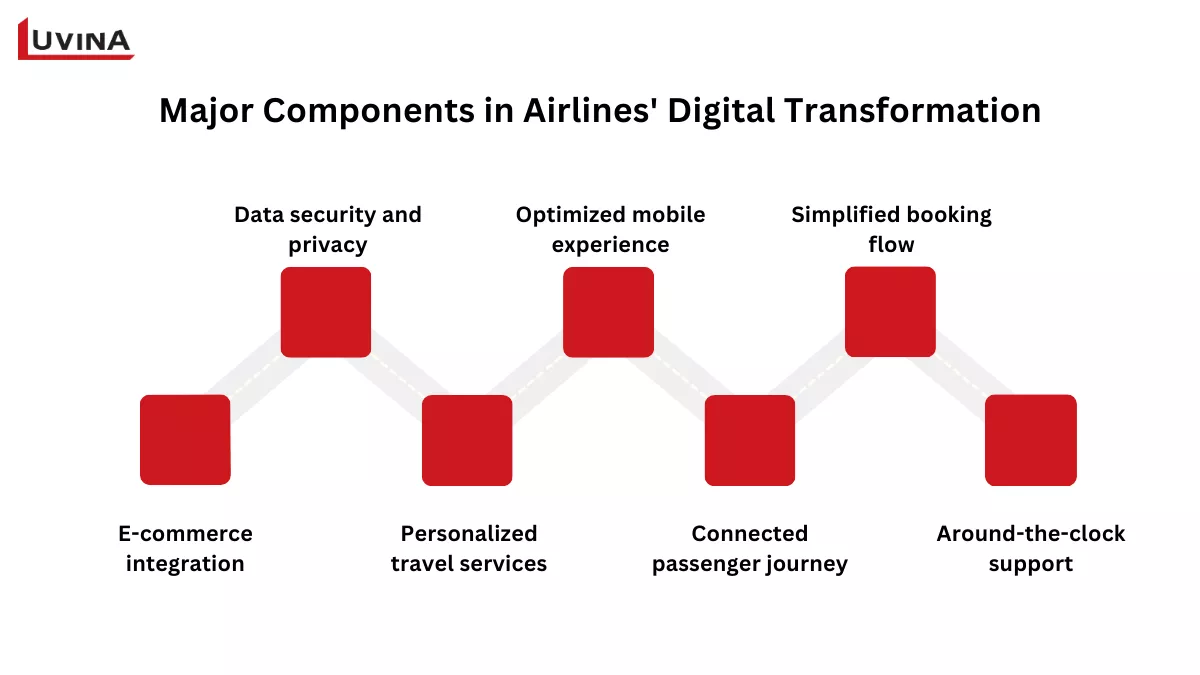
Digital transformation is an improvement across multiple aspects
E-commerce integration
Integrating current e-commerce technology into aging systems is a necessary part of the journey to complete the airline digital transformation. It enables customers to book their flight, add on service options, and change their flight easily. The ability to offer passengers low rates and customized bundles in real-time allows airlines to continue providing reliable operations while also growing their customer base.
Data security and privacy
Airlines have to follow international privacy rules, use sophisticated encryption, and secure payment systems. Not only does guaranteeing data security guard consumers, but it also builds faith in virtual channels.
Personalized travel services
By using artificial intelligence and machine learning, digital transformation in airlines can provide tailored travel recommendations, targeted discounts, and predictive assistance. This approach enhances user experience by offering a simple-to-use interface that mirrors the airline’s brand principles.
Mobile-first passenger experience
For many consumers, mobile devices are the primary point of access to services. Therefore, as part of the airline digital transformation process, mobile apps and responsive platforms support booking, check-in, boarding passes, notifications, and real-time updates.
Connected passenger journey
Airlines can combine touchpoints to establish an integrated and consistent passenger experience. Integration across websites, mobile apps, airport systems, and IoT devices ensures consistent and seamless experiences from booking to arrival.
24/7 digital support
For airport digital transformation, it’s vital to offer help around the clock via live agents straight on booking sites and chatbots. Many tourists make purchases based on the caliber of service and responsiveness; hence, efficient customer support directly affects conversion rates and loyalty.
Global Case Studies: Lessons from Leading Airlines
Top airlines around the world offer insightful observations on the effects of airline digital transformation. The following case studies showcase the successes, methods, and lessons learned from three industry leaders:

Major players in the industry are actively undergoing digital transformation
Singapore Airlines
Challenge: As the digital revolution gathers momentum, Singapore Airlines has encountered difficulty in connecting its new technologies to both its existing legacy systems as well as managing cybersecurity issues.
Solution: In order to beat these obstacles, Singapore Airlines has embarked on a complete airline digital transformation, which includes enhancing mobile apps for customers along with predictive data analysis and better-connected in-flight services. They also use VR (Virtual Reality) based training for staff, and use automated processes within both the check-in/baggage handling process and maintenance procedure process.
Outcome: SIA increased conversion rates, improved on-time performance, and achieved higher ancillary conversion through personalized offers.
The airline digital transformation of Delta Airlines
Challenge: Delta Airlines had difficulties, including privacy issues with biometric systems and the complexity of integrating AI, RFID, and AR technologies across current activities.
Solution: The airline implemented biometric boarding, real-time baggage monitoring, AI-driven flight optimization, and AR-assisted maintenance by means of deliberate airline digital transformation.
Outcome: Delta reduced maintenance-related delays by 25% after applying predictive analytics across its fleet.
Emirates
Challenge: Emirates faced challenges with an expensive implementation, risk to data security, and the requirement to maintain service levels globally.
Solution: In response, this airline developed a comprehensive solution with the use of digital twins, blockchain for loyalty programs, AI for personalized entertainment, virtual reality to train staff, and sustainable digital tools.
Outcome: These efforts provided increased operational reliability, customer satisfaction, employee training efficiency, and environmental efficiency. Automated bag-drop + biometrics reduced passenger processing time by 30%.
Key Challenges in Airline Digital Transformation
Implementing airline digital transformation presents major challenges as airlines embrace contemporary technologies. Airlines face mostly problems nowadays, as shown below:
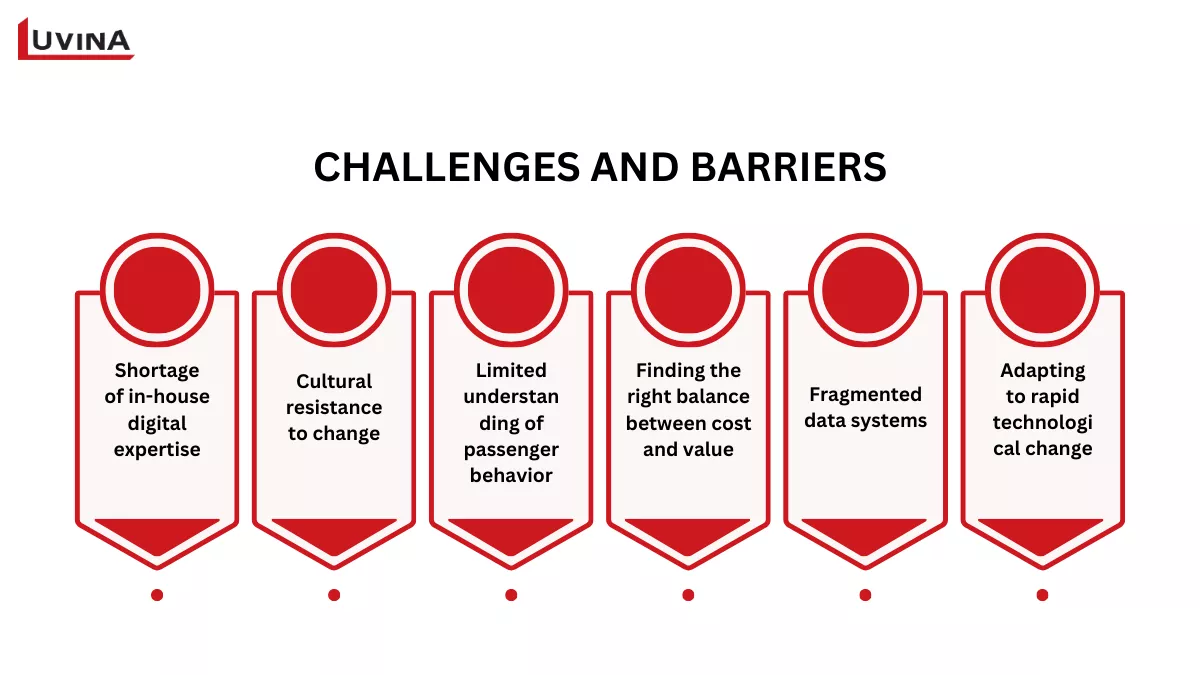
The transition from old systems to new ones inevitably faces barriers
Shortage of in-house digital expertise
Most airlines are unable to establish their own internal team of experienced digital professionals, which may slow down the implementation of large-scale projects in their long term, and may also limit their ability to innovate through technology.
Cultural resistance to change
Traditional airlines give perfect operations first rank, which fights innovation and nimble strategies needed for digital projects.
Limited understanding of passenger behavior
Lack of access to credible feedback from many third-party systems means that airlines lack the ability to analyze passenger behaviour data and the ability to make full use of revenue management.
Finding the right balance between cost and value
While they must provide more value, airlines are under tremendous pricing pressure. Uncorrected digital projects can either underdeliver or turn out to be excessively pricey.
Fragmented data systems
Separation of operational and maintenance data systems obstructs both real-time visibility into the operations of an airline and predictive planning.
Adapting to rapid technological change
The growing use of new technology, such as Artificial Intelligence, Virtual Reality, and Internet of Things (IoT), is moving at a pace that is much faster than the airline industry’s ability to keep up with it, creating an even more complicated process of modernising the industry.
Digital Transformation Roadmap for Airlines
In order for airlines to successfully initiate an airline digital transformation, it is important that there is a structured approach in place. A structured roadmap helps airlines align technology, operations, and passenger experience.
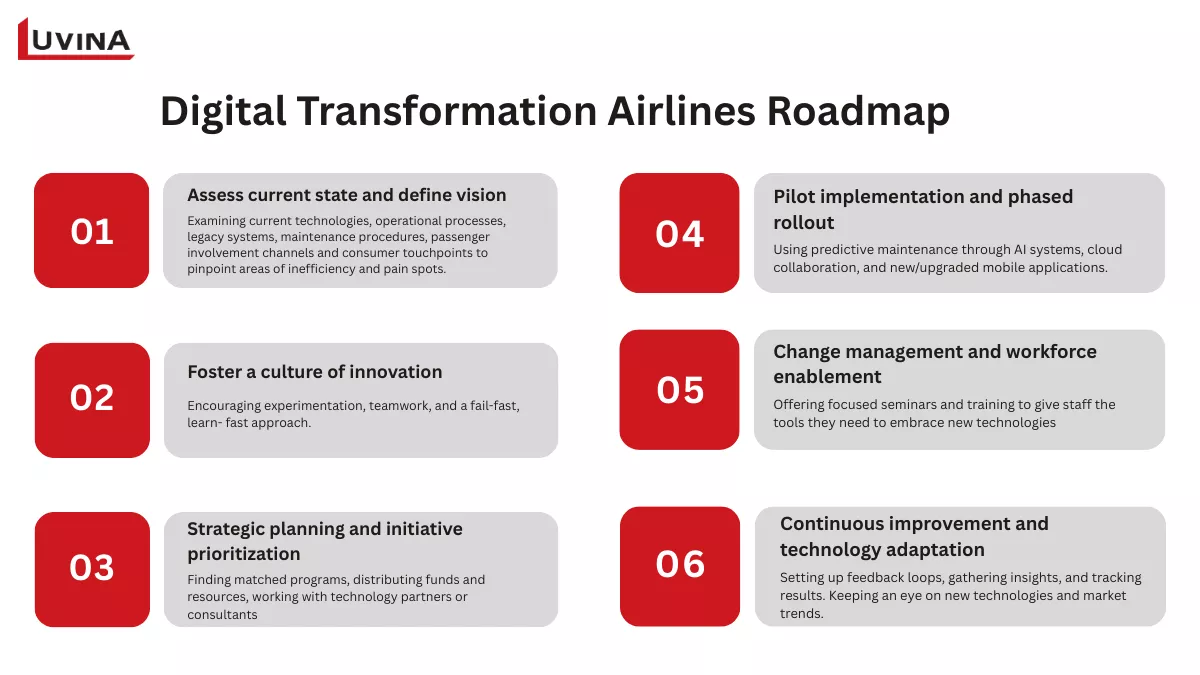
Basic steps of digital transformation for airlines
Step 1 – Assess current state and define vision
Begin by examining current technologies, operational processes, and consumer touchpoints to pinpoint areas of inefficiency and pain spots. Evaluate legacy systems, maintenance procedures, and passenger involvement channels.
From this evaluation, establish quantifiable goals that fit with the strategic objectives of the airline. Setting this basis guarantees that airline digital transformation initiatives are directed and effective.
Step 2 – Foster a culture of innovation
Employees accepting change define a successful conversion. Good leadership encourages experimentation, teamwork, and a fail-fast, learn- fast approach. Encouraging personnel to try out new technologies, propose process improvements, and interact with creative solutions helps to establish a sustainable culture that promotes long-term change.
Step 3 – Prioritize high-impact initiatives
Find programs that most match business goals and provide the most value. Carefully distribute funds and resources based on operational influence and ROI. Work with technology partners or consultants to implement solutions efficiently.
This stage guarantees that airline digital transformation produces quantifiable improvements in safety, customer satisfaction, and efficiency.
Step 4 – Pilot and scale
It is important to pilot test new technology on a smaller scale before full-scale implementation to ensure performance, gather data, and identify any necessary changes to address the performance issues identified during the pilot testing phase. Pilot programs could include the use of predictive maintenance through AI systems, cloud collaboration, and new/upgraded mobile applications used to engage passengers.
Once a pilot has been successful, the organization will implement the pilot technologies throughout the organization so that there is a unified, maximum, and synergistic impact.
For optimal effect, successful pilots are next distributed throughout the company.
Step 5 – Enable change management
Ensure stakeholder acceptance and transparently discuss the advantages and consequences of cutting-edge digital technology. Offer focused seminars and training to give staff the tools they need to embrace new technologies with confidence, hence guaranteeing easy incorporation into daily activities.
Step 6 – Continuously improve
Set up feedback loops to continually improve procedures, gather insights, and track results. Keep an eye on new technologies and market trends to keep efficiency and improve passenger experiences. This method guarantees that digital transformation airlines stays alive.
Emerging Trends & Future Outlook for Airline Digital Transformation
Staying competitive depends on the digital transformation airline. The main future trends include:
– Smarter ground operations: Ground operations and passenger experience have been enhanced through the implementation of smart technology within the area of baggage handling. Using self-service kiosks along with IoT-enabled cargo tracking could enhance passenger satisfaction through reduced delays, increased operational efficiency.
– Personalized passenger experiences: NDC and offer and order management systems let airlines dynamically price, customize offers, and provide customized services, therefore improving customer experiences. AI and analytics enable airlines to learn passenger preferences, hence fueling loyalty and revenue growth, therefore mirroring best practices in airline digital transformation.
– Sustainable aviation practices: Digital tools that help airlines reduce their carbon footprint can also help airlines improve safety, while at the same time allowing airlines to operate sustainably by reducing fuel consumption, minimizing waste, and quantifying their impact on the environment.
– Biometric and security technologies: Face recognition, fingerprint scanning and advanced data protection are used to streamline the boarding process and increase security. As a result of the growing focus on airport digital transformation, airport projects are required to incorporate these technologies as part of their successful implementation.
Conclusion
Airline digital transformation is no longer optional. It is a strategic requirement for improving efficiency, resilience, and passenger experience in an increasingly competitive aviation industry.
Airlines that align technology, data, and people through a structured transformation roadmap will be better positioned to scale, innovate, and adapt to future disruptions.
A successful digital journey depends on working with the appropriate technology team. We at Luvina will assist airlines with customized digital solutions. Your digital projects are guaranteed to provide actual worth thanks to our knowledge, therefore, preparing your airline for the future of aviation.
Luvina will help you reach the full capacity of your airline. Contact us right now.
Resources
- https://amadeus.com/en/blog/articles/next-generation-technology-accelerates-digital-transformation-in-airlines
- https://remarkable.global/insights/airline-digital-transformation/
- https://digitaldefynd.com/IQ/digital-transformation-in-aviation-case-studies/
- https://www.mainblades.com/blog-posts/maintenance-of-aircraft-3-obstacles-for-the-digital-transformation
- https://www.linkedin.com/pulse/key-drivers-digital-aviation-avinash-ramachandran-5rx7f/
READY TO START A PROJECT?
Our experts are eager to explore your needs.

Read More From Us?
Sign up for our newsletter
Read More From Us?
Sign up for our newsletter