




9+ Benefits of Robotic Process Automation You Should Know


Many enterprise teams still spend thousands of hours every month on repetitive operational tasks such as invoice processing, data validation, reconciliation, and report generation.
Robotic Process Automation (RPA) helps organizations automate these repetitive workflows using software bots that can work across systems with high speed and consistency.
Today, businesses are using RPA not only to reduce manual work but also to improve scalability, strengthen compliance, and build the operational foundation for AI-driven automation.In this article, we’ll explore the most important benefits of robotic process automation, real-world enterprise use cases, and how organizations measure automation ROI.
What Is RPA?
Robotic Process Automation (RPA) is a type of business process automation that uses software bots to handle repetitive, rule-based tasks traditionally completed by humans. These bots can interact with digital systems the same way employees do, such as entering data, validating information, generating reports, processing claims, or moving between applications.
RPA is often confused with other automation technologies, but there are important differences between them. Business Process Management (BPM), for example, focuses on redesigning and optimizing entire workflows from a strategic level. RPA, on the other hand, concentrates on automating specific repetitive tasks within those workflows. Intelligent Automation (IA) combines RPA with technologies such as machine learning and AI to support more cognitive decision-making. Hyperautomation goes even further by connecting multiple automation tools, analytics platforms, and AI systems into a broader automation ecosystem.
One reason businesses continue investing in RPA is the wide range of benefits of robotic process automation across daily operations. In many organizations, RPA acts as the operational “workhorse,” while AI technologies provide higher-level intelligence for more advanced automation strategies.
The global market reflects this growing demand. According to Precedence Research, the RPA market is predicted to increase from USD 35.27 billion in 2026 to approximately USD 247.34 billion by 2035, expanding at a CAGR of 24.20% from 2026 to 2035. At the same time, Deloitte reported (2021) RPA and automation, reporting, and process excellence are now part of at least 50% of GBS organizations.
The 4-Axis Value Framework: How To Classify RPA Benefits
To better understand the real business value it delivers, many organizations evaluate the benefits of robotic process automation through 4 key areas: operational, financial, human, and strategic outcomes.
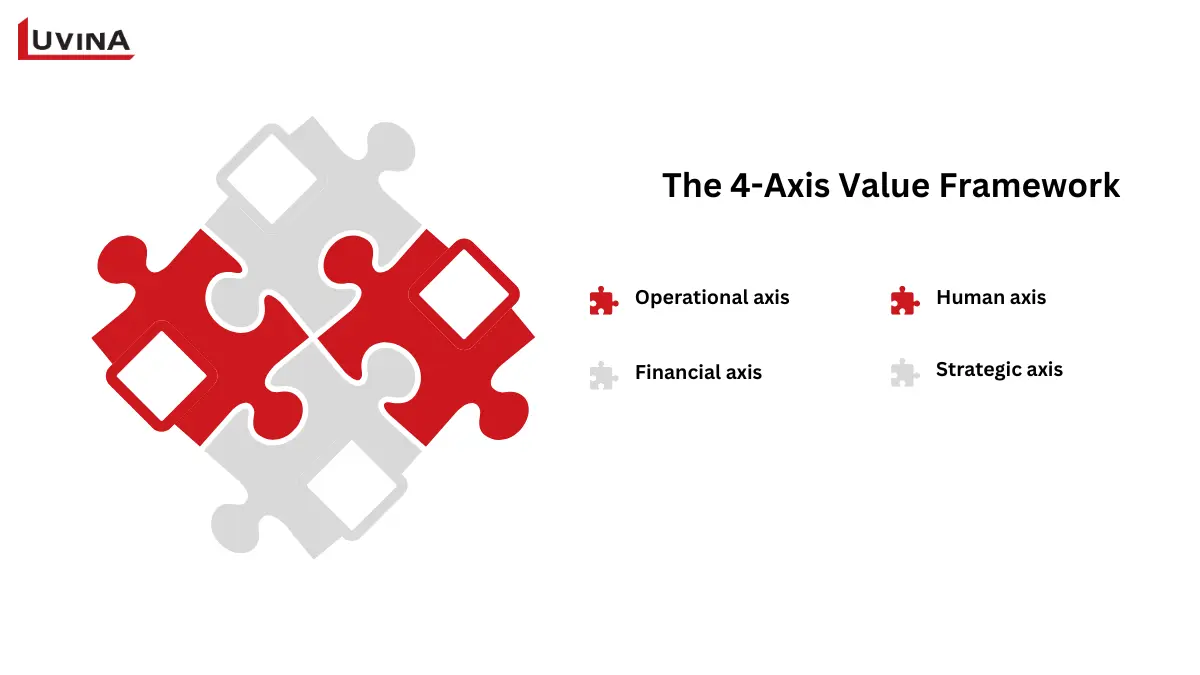
4 types of benefits of robotic process automation
– Operational axis: RPA increases processing speed, improves productivity, reduces manual errors, and enables 24/7 execution for repetitive tasks. This helps businesses maintain more consistent and efficient workflows.
– Financial axis: Companies use RPA to reduce operational costs, improve ROI, lower Total Cost of Ownership (TCO), and achieve faster payback periods from automation investments.
– Human axis: By automating repetitive work, RPA helps reduce employee burnout and improve the overall work experience. Teams can spend more time on strategic and customer-focused activities instead of manual processing.
– Strategic axis: Beyond efficiency, the benefits of robotic process automation also include stronger compliance, better scalability, support for modernization initiatives, and a stronger foundation for future innovation.
Core Benefits Of Robotic Process Automation
From faster operations to stronger compliance, RPA delivers measurable value across multiple business functions. Below are some of the most important benefits of robotic process automation:
| Axis | Benefit | Business impact |
| Operational | 24/7 productivity | Bots work continuously to improve speed, productivity, and accuracy. According to industry reports, 86% of enterprises have experienced productivity improvements after adopting automation technologies. |
| 60-70% faster cycle times | RPA accelerates process execution across multiple systems, helping organizations complete workflows significantly faster than manual operations. | |
| Fewer manual errors | For businesses exploring why to implement RPA, automation often becomes the first step toward broader digital transformation strategies involving hyperautomation, intelligent automation, and AI agents. | |
| Improved customer experience | Faster back-office operations and fewer processing errors help businesses deliver quicker responses and more reliable customer service experiences. | |
| Financial | Lower operating costs | Reduces manual workloads and allows businesses to achieve more with fewer resources. By shifting repetitive tasks to bots, teams can focus on higher-value work while improving overall efficiency. |
| 3-10x ROI within the first year | One of the major benefits of robotic process automation is rapid return on investment. Many businesses achieve measurable ROI within months, while some automation projects deliver payback within weeks. | |
| Faster time-to-value | Modern no-code and low-code RPA platforms allow organizations to deploy automation quickly, with many first-process implementations completed within 4–8 weeks. | |
| Elastic scalability | Businesses can scale bots up or down based on workload demands. This flexibility supports growth, seasonal demand spikes, and enterprise-wide automation initiatives more efficiently. | |
| Strategic | Stronger compliance and audit trails | RPA creates detailed activity logs and standardized workflows, helping businesses maintain compliance and streamline audits in regulated industries such as healthcare, finance, insurance, and legal services. |
| Legacy system modernization | RPA can work across existing applications without requiring a complete system replacement. This allows organizations to modernize workflows while continuing to use legacy infrastructure. | |
| Foundation for hyperautomation and AI | Supports AI, hyperautomation, and software development initiatives through scalable automation foundations. | |
| Human | Better employee experience | One of the overlooked benefits of robotic process automation is employee satisfaction. By removing repetitive tasks, employees can focus on strategic, creative, and customer-facing responsibilities. |
Reasons why implement RPA
Calculating RPA ROI
RPA delivers value far beyond task automation, including lower operational costs, better scalability, and long-term process efficiency. Businesses also use RPA to reduce operational costs, improve scalability, and increase long-term efficiency across departments.
To maximize the benefits of robotic process automation, businesses should first identify high-value, low-complexity tasks. Automating these processes often leads to faster returns and creates a strong foundation for broader automation initiatives. Measuring ROI also helps organizations understand both the short-term payback period and the long-term savings generated after implementation.
Before calculating ROI, businesses typically gather several key metrics, including:
– Number of FTE resources involved in the process
– Number of tasks completed per day
– Average task duration
– Fully loaded labor cost per hour
– Initial RPA implementation cost
– Monthly RPA maintenance cost
– Estimated business growth rate over time
These metrics provide a clearer view of overall automation value and help track ongoing RPA productivity improvement after deployment.
Step 1: Calculate the current cost of the task
Start by calculating how much the process currently costs without automation.
(FTE Resources × Fully Loaded FTE Cost) ÷ ((Task Duration × Number of Tasks Per Day) ÷ 8) = Hourly Task Cost
Then calculate:
Weekly Task Cost = Hourly Task Cost × Weekly Hours
Monthly Task Cost = Weekly Task Cost × 4
This becomes your baseline cost for comparison.
Step 2: Determine the cost of RPA implementation
RPA costs typically include:
– Initial setup and deployment fees
– Software licensing costs
– Training and onboarding expenses
– Monthly support and maintenance fees
Organizations using RPA outsourcing models can often reduce deployment complexity without building internal automation teams.
Step 3: Create a monthly ROI comparison
The final step is comparing manual process costs against automation costs over time:
| Month | Manual process cost | RPA cost | Savings |
| Month 1 | Baseline Monthly Cost | Initial Setup Cost | Difference |
| Month 2 | Previous Cost × Growth Rate | Monthly RPA Cost | Difference |
| Month 3 | Adjusted Monthly Cost | Monthly RPA Cost | Difference |
Monthly ROI comparison table after RPA implementation
When the savings column reaches zero or becomes positive, the organization has achieved ROI. Many companies experience this within weeks or months, depending on process complexity and automation scale.
Beyond short-term savings, the benefits of robotic process automation also include ongoing operational efficiency, lower labor dependency, and better scalability as workloads increase. This long-term “return on investment” often becomes even more valuable as businesses continue expanding automation initiatives across multiple workflows.
RPA Benefits By Industries
The impact of RPA varies across industries, but the goal remains the same: improving efficiency, accuracy, scalability, and compliance. The benefits of robotic process automation become especially valuable in sectors that manage large volumes of repetitive and rule-based processes. Below is a quick overview of how different industries apply RPA and the business value they gain from automation initiatives.
| Industry | Departments | Common use cases | Key benefits |
| BFSI | Compliance | KYC verification, AML screening, audit reporting, regulatory checks | Faster onboarding, stronger compliance, fraud reduction, and quicker close cycles. |
| Finance | Reconciliation, invoice processing, financial reporting, payment validation | ||
| Operations | Claims processing, customer onboarding, account updates, document verification | ||
| Healthcare | Administration | Patient registration, appointment scheduling, eligibility checks, document routing | Reduces administrative burden while improving data accuracy and cost efficiency. |
| Billing | Claims processing, invoice generation, payment reconciliation, coding support | ||
| Medical records | EHR data entry, patient data updates, records synchronization, form processing | ||
| Manufacturing | Supply chain | Inventory tracking, procurement workflows, supplier communication, demand forecasting updates | Improves production planning, inventory visibility, and operational throughput. |
| Operations | ERP synchronization, production scheduling, work order management, status reporting | ||
| Quality control | Inspection reporting, compliance documentation, defect tracking, audit preparation | ||
| Retail and eCommerce | Operations | Order processing, catalog updates, inventory synchronization, invoice generation | Supports scalability with faster order handling and better inventory accuracy. |
| Customer services | Returns management, order tracking, ticket routing, refund processing | ||
| Pricing | Cross-platform price synchronization, discount updates, promotion management | ||
| Logistics | Shipping | Shipment tracking, dispatch updates, delivery scheduling, proof-of-delivery processing | Streamlines logistics operations and reduces delivery delays and processing costs. |
| Finance | Billing reconciliation, invoice processing, payment matching, freight auditing | ||
| Compliance | Customs documentation, shipment validation, trade compliance reporting | ||
| Public sector | Citizen services | Application processing, case management, request routing, benefits administration | One of the practical benefits of robotic process automation is faster and more consistent public service delivery. |
| Administration | Data migration, document management, records updates, workflow approvals | ||
| Compliance | Regulatory reporting, audit preparation, policy documentation tracking |
RPA is being adopted across multiple industries and delivering significant benefits
Many companies also see measurable RPA productivity improvement through faster processing speeds, reduced manual errors, and better operational consistency across departments.
SMB vs Enterprise
RPA adoption varies by business size and operational needs. Smaller businesses usually focus on fast deployment and affordability, while enterprises prioritize scalability, governance, and integration with larger automation ecosystems. Understanding the benefits of robotic process automation helps organizations choose the right approach based on their growth stage and automation goals.
SMBs often prefer cloud-hosted bots, flexible licensing, and simple deployment models to achieve quick wins with lower costs. Mid-market companies typically see the strongest ROI potential because they can scale automation without overly complex governance structures. Meanwhile, large organizations focus more on compliance, centralized governance, and broader hyperautomation strategies. Many RPA advantages enterprise businesses look for include high availability, advanced security, and integration with AI and intelligent automation platforms.
| Business size | Primary focus | Key considerations |
| SMB | Quick wins and lower TCO | Easy deployment, cloud bots, flexible licensing |
| Mid-market | Balanced ROI and scalability | Lightweight governance and gradual expansion |
| Enterprise | Scale and automation governance | Compliance, CoE investment, hyperautomation integration |
RPA adoption recommendations by business size
RPA + AI Agents & Hyperautomation
As AI technologies continue evolving, RPA is becoming more important, not less. While AI can analyze information, generate insights, and make contextual decisions, RPA remains the execution layer that carries out structured actions across systems and workflows. This combination is expanding the benefits of robotic process automation far beyond traditional task automation.
Modern Intelligent Automation (IA) combines RPA with AI, machine learning, BPM, NLP, computer vision, and Intelligent Document Processing (IDP). In this model, AI handles interpretation and reasoning, while RPA executes the actions required to complete the workflow. This “AI decides, RPA executes” approach is becoming a common automation pattern for enterprises building scalable hyperautomation strategies.
A practical example is invoice exception handling. First, IDP extracts invoice data from different document formats. Then, AI agents analyze missing fields, validate inconsistencies, or make contextual decisions based on business rules. Finally, RPA bots automatically post the approved data to ERP or finance systems.
Compared with RPA vs. traditional automation models, AI-powered automation can adapt more easily to changing workflows and more complex business scenarios. RPA alone works best for repetitive, rule-based tasks, but AI integration enables organizations to automate processes that require reasoning, pattern recognition, and contextual understanding.
This integration also introduces new automation capabilities, including:
– Handling unstructured documents and data
– Supporting contextual and cognitive decisions
– Enabling self-healing workflows
– Improving end-to-end process visibility
– Increasing overall productivity and scalability
Combined with AI agents and hyperautomation platforms, the benefits of robotic process automation now extend into intelligent orchestration, adaptive workflows, and enterprise-wide digital transformation.
Risks, Hidden Costs, and Why RPA Projects Fail
Although RPA delivers major efficiency gains, automation projects are not always successful. According to Deloitte’s (2021) research, 30-50% of RPA projects fail due to weak governance, poor maintenance, and unexpected operational issues. Understanding these risks is essential for maximizing the benefits of robotic process automation while avoiding costly disruptions.
Below are some of the most common RPA challenges and practical ways businesses can reduce automation risks.
| Challenge | Why it happens | Solution |
| Wek governance | Lack of standards leads to fragmented bots, security gaps, and inconsistent development. | Build a centralized governance framework and establish an RPA CoE. |
| Bot debt | UI updates or software changes can break automation workflows. | Use AI-driven monitoring and adaptive automation capabilities. |
| Credential sprawl and security risks | Bots may access sensitive systems with excessive permissions. | Apply RBAC, secure credential vaults, and stronger audit controls. |
| Shadow RPA | Business units create bots without IT oversight. | Centralize automation management and audit all existing bots. |
| Change management issues | Employees may resist automation due to workflow disruption or job concerns. | Provide training, internal advocacy, and clear communication. |
| Poor scalability planning | Automations are deployed without long-term infrastructure planning. | Implement scalable platforms with governance and monitoring support. |
Challenges of RPA implementation and how to address them
Organizations that successfully address these risks are more likely to achieve the long-term benefits of robotic process automation, including operational stability, compliance, scalability, and sustainable ROI.
Many organizations achieve strong early results with pilot automations but struggle to scale RPA across departments. In many cases, the challenge is not the technology itself, but weak governance, poor process selection, and uncontrolled bot growth.
Automating unstable workflows or heavily customized processes often creates “bot debt,” where maintenance costs increase faster than operational value.
Successful organizations usually begin with stable, high-volume workflows and establish governance standards before scaling enterprise-wide automation initiatives.
When RPA Is The Right Choice
RPA works best when businesses need to automate repetitive, rule-based tasks across multiple systems. To maximize the benefits of robotic process automation, organizations should first evaluate whether the target process is stable, high-volume, and structured enough for automation.
RPA is usually a strong fit when:
– Tasks are repetitive and performed frequently
– Processes follow clear business rules
– Data is structured and predictable
– Applications have relatively stable user interfaces
– Employees spend time switching between multiple systems (“swivel-chair” work)
– Processes require high accuracy, compliance, and auditability
Many businesses also choose RPA when they face large legacy integration backlogs. However, RPA is not always the best solution for every automation challenge. Businesses should evaluate automation options carefully before implementation.
| Scenerio | Best fit |
| Repetitive tasks with structured data | RPA |
| Real-time system-to-system integration | API integration |
| Complex custom business logic | Custom development |
| High-volume manual operations with external staffing needs | BPO services |
When is RPA the right choice and when is it not
RPA may not be the ideal choice when processes change frequently, transaction volumes are very low, or mature APIs already exist for direct integration. In those situations, APIs or custom development may offer better long-term scalability and maintenance efficiency.
A 90-Day Roadmap
Successfully adopting RPA requires more than deploying a few bots. Businesses need a structured rollout plan that balances quick wins with long-term scalability and governance. The benefits of robotic process automation become much easier to achieve when organizations start with clear priorities, measurable KPIs, and controlled pilot implementations. Below is a phased 90-day roadmap for the implementation of RPA
| Timeline | Key activities | Main deliverable |
| Days 0-30 | Conduct process discovery, audit workflows, define KPIs, build the business case, and select 1-2 pilot processes. | Automation Heatmap identifying high-impact automation opportunities. |
| Days 31-60 | Develop and test bots, establish basic governance, integrate AI or orchestration tools where needed, and capture KPI baselines. | AI Orchestration Pilot with human-in-the-loop oversight. |
| Days 61-90 | Deploy automations, measure ROI, document lessons learned, and prepare the next automation wave. | Autonomous Workflow Blueprint for future scaling. |
90-day RPA implementation roadmap
During the first phase, businesses should focus on repetitive, rule-based workflows with clear process boundaries. This allows organizations to realize the benefits of robotic process automation faster while minimizing implementation complexity.
As automation matures, governance and scalability become increasingly important. Many RPA advantages enterprise organizations prioritize include centralized monitoring, observability dashboards, compliance controls, and standardized deployment frameworks that support long-term expansion across departments.
Before scaling automation initiatives, businesses should also evaluate overall automation readiness through a structured checklist covering:
1. Process readiness
- Clear documentation for core workflows
- Repetitive and rule-based tasks identified
- Defined KPIs and ROI metrics
- Productivity bottlenecks identified
- Clear task start-to-finish visibility
2. Personnel readiness
- Leadership and employee buy-in
- Teams are prepared for operational change
- Automation goals discussed internally
- Internal resources available for implementation
- Dedicated automation or transformation ownership
3. IT Infrastructure readiness
- Systems support APIs or digital integrations
- Processes can be completed digitally
- Automation access permissions available
- IT support available for integrations
4. Automation suitability
- Processes require minimal human judgment
- Inputs and outputs are standardized
- Workflows remain relatively stable
- Processes are high-volume and manual-intensive
5. Security and compliance readiness
- Sensitive data handling policies defined
- Compliance requirements documented
- Security policies support automation access
- Logging and reporting systems available
6. Scalability readiness
- Willingness to start with pilot projects
- Reporting tools available for performance tracking
- Plans for scaling automation initiatives
- Long-term transformation roadmap defined
- Additional future automation opportunities identified
Measuring RPA Benefits
To fully understand the benefits of robotic process automation, businesses need clear performance metrics that track operational efficiency, financial impact, and user experience over time. Measuring the right KPIs also helps organizations optimize automation performance and identify opportunities for future scaling.
To measure automation performance effectively, businesses typically track KPIs across three main categories: operational efficiency, business impact, and user experience.
| KPI category | Metrics to track | Busines value |
| Operational KPIs | Bot uptime, throughput, exception rate | Measures automation reliability, processing speed, and workflow stability. |
| Business KPIs | Cost savings, FTE capacity freed, cycle-time reduction | Tracks financial impact and operational efficiency improvements. |
| Experience KPIs | Employee eNPS, customer SLA hit rate | Evaluates employee satisfaction and customer service performance. |
RPA performance metrics
FAQs
1. What is the biggest benefit of RPA for an enterprise?
The biggest benefit of RPA is improved operational efficiency through 24/7 automation of repetitive tasks, helping enterprises reduce costs and improve accuracy.
2. What is the typical RPA ROI in the first year?
According to Deloitte, many companies achieve around 20% ROI in the first year, while larger-scale deployments can deliver significantly higher returns.
3. Will RPA replace my employees?
No. RPA is designed to automate repetitive tasks so employees can focus on strategic, creative, and customer-facing work.
4. Should small and mid-sized businesses adopt RPA?
Yes. RPA helps SMBs improve efficiency, reduce costs, and automate repetitive workflows without large IT investments.
5. How does RPA integrate with legacy systems?
RPA interacts directly with existing software interfaces, allowing businesses to automate workflows without major system changes or APIs.
6. How do RPA benefits differ for banking and insurance?
Banking focuses more on transaction speed and fraud reduction, while insurance prioritizes document-heavy workflows and claims processing.
7. Is RPA still relevant now that AI agents exist?
Yes. RPA remains important for executing structured tasks, while AI agents handle reasoning and decision-making.
8. Why do some RPA projects fail?
Common reasons include poor process selection, weak governance, lack of change management, and difficulties scaling beyond pilot projects.
9. How long until a company sees the first RPA benefit?
Many organizations see initial improvements within 4-8 weeks, while full ROI may take several months.
10. What is the difference between attended and unattended RPA benefits?
Attended RPA assists employees with desktop tasks, while unattended RPA runs independently to automate high-volume back-office processes.
Conclusion
As businesses continue accelerating digital transformation initiatives, RPA is becoming a critical tool for improving operational efficiency, reducing costs, and increasing scalability. From finance and healthcare to manufacturing and customer service, the benefits of robotic process automation are helping organizations automate repetitive work, improve accuracy, and free employees to focus on higher-value activities.
However, successful automation requires more than simply deploying bots. Businesses also need the right processes, governance framework, scalability strategy, and long-term automation roadmap to maximize ROI and sustain performance over time.
If you’re looking to modernize operations and scale automation effectively, partnering with an experienced provider can help accelerate implementation and reduce operational complexity. Contact Luvina today to start your digital transformation journey!
Resources
READY TO START A PROJECT?
Our experts are eager to explore your needs.

Read More From Us?
Sign up for our newsletter
Read More From Us?
Sign up for our newsletter