




Digital Transformation Stages: The 6-Stage Maturity Model


Digital transformation stages are maturity levels. They show how far a company has moved from scattered, manual work toward coordinated, measured operations. A company can have an ERP, CRM and cloud infrastructure in place and still struggle with disconnected workflows, inconsistent data, and low employee adoption. Knowing your stage helps you decide what to fix first, instead of buying another tool your teams are not ready to use.
This article walks through six stages, with the signals that identify each one and the priority that fits it. By the end, you should be able to place your business on the list and choose your next step. Teams within the same company can sit at different stages, so read the table below as a starting point for your own assessment.
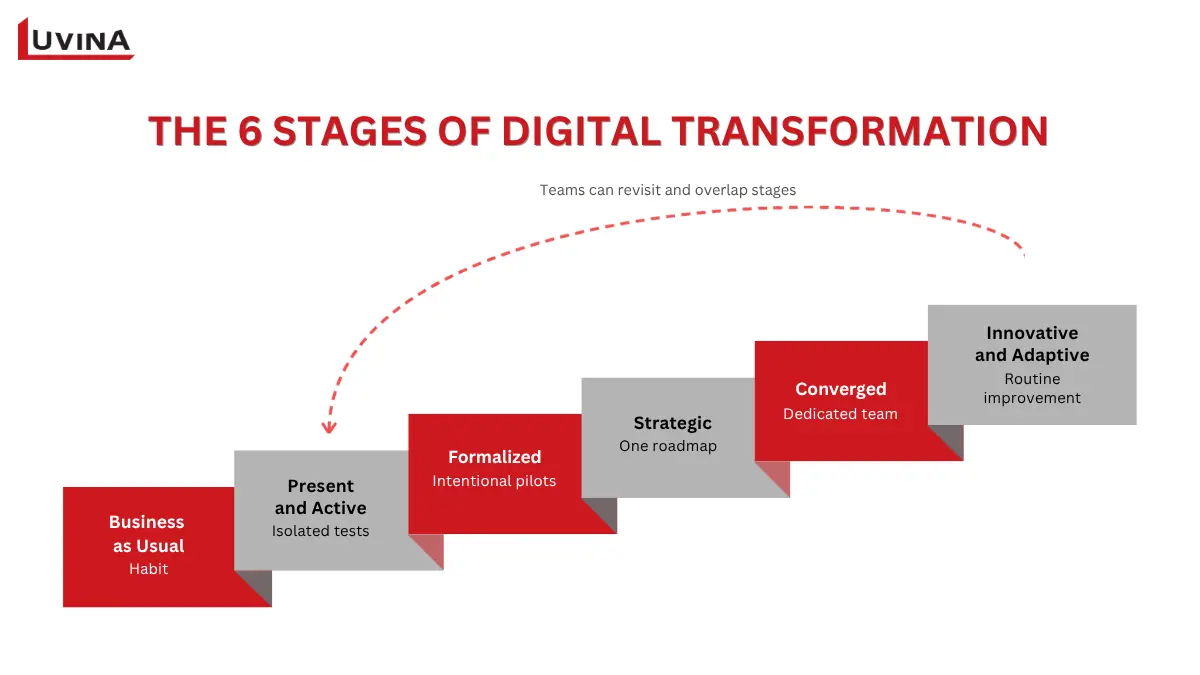
| Stage | Main signal | Priority |
| Business as Usual | Teams keep current ways of working with no shared goal for change | Name one business problem, an owner, and a baseline |
| Present and Active | Teams test tools on their own | Run a scoped pilot and record the results |
| Formalized | Experiments become intentional and teams ask executives for resources | Check value, usage, and data quality, then set scale-up conditions |
| Strategic | Departments share goals and one roadmap | Align KPIs, ownership, governance, and rollout order |
| Converged | A dedicated team leads, and shared processes and platforms span several teams | Focus on integration, data quality, security, and adoption |
| Innovative and Adaptive | Testing and improvement are routine | Keep improving value, with no fixed end point |
The six digital transformation stages at a glance
What Are Digital Transformation Stages
Digital transformation stages are maturity levels. Each one describes how a company currently uses digital tools, data, and decisions, so you can answer a simple question: where do we stand today?
Stages are easy to mix up with two other terms:
- Stages: show your current position.
- Framework: guides how the organization carries out change.
- Roadmap: arranges initiatives, owners, and milestones over time.
Stages come first, since you need a starting point before planning a route. The overall direction sits in your digital transformation strategy, and the stages show how far along it you are.
About the model used in this article
- There is no single number of stages. This article follows one model throughout: the six-stage model from Altimeter, now part of Prophet (2016).
- The research centers on digital customer experience, one of several paths to change.
- Stages are not strict ladders. Companies can span several at once, move back, or overlap them. A finance team may run standardized, automated workflows while the warehouse still handles some tasks manually, such as stock counts and delivery handoffs.
- The signals, KPIs, examples, and next actions here are Luvina’s own interpretation of the model.
The 6 Stages of Digital Transformation
Use this section to place your business. Each stage shows what you will see day to day, a common mistake in self-assessment, and the next priority. Teams can sit at different stages, so look for evidence such as shared goals and real usage.
Stage 1: Business as Usual
The company runs on established routines, and no clear owner is assigned for digital transformation planning yet.
What you’ll see
- Reports come from several files merged by hand each month. Two people can produce two versions of the same number.
- Processes are rarely reviewed. When two teams clash over a handoff, someone fixes it case by case.
- Any new tool only supports the old routine, since no shared goal says what should change.
Common mistake: Assuming every company that uses Excel sits at stage 1. Spreadsheets show up at every stage. Look for missing reviews and missing shared goals instead.
Next priority: Name one business problem people already complain about, such as reports that arrive late. Give it an owner and a baseline, for example processing time or data-entry errors.
Stage 2: Present and Active
Different teams are trying different things, but nobody evaluates what improved or connects the results across departments.
What you’ll see
- Sales team picks a CRM. Operations tests order-entry automation. Each team chose its own tool and keeps its own data.
- Pilot results sit in one person’s inbox or slide deck, where nobody else can find them.
- Nobody can say whether a pilot worked, because no one wrote down the starting numbers.
Common mistake: Counting the number of tools tried as progress. Several pilots without a baseline prove nothing.
Next priority: Pick one pilot with a clear scope. Give it an owner, a baseline, and success criteria, then write down what it changed instead of listing tool features.
Stage 3: Formalized
Experiments become intentional, and the people behind them start asking executives for backing.
What you’ll see
- Pilots have a stated goal and a named owner on each side, such as operations and IT sharing an order-processing pilot.
- A business case exists, and the team uses it to request budget and tools.
- Someone tracks pilot results against a target, so a pilot cannot quietly fade out.
Common mistake: Calling a pilot a success because it launched on time. Launch tells you little about whether people use it, whether the data is clean, or whether support can handle it.
Next priority: Decide in advance what would make you scale the pilot and what would make you stop. Check out 4 things: value delivered, real usage, data quality, and support needs.
Stage 4: Strategic
Departments stop buying separate tools and start coordinating around a shared roadmap.
What you’ll see
- Sales, operations, and finance agree on shared priorities, and the dependencies between them are written down.
- A plan to connect orders, customers, and inventory is built around results such as fewer order errors, instead of around which tool to buy. For a retail view of this kind of connection, see digital transformation in retail.
- Someone has clear authority to decide when two teams want different things.
Common mistake: Mistaking a roadmap document for alignment. If each team still runs its own KPIs and tools, the roadmap exists only on paper.
Next priority: Align KPIs, process and data owners, governance, and rollout order. Settle who resolves conflicts before the work starts.
Stage 5: Converged
Work now has a dedicated team behind it, and shared platforms replace local fixes.
What you’ll see
- A dedicated digital transformation team guides strategy and operations. Altimeter treats this as the mark of the stage.
- One order process links sales, warehouse, and accounting, so staff stop re-entering the same data in each system.
- Roles, processes, and systems that support the change are settled, with training and support organized before rollout.
Common mistake: Treating ownership of an ERP or CRM as proof of this stage. Check whether the systems actually share data and whether people use it every day.
Next priority: Focus on integration, data quality, security, adoption, and day-to-day operability.
Stage 6: Innovative and Adaptive
Improvement is routine, and new ideas are judged by their results.
What you’ll see
- New initiatives are chosen from results and business needs, then measured after rollout.
- A team uses operational data to adjust to a service, then tests a new way to handle a spike in demand.
- Earlier stages get revisited as the business changes.
Common mistake: Treating this stage as a finish line or as a requirement to adopt AI. It describes how a company keeps learning, and AI is one possible tool among many.
Next priority: Keep improving value. Compare each change against the baselines set in earlier stages, so you can see what it delivered.
Across these stages, the biggest shift is not simply the adoption of more advanced technology. It is how the organization makes decisions: from individual workarounds to shared processes, accountable ownership, and measurable business outcomes.
You may recognize your business in more than one stage. That is expected when teams move at different speeds. Pick the stage your evidence supports best, then test it with the checklist in the next section.
How to Identify Your Current Stage
Answer each question for your business, then look for evidence behind the answer. A confident “yes” with nothing to show for it is only a guess. This checklist is a discussion aid and carries no score.
| Area | Question | Evidence to look for |
| Strategy | Do our initiatives share clear business goals and accountable owners? | Written goals, a named owner for each initiative |
| Processes | Do teams follow the same workflow for the same task? | Process maps, fewer team-specific workarounds |
| Systems | Where do teams still re-enter data or work around disconnected systems? | A list of manual handoffs between tools |
| Data | Do we measure business outcomes against a baseline? | Baseline metrics, one agreed source for key reports |
| People | Do employees use the new workflows consistently? | Usage rates, training records, support requests |
Self-assessment checklist by area
Here is what the Systems and Data rows can look like in practice. A Luvina client, a recycling company in Singapore with operations in five countries, ran its finance work on Excel files and individual bank transactions. Data differed between regions, and the company hired outside reviewers to standardize it. Those are the signals the checklist looks for: manual handoffs and no single source for key numbers.
Luvina replaced the spreadsheets with one cloud ERP and automated about 17 processes. According to Luvina’s operational digitization case for a Singaporean recycling enterprise, payment and administrative processing time dropped by 70%, and bank reconciliation discrepancies fell by up to 90%.
Once you have answers, pick up the one gap that costs the business most, such as staff re-entering the same order data in two systems. Start with the priority for that gap in the stages above.
If capability differs between departments, run the checklist once per department. Finance and the warehouse rarely answer alike.
How to Move to the Next Stage
Moving up a stage starts with proof that the current step works. Four steps get you there.
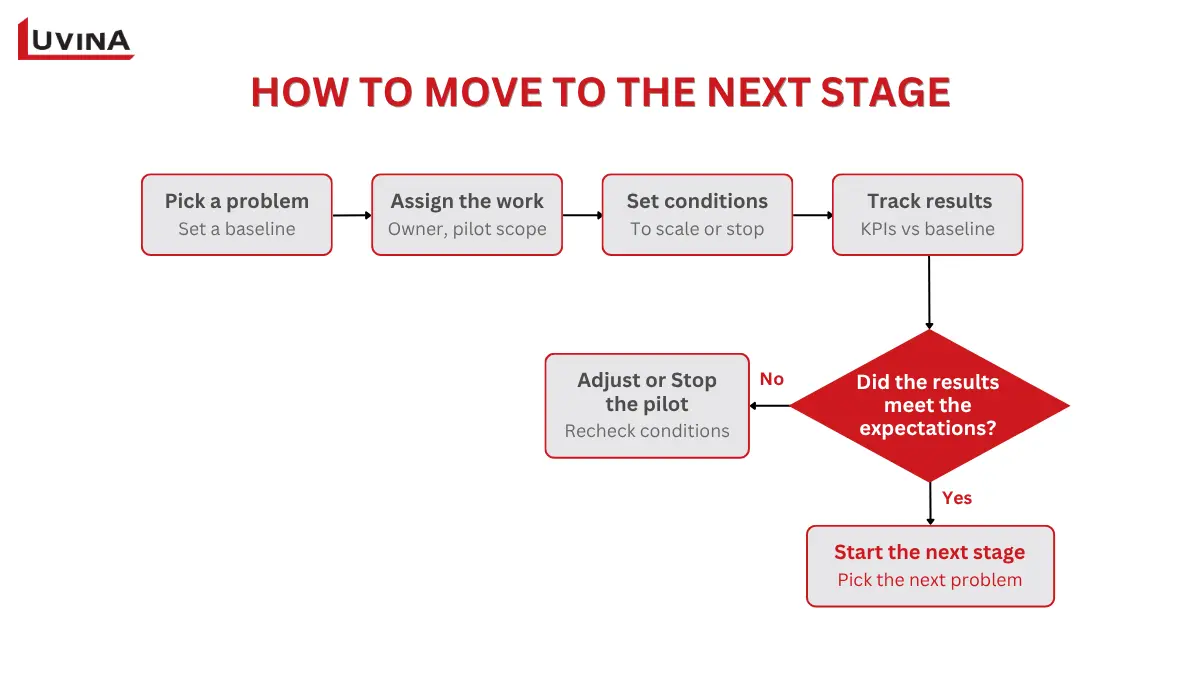
- Pick out a problem that affects business results. Record the baseline and the target before choosing a tool. For an order process, that could be the time to process an order and the number of data-entry errors measured before the pilot starts.
- Assign the work. Name the owner and set the pilot scope. List the data requirements, decide who changes the process, and arrange support for users. Skills are a common gap. KPMG’s Global Tech Report 2026 found that 53% of organizations lack the talent to deliver their digital transformation strategies.
- Set conditions to scale or stop. Agree on measurable value, adoption, data quality, and support capacity. If the evidence is missing, adjust the pilot before widening it. Scaling also raises the stakes for data, security, and adoption, so review digital transformation risks and how to manage them first.
- Track results. Useful KPIs include order processing time, data-entry errors, and the share of orders that use the new process. Keep “system delivered” and “results improved” apart. A system can go live on schedule and still leave the error count unchanged.
If the results meet your success criteria, you have the evidence to start the next stage. If they stay flat, fix the pilot first.
A Practical Example of Digital Transformation Stages
Picture a distributor where sales, warehouse, and accounting all touch the same order. This example is hypothetical, with no real company or figures behind it. Watch how coordination, responsibility, and decisions change at each stage. Software purchases are only part of the story.
| Stage | What changes | How decisions change |
| Business as Usual | Sales, warehouses, and accounting keep separate files. Reports are assembled by hand. | Whoever has the latest file decides |
| Present and Active | One team tests order-entry automation, another tests a CRM | Each team judges its own tool |
| Formalized | The order pilot gets an owner and a baseline for processing time and entry errors, and the team makes the case for budget | Operations and IT define success criteria, and executives decide on budget |
| Strategic | Departments agree on one roadmap linking orders, customers, and inventory | Priorities and KPIs are set jointly |
| Converged | The order process runs across sales, warehouse, and accounting with less re-entry | A dedicated team leads, with one process owner and shared data |
| Innovative and Adaptive | The team reviews operating data and tests ways to handle new demand | New initiatives are picked based on results |
How a hypothetical distributor moves through the six stages
Read down the right-hand column and a pattern shows up. Decisions move from whoever holds the latest file to shared owners, shared numbers, and agreed criteria. The software changes along the way, but the ownership and decision rights make the difference. For a wider view of connecting orders, warehouse, and customers, see this digital supply chain transformation roadmap.
FAQs
Are there three, five, or six digital transformation stages?
The number depends on the model and its purpose. Some sources describe three stages, such as enablement, optimization, and transformation, and others describe five. This article uses the six-stage Altimeter model. Each model defines its own steps, so compare stage names before comparing counts.
Can different departments be at different stages?
Yes. Prophet notes that companies can span several stages at once. Finance may run standard workflows while the warehouse still works from spreadsheets. Assess the evidence for each department and each capability, such as data or adoption.
How long does each stage take?
There is no universal timeline. It depends on scope, existing systems, data quality, available resources, and how quickly people adopt new workflows. A pilot in one team and an integration across the company call for very different amounts of effort.
What is the difference between stages and framework?
Stages identify your current state. A framework helps organize change. A roadmap turns goals into initiatives and responsibilities. For a closer look, see digital transformation frameworks and how to choose one.
Conclusion
Digital transformation maturity is not defined by how many systems a business has implemented. It is reflected in how well people, processes, data, and technology work together to deliver measurable outcomes.
Place your business with the checklist, then choose the one gap that costs you most. Run a scoped pilot against a baseline, evaluate the changes, improve, and roll out with measurement. For the path from planning to delivery, see managing digital transformation from strategy to execution.
If you are evaluating your next digital initiative or planning to connect existing systems, Luvina can work with your team to assess feasibility and define a practical POC or integration plan.
Resources
- https://prophet.com/2016/04/the-six-stages-of-digital-transformation/
- https://briansolis.com/2016/07/huffington-post-6-stages-digital-transformation-research/
- https://kpmg.com/xx/en/media/press-releases/2026/01/tech-executives-double-down-on-ai-talent-and-adapative-strategies.html
READY TO START A PROJECT?
Our experts are eager to explore your needs.

Read More From Us?
Sign up for our newsletter
Read More From Us?
Sign up for our newsletter