




Awareness-Driven Software Reengineering: Concepts and Models


The Standish Group’s CHAOS Report claims that more than 70% percent of software projects fall short of completely satisfying their initial goals. Awareness-driven software reengineering is rising as a response to software systems that many companies are familiar with: those that functionally still operate but have lost their fit with actual business objectives, user behaviour, or shifting environments. This method asks a deeper question: Does the system grasp what is going on around it and respond appropriately? rather than concentrating just on code-level changes.
What is Awareness-Driven Software Reengineering?
Awareness-driven software reengineering is an approach to modernizing legacy systems by enabling software to monitor its own behavior and operating context. This method combines high-level, context-aware management logic straight into the system design rather than concentrating only on code-level improvements; this lets software react more intelligently to change.
Adaptation logic is given first-class attention in awareness-driven reengineering and explicitly distinct from application logic. This solves a typical constraint of conventional design recovery methods, which typically recover just application logic and leave adaptation mechanisms buried in low-level models, hence causing integration issues and execution difficulties.
If adaptation logic is currently embedded deep inside your codebase, awareness-driven reengineering helps surface it as a first-class concern.
Awareness Requirements & Goal-oriented Models
Awareness requirements are a type of non-functional requirement that describes what the system needs to perceive about itself and its operating context. In awareness-driven software reengineering, requirements focus on why the system exists, what high-level objectives it must achieve, and how it should remain aligned with its environment over time. Awareness requirements specify what the system must observe to ensure it continues fulfilling its goals over time, not just how it operates at a given moment.
A billing system may function correctly but remain unaware of repeated invoice disputes – an awareness gap that prevents corrective adaptation.
Goal-oriented models provide a structured way to reason about adaptation, responsibility assignment, trade-offs, and alternative system configurations before implementation begins. The following models are commonly used:
| Model | Purpose | Characteristic |
| NFR Framework | Analyze non-functional requirements | Uses softgoals, contribution links, and trade-off analysis |
| i*/Tropos | Model stakeholders and agent dependencies | Strategic Dependency (SD) & Strategic Rationale (SR) models |
| KAOS | Formal goal modeling and refinement | AND/OR goal hierarchies, agent responsibility assignment |
| GBRAM | Identify and refine goals from existing sources | Text-based goal analysis and precedence reasoning |
Goal-oriented Models in awareness-driven software reengineering
Goal models are especially valuable when documentation is missing and business intent must be reconstructed from behavior.
Process Overview: Steps in Awareness-Driven Re-engineering
Rather than a one-time technical upgrade, the re-engineering process is meant as an iterative loop. Every phase first develops system awareness, then uses that awareness to direct design and execution choices.
These stages describe how awareness is progressively formed, used, and confirmed throughout the re-engineering process.
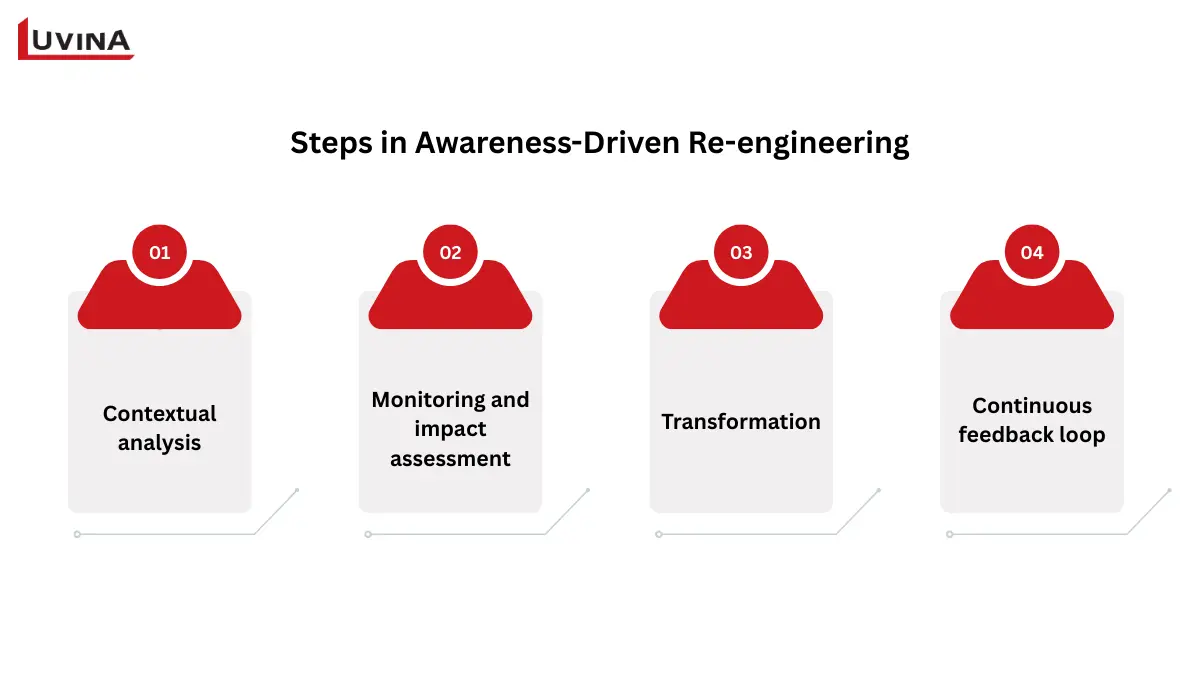
The awareness-driven re-engineering process consists of these 4 steps
Step 1: Contextual analysis (Awareness gathering)
Developing a thorough knowledge of the current system starts the process. Teams also look for important pain spots like scalability restrictions or performance bottlenecks where the system no longer satisfies current requirements. Business knowledge contained in legacy code is restored in tandem, especially in instances when documentation is obsolete or missing. In many legacy ERP systems, undocumented business rules are only rediscovered during this stage.
Step 2: Monitoring and impact assessment
Once the system context is understood, real-time monitoring is introduced to observe how the legacy system behaves in practice. While usage analysis emphasizes which features offer actual worth and which have fallen out-of-date, resource use statistics show actual CPU and memory use.
Following that, impact assessment methods assist teams in predicting dangers before transformation starts by assessing how changes in one component could affect others. If you cannot quantify runtime impact today, any modernization decision in awareness-driven software reengineering is largely speculative.
Step 3: Transformation (The re-engineering act)
Technical change can happen in a regulated manner with enough awareness in place. Higher-level abstractions are obtained from already developed implementations using reverse engineering, therefore simplifying the reasoning on the system. Through reorganizing processes like refactoring, internal structures are subsequently changed without changing outside behavior. Teams often discover that only 20–30% of modules require refactoring once awareness data is available.
At last, informed by observations made earlier in the process, forward engineering adds new or revised needs to the contemporary system.
Step 4: Continuous feedback loop
The contemporary system is always tested against already defined standards following release. Continuous input guarantees that the redesigned system produces evident gains in flexibility, stability, and performance. This ongoing comparison completes the cycle and elevates awareness-driven software reengineering as a long-term competence rather than a short-term project phase.
Case Example: Applying an Awareness-driven Approach
The following short cases illustrate how awareness-driven reengineering enables systems to detect misalignment early and adapt without manual intervention.
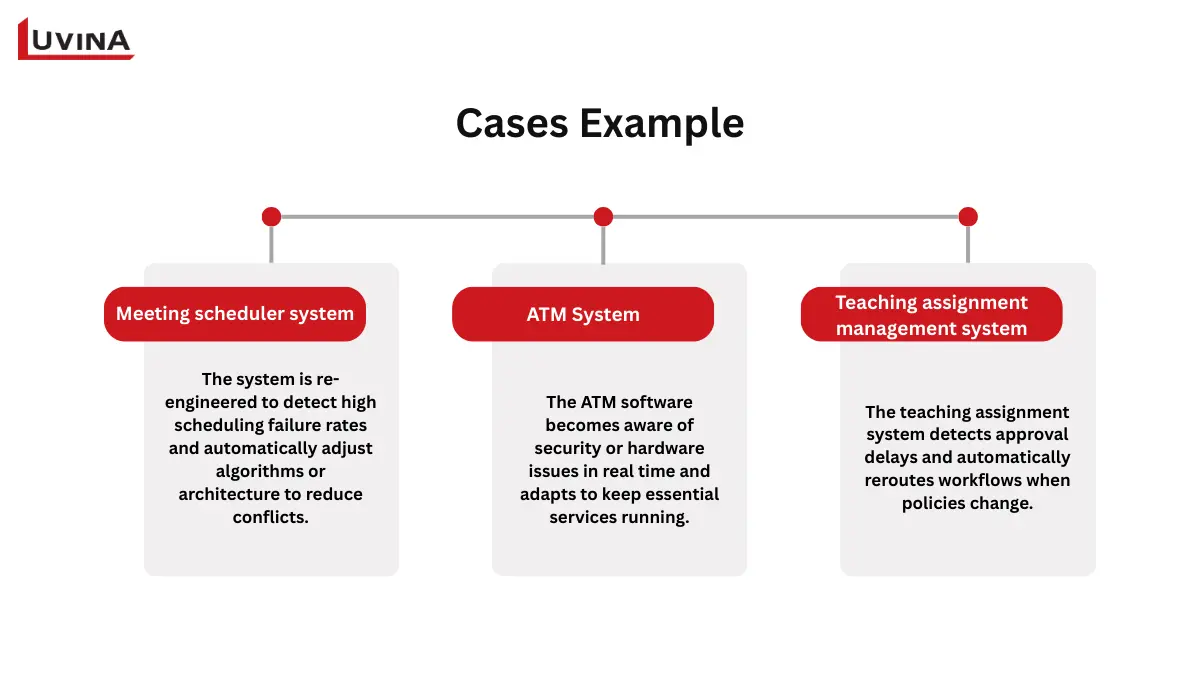
These examples show the value of the awareness-driven approach
Meeting scheduler system
Frequently failing under environmental influences like time zone changes or unavailable meeting venues, the legacy meeting scheduling system’s awareness requirements were included to track the scheduling success rate using awareness-driven software reengineering.
The system automatically started re-engineering activities – including modifying optimization logic or reorganizing scheduling components for more flexibility – when the failure rate crossed a predetermined level. This lets the system self-adjust and minimize frequent scheduling mistakes without continuous human participation.
ATM System
Introducing fresh security measures without interrupting services is especially difficult in long-running ATM systems. Using awareness-driven software reengineering backed by the Zanshin Framework, the system was improved to detect hardware problems and repeated authentication failures in real time.
Based on this knowledge, transaction flows were dynamically reconfigured to isolate defective modules while preserving vital services, including balance checks, therefore increasing resilience without complete system shutdowns.
Teaching assignment management system
Frequent regulatory revisions made it difficult for a university teaching assignment system to manage, hence approval process delays developed. Awareness was included in the procedure to track latency at every stage of approval.
The system automatically rechanneled assignments to equivalent agencies if delays exceeded a set time limit. This awareness-driven adaptation streamlined operations and helped to clear bottlenecks in a dynamic policy context.
Comparison with Other Software Reengineering Approaches
In legacy software modernization initiatives, different reengineering approaches address different aspects of system evolution. The table below highlights the key differences between awareness-driven software reengineering and other common approaches using comparable criteria.
| Approach | Primary focus | Key data sources | Main optimization goal | Adaptability to change |
| Model-driven re-engineering (MDR) | Architectural and structural alignment | Design and system models | Maintain architectural consistency | Low – largely static and design-time driven |
| Search-based software engineering (SBSE) | Code-level optimization | Static code metrics | Improve technical quality metrics | Low – lacks runtime or business awareness |
| Data-driven software re-engineering (DDSR) | Failure and risk prediction | Historical logs and system records | Reduce defects based on past behavior | Medium – reactive to historical trends |
| Awareness-driven software reengineering | Context-aware system evolution | Runtime monitoring and system awareness | Align system behavior with business goals | High – continuous and adaptive |
| AI-assisted re-engineering | Automation of code transformation | Source code patterns and templates | Increase developer productivity | Low – limited understanding of real-world impact |
Comparison table of re-engineering approaches
If your goal is continuous business alignment rather than structural cleanup, awareness-driven reengineering provides the highest adaptability.
Benefits and Challenges
Embedding runtime awareness into the modernization initiative helps teams advance from intuition-based decisions to measurable, goal-oriented improvements by means of awareness-driven software reengineering. Its primary advantages and challenges are shown in short form below.
Benefits
– Higher precision: Re-engineered components are only those missing their objectives.
– Better cost efficiency: Less effort delivers greater performance impact.
– Lower operational risk: Early rollback or correction depends on continuous monitoring.
– Business alignment: Re-engineering is driven by KPIs, not code aesthetics.
– Sustainability support: Energy usage can directly trigger optimization actions.
Though it is efficient, awareness-driven software reengineering presents a number of logistical difficulties that teams have to overcome.
Challenges
– Instrumentation overhead: Adding sensors to legacy code can be intrusive.
– Awareness requirements gap: Harder to define than functional requirements.
– Skill dependency demands knowledge across architecture, data, and DevOps.
– Observer effect: Monitoring could affect system performance.
– Organizational readiness: Lack the processes, culture, or governance needed to adopt awareness-driven practices effectively.
Tools and Techniques Supporting Awareness-driven Reengineering
To make runtime awareness actionable, awareness-driven software reengineering relies on a combination of architectural techniques and supporting tools. The following table groups the main techniques and tools, then briefly explains the role each one plays.
| Tool/ Technique | Role | |
| Core techniques | Goal modeling (i*, Tropos) | Defines business goals, softgoals, and awareness requirements (AwReqs). |
| MAPE-K loop | Drives monitoring, analysis, planning, and execution of adaptations. | |
| Strangler fig pattern | Gradually replaces legacy modules based on runtime evidence. | |
| Instrumentation | Injects probes to collect performance and behavior data. | |
| Specialized frameworks | Zanshin framework | Models and monitors AwReqs automatically at runtime. |
| DREAMS | Evaluates re-engineering options using live system data. | |
| Observability tools | Prometheus and Grafana | Collects and visualizes metrics tied to awareness goals. |
| Dynatrace/ New Relic | Detects bottlenecks and anomalies with APM and AI support. | |
| OpenTelemetry | Standardizes logs, metrics, and traces across services. | |
| Code analysis tools | SonarQube | Assesses technical debt through static analysis. |
| Structure101 | Visualizes dependencies to support modularization. |
Key tools for awareness-driven re-engineering
Future Trends in Adaptive System Reengineering
Adaptive reengineering is developing beyond reactive solutions towards predictive and sustainable change as systems get increasingly autonomous and context-aware. Combining runtime awareness with intelligence, transparency, and ecological responsibility, awareness-driven software reengineering should be at the core of this transition.
Key developments affecting adaptive system redesign going forward are provided below.
– AI-augmented awareness: Machine learning algorithms learn typical system behavior and anticipate goal violations before they happen, thus lowering dependency on manually specified thresholds.
– Green-aware reengineering: Awareness grows to encompass energy and carbon metrics, thereby allowing the program to modify its architecture and workload according to energy consumption and environmental impact.
– Chaos-driven awareness: Intentional injections of faults are used to see if the awareness layer can recognize and react, therefore directing targeted reengineering for improved observability.
– Edge-native adaptive systems: Reengineering aids in place and bandwidth awareness; therefore, edge-native adaptive systems can dynamically divide jobs between cloud and edge devices.
– Explainable adaptivity (X-awareness): Systems clarify why and how changes were initiated, therefore making adaptation choices visible.
Organizations planning long-term digital resilience should evaluate which of these awareness dimensions matter most today.
Final Thoughts
Awareness-driven software reengineering shifts modernization from isolated technical upgrades to continuous alignment with real business conditions. For organizations maintaining long-lived systems, this approach reduces risk while preserving strategic flexibility. Organizations may lower risk, manage costs, and make data-based judgments during modernizations, which will also support traditional software migration.
Feel free to contact Luvina for consultation and practical assistance if you are intending to update or redesign a current system and need professional advice fit to your business objectives. assessing refactoring, reengineering, or organizing a more extensive modernization trip, Luvina can assist in evaluating your present system and advise on the most appropriate strategy. Get expert counseling by contacting Luvina right away.
Resources
- https://ieeexplore.ieee.org/document/8049182/figures#figures
- https://www.cs.utoronto.ca/~alexei/pub/Lapouchnian-Depth.pdf
- https://sites.cc.gatech.edu/morale/tools/isvis/2009/summaries/Reverse_Engineering_and_Design_Recovery_A_Tax.pdf
- https://nemo.inf.ufes.br/wp-content/papercite-data/pdf/souza-et-al-sefsas13.pdf
- https://www.mdpi.com/2076-3417/15/5/2756
- https://www.researchgate.net/publication/4250869_The_Current_State_and_Future_of_Search_Based_Software_Engineering
- https://www.researchgate.net/publication/318816158_An_Introduction_to_Docker_and_Analysis_of_its_Performance
READY TO START A PROJECT?
Our experts are eager to explore your needs.

Read More From Us?
Sign up for our newsletter
Read More From Us?
Sign up for our newsletter