




Digital Transformation in Healthcare: The Future of Care


Digital transformation in healthcare is altering the way patients receive medical care, occasionally before they even enter a hospital. Using a mobile application, a patient can now schedule an appointment, get AI-assisted diagnostic assistance, and have their health monitored remotely using linked devices.
Almost 90% of health system leaders view digital and artificial intelligence change as a top priority for their companies, according to a McKinsey & Company study. Investing in digital technology has become a must for healthcare providers fighting rising expenses, labor shortages, and increasing patient expectations to improve productivity and provide better care.
We investigate in this article how digital healthcare transformation is changing this industry, the tools powering this change, and what the future of care may seem like for patients as well as providers.
What Is Digital Transformation in Healthcare?
Digital transformation in healthcare is the application of digital technologies, data, and contemporary methods to better manage and provide healthcare. Using technology such as EHR, EMR, IoT, artificial intelligence, and machine learning, healthcare professionals may better manage patient data, help to make more accurate diagnoses, and enhance the general quality of care.
More critically, digital transformation for healthcare is a bigger change in how healthcare systems reconfigure processes, maximize operations, and foster departmental cooperation. While integrated platforms like healthcare ERP systems simplify administrative and clinical operations, solutions like healthcare app development enable patients to have easier access to medical care.
Why It Matters More Than Ever
Better care under limited resources is under increasing pressure for healthcare systems all across. Within this framework, digital transformation in healthcare has taken on great significance now. By incorporating modern technologies into medical treatments, healthcare providers can raise the quality and availability of care.
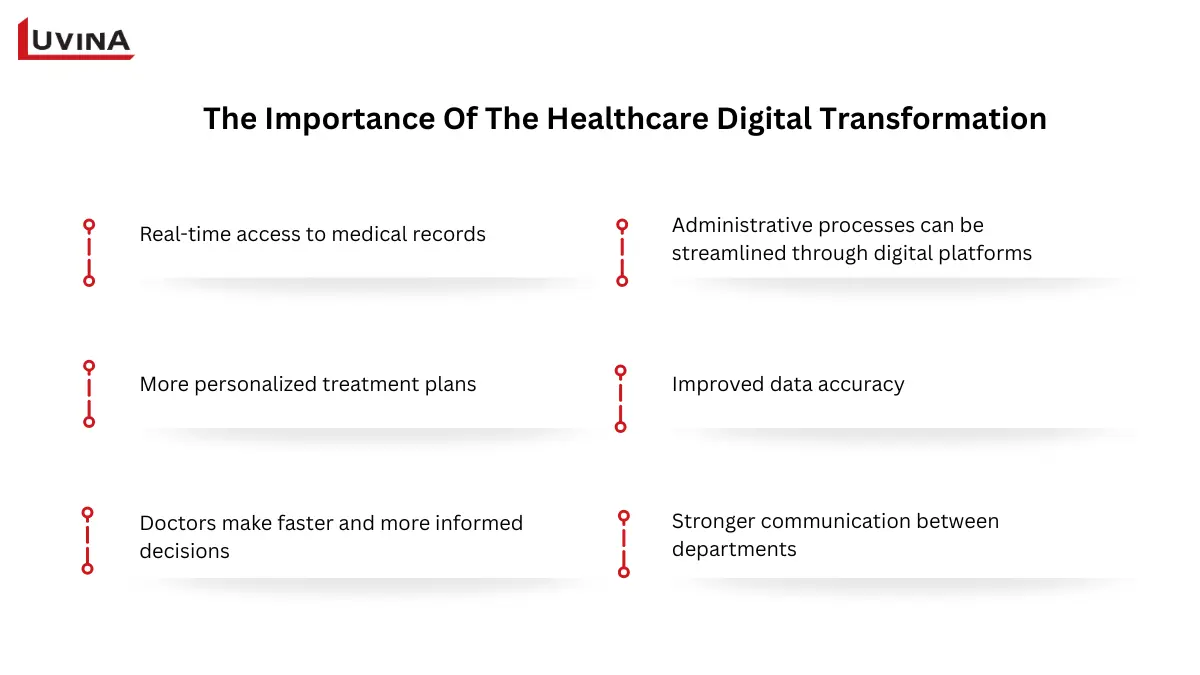
Digital transformation in healthcare is essential to meet the needs of customers and patients
Simultaneously, digital transformation in healthcare allows healthcare organizations to run more efficiently. Through digital platforms, administrative procedures, including documentation, scheduling, and data management, can be simplified, hence lowering paper burden and enabling medical personnel to give more attention to patient care. Better data accuracy and more departmental communication also help to make healthcare treatments more dependable and well coordinated.
Organizations need a defined digital transformation strategy that matches technology adoption with operational goals and patient needs in order to realize these advantages. Properly carried out, digital transformation in healthcare helps to build a more linked and patient-centered healthcare system in addition to increasing efficiency.
Core Technologies Driving the Transformation
Modern healthcare depends on main technologies that help to digital transformation in healthcare, simplify processes, and improve patient care. The fundamental technologies are presented clearly and briefly in the table below.
| Technology | Role in healthcare digital transformation |
|---|---|
| AI and ML | Examine patient data for diagnosis, risk assessment, and treatment optimization. Includes patient chatbot conversation AI, reminders, and engagement. |
| Electronic health records (EHR) | Reduce reliance on paper records and speed coordinated care by centralizing patient information. |
| Telemedicine and remote patient monitoring | Allow mobile health apps and linked devices to provide continuous health tracking and remote consultations. |
| IoT and wearable devices | Through smartwatches, blood pressure monitors, or implanted devices for continuous monitoring, collect real-time patient data. |
| Cloud computing and big data | Improve clinical and operational decisions by safely storing and analyzing big datasets. |
| Administrative automation systems | Reduce your workload and boost efficiency by automating scheduling, billing, and documentation, thereby furthering digital transformation in healthcare projects. |
| Data analytics platforms | Transform medical information into practical insights to improve hospital performance and patient outcomes. |
| Blockchain | Make certain that patient information is shared safely and clearly throughout platforms. |
Core technologies driving healthcare digital transformation
Key Benefits for Patients and Providers
Apart from bettering care quality, digital transformation in healthcare also increases patient involvement, accessibility, and efficiency. The following are the major advantages that make this change crucial:
Improved patient outcomes
Centralized digital health records and faster data sharing allow providers to make quicker, more accurate diagnoses and create personalized treatment plans. Patients also gain more control and understanding of their care through portals and access to their own health data.
Less cost and more efficient work
By automating administrative tasks and making paperwork simpler to complete, errors in the process can be reduced. Clinicians can spend less time on administrative duties and less time performing unnecessary procedures. This creates a lower cost for hospitals and improves the productivity of staff members.
More flexible access to care
Telemedicine, remote monitoring, and patient portals provide increased access and availability of healthcare services, especially for populations that reside in rural or impoverished areas. Patients can schedule appointments, access their medical records, and communicate with their providers easily from anywhere.
Improved privacy and security of health records
Current systems will ensure patients’ health records will remain protected during the digital transformation in healthcare; thus, creating both provider and Patient confidence to disclose sensitive medical information.
Challenges
While digital transformation in healthcare offers significant benefits, implementing it comes with multiple challenges. Healthcare organizations must carefully navigate these obstacles to ensure successful adoption and sustainable improvements. The table below summarizes the main challenges and their impacts.
| Challenge | Impact | Solution |
|---|---|---|
| Data privacy and security | Possibility of breaches and loss of sensitive patient information | Improving cybersecurity, implementing access controls, and guaranteeing regulatory compliance |
| Integration with legacy systems | The cost of high implementation and interruptions in the workflow | Gradual cloud integration, interoperable platforms, and system upgrades |
| Resistance to change | Slow adoption by medical professionals and employees | Managing digital transformation successfully requires early stakeholder participation and the advancement of cross-functional cooperation. |
| Skill gaps | Slower efficiency and mistakes brought on by a lack of digital proficiency | Offering instruction in artificial intelligence, automation, cybersecurity, and digital instruments |
| Regulatory and ethical compliance | Penalties, legal matters, or patient resentment | Maintaining governance structures and harmonizing methods with HIPAA/GDPR norms |
| Workflow and process challenges | Burnout among staff and ineffective procedures | Redesigning processes and automating everyday activities to enable digital transformation in healthcare |
Challenges and how to overcome them
How to Implement Digital Transformation in Healthcare
To be successful in digital transformation in healthcare, there needs to be effective planning, an organized approach, and measurable results. But there also needs to be clear objectives before all of that can happen, clear objectives. The guide provided below will provide a structure for you to follow through on the different digital transformation stages for healthcare, so you’ll have clear guidelines to implement them correctly and receive measurable outcomes.
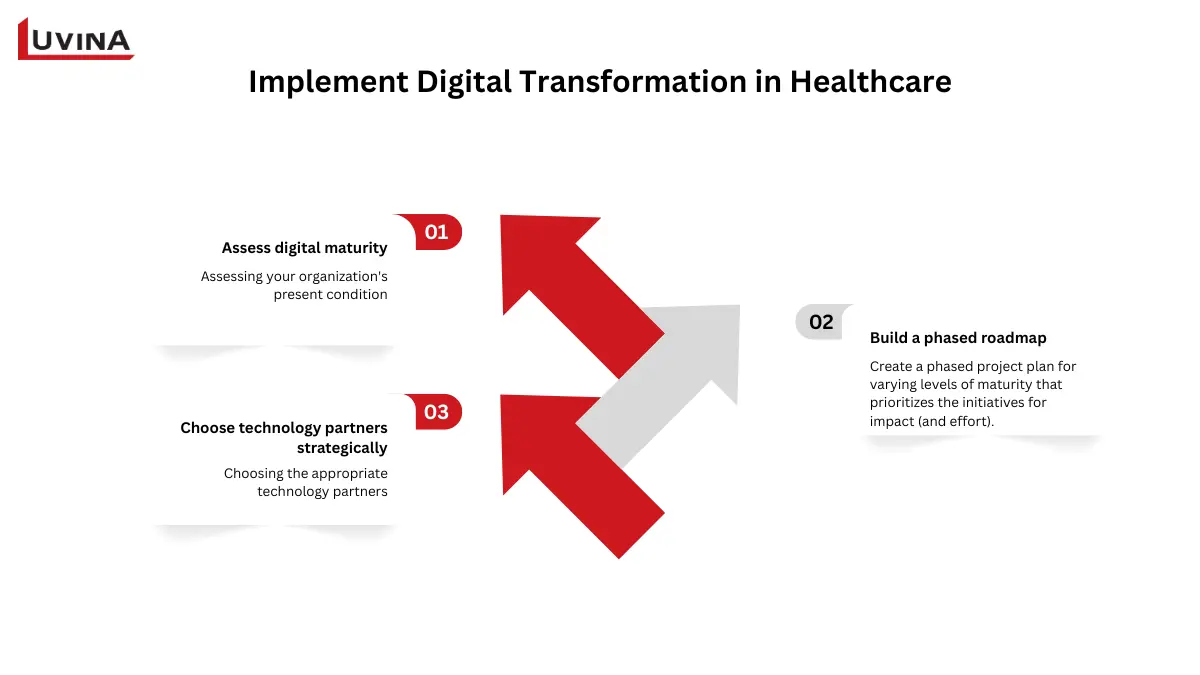
Overview of the implementation stages of the digital transformation of healthcare
Stage 1: Assess digital maturity
Begin by assessing your organization’s present condition. To find areas that would gain from digital solutions, inefficiencies, and antiquated systems, look at processes for administration, clinical, and IT systems, and workflows. Evaluate department data integration and staff preparedness.
Establishing explicit, quantifiable objectives at this point, like enhancing patient experience, lowering expenses, or quick decision-making, builds a base for successful digital transformation in healthcare.
Stage 2: Build a phased roadmap
Create a phased project plan for varying levels of maturity that prioritizes the initiatives for impact (and effort) to help focus short- and long-term strategies/workflows/resource allocations on quality improvement and measure success via performance controls (KPI). Each phase should identify key project areas (e.g., transforming EHRs, implementing telehealth approaches, converting into AI-driven analytical systems, automating workflows, etc.) to design and allocate resources efficiently.
A well-defined plan guarantees that every stage advances the general digital transformation of healthcare, and adoption becomes organized instead of arbitrary.
Stage 3: Choose technology partners strategically
Choosing the appropriate technology partners is essential for effective implementation. Choose vendors that offer continuous training and support, assist scalability, and can fit naturally with already in place systems. Think about technologies such as AI analytics tools, IoT-enabled devices, and cloud-based systems.
The Future of Digital Transformation in Healthcare
Digital transformation in healthcare is changing its course as technologies that provide more customized, effective, and safe treatment. The table below provides a summary of major trends affecting the following phase of digital healthcare transformation.
| Trend | Impact/Benefit |
|---|---|
| Personalized medicine and predictive analytics | Tailor-made treatments depending on genetics and lifestyle improve results and lower useless treatment. |
| Blockchain for secure health data | Increases openness and confidentiality; patients manage access to their information. |
| Digital patient engagement | Encourages self-management; apps and portals help adherence and communication. |
| AI-driven insights | Encourages early intervention and faster diagnosis, hence increasing productivity. |
| Telemedicine and remote monitoring | Opens access to treatment; allows for prompt treatment via remote appointments and wearable devices |
Digital healthcare transformation will continue to evolve with new trends
Conclusion
For companies trying to remain competitive while providing excellent, patient-centered treatment, embracing digital transformation in healthcare is especially important. Faster decision-making, better patient outcomes, and more effective operations are made possible by sophisticated technologies, including IoT, artificial intelligence, telemedicine…
Organizations can create a future-ready IT infrastructure with Luvina’s competent assistance that improves care delivery, lowers operational complexity, and guarantees long-term resilience. Contact Luvina and discover customized digital solutions for your healthcare business right now.
>>> Read more: Healthcare IT outsourcing services..
FAQ
1. What is digital transformation in healthcare?
Digital healthcare transformation is the integration of digital technologies like AI, IoT, and telehealth to improve patient care, operational efficiency, and overall healthcare delivery.
2. How does cloud technology support healthcare?
The cloud enables secure storage, real-time access to medical records, telemedicine services, and AI-powered diagnostics, making healthcare more efficient and accessible.
3. What are the main types of digital transformation in healthcare?
Key types include process transformation, technology adoption, organizational change, and expanding digital services
Resources
- https://www.sermo.com/resources/digital-transformation-in-healthcare/
- https://online.northeastern.edu/resources/what-is-digital-transformation-in-healthcare/
- https://kaizen.com/insights/digital-transformation-healthcare-pioneering-innovation-enhancing-patient-outcomes/
READY TO START A PROJECT?
Our experts are eager to explore your needs.

Read More From Us?
Sign up for our newsletter
Read More From Us?
Sign up for our newsletter