




Digital Transformation in Insurance Industry: Strategy Guide


74% of insurers are prioritizing digital transformation in the insurance industry initiatives in 2025; 96% of insurance CEOs say the COVID-19 epidemic sped digital efforts throughout the industry.
The insurance industry is no longer asking whether to digitize, but how to scale transformation beyond isolated pilots.
Despite heavy investment, many insurers struggle to translate digital initiatives into measurable business outcomes. The gap often lies not in technology, but in execution, integration, and organizational alignment.
This guide breaks down what digital transformation in insurance industry actually looks like in 2026: from core technologies and real-world impact to a practical framework. Insurers must read this to scale transformation effectively.
What Is Digital Transformation in the Insurance Industry?
Digital transformation in the insurance industry refers to the end-to-end adoption of digital technologies, data, and AI to redesign core operations such as underwriting, claims, policy administration, and customer experience.
For insurance, almost all facets of the company are affected by a digital transformation strategy. Among several forces driving insurance companies to speed digital transformation insurance industry in 2026 are:
– Increasing client expectations: Like those provided by e-commerce sites and mobile banking applications, modern consumers anticipate perfect digital experiences. Simple digital interfaces enable them to buy policies, modify data, and file claims quickly.
– InsurTech competition: Faster, more adaptable data-driven products are being developed by digital-native firms. With innovation labs, digital platforms, and system upgrades, conventional insurers are funding digital transformation in insurance industry to keep pace.
– Legacy system costs: Many insurance companies still depend on obsolete IT infrastructure that is expensive to maintain and challenging to link with modern technologies, therefore stifling innovation and raising operational complexity.
– Regulatory and cybersecurity pressures: Insurers are under increased cyber threat and more stringent compliance expectations, thereby under stress from regulatory and security measures. By 2029, the global cost of cybercrime is forecast to reach $15.63 trillion, prompting businesses to increase their investments in robust digital risk management and compliance capabilities.
Key Technologies Reshaping Insurance
Modern insurance innovation is fueled by technology. To remain competitive and enhance client experiences, insurers are embracing a range of core technologies that enable automation, more accurate risk assessment, and more flexible digital services. Accelerating the shift toward smarter, data-driven operations, these technologies form the foundation of modern insurance digital transformation.
| Technology | Role in insurance transformation |
| AI and machine learning | Detect fraud, automate underwriting, improve pricing |
| IoT and telematics | Provide real-time risk data for usage-based insurance |
| Cloud and APIs | Enable scalable platforms and faster integration |
| Blockchain and smart contracts | Improve trust and automate claims via smart contracts |
| Robotic process automation (RPA) | Automate repetitive back-office tasks |
Key technologies driving transformation in the insurance industry
>> Read more: Explainable AI in finance
Where Transformation Is Delivering Real Impact
Digital transformation is delivering the most measurable impact across three core areas: underwriting, claims processing, and customer experience. From underwriting to claims management and customer experience, insurers are using digital tools to streamline workflows and create more responsive services.
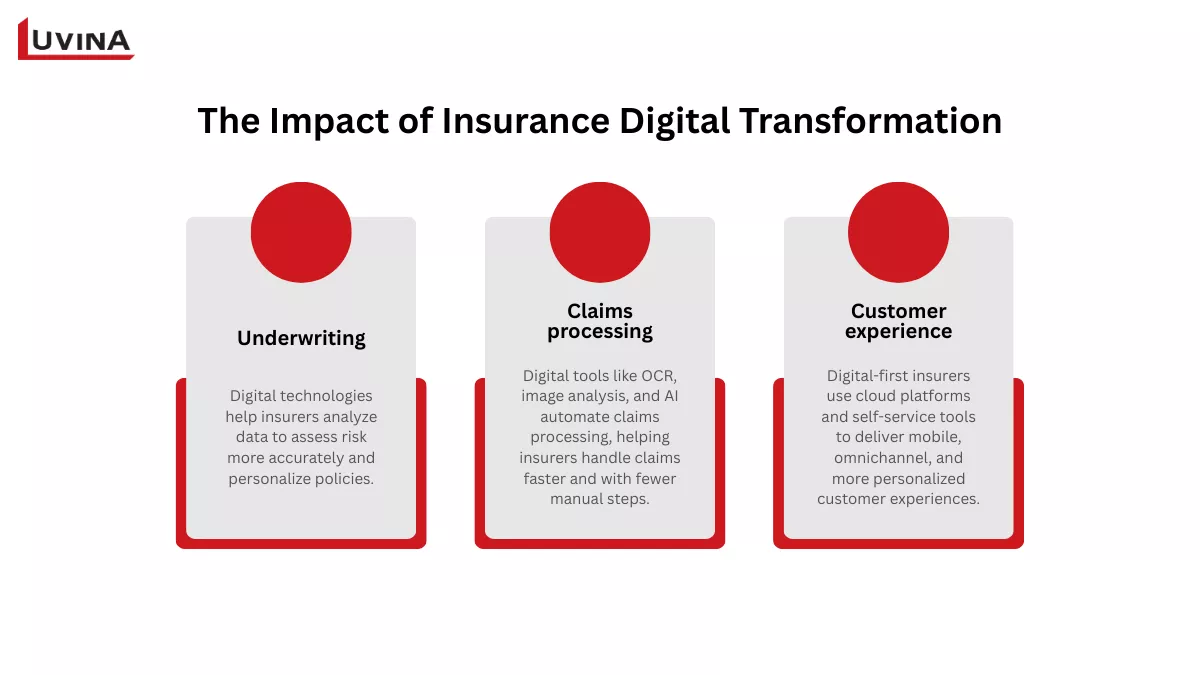
These are the 3 areas most affected by the transformation
Underwriting
Digital technologies are transforming how insurers assess and manage risk. By collecting and analyzing large volumes of data from sources such as telematics devices, wearables, and even social media, insurers can build a more accurate view of individual risk profiles. This allows companies to design personalized policies and adjust premiums based on real behavior and usage patterns rather than relying solely on historical averages.
Advanced analytics and AI models also help underwriters process information faster and identify patterns that would be difficult to detect manually. As a result, insurance digital transformation enables insurers to make more informed underwriting decisions while improving both pricing accuracy and product relevance for customers.
Insurers using AI-based claims automation can reduce processing time by up to 70% while improving fraud detection accuracy.
Claims processing
Claims management is another area where digital transformation in insurance industry is producing clear operational gains. Automation technologies such as optical character recognition (OCR), image analysis, and AI-powered workflows help insurers process claims more quickly and with fewer manual steps. These systems can automatically extract data from documents, validate policy details, and flag suspicious claims for further review.
For example, Swiss Re has introduced generative AI tools to support underwriting and claims processing, enabling faster access to critical data and reducing manual effort. Such implementations demonstrate how AI can significantly improve both operational efficiency and decision accuracy.
Customer experience
Digital-first insurers are replacing legacy systems with cloud-based customer platforms that support mobile services, omnichannel communication, and personalized interactions. At the same time, digital portals, chat-based support, and self-service tools allow customers to manage policies, submit claims, and track updates at any time.
The Biggest Challenges (And How to Address Them)
Despite its benefits, implementing digital transformation in insurance industry initiatives often comes with practical obstacles. Many insurers must modernize complex systems, build new digital skills, and manage organizational change while staying compliant with strict regulations.
The table below summarizes the common challenges, their impact, and practical solutions to address them.
| Challenge | Impact | Solution |
| Legacy systems | Old infrastructure complicates the incorporation of new technologies and inhibits creativity. | Apply a phased modernizing strategy using modular, API-friendly platforms and middleware linking existing and new systems. |
| Talent and skills gap | Not enough experts with digital abilities and insurance knowledge restrict acceptance. | Give focused training, upskilling initiatives, and organized change management. |
| Cultural resistance | Unfamiliar processes or fear of job disruption can cause employees to oppose new tools. | Present a clear vision, provide practical training, and designate internal “digital champions”. |
| Regulatory complexity | Compliance with privacy, solvency, and AI rules adds operational challenges. | Embed controls, audit trails, and governance into digital workflows – critical for digital transformation in life insurance. |
Transitioning from old to new inevitably brings challenges
A Practical Framework for Getting Started
For insurers ready to move beyond pilot projects, a structured approach is key to achieving sustainable digital transformation in insurance industry.
The following framework shows how insurers can move from initial pilots to enterprise-wide adoption, creating lasting impact through life insurance digital transformation:
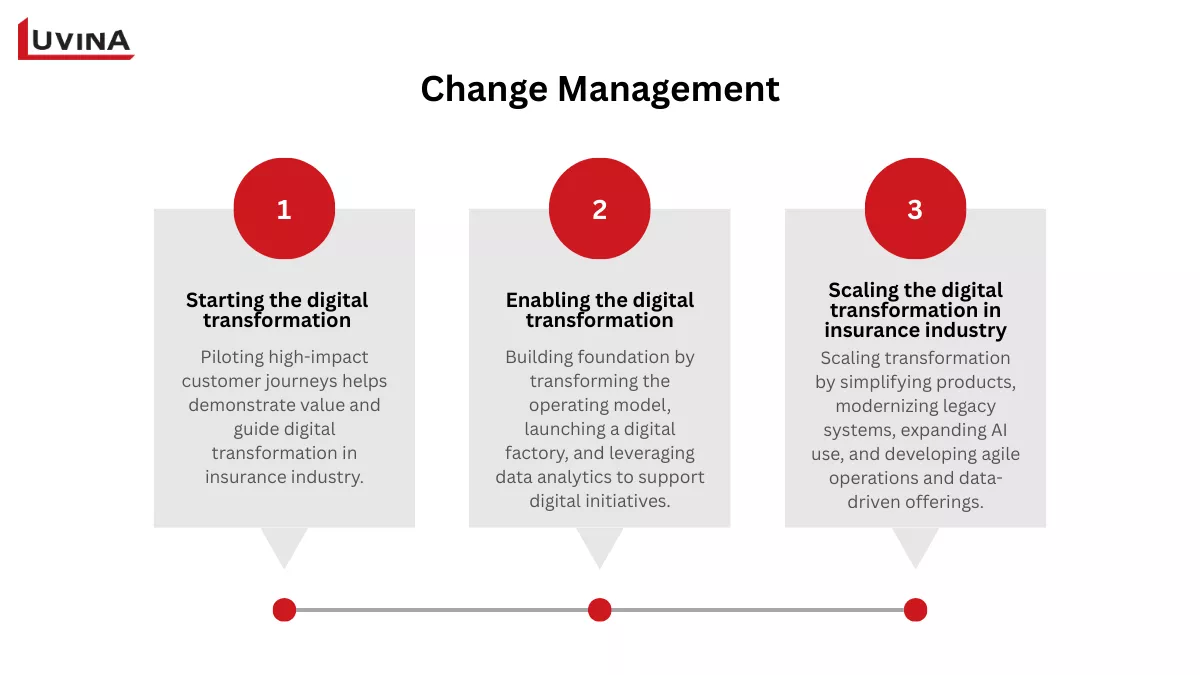
The 3 main stages of digital transformation in the insurance industry
1. Starting the digital transformation
The journey starts with piloting important customer journeys, as these immediately show value for digital projects. Insurers should give trips with high transaction volumes, noteworthy efficiency improvements, and excellent organizational support top priority. Early pilots help to highlight adoption barriers and direct more general initiatives in the digital transformation in insurance industry.
2. Enabling the digital transformation
This stage sets the ground for more general change, including:
– Transforming the operating model: Design channels to balance complicated and digital transactions. Modify the skill profiles of your employees and agents to guarantee a customer-centric approach, match incentives, and monitor performance using KPIs such as resolution ratios and processing time.
– Implementing a digital factory: Control cross-functional, agile teams with small businesses. Launch and perfect digital customer journeys using rapid iteration while simultaneously arranging outside alliances for added-value services.
– Leveraging data analytics: Using data analytics, create a center of excellence to give priority to use cases, produce actionable insights, and enable life insurance digital transformation via customized products and risk management.
3. Scaling the digital transformation in insurance industry
Insurers turn their attention to projects that will span the whole company once basic capabilities are established. Key issues include:
– Before introducing wholly digital goods, rationalize product portfolios.
– Using interim solutions like RPA, slowly replace legacy systems.
– Separate “change” and “run” processes for client journeys to help you keep improving constantly.
– Widely deploy artificial intelligence applications to maximize value by handling issues of talent, governance, and integration.
– Create targeted, unique offers and integrated systems that use real-time data to help you to maintain a competitive edge in a fast-changing industry.erations planning and swiftly react to shifting circumstances.
FAQ
1. What is digital transformation in insurance industry?
It’s a company-wide shift to data-driven, automated, and AI-enabled operations across underwriting, claims, policy admin, billing, and service, modernizing systems and improving outcomes for customers and the business.
2. What technologies are used in insurance digital transformation?
Key tools include cloud platforms, APIs, microservices, RPA, machine learning, generative AI, and low-code platforms for faster, governed, and reusable digital solutions.
3. What are the biggest challenges in insurance digital transformation?
Major barriers are legacy systems, fragmented data, regulatory changes, and workforce adoption. Solutions include phased modernization, governed data, workflow controls, and employee enablement.
4. How does AI improve insurance underwriting?
AI enhances human decisions by extracting data, spotting anomalies, guiding evaluators, detecting fraud, and accelerating knowledge work while keeping compliance intact.
5. What is embedded insurance?
Embedded insurance integrates coverage seamlessly into other products or services, allowing customers to buy insurance at the point of need without visiting an insurer separately.
Conclusion
Digital transformation in the insurance industry is not just about adopting new technologies. It requires a structured approach to scaling change across systems, processes, and people.
Insurers that succeed are those that move beyond pilots, align business and technology strategies, and continuously optimize based on real-world data.
If you’re looking to build or scale your digital transformation roadmap, Luvina provides end-to-end consulting and implementation support tailored for insurance organizations.
Talk to our experts to explore your transformation strategy.
Resources
- https://kpmg.com/tt/en/home/services/advisory/risk-consulting/internal-audit-risk/96-percent-of-insurance-ceos-indicate-acceleration-in-digitization-due-to-the-pandemic.html
- https://fintech.global/2025/04/24/74-of-insurers-are-prioritising-digital-transformation-and-tech-adoption-in-2025/
- https://www.prosci.com/blog/digital-transformation-in-insurance-industry
- https://www.outsystems.com/digital-transformation/insurance/#faq
- https://sapiens.com/resources/blog/digital-transformation-in-insurance/
- https://www.bcg.com/industries/insurance/digital-transformation-insurance
READY TO START A PROJECT?
Our experts are eager to explore your needs.

Read More From Us?
Sign up for our newsletter
Read More From Us?
Sign up for our newsletter