




Digital Transformation in Education: Beyond the Buzzwords


Digital transformation in education starts not with technology. It begins with a minor change in learning methods for kids. Many people had hoped this change would go quicker. Recent data show that 86% of students already use artificial intelligence in some manner. Beyond the buzzwords, though, what does this change actually imply for schools, teachers, and students?
This article explores what digital transformation in education means in 2026, including key technologies, real-world applications, challenges, and a practical framework for implementation.
What is digital transformation in education?
Digital transformation in education is the strategic use of digital technologies, data, and platforms to redesign teaching, learning, and institutional operations for better efficiency, accessibility, and outcomes. It is transforming the daily functioning of universities, the way knowledge is disseminated, and how pupils interact with content.
Digitization, digitalization, and digital transformation of education vary in:
– Digitization: Converting physical content (e.g., textbooks) into digital formats (PDFs).
– Digitalization: Using digital tools to improve existing processes (e.g., online learning platforms).
– Digital transformation: Redesigning the entire education ecosystem using technology and data.
Why digital transformation in education is accelerating
Digital transformation in education is accelerating due to several key drivers, including global disruption, changing learner expectations, and workforce demands.
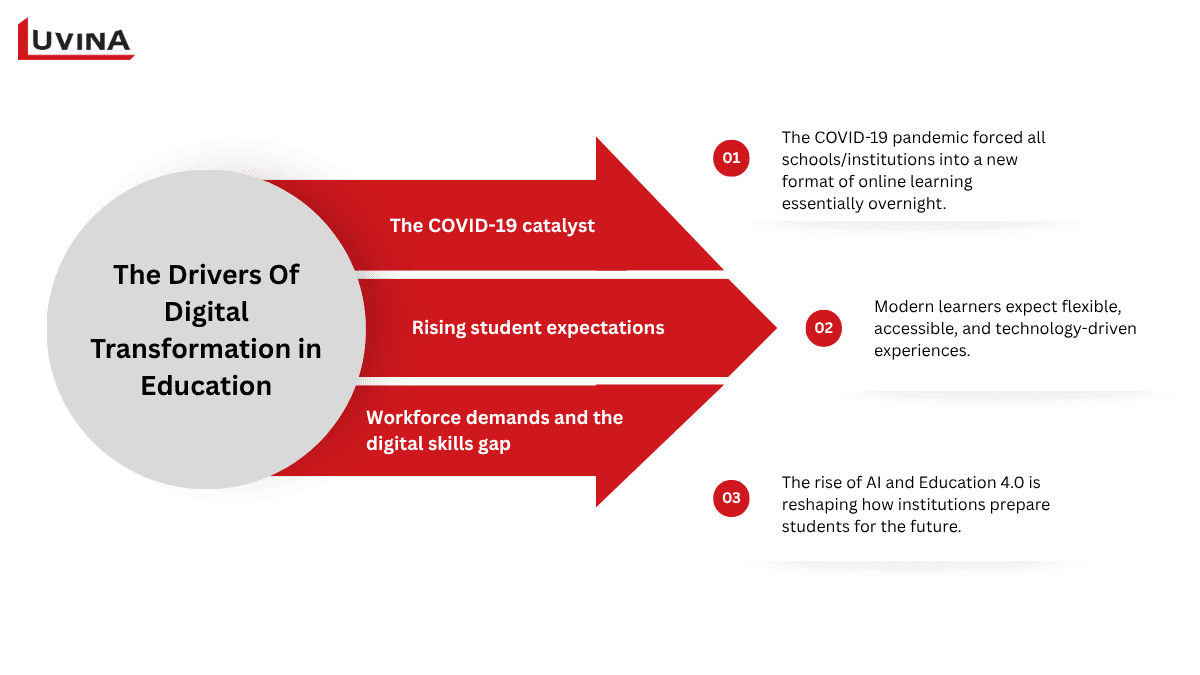
Digital transformation in education is driven by both social factors and the current realities of the education
The COVID-19 catalyst
The COVID-19 pandemic has catalyzed education’s digital transformation because it forced all schools/institutions into a new format of online learning essentially overnight. With this transformation, there were many opportunities to identify the infrastructure gaps that already existed.
For example, in some regions, limited infrastructure during the pandemic revealed major gaps in digital readiness, highlighting the need for scalable solutions.
Rising student expectations
Modern learners expect flexible, accessible, and technology-driven experiences. This demand is pushing universities to move beyond traditional lectures and adopt interactive, student-centred learning models. As part of digital transformation in education, institutions are investing in digital platforms that support real-time engagement, collaboration, and personalized learning, while also expanding access to global audiences.
Workforce demands and the digital skills gap
The rise of AI and Education 4.0 is reshaping how institutions prepare students for the future. Through digital transformation in education, universities are integrating digital tools and innovative learning models to equip learners with critical thinking, adaptability, and digital skills.
Key technologies driving digital transformation in education
A group of core technologies changing how learning is presented, administered, and experienced drives the quick expansion of digital transformation in education. The chart below draws attention to the most significant technologies and their real-world uses.
| Technology | Key applications in education |
| Artificial intelligence (AI) and machine learning | – Adaptive and customized learning routes- Virtual helpers and AI chatbots for rapid assistance- Automated scoring and comments- Voice-to-text, text-to–voice accessibility technologies- Automation of back-office and administrative chores |
| Learning management systems (LMS) | – Content, assignments, and communication on a central platform- Encouragement of virtual learning environments (VLE)- Enable blended and hybrid learning systems.- Group projects and conversations benefit from collaboration tools. |
| Cloud computing | – Remote access to learning platforms and resources- Virtual classrooms and real-time collaboration- Secure storage and sharing of materials- Scalable infrastructure supporting digital transformation in education |
| AR, VR, and immersive learning | – Augmented reality in classrooms- Virtual labs and simulations- Hands-on training for medical and technical fields- Interactive, experience-based learning environments |
| Data analytics and learning analytics | – Track and analyze student performance- Identify patterns to improve teaching strategies- Enable targeted and data-driven learning support- Improve decision-making across institutions |
| Blockchain | – Secure credential verification- Transparent admissions and enrollment processes- Smart contracts for tuition and scholarships- Trusted data management for digital transformation in higher education |
Key technologies driving the transformation of teaching and learning
Key technologies driving digital transformation in education include:
- AI for personalization and automation
- LMS for content delivery and collaboration
- Cloud for scalability and remote access
- AR/VR for immersive learning
- Data analytics for performance insights
Key Benefits of Digital Transformation in Education
Digital transformation in education creates value across three key groups: students, educators, and institutions.
The move toward digital transformation in education is altering how teachers instruct, students learn, and institutions work. You can see the advantages of this change plainly among three major categories: students, educators, and institutions.
For students
By providing more interesting, accessible, and customized experiences, digital transformation in education helps students:
– Individualized learning routes match the speed, style, and skills of every pupil.
– Improved accessibility breaks down geographical obstacles by letting learning occur whenever and anywhere.
– Interactive programs, gamification, and multimedia boost motivation and engagement.
– Digital, teamwork, and problem-solving skills development equip pupils for their next jobs.
– Real-time feedback enables pupils to immediately recognize improvement needs.
For educators
With technology-driven tools, teachers get effectiveness and insights:
– Automation of administrative duties and grading gives teachers more time to teach.
– Availability of a broad spectrum of digital tools improves instruction approaches and increases imagination.
– Analytics offer practical insights for tracking development and plan modification.
– Interactive systems encourage classroom cooperation and involvement.
– Regular use of technology raises teachers’ digital abilities.
For institutions
Through digital transformation in universities, schools and colleges gain from simplified processes and wider reach:
– Less paperwork and streamlined procedures help to enhance operational efficiency.
– Data-driven decision-making improves strategic planning and results.
– Global students are drawn to online and hybrid programs, hence increasing enrollments.
– Digital platforms improve stakeholder cooperation and communication.
– Reduced physical materials and automated administrative activities provide cost benefits.
Digital transformation in higher education
Today’s learners expect flexible, personalized, and technology-driven experiences while balancing work, life, and study.
As a result, higher education institutions are leveraging digital transformation to improve learning outcomes, optimize operations, and remain competitive.
Some innovations are made possible by digital transformation in universities:
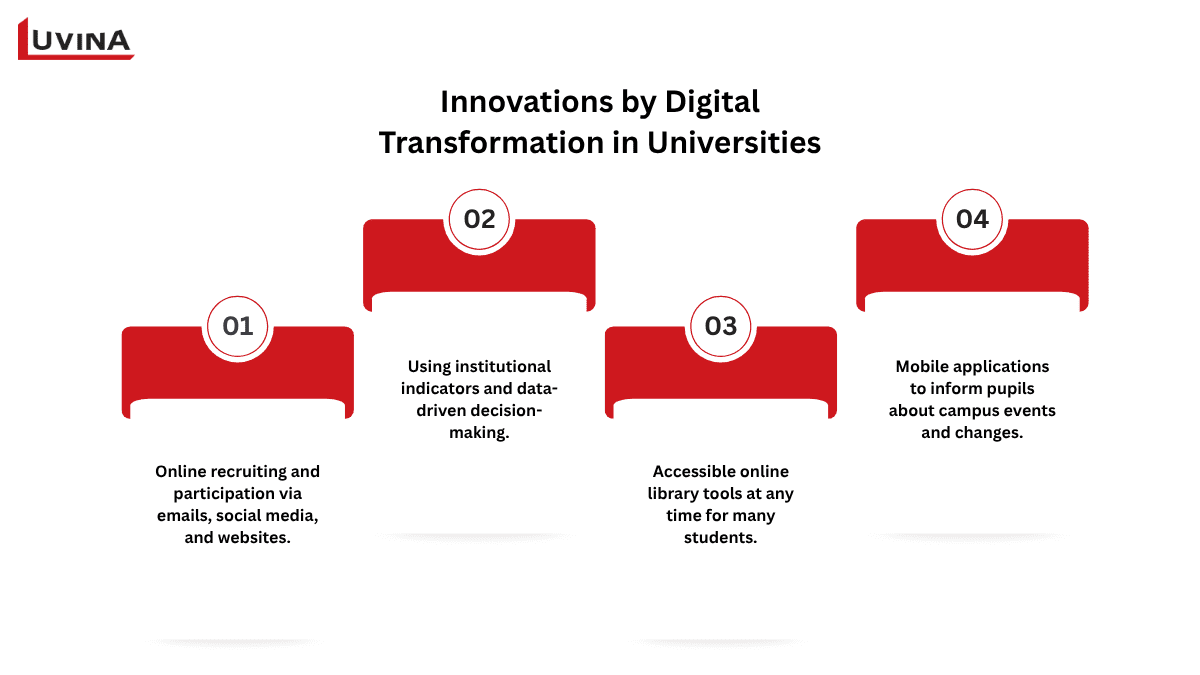
Digital transformation brings many positive changes to higher education
– Online recruiting and participation via emails, social media, and websites.
– Using institutional indicators and data-driven decision-making
– Accessible online library tools at any time for many students.
– Mobile applications to inform pupils about campus events and changes.
Higher education digital transformation pivots on intelligent campuses and hybrid learning methods. Students may study anytime, anywhere with internet and mixed learning systems, mobile learning, and interactive content. While virtual and augmented reality enhance hands-on experiences in fields like medicine and engineering, learning management systems (LMS) such as Moodle and Blackboard enable course distribution, communication, and assessment.
Digital transformation in education also helps with administrative processes as robotic process automation simplifies registration, financial aid, and record-keeping, therefore increasing efficiency. Advanced data analysis enables schools to monitor student performance, find at-risk students, and tailor learning routes. Sustainable digital transformation builds on a strong framework provided by cloud computing and safe data storage, as well as other technologies.
Challenges of digital transformation in education
Not every forward move is simple. Although technology presents fresh possibilities, digital transformation in education reveals disparities in resources, access, and ability. Institutions must first clearly define these obstacles and then provide sensible solutions if they are to advance well. The table below compiles the main problems and how to solve them.
| Challenge | Description | Solution |
| The digital divide | Especially in rural or low-income areas, many students do not have consistent internet, devices, or infrastructure, therefore restricting equal learning opportunities. | Improve internet access and infrastructure, provide affordable devices, and ensure equal access to digital learning. |
| Teacher digital literacy and resistance to change | Teachers and students may not have digital literacy, and some favor conventional methods, hence slowing the acceptance of new technologies. Online learning effects can also worry parents. | To aid teachers in adapting more readily, offer basic and ongoing training, support teachers in utilizing digital tools, and clearly demonstrate the advantages. |
| Data privacy and cybersecurity | If systems are not properly secured,and digitally handling and storing student data raises the risk of security breaches. | Protect teacher and student information by setting precise data management policies, employing robust security systems, and constantly updating systems. |
| Budget constraints and ROI uncertainty | For many organizations, high initial costs for equipment, software, and infrastructure make investing challenging – particularly given low financing. | Manage expenses more effectively by planning expenditures precisely, concentrating on cost-effective solutions, and progressively carrying out digital transformation in education tools. |
Common challenges in digital transformation in education
How to implement digital transformation in education
There is no one recipe for success. Digital transformation in education needs a methodical, step-by-step process matching technology with real institutional demands. An applied structure to direct implementation is found here. A structured approach is essential for successful implementation. Most institutions follow a five-step transformation model:
Step 1: Assess digital maturity
Begin by appreciating your present situation. Many organizations struggle with inconsistent data throughout platforms, including LMS or student information systems, as well as with disjointed systems. Find holes by means of audits throughout infrastructure, processes, and skills. Make sure leadership and important stakeholders are aligned; define specific objectives, KPIs, and a path.
Step 2: Define a clear digital strategy
An effective digital transformation strategy centers on tackling particular issues rather than using technology all throughout. Set measurable goals by first identifying one priority sector, say, enhancing the onboarding experience or student engagement. Increasing course completion rates or enhancing user activation can help track actual influence and drive technology implementation.
Step 3: Build infrastructure and select technologies
Before scaling, you will need to have the correct base on which you plan to grow. Put money into a flexible platform that is able to grow with your needs (these may include LMSs, cloud-based systems, and mobile applications) as well as adding more advanced technologies such as data analytics, artificial intelligence, and cybersecurity based upon additional needs. Simultaneously, ensure that best practices regarding both data governance and data privacy are appropriately adhered to in order to create a structure that can support long-term success.
Step 4: Upskill educators and engage stakeholders
Having technology alone isn’t enough, as educators, learners, and school leaders require the capability and willingness to adopt new ways of teaching/learning. To do this, continue providing educators with additional training on the use of technology, encourage those educators to experiment with new educational practices, and develop new learning experiences that are more interactive and personalized for learners. A supportive culture must be created in order for successful digital transformation in education.
Step 5: Measure, iterate, and scale
Change is a never-ending journey. Track performance using operational metrics and learning analytics; compile teacher and student comments. Refine instruments, streamline operations, and modify teaching approaches using these ideas. Once shown to be successful, distribute solutions throughout the organization to maximize influence.
Real-world examples of digital transformation in education
In order for people to visualize what digital transformation in education might be like in actual practice rather than just in theory, examples from different types of platforms, tools, and complete education systems in which they were applied will help paint that picture. The following examples show how digital transformation is applied across different education scenarios:
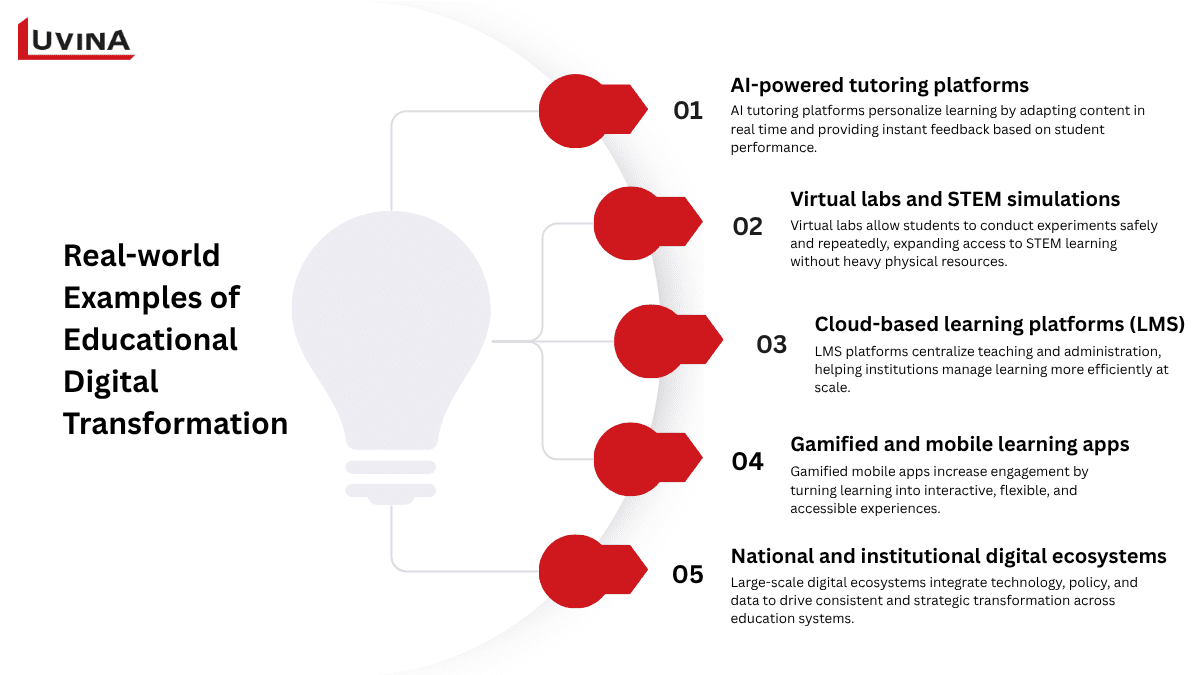
A few examples of how education is evolving
AI-powered tutoring platforms
AI tools such as Carnegie Learning or Squirrel AI are great examples of how digital transformation in education can personalize a student’s learning experience. Both of these systems utilize artificial intelligence capabilities to provide real-time interactions with virtual tutors who help the student to learn by adapting material based on how well the student is progressing through the material and giving instant feedback to help improve the student’s success rate and overall performance.
Virtual labs and STEM simulations
Through the development of virtual labs and STEM simulations such as those provided by Labster or PhET, schools are able to teach science through virtual laboratory experiences instead of being completely dependent upon physical laboratory facilities as they were before the advent of digital learning.
Students have the opportunity to conduct experiments in a simulated environment, conduct complex experimental procedures repeatedly, and examine/experiment with previously unrealistic or unachievable scenarios because of costs or safety issues. By using virtual laboratories, students can experience learning on a scale that would otherwise require a substantial amount of financial and/or resource investment.
All of these methods provide institutions with opportunities to offer STEM educational options without sacrificing the quality of education while benefiting from increased access to quality educational resources and opportunities for students through digital transformation.
Cloud-based learning platforms (LMS)
Modern schooling runs on the operational foundation provided by tools like Google Classroom, Moodle, and Canvas. Course designs, task assignments, progress monitoring, and student contact are all done in one location by teachers. Institutions can also effectively handle high volumes of students and standardize procedures across divisions at the same time.
This is a perfect illustration of how digital transformation education increases administrative efficiency at scale and enhances teaching delivery.
>> Read more: LMS Software Development Company
Gamified and mobile learning apps
Through technology, apps like Kahoot! and BYJU’s show how engagement can be rethought. These sites convert passive learning into active involvement by means of quizzes, prizes, and brief-form lessons. Learners may study anytime through mobile devices, therefore enhancing the flexibility and consistency of education with current practices. For preserving motivation and enhancing knowledge retention throughout time, this strategy works especially well.
National and institutional digital ecosystems
On a broad level, programs by the University of Michigan, the Ministry of Education Singapore, and Estonia demonstrate how change unfolds at a grand scale. These models provide a cohesive plan including data systems, policy, instructor development, and infrastructure. Real-time monitoring of student performance is made possible by centralized platforms, whereas national roadmaps guarantee equal adoption among schools.
Such ecosystems show how digital transformation in education entails more than simply tools; it is about matching technology with long-term strategy and governance.
Key trends in 2026
Learning’s future is already starting to manifest. Digital transformation in education is changing from minor experiments to system-wide acceptance as technology advances. The following trends show what will shape the digital transformation of education in 2026.
| Trend | What does it mean in practice? |
| AI-driven learning and automation | Personalized learning routes; artificial intelligence instructors 24/7; automated grading; early discovery of learning deficiencies; increased emphasis on ethics and government |
| Hyper-personalized learning experiences | Adaptive programs based on student behavior; flexible pace; more student-centered learning |
| Micro-credentials and lifelong learning | Short, stackable certifications; job-relevant skills; support for ongoing learning |
| IoT-enabled smart campuses | Intelligent attendance, linked labs, interactive boards, and sensors for security and environment. |
| Data-driven education and decision-making | Real-time analysis, better institutional choices, enhanced instructional techniques, and encourages large-scale digital transformation in education |
The education sector will continue to evolve with many emerging trendsand swiftly react to shifting circumstances.
FAQ
1. What is digital transformation in education?
It is the integration of digital tools and technologies to improve teaching, learning, and administration in schools and universities.
2. How does digital transformation benefit students?
Students gain personalized learning, more engagement, and better preparation for future skills.
3. What are the biggest challenges of digital transformation in education?
Main challenges include limited access to devices, gaps in teacher digital skills, resistance to change, and data privacy concerns.
4. How are universities implementing digital transformation?
Universities use hybrid learning models, smart campuses, AI analytics, and cloud platforms to enhance learning and streamline operations.
5. What technologies are driving digital transformation in education?
Key technologies include AI, learning management systems (LMS), virtual and augmented reality, cloud computing, and mobile learning tools.
Conclusion
Digital transformation in education is reshaping how institutions deliver learning, operate, and scale. However, success depends on having the right strategy, technology, and execution approach.
If your organization is planning to build or scale digital learning platforms, Luvina provides end-to-end consulting and development services tailored for education and LMS systems.
Get in touch to explore your digital transformation roadmap.
Resources
- https://www.prosci.com/blog/digital-transformation-in-higher-education
- https://conecta.tec.mx/en/news/national/education/ten-educational-trends-2026-where-learning-headed
- https://www.linkedin.com/pulse/digital-transformation-education-challenges-zia-ullah-pbzlf/
READY TO START A PROJECT?
Our experts are eager to explore your needs.

Read More From Us?
Sign up for our newsletter
Read More From Us?
Sign up for our newsletter