




Explaining The Difference Between Software Reengineering And Refactoring


Explain the differences between software reengineering and refactoring – this is a question that many engineering teams start to raise when older systems begin to slow down innovation rather than enable it. According to Gartner, businesses allocate nearly 70% of their IT budget on updating and keeping up current systems instead of creating fresh ones.
This article examines these two ideas straightforwardly and practically so that you may grasp when refactoring is adequate, when reengineering is required, and why conflating the two can cause lost time, cost overruns, or technical risk.
What is Software Refactoring?
IBM defines software refactoring as “a disciplined technique for restructuring an existing body of code, altering its internal structure without changing its external behaviour.” Simply said, refactoring retains the functionality of a system while making its code cleaner and more manageable.
Common activities in refactoring include:
– Correcting irregular formatting
– Renaming of indeterminate variables
– Eliminating extraneous or duplicated functions
– Break big methods into more manageable pieces
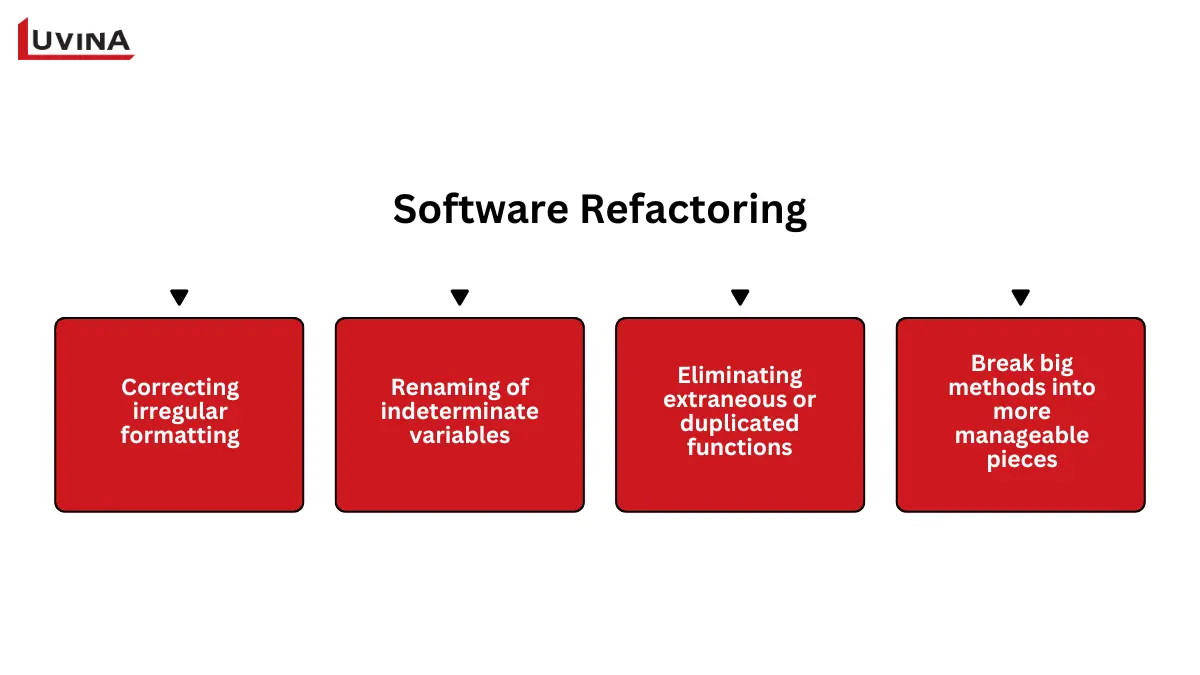
Activities involved in refactoring
What is Software Re-engineering?
Software re-engineering – The procedure of analyzing, evaluating, and transforming an already implemented software system into a more viable form. The objective of re-engineering is to increase the functionality, performance, maintainability, and flexibility of a software application that has to meet new technology needs or changes in business strategy. The difference between software reengineering and refactoring is that it takes an overall view of the software system, as opposed to just focusing on fine-tuning smaller sections of the internal product code.
Legacy systems are business-critical systems that have old and/or restrictive architectures and/or no ‘headroom’ (scalability) to support current or future business demands, and will often require software re-engineering. Software re-engineering will include:
– Re-designing the software architecture
– Rewriting large portions of the source code
– Rebuilding the software application while maintaining the core business logic.
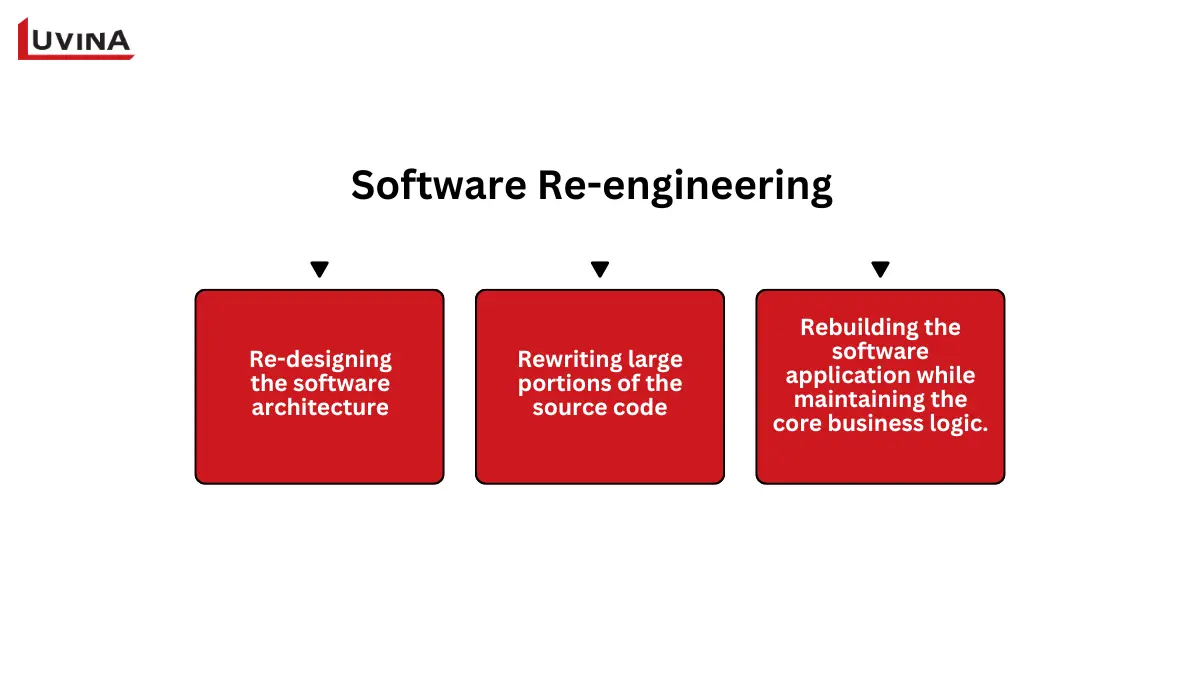
Software re-engineering may include the following activities
Direct Comparison: The Difference between Software Reengineering and Refactoring
Although re-engineering and refactoring are frequently spoken of in conjunction while dealing with legacy software, they meet rather distinct needs. The following contrast shows the major difference between software reengineering and refactoring.
| Aspect | Refactoring | Re-engineering |
| Scope of change | Focuses on small, local code-level improvements | Affects large parts of the system or the entire system |
| Purpose | Improves code readability, structure, and maintainability | Modernizes the system to meet new technical or business needs |
| Impact on behavior | Preserves existing external behavior | May change functionality, performance, or user experience |
| Scale | Small-scale and continuous | Large-scale and often project-based |
| Process | Behavior-preserving restructuring of code | System-level analysis, redesign, and reconstruction |
| Result | Cleaner internal structure with the same functionality | A transformed system, possibly with a new structure or behavior |
| Cost implementation | Lower cost; ongoing refactoring can reduce long-term maintenance costs | Higher cost due to extensive changes and broader impact |
Comparison table: Difference between software reengineering and refactoring
In short, the key difference between software reengineering and refactoring is intention and consequence.
>> Read more: software re-engineering and modernisatin explained
Refactoring & Re-engineering in the Software Lifecycle
Different stages of the software life cycle include refactoring and re-engineering, which also have quite distinct functions.
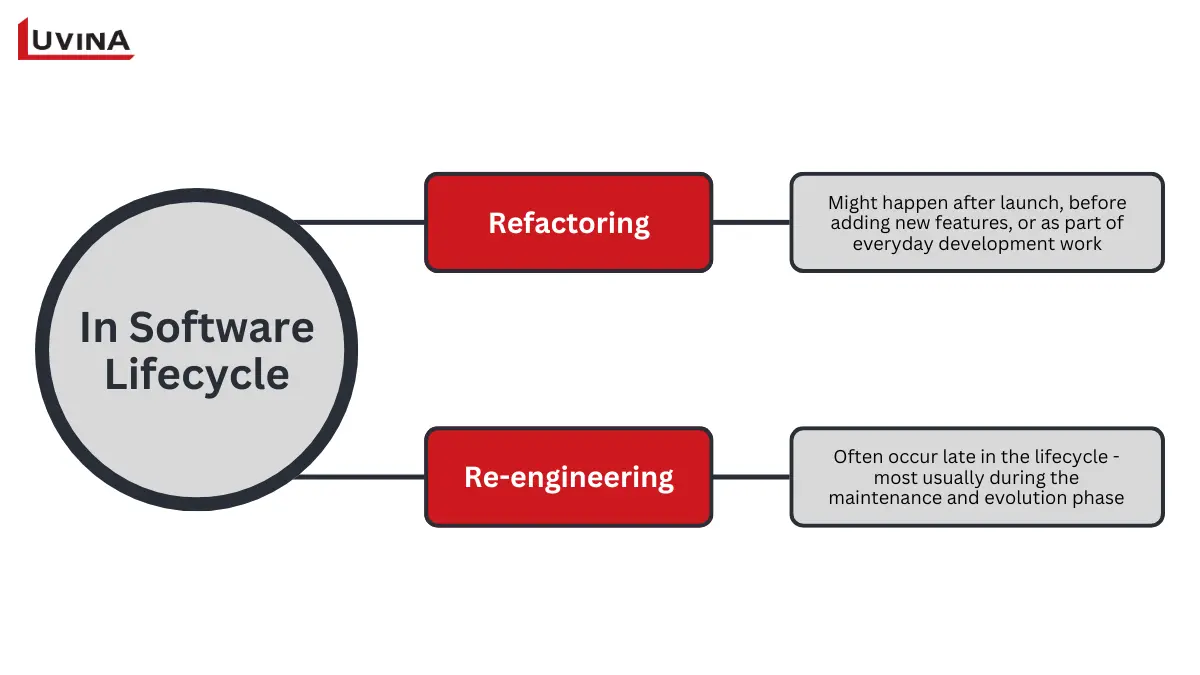
Refactoring and reengineering can take place at different stages of the software lifecycle
Refactoring
Refactoring might happen after launch, before adding new features, or as part of everyday development work. Teams make the codebase simpler to comprehend and extend by constantly simplifying and cleaning up current code. This constant activity strengthens the difference between software reengineering and refactoring early on and helps to lower technical debt.
To retain a clean and manageable structure throughout time, developers can refactor code both before and after adding new features.
Re-engineering
Most often occurring late in the lifecycle – most usually during the maintenance and evolution phase – re-engineering usually involves incremental improvements that are no longer adequate at this point; rather, a more radical transformation is required to modernize historical systems.
Refactoring is shown as a regular activity and re-engineering as a strategic, high-impact intervention.
Examples and Real-World Use Cases
Actual projects demonstrate how system maturity, technical risk, and business urgency significantly affect the decision between refactoring and re-engineering.
Software re-engineering in practice
Large companies use re-engineering techniques when performance, scalability, or operating efficiency hit a bottleneck:
– Employing Go, PayPal restructured parts of its platform to enable high-traffic workloads with better scalability and cleaner code.
– Using Agile and DevOps to update its historical package tracking systems, UPS helps to enable continuous interface changes and lower operational costs.
– Walmart increased inventory accuracy and fulfillment efficiency by using data-driven software and automation to rebuild key supply chain systems.
>> Explore a real-world case studies of re-engineering
Refactoring in real-world products
When it comes to the difference between software reengineering and refactoring, refactoring is more common in fast-evolving digital products where the overall architecture remains valid, but code quality must be maintained continuously. Well-known technology companies rely on regular refactoring to keep their systems stable and adaptable:
– Netflix performs frequent refactoring to keep its codebase lean and scalable while supporting continuous delivery.
– Google Chrome uses automated tools and disciplined refactoring to maintain performance and stability across releases.
– Facebook, Uber, and Apache HTTP Server invest in ongoing refactoring to reduce bugs, improve maintainability, and speed up feature development.
When to Choose What
The state of the system, future objectives, and the extent of change needed will determine which between refactoring and re-engineering should be selected. Teams that clearly grasp the difference between software reengineering and refactoring save themselves from over-engineering minor problems or undervaluing more serious structural issues. The following chart provides a summary of each method’s best-fit circumstances.
| When to choose Refactoring? | When to choose Re-engineering? |
| – Code quality is declining, but the overall architecture is still sound – During day-to-day development, to keep code clean and maintainable – Before adding new features to simplify existing code and reduce risk – Managing technical debt incrementally- Performance issues are localized and code-level- Preserves existing behavior | – The system structure or architecture no longer supports business or technical needs- Dealing with legacy systems that are hard to maintain or extend- Major new business requirements cannot be supported by the current system- Technical debt has accumulated to a critical level- Performance or scalability issues are systemic |
Use cases of refactoring and reengineering
Conclusion
Software reengineering is a strategic way to modernize legacy sKnowing the difference between software reengineering and refactoring helps you to make the appropriate technical choices during the life of the programme. Particularly when systems have to change to new technologies, scalability requirements, or software migration projects.
Should your company be assessing refactoring, reengineering, or organizing a more extensive modernization trip, Luvina can assist in evaluating your present system and advise on the most appropriate strategy. Get expert counseling by contacting Luvina right away.
Resources
- https://www.ibm.com/think/topics/code-refactoring
- https://www.institutedata.com/blog/refactoring-and-reengineering/
- https://en.itpedia.nl/2024/08/03/de-verschillen-tussen-code-refactoring-en-re-engineering-van-software/
- http://newserverside.blogspot.com/2011/09/re-engineering-vs-refactoring-in.html#google_vignette
- https://www.techtarget.com/searchapparchitecture/definition/refactoring
READY TO START A PROJECT?
Our experts are eager to explore your needs.


Read More From Us?
Sign up for our newsletter
Read More From Us?
Sign up for our newsletter