




Forward Deployed Engineer: Role, Skills and AI Projects


A forward deployed engineer (FDE) is a software engineer who works closely with a customer to adapt, integrate, and deploy software for a specific operational problem. The role pairs production engineering with a firsthand understanding of the customer’s work, because code that runs well can still solve the wrong problem. This guide covers what an FDE does, how the role compares with a software engineer, and where AI projects fit.
What Is a Forward Deployed Engineer?
Forward Deployed Engineer vs Forward Deployed Software Engineer
FDE stands for forward deployed engineer. Some employers write the title as forward deployed software engineer, shortened to FDSE. The two titles are closely related, so this article treats them as one role.
- What “deployed” means: close work with the customer’s workflows and constraints. It does not automatically mean a permanent onsite assignment.
- Not the same as forward engineering: forward engineering means building a system from a specification or design, which is a separate topic.
A Role Title and a Way of Working
The title also describes a delivery model:
- Implement: help a customer put software or a platform into use.
- Feedback: bring field learning to product or engineering teams. A repeated integration problem for one client, for example, can become a feature for every customer.
Service firms use the title too, as Accenture’s posting shows. Scope varies, so check these three points before comparing roles:
- Scope: which systems and problems the role covers
- Authority: which decisions the engineer can make
- Deliverables: what the engineer must hand over
What Does a Forward Deployed Engineer Do?
A forward deployed engineer turns a customer-specific problem into a working production solution, from discovery and integration through deployment and feedback. Below is the typical output at each step.
| Responsibility | Typical output |
| Understand workflows and constraints | Problem definition and acceptance criteria |
| Design and connect systems | Integration design, data mapping and permissions |
| Build and validate | Production code, tests and deployment |
| Work with users after release | Feedback and issue resolution |
| Share reusable learning | Product feedback and reusable patterns |
Typical forward deployed engineer responsibilities and outputs
The second row is integration work. Getting systems, data and permissions to connect reliably is the core of software integration services.
An FDE rarely works alone. Typical counterparts on the client side:
- Product teams: shape what the solution needs to do
- Security teams: set the rules for access and data handling
- Operations teams: explain how the work runs day to day
- Domain teams: supply the business rules the software must follow
The FDE supplies the engineering view in each of these conversations. Business rules and security policies stay with the client.
Forward Deployed Engineer vs Software Engineer
How the Emphasis Differs
An FDE is a type of software engineer. In this comparison, “software engineer” means a role focused mainly on a reusable product or platform. The difference is where the effort goes, not how technical the work is.
| Dimension | FDE emphasis | Product software engineer emphasis |
| Focus | Customer-specific operational problem | Reusable product or platform capability |
| Collaboration | Frequent customer interaction | Mainly internal product and engineering teams |
| Typical code | Integrations, adaptations and deployment features | Shared services, features and platform components |
| Feedback | Customer usage and deployment lessons | Product usage, reliability and roadmap priorities |
| Success | Customer outcome plus software quality | Product outcome plus software quality |
Forward deployed engineer and product software engineer compared by emphasis
Take a customer whose order system cannot send data to a new platform. An FDE builds and tests the connector for that customer. A product software engineer is more likely to build the shared API that many customers use.
Both roles can:
- Write production code
- Work with users
- Handle incidents
- Improve reusable systems
Neither is inherently more technical.
Forward Deployed Engineer vs Business Analyst
Both a forward deployed engineer and a business analyst (BA) work closely with the customer to understand the problem and its workflows. The difference is how far each one follows the work:
- BA: mainly turns a business problem into requirements.
- FDE: often continues from requirements into technical design, build or integration, and deployment.
Overlap With Solutions Engineering and Consulting
Two nearby roles are often confused with the FDE:
- Solutions engineering: may stress technical evaluation and solution design.
- Implementation engineers and consulting teams: may also own production delivery.
Job titles alone do not decide who owns the code, how much sales are involved, or how well the handover goes. One company’s implementation engineer may write production code, while another covers configuration only. Check the role description or project scope for these details.
What Is an AI Forward Deployed Engineer?
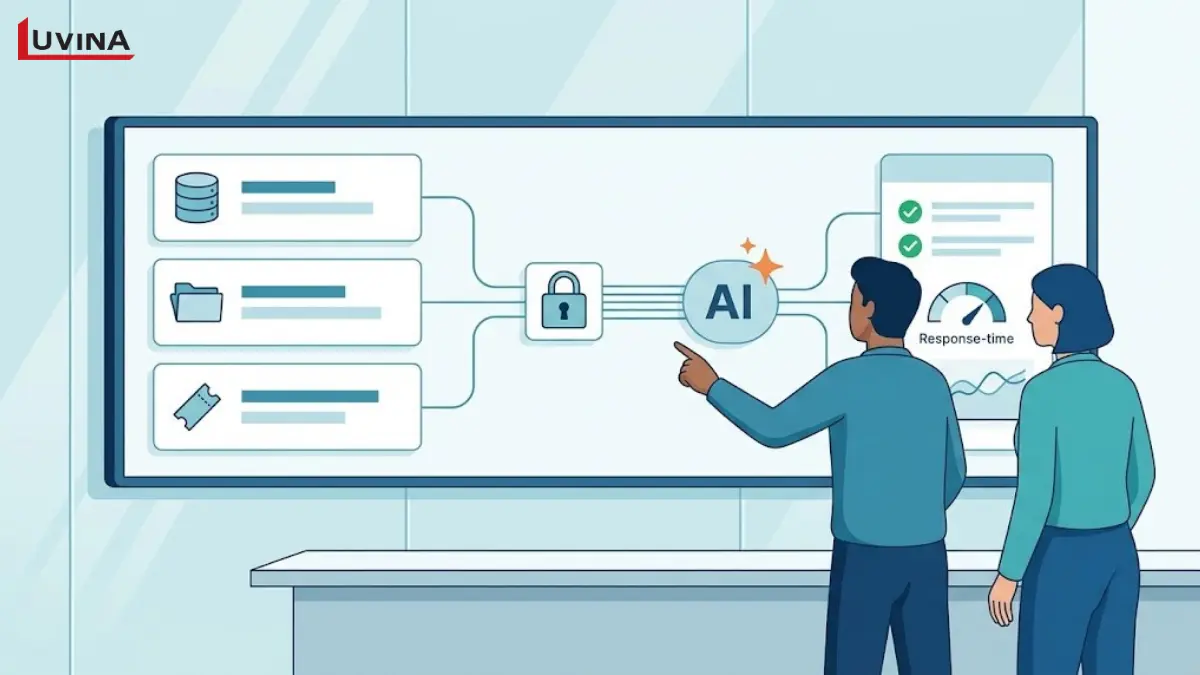
AI forward deployed engineer customer systems
An AI FDE applies the same customer-facing engineering model to AI-enabled systems, making sure the solution works with real data, workflows and users. The title does not imply training foundation models. The job is to get AI working inside a customer’s real systems and keep it reliable once people start using it.
The production work usually covers:
- Integration: connecting the AI to the customer’s existing tools
- Data permissions: making sure the system only uses data the user may access
- Evaluation: testing outputs against defined tasks and acceptance conditions, before and after release
- Latency: response times users will accept
- Usage cost: what each request costs to run
- Monitoring: watching quality and failures in production
Retrieval-augmented generation (RAG) lets the model look up information from approved sources before it answers. Not every solution need RAG, agents, or fine-tuning. Where retrieval is used, its quality depends on clean, permitted data, which is where data engineering services often come in.
Practical checks before a wider rollout:
- Representative test cases drawn from real tasks
- Access controls on data and actions
- Escalation to a person for uncertain or sensitive requests
- Monitoring after release
- An agreed response when the system fails
Forward Deployed Engineer Project Example
Illustrative scenario, not a reported client result.
An APAC software provider deploys an AI support assistant. It answers from approved knowledge and permits account data. Staff review uncertain answers and take over sensitive requests. The important part is not simply getting the assistant to work. It is deciding whether it is ready to be used by real people.
| Stage | FDE work | Expected output |
| Discover | Define use cases and constraints | Scope and success measures |
| Integrate | Connect approved data and permissions | Working integration and access tests |
| Validate | Test quality and failure cases | Evaluation results against agreed criteria |
| Release | Roll out to limited users | Monitoring, escalation and rollback process |
| Handover | Transfer knowledge and ownership | Runbook, repository access and maintenance owner |
Illustrative AI support assistant project by stage
Teams often start with discovery and proof-of-concept work to define scope and success measures before a wider rollout. In this scenario, that is the Discover stage.
One feedback loop
- During the limited release, the assistant quotes an outdated pricing page to a customer.
- Before more users are added, the FDE checks three places: retrieval (did it pull the wrong document?), data quality (is the old page still in the approved knowledge?) and workflow design (should pricing questions go to a person?).
- The fix goes first. Only then does the rollout widen.
Possible measures include task completion, answer quality, adoption, response time, and cost. In practice, that means asking whether customers get their issue resolved, how often staff have to correct or take over an answer, whether people keep using the assistant, how fast it replies, and what each request costs to run. This scenario sets no targets for any of them.
Skills of a Forward Deployed Engineer
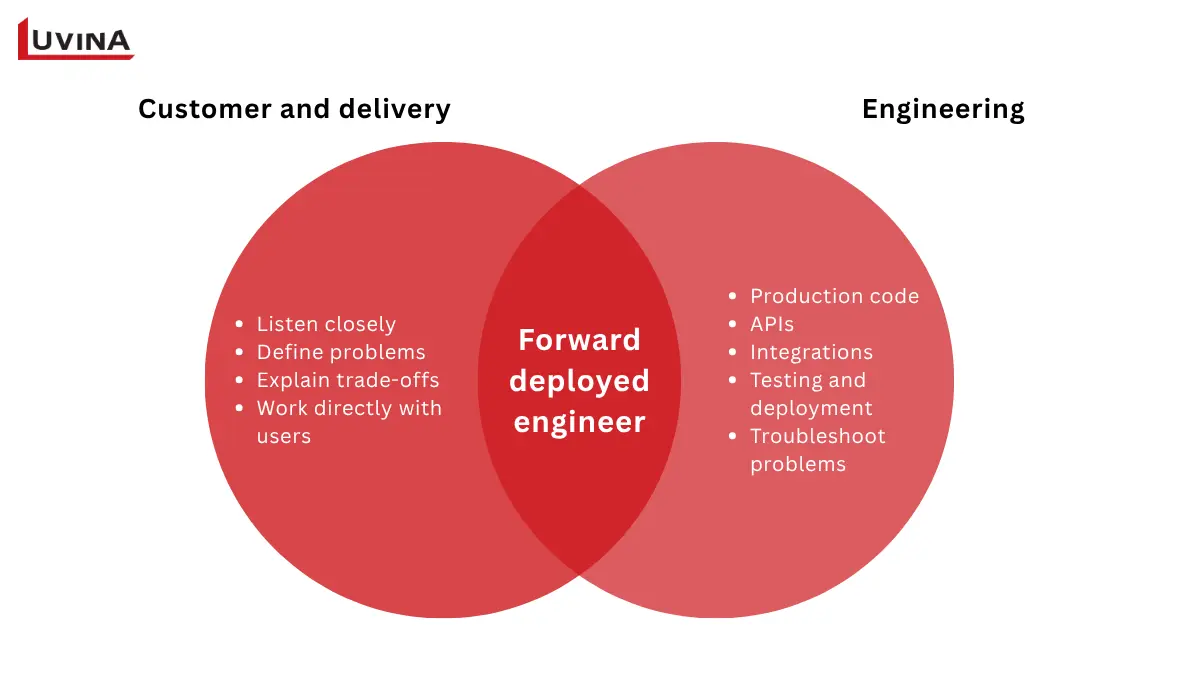
Forward deployed engineer skills sit where engineering and customer delivery overlap
Engineering
- Write and ship production code: APIs, integrations, data handling, testing and deployment.
- Troubleshoot problems that only show up once real users are on the system.
- Evaluate AI output and model behavior, but only where the project needs it.
- Languages and tools depend on the stack, so no fixed list applies everywhere.
Customer and delivery
- Listen closely and define problems the customer has not fully described yet.
- Explain trade-offs to people who are not engineers.
- Work directly with users and turn their feedback into technical requirements.
A practical path is to build strong software engineering fundamentals first, then gain experience with integrations, production systems, and direct customer delivery. Employers set their own requirements, so no degree, certification or number of years applies to every role.
When Does a Forward Deployed Approach Make Sense?
A forward deployed approach is most useful when the problem is not fully defined at the start, and the solution has to work with the customer’s existing systems. For simpler work, a lighter model is usually enough.
Where the Approach Can Fit
The forward deployed approach tends to fit when a project has:
- Substantial customer-specific integration
- Requirements that need discovery
- Several systems or data sources
- A need for frequent user feedback
Software vendors have two routes: build an internal FDE function or engage in external delivery support. For SMEs, scoped support from software development services may offer a similar delivery model without a permanent hire.
When Another Approach May Be Sufficient
A forward-deployed approach is not always the right call. A lighter model may be enough in two cases:
- Standard configuration: implementation support may be enough.
- A clearly specified feature: an existing product team or development partner may handle it.
More engineers will not fix missing data access, the lack of an accountable business owner, or an undefined problem. Settle those first.
What to Agree Before Work Begins
A forward deployed project touches the customer’s systems, data and people, so gaps show fast. Integration stalls when access has not been approved. Acceptance turns into a debate if nobody defined what “done” means. And after handover, a solution with no named owner tends to go unmaintained. Confirm these six points before work begins.
| Topic | What to confirm |
| Scope | What is in and out of the engagement |
| Ownership | Repository and IP ownership |
| Access | Approved access to systems and data |
| Decisions | Who the decisionmakers are |
| Acceptance | Criteria for calling the work done |
| Handover | Who maintains the solution and who receives the handover |
Items to agree before a forward deployed engagement begins
For distributed APAC teams, also agree on collaboration windows and any onsite needs. If the customer is in Singapore or elsewhere in APAC, check how personal data rules apply to the engagement:
- Singapore’s PDPA: the Personal Data Protection Act, overseen by the Personal Data Protection Commission (PDPC), sets how organisations handle personal data.
- Your role in the data: a team that processes personal data on the customer’s behalf may count as a data intermediary. That role carries Protection and Retention Limitation obligations, while the customer stays responsible as if it processed the data itself.
- Overseas transfers: the PDPA does not ban them, but it sets conditions. Data sent out of Singapore, for example to an offshore delivery team, needs comparable protection.
- Other APAC markets: each has its own rules, so confirm them per project with legal counsel.
FAQs
1. What does FDE stand for in software engineering?
FDE stands for forward deployed engineer. It is a software engineer who works with a customer to adapt, integrate and deploy software for operational problems. Some employers write the title as forward deployed software engineer, or FDSE.
2. Is a forward deployed engineer the same as a software engineer?
Not quite. An FDE is a type of software engineer, and both write production code. The difference is focus: an FDE works on customers’ operational problems and deployment needs, while a product software engineer builds capabilities many customers share. Neither role is more technical than the other.
3. Does a forward deployed engineer need to work onsite?
Not always. Working close to a customer can mean regular workshops, shared channels, or occasional visits, depending on the engagement. Role descriptions differ, so check location and travel expectations in each one. Distributed teams should agree with collaboration windows up front.
4. How do you become a forward deployed engineer?
Start with solid software engineering fundamentals. Then look for work that involves integrations, production systems, and direct contact with customers, so you practice all three. Employers set their own requirements, and no single degree; certification or number of years applies to every role.
Conclusion
A forward deployed engineer is a software engineer who adapts, integrates, and deploys software for one customer’s problem. The role differs from a product software engineer in focus, not technical depth, and on AI projects it adds evaluation and monitoring. It fits best when requirements need to be discovered, and several systems must connect. For simpler work, standard configuration or a scoped feature is often enough.
Luvina takes the role seriously enough to train for it. The company started an internal FDE program in September 2026, and more than 20 colleagues are in the first cohort. They move from a bootcamp to shadowing to pair working on real problems, beginning with Luvina’s own projects. The goal is to build up to GenAI advisory and delivery for customers.
Luvina is a Vietnamese IT company specializing in custom software development and AI integration, with customers in Japan, Singapore and wider APAC. Its engineers work on projects where systems have to connect, and the requirements take some discovery. Not sure which delivery model fits yours? Discuss your software integration and delivery needs with Luvina.
READY TO START A PROJECT?
Our experts are eager to explore your needs.

Read More From Us?
Sign up for our newsletter
Read More From Us?
Sign up for our newsletter