




IT Consulting Services for Small Business: How to Choose a Partner


IT consulting helps small businesses decide what to change before they spend on new technology. A consultant assesses current systems, business priorities, and operational needs to define a practical direction and what to fix first.
For Singapore SMEs, this guide explains when IT consulting makes sense, what to expect from an engagement, and how to choose a partner based on business needs rather than a vendor pitch.
What Are IT Consulting Services for a Small Business
The role of an IT consultant goes beyond recommending software. A consultant looks at how a business currently works, where systems or workflows fall short, what the business needs to achieve, and which technology decisions can support those goals. This typically means assessing current systems, clarifying priorities, defining requirements, and guiding implementation decisions.
Digital transformation is already underway across Singapore businesses, but it remains an active priority for only part of the SME market. According to SBF National Business Survey 2025, 57% of SMEs identified digital transformation as a top priority over the next 12 months, down from 68% in 2024. At the same time, 58% of businesses cited the high cost of technology adoption as their primary challenge.
Consulting helps businesses make those investments in a clearer direction. It comes before the build, so the business can define what needs to change before buying a tool and figuring it out later. The result is a practical basis for deciding what to implement, what to improve first, and what can wait.
A consulting engagement should leave the business with practical outputs that can guide the next stage. Use this checklist to assess what a consulting partner is delivering:
- Current-state findings: A clear account of the systems, workflows, and gaps affecting day-to-day operations.
- Prioritized roadmap: A sequence of initiatives based on business impact, dependencies, and urgency, rather than a list of ideas.
- Requirements or integration design: Enough detail for a development team to scope the work and understand key system connections.
- Implementation plan: Defined phases, owners, dependencies, and key steps for moving into delivery.
- Decision log: A record of major technology decisions and the reasons behind them for future reference.
- Handover documentation: Clear documentation that allows the business to move forward without depending on one consultant’s memory.
When Should a Small Business Hire an IT Consultant
The right time to hire an IT consultant is usually defined by a business decision that needs to be made, rather than a general need to “improve IT.”
| Decision trigger | What it looks like in practice | What consulting can help with |
| Fragmented systems and data | Accounting data sits in one tool while inventory lives in a spreadsheet. Sales uses a CRM that operations rarely sees. POS and stock data are disconnected. | Map data flows, identify process gaps, and determine whether integration, process changes, or a different system setup is needed. |
| A major system change is planned | You are considering a cloud ERP migration, connecting a new e-commerce channel to existing inventory, replacing a legacy on-premises system, or adding workflow automation. | Define requirements, dependencies, migration risks, and implementation options before you commit the budget. If replacing an existing application is on the roadmap, you may also want to modernize a legacy system without a full rebuild. |
| An independent assessment is needed | A software vendor is recommending its own platform, but you need to know whether the proposed solution actually fits your business requirements. | Validate requirements, compare options, and coordinate with potential vendors without starting from a predetermined platform. |
| The issue is operational, not strategic | The problem is a broken printer, forgotten password, single-device issue, or the need for ongoing day-to-day IT operations. | Consulting is usually not the first step. IT support or managed IT services is more appropriate for these needs. |
Common decision triggers for hiring an IT consultant
One practical warning sign cuts across the first three situations: someone in the business is regularly working around the limitations of existing systems, whether by reconciling numbers manually, moving data between tools, or creating spreadsheets to fill process gaps.
Consulting becomes valuable when the business needs to decide what should change, why it should change, and how to approach the change, rather than simply fixing an isolated IT issue.
IT Consulting vs Managed IT Services vs IT Support vs Software Development
IT services can serve very different business needs, so the appropriate choice depends on the service function, working model, and the point at which you need external support.
| Service type | Primary function | When to choose it |
| IT Consulting | Define the problem, priorities, requirements, and roadmap before spending on a build | You need to decide what to change before building or buying anything |
| Managed IT Services | Operate and maintain an agreed IT environment on an ongoing basis | You need continuous operational ownership of systems already in place |
| IT Support | Resolve individual incidents and routine user or device issues | The issue is operational, such as a support ticket, rather than a transformation decision |
| Software Development / Integration | Build, modify, or connect systems once requirements are validated | You already know what needs to be delivered and are ready to build |
IT Service Options for Small Businesses
The decision rule is simple: choose consulting for clarity, managed IT services for ongoing operations, IT support for immediate issues, and development or integration once requirements are validated.
What Should an IT Consulting Engagement Include
A consulting engagement should go beyond a high-level assessment. The work should connect business goals with systems, processes, delivery choices, and the risks that could affect implementation.
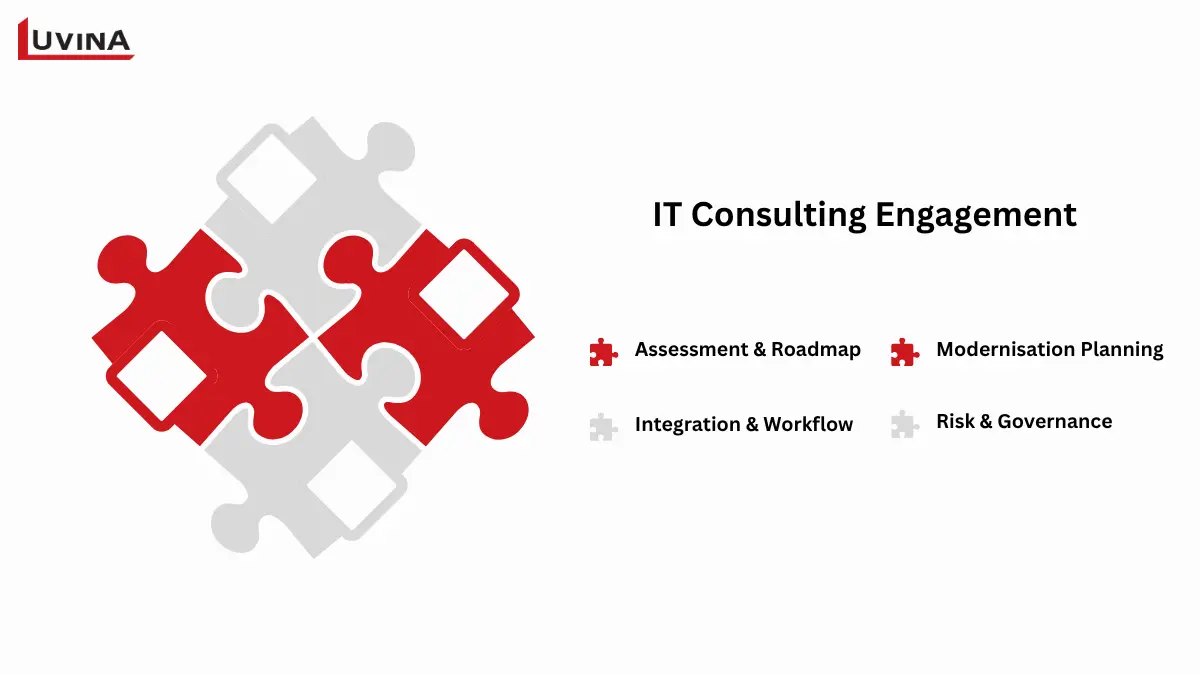
What an IT Consulting Engagement Should Cover
IT Assessment and a Prioritized Roadmap
The assessment should start with the business goals and an inventory of the systems currently supporting them. From there, the consultant should map dependencies between systems, identify the risks of leaving current issues unresolved, and establish criteria for deciding what should happen first.
A useful roadmap makes those decisions visible. It should distinguish between what needs to be addressed now, what can be deferred, and why, rather than treating every improvement as equally urgent. This gives the business a clear basis for moving from requirements to delivery and helps the development team turn requirements into a working software solution.
Systems Integration and Workflow Design
Integration planning should look at how data actually moves through the business. The consultant should identify where information is duplicated, where processes break between systems, and what interfaces are needed to connect them.
Ownership also matters. Each system should have a clear owner, along with defined responsibilities for data and ongoing changes. Success should be measured through operational outcomes such as fewer manual handoffs, faster processing, or more consistent information, rather than simply confirming that two systems are technically connected.
Modernization and Software Change Planning
For legacy systems, the question is rarely just whether to replace them. The assessment should identify what is constraining the current system, such as outdated technology, difficult maintenance, limited integration options, or business rules embedded in old applications.
Depending on those constraints, realistic options may include replacement, re-platforming, or incremental modernization. A phased approach can allow the business to address high-priority areas first, reducing the need for one large and potentially disruptive cutover.
Risk, Continuity, and Data Governance Readiness
This part of consulting is about identifying risks and responsibilities before delivery begins, not providing an ongoing managed security service.
The engagement should clarify who can access systems and data, what happens if a vendor relationship ends, how information is stored and transferred, and who remains responsible for it. For cross-border delivery, the assessment should also consider what data moves between Singapore and an offshore team and how that movement is governed.
What Should IT Consulting Deliver in Your Industry
IT consulting should start with the way a business operates and the constraints it faces, not with a preferred technology stack. The consultant should first understand where work moves between teams, systems, and external partners, then determine what needs to change.
| Industry | Workflow examples a consultant should map |
| Manufacturing & Wholesale Distribution | If inventory, warehouse, and ERP data are disconnected, an IT consultant should first map the order-to-fulfilment workflow, identify ownership of inventory data, and determine whether integration, process redesign or system replacement is required. |
| Retail & E-commerce | Connections between online and physical sales channels, POS-to-inventory sync, CRM and loyalty data, order management, and product data consistency |
| Logistics & Transportation | Booking and order workflows, shipment tracking data, document handling for invoices, customs, and proof of delivery, customer status updates, and partner-system integration |
| B2B Professional Services | Lead-to-contract workflows, CRM adoption, project and resource management, billing and time tracking, knowledge management, and management reporting |
Consulting Focus Areas by Industry
The output should turn each industry’s business problem into a priority workflow, target outcome, system dependencies, delivery options, and implementation plan rather than a generic list of technologies.
How an IT Consulting Engagement Works: 4 Steps
A typical IT consulting engagement moves through four stages, from understanding the current environment to preparing delivery and defining what happens after handover.
| Stage | What happens | Key output |
| 1. Discovery and Current-State Assessment | Review business objectives, inventory of existing systems, interview stakeholders, and map constraints, risks, and data dependencies. | A fact-based view of the current environment and the changes the business needs |
| 2. Prioritized Roadmap and Decision Gate | Define what to address first, what can be deferred, expected outcomes, assumptions, and the factors affecting delivery effort. | A prioritized roadmap and a clear point for deciding whether to proceed |
| 3. Proof of Concept or Implementation Plan | Validate technical or commercial feasibility when an important uncertainty cannot be resolved through analysis alone. | A validated approach or a detailed plan ready for implementation |
| 4. Delivery Handover and Ongoing Governance | Define ownership, acceptance criteria, documentation, responsibilities, and the boundary between consulting and ongoing support. | A clear handover and governance model for the next stage |
IT Consulting Engagement Stages
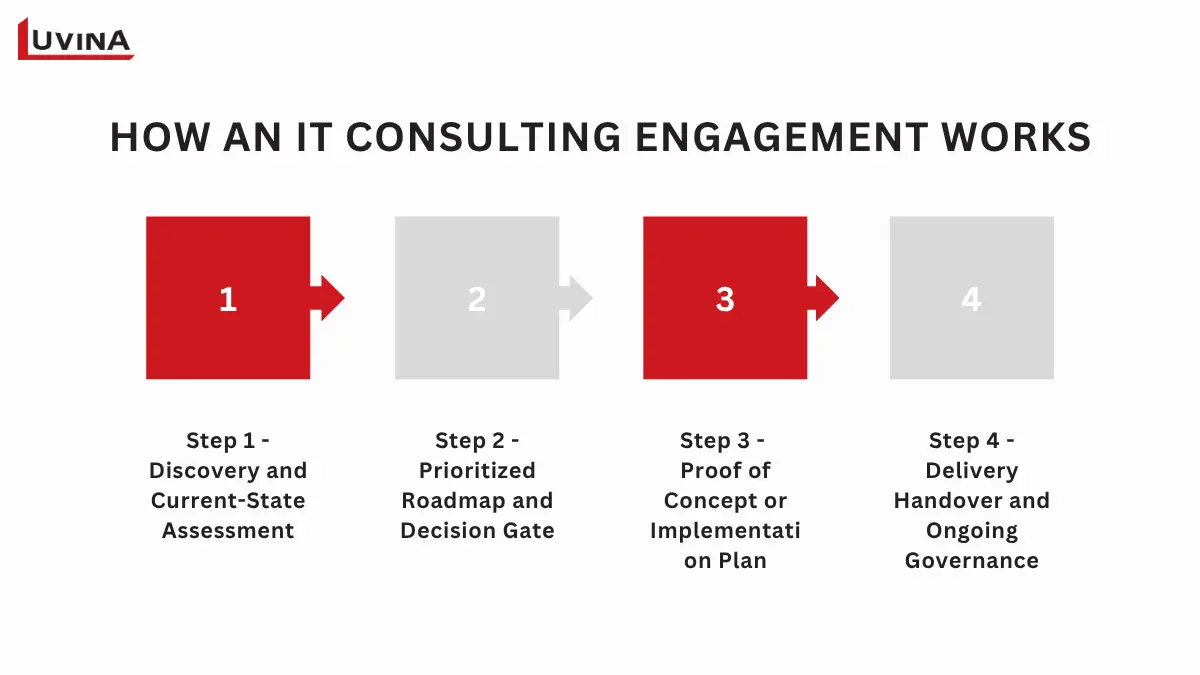
IT Consulting Engagement Stages
Discovery and Current-State Assessment
This stage is where the consultant earns the independent view discussed earlier. Instead of starting with a preferred technology or vendor, the assessment looks at how the business operates today and what is actually limiting it.
Stakeholder interviews are particularly important because system documentation rarely captures every workaround, dependency, or operational constraint.
Prioritized Roadmap and Decision Gate
The roadmap should make the decision sequence visible. Each initiative needs a clear outcome, while assumptions and dependencies should be documented before the business commits to delivery.
Budget expectations can also be refined at this stage. Scope, team size, and integration complexity are common factors that influence the effort required.
Proof of Concept or Implementation Plan
A Proof of Concept (POC) is useful when the business needs evidence before committing to a full build. This could involve testing a new integration approach, a technology choice, or a technically uncertain workflow.
A POC should answer a specific feasibility question with defined success criteria. It is not a mandatory step for every engagement. When feasibility is already clear, the work can move directly into software development planning and delivery.
Delivery Handover and Ongoing Governance
Before implementation begins, the engagement should establish who owns the system, what defines acceptance, and what documentation must be handed over.
The business should also know where consulting ends and ongoing support or maintenance begins. A defined review cadence helps stakeholders revisit outcomes, new requirements, and future technology decisions without blurring those responsibilities.
A consulting partner that fits the project should be able to show evidence that matches your business problem, explain how the engagement will be delivered, and take clear responsibility for the work. Instead of evaluating providers by reputation alone, assess four areas before making a decision.
How Should You Choose an IT Consulting Partner
A consulting partner should be able to show evidence that matches your business problem, explain how the engagement will be delivered, and take clear responsibility for the work. Instead of evaluating providers by reputation alone, assess four areas before making a decision.
Assess Relevant Business and Delivery Experience
Start with the problem you need to solve, then look for evidence that the consultant has handled similar work.
Ask for:
- Relevant project examples: Work involving workflow redesign, systems integration, legacy modernisation, or custom software, depending on your situation.
- Comparable scope: Projects with similar system complexity, number of stakeholders, or integration requirements.
- Clear responsibilities: What the consultant actually delivered, rather than simply being listed as a technology partner.
Years in business can provide context, but they do not demonstrate experience with your specific challenge.
Check Data Handling, Security, and Accountability
Consulting may require access to business processes, system information, and sensitive data. Before granting that access, clarify how information will be protected and who remains accountable throughout the engagement.
Key questions include:
- How is access to systems and data controlled?
- Where is business data transferred and stored?
- What confidentiality obligations apply?
- Will subcontractors or third parties have access?
- Who is accountable if data is mishandled or an agreed control fails?
These details should be clear before delivery begins, not addressed only after an issue occurs.
Check the Team and Delivery Model
A strong proposal should tell you who will do the work and how you will work together.
Look for:
- Named team members and their roles
- Direct access to relevant technical or business stakeholders
- A defined communication and reporting cadence
- An escalation path for issues and decisions
- A clear basis for estimates, scope changes, and acceptance criteria
This makes the engagement easier to manage and gives both sides a shared understanding of what successful delivery means.
Assess “Top Rated” IT Consulting Services Carefully
Directories such as Clutch can help you discover potential providers, but ratings should be treated as a starting point, not proof of fit.
A high rating reflects the experiences reported by past clients. It does not establish whether that provider has the right experience for your specific business problem.
When comparing shortlisted providers, look beyond the rating:
| Compare | What to verify |
| Past work | Does the provider have relevant examples? |
| Project scope | Did its role match the work you need? |
| References | Can previous clients provide useful evidence about delivery? |
| Team | Is the proposed team comparable to the one that delivered those projects? |
How to Compare Consulting Providers
The goal is not to find the provider with the highest rating. It is to find enough relevant evidence to judge whether the provider meets your specific requirements.
Local, Regional, and Offshore Delivery Options: What Fits Your Business
Choose the delivery model based on the type of work and governance needs, not the country label alone. A suitable setup depends on how closely teams need to collaborate, how much on-site involvement is required, and how the project will be governed.
Local Singapore Partner
A local partner can be a practical fit when the project requires frequent on-site presence, direct knowledge of Singapore-specific regulatory or compliance requirements, or close accountability with business stakeholders in the same location.
This model may also suit projects where decisions are made frequently in person or where travel between the business and delivery team would add unnecessary friction.
Vietnam-Based Regional Delivery Partner
Vietnam is one hour behind Singapore, with Vietnam at UTC+7 and Singapore at UTC+8. This means a standard Singapore workday overlaps almost entirely with normal working hours for a Vietnam-based team. Daily syncs, same-day clarification, and feedback cycles can therefore happen within regular business hours.
Time zone alignment is useful, but it does not replace delivery capability. Businesses should also assess whether the partner has:
- Singapore-facing communication practices
- Relevant software delivery experience
- Stable teams with clear ownership
- Consistent technical and project documentation
For businesses considering this model, the focus should be on whether the proposed team can combine regional accessibility with the engineering capabilities required for the project. This can make it practical to work with a remote software delivery team.
India-Based Offshore Delivery Partner
India is approximately 2.5 hours behind Singapore, at UTC+5:30. This still provides a meaningful working-hour overlap, although meetings, handoffs, and urgent discussions require more deliberate scheduling than with a same-region partner.
For some projects, an India-based partner may propose a larger delivery team or specialized capabilities. These should be evaluated against the actual team, scope, and delivery model rather than assumed from location alone.
Time Zone Overlap by Delivery Location
| Delivery model | Time zone vs Singapore (UTC+8) | Practical implication |
| Local Singapore | Same time zone | Full same-day overlap; practical for on-site or highly regulated work |
| Vietnam | UTC+7, 1 hour behind | Near-total overlap with a standard Singapore workday; daily syncs and same-day feedback are realistic |
| India | UTC+5:30, 2.5 hours be | Meaningful overlap, roughly 5 to 6 hours; workable with more deliberate scheduling |
Singapore Time Zone Comparison
What to Compare Before Choosing
Time zone is only one part of the decision. Before selecting a delivery model, use this checklist:
- Timeline and business-hour overlap: Can key decisions and feedback happen within the required working window?
- Communication: Are communication practices and working English suitable for your stakeholders?
- Stakeholder alignment: Will the team understand the business context and work comfortably with your internal teams?
- On-site needs: How often will face-to-face meetings or travel be necessary?
- Named team: Do you know who will actually deliver the project?
- Governance: Are reporting, escalation, decision-making, and ownership clearly defined?
- IP and data: Are intellectual property ownership and data handling terms documented?
- Quality controls: How will requirements, testing, documentation, and acceptance be managed?
- Post-delivery support: Who handles maintenance, enhancements, or issues after implementation?
- Total delivery effort: Consider coordination, travel, management, and handoffs alongside the quoted rate rather than comparing hourly rates alone.
Where Luvina Fits After the Consulting Decision
Once the business problem, priorities, and delivery approach are clear, the next step is turning those decisions into practical technology work. This is where Luvina can support businesses that have moved beyond the initial consulting question and need a delivery partner.
Luvina’s relevant capabilities include:
- Business consulting and Proof of Concept: Validate solution approaches and clarify technical requirements before larger implementation work.
- Systems integration: Connect applications and data flows across existing business systems.
- Software modernization: Improve or replace legacy applications while addressing the constraints of the existing environment.
- Custom software development: Build applications around specific business requirements rather than forcing processes into an off-the-shelf product.
- Application maintenance and enhancement: Continue improving existing applications as business requirements evolve.
For Singapore businesses, Luvina combines a Singapore-facing engagement model with Vietnam-based engineering capacity. The one-hour time difference established earlier in this article allows the teams to work within closely aligned business hours.
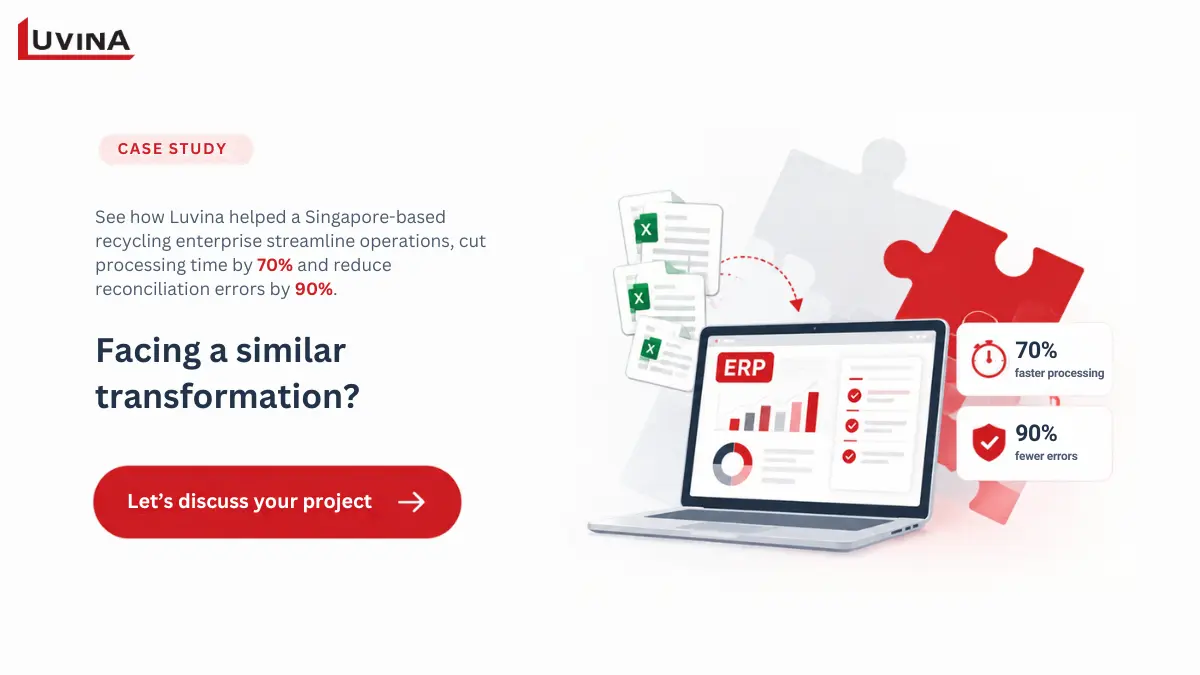
See how this approach works in practice. Read the case study on how Luvina helped a Singapore-based recycling enterprise replace fragmented spreadsheets with a unified ERP system, cutting processing time by 70% and reconciliation errors by 90%.
The appropriate starting point depends on how clearly the business has defined its next step. Some projects may require a Proof of Concept first. Others may be ready for integration, modernization, custom development, or ongoing application enhancement.
FAQs
1. What Do IT Consulting Services Include for a Small Business?
IT consulting typically includes a current-state assessment, a prioritized roadmap, defined requirements, and an implementation plan. The engagement may also cover systems integration, modernization planning, or a Proof of Concept when needed. These deliverables give the business a clear basis for making technology decisions and moving into implementation.
2. When Should a Small Business Hire an IT Consultant?
A small business should consider IT consulting when disconnected systems, a major technology change, or uncertainty about the right solution makes decision-making difficult. Consulting is less suitable for isolated technical issues that require routine IT support or ongoing system operations.
3. How Is IT Consulting Different From Managed IT Services?
IT consulting helps a business decide what should change and why. It focuses on priorities, requirements, technology decisions, and implementation direction. Managed IT services focus on operating and maintaining existing systems. The key difference is whether the business needs help deciding what to change or managing what is already running.
4. How Much Do IT Consulting Services Cost?
IT consulting is usually scoped around the type of assessment, number of systems involved, stakeholder participation, technical complexity, and required deliverables. A short assessment and roadmap will typically require a different level of effort from a multi-system integration assessment or modernization program.
5. Can a Small Business Work with an Offshore IT Consulting Partner?
Yes. A small business can work with an offshore IT consulting partner when there is sufficient time zone overlap and clear governance. Communication routines, decision ownership, escalation paths, data responsibilities, and documentation expectations should be agreed from the start. A suitable setup depends on the project’s specific delivery and coordination needs.
Conclusion
Start with the business goal, then choose the service model that supports it. After that, evaluate delivery partners based on relevant experience, accountability, delivery practices, and evidence of fit. Reputation or location alone should not determine the decision.
Once those decisions are clear, the focus shifts from choosing the approach that fits the situation to putting it into practice. For businesses ready to move forward with a Proof of Concept, systems integration, software modernization, custom development, or long-term application improvement, Luvina can support the next stage.
If you are still deciding what should change before committing to a technology project, Luvina can help assess the current environment, clarify requirements, and define the next practical step.
READY TO START A PROJECT?
Our experts are eager to explore your needs.

Read More From Us?
Sign up for our newsletter
Read More From Us?
Sign up for our newsletter