




How To Choose Managed IT Service Provider?


Choosing the wrong managed IT service provider doesn’t just waste budget. It creates long-term operational risk.
Many providers promise the same things: 24/7 support, strong security, and high uptime. But in reality, the difference only becomes clear after implementation, when response times lag, systems fail to integrate, or hidden costs start to appear.
So how to choose managed IT service provider beyond marketing claims?
This guide breaks down a structured approach, from internal assessment to vendor evaluation, helping you make a confident and informed decision.
The Assessment Phase
A more structured approach at this stage will help you avoid choosing managed IT service provider based on surface-level promises. Instead of jumping straight into vendor comparisons, break the assessment into 3 key areas:
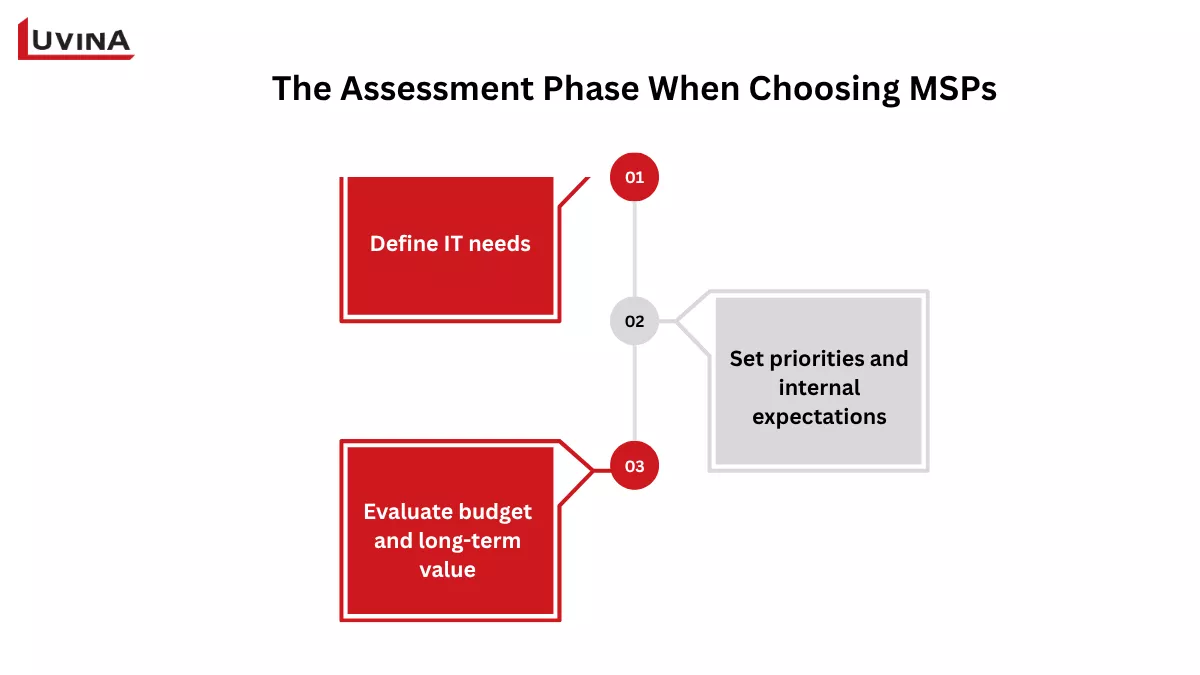
Start with a comprehensive assessment of your IT environment and capabilities
Define your IT needs clearly
Start the process of how to choose managed IT service provider by analyzing your current IT environment, including network infrastructure, data storage, software applications, and hardware systems. The goal is to identify gaps, inefficiencies, or risks that need to be addressed. From there, clarify whether you need full-service support or targeted solutions such as cybersecurity, cloud management, or network optimization.
Set priorities and internal expectations
Once you understand your needs, define what matters most. Common priorities include data security, system uptime, compliance, and scalability. At the same time, determine how an MSP will fit into your existing structure. Will they support your internal IT team or replace certain functions? For example, you might outsource strategic areas like cybersecurity governance while keeping control of core systems, or offload daily administrative tasks such as help desk support, license management, and employee onboarding.
Evaluate budget and long-term value
Before learning how to choose managed IT service provider, define your budget and assess how managed IT services can reduce operational costs, minimize downtime, and improve efficiency over time. Comparing pricing models across providers will help you understand which level of service delivers the best value for your investment.
Comparing Engagement Models
Different MSP engagement models offer different levels of control, support, and flexibility. When reviewing types of managed services, it’s important to choose a structure that matches your internal resources and business goals, especially when implementing. Here’s a quick comparison:
| Model | How it works | Best for | Resposibilites |
|---|---|---|---|
| Fully managed services | The MSP takes full control of your IT environment | Businesses with no in-house IT team or those wanting to outsource completely | End-to-end management: monitoring, maintenance, software licensing, help desk, and ongoing support |
| Co-managed services | The MSP works alongside your internal IT team | Companies that want to keep internal control but need extra expertise | Shared responsibilities; MSP typically handles areas like cybersecurity, patching, monitoring, reporting, and governance for specific systems |
| On-demand/ Project-based services | The MSP provides services only when needed or for a defined project | Businesses needing flexibility or short-term support | Temporary engagement focused on specific tasks or projects, offering cost control without long-term commitment |
Compare different models when choosing managed IT service providers
Choosing the wrong engagement model can lead to either overpaying for unused services or lacking support when critical issues occur. For most manufacturing businesses, a co-managed model is often the most practical starting point.
How To Choose Managed IT Service Provider: The 7 Core MSP Selection Criteria
Once you’ve defined your needs and chosen the right engagement model, the next step is evaluating providers based on what truly matters. Not all MSPs deliver the same level of value when it comes to how to choose managed IT service provider. The criteria below will help you make a more informed decision.
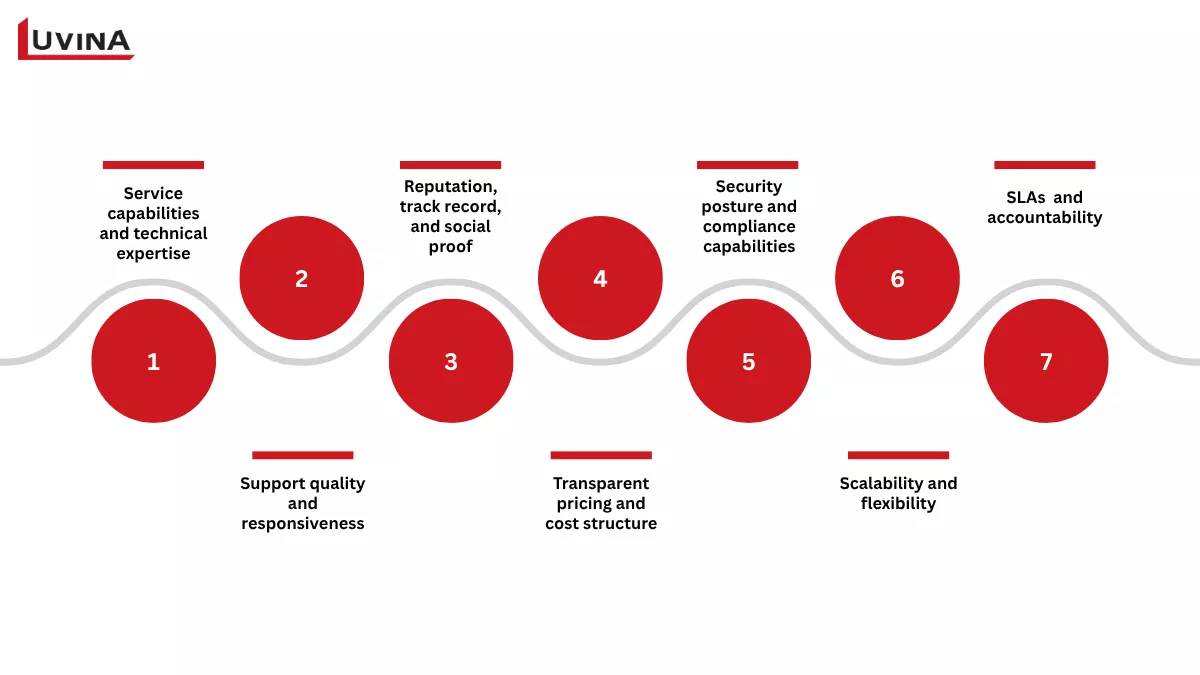
Key criteria for selecting MSPs
Service capabilities and technical expertise
Look for providers with proven experience in your industry, compliance requirements, and operational challenges. Evaluate their certifications and partnerships (such as Cisco, Microsoft, or AWS), as well as their capabilities across cloud, security, networking, and cross-platform integration. It’s also important to understand how their teams are structured, how they manage specialized skills, and whether they can support both traditional IT and modern hybrid environments. This criterion determines whether they can support complex environments and deliver reliable managed IT services, instead of just handling basic IT tasks.
Support quality and responsiveness
The question of whether the managed IT services providers offer 24/7 support or limited-hour coverage, and understand how support is delivered, is important when it comes to how to choose managed IT service provider. Will you have a dedicated account manager or rely on a general helpdesk? Pay attention to how quickly they respond, how clearly they communicate, and whether they can handle urgent issues effectively. The difference shows up during critical moments – fast, clear support helps minimize downtime and keeps operations running smoothly.
Reputation, track record, and social proof
Review client testimonials, case studies, and online feedback to understand their strengths and weaknesses. Focus on businesses similar to yours in size or industry, and look for consistent themes in customer experiences. Don’t hesitate to request references and speak directly with past clients to evaluate responsiveness, problem-solving ability, and overall professionalism. Patterns in feedback can reveal strengths or recurring issues, helping you reduce risk when selecting a partner for managed it services for manufacturing.
Transparent pricing and cost structure
Look for providers that offer clear, transparent pricing without hidden fees. Compare different pricing models, such as per-user, per-device, or flat-rate, to see which best fits your business. Beyond numbers, evaluate the overall managed IT services cost in relation to value. This includes service quality, included features, and long-term benefits like reduced downtime and improved efficiency. This helps avoid unexpected expenses and ensures your investment makes sense long term. Service Level Agreements (SLAs) should also align with pricing, clearly defining what you are paying for.
Security posture and compliance capabilities
When learning how to choose managed IT service provider, you should carefully evaluate their approach to data protection, including encryption, multi-factor authentication, and proactive threat detection. It’s also important to review their experience with industry-specific compliance standards. A provider with strong security practices and solid regulatory knowledge will better protect your business from cyber threats and compliance risks.
Scalability and flexibility
Your business won’t stay the same, and your IT shouldn’t either. This includes the ability to adjust support levels, expand infrastructure, and adapt to new technologies. This flexibility is what allows your IT environment to grow alongside your business, instead of becoming a limitation over time.
Service level agreements (SLAs) and accountability
A key part of how to choose managed IT service provider is reviewing SLA agreements to ensure they align with your operational needs. Look for clear commitments, such as uptime guarantees and defined response times for critical issues. It’s equally important to check accountability measures, including penalties or remedies if the provider fails to meet agreed standards. Clear SLAs ensure responsibility is defined and performance is measurable.
The Critical Questions to Ask Potential MSPs
When figuring out how to choose managed IT service provider, asking targeted, practical questions will help you determine whether an MSP can truly support your operations and long-term goals. Use the questions below as a structured checklist:
| No. | Question | Why it matters |
|---|---|---|
| 1 | What experience do you have in our industry? | Ensures they understand your systems, compliance requirements, and overall business needs. |
| 2 | What services do you offer? | Confirms if they cover full IT needs or only partial support. |
| 3 | How quickly do you respond to IT issues? | Fast response reduces downtime and operational risk. |
| 4 | Do you offer proactive monitoring and maintenance? | Helps prevent issues instead of just fixing them. |
| 5 | What cybersecurity measures do you have in place? | Protects data and supports compliance requirements. |
| 6 | How do you handle data backup and disaster recovery? | Ensures quick recovery and minimal data loss. |
| 7 | What are your pricing models and contract terms? | Avoids hidden costs and ensures budget alignment. |
| 8 | How will you onboard our business? | Ensures smooth transition with minimal disruption. |
| 9 | Will we have a dedicated point of contact? | Improves communication and accountability. |
| 10 | Can you provide references or case studies? | Validates real-world performance and reliability. |
Questions to ask service providers for a clear, actionable understanding
As you review answers, focus on clarity and transparency. Strong responses are a key signal when considering how to choose managed IT service provider, as they show the provider can reliably support both your current operations and future growth.
Red Flags That Should Immediately Concern You
Even strong-looking providers can reveal risks early if you know what to look for. Below are the key warning signs to watch for when choosing managed IT service provider:
– Vague or missing SLA → unclear accountability
– Slow or unclear communication → likely poor support experience
– No industry-specific experience → high implementation risk
– Overly generic solutions → lack of customization
– Pushy long-term contracts → focus on locking clients, not delivering value
If you notice multiple red flags early, it’s often a sign to walk away.
MSP Evaluation Framework
When exploring how to choose managed IT service provider, your goal is to find a partner that not only supports your systems but also aligns with your business direction. Below is a structured framework to guide your decision-making:
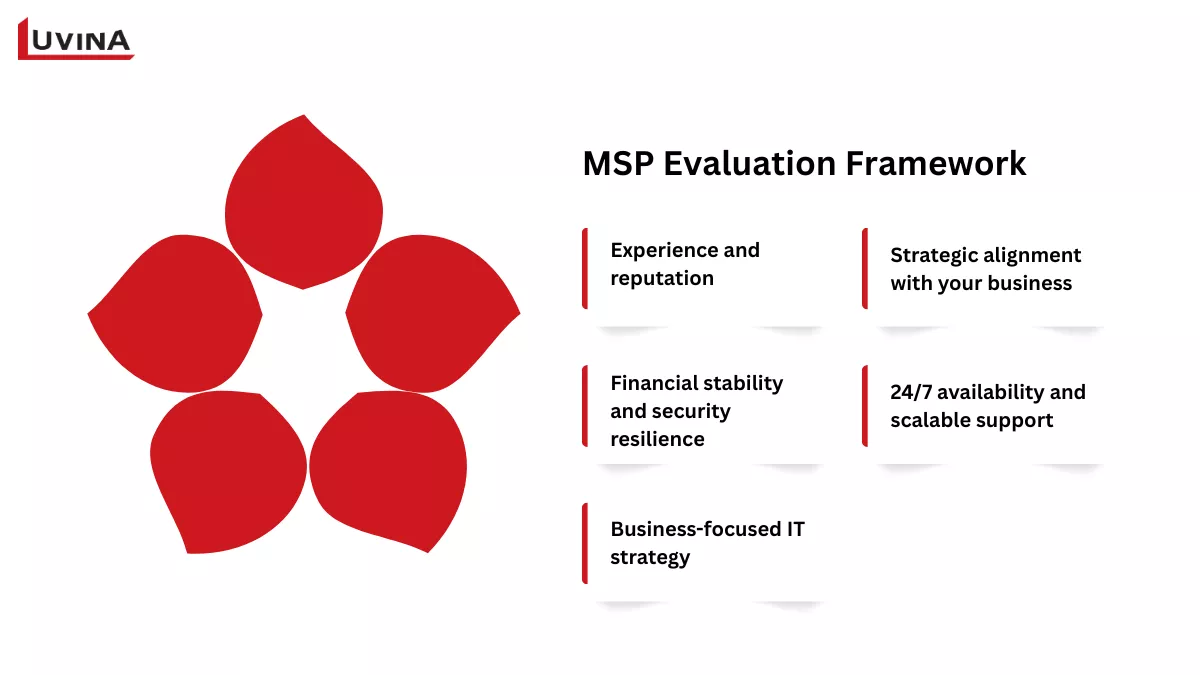
Framework for selecting MSPs
1 – Experience and reputation
Review how long the provider has been operating, the size and qualifications of their team, and their certifications. Client testimonials, case studies, and references from similar businesses help validate their ability to deliver real results. This is especially important when considering how to choose managed IT service provider, as industry-specific experience can directly impact performance.
2 – Strategic alignment with your business
A strong MSP should act as a strategic partner, not just a technical vendor. Look for providers that build services around your business goals and offer proactive guidance. Regular reviews and technology roadmap planning are key indicators that they can adapt IT strategies as your business evolves.
3 – Financial stability and security resilience
Evaluate whether the provider has the resources to support you in critical situations. Financial strength often reflects their ability to maintain operations, invest in technology, and recover from disruptions. At the same time, assess their cybersecurity readiness – both in protecting your systems and handling potential incidents effectively.
4 – 24/7 availability and scalable support
IT issues can happen at any time, so consistent availability is important. Confirm whether support is truly 24/7 and whether the provider has a full team or relies on limited resources. A scalable support model ensures they can handle growing demands – an important factor when considering how to choose managed IT service provider for long-term reliability.
5 – Business-focused IT strategy
A reliable MSP should help you plan, align IT with business goals, and continuously improve performance. This includes strategic consulting, regular reviews, and solutions that evolve with your needs – helping you make smarter decisions when evaluating how to choose managed IT service provider for sustainable growth.
Post-Selection: Transition and Partnership Management
The real value becomes clear when you understand how to choose managed IT service provider based on their ability to execute a smooth transition and manage the partnership over time. A structured onboarding and post-go-live approach helps ensure “implementation without interruption.”
Onboarding and knowledge transfer
The transition should start with a clear onboarding plan. This includes transferring system knowledge, documenting your current infrastructure, and aligning both teams on responsibilities. A well-prepared MSP will schedule technical changes, such as deploying monitoring tools or antivirus systems, during low-risk periods (often weekends) to minimize disruption.
At the same time, the previous provider must fully offboard by removing their tools and access. Internally, change management is just as important. Your team needs clear communication about new processes, contacts, and support channels to avoid confusion during the first few weeks.
Monitoring performance and continuous optimization
The MSP should continuously monitor systems, track operational metrics, and gather user feedback to identify areas for optimization. Regular reviews help fine-tune services, improve response times, and ensure the setup aligns with your actual business needs. This ongoing process is essential when evaluating how to choose managed IT service provider to maximize long-term value.
FAQs
1. How much should managed IT services cost?
Managed IT services range from $150 to $400 per user/month in the US and Canada. The exact cost depends on the service scope.
2. Can we switch MSPs if we’re unhappy?
Yes. You can switch MSPs at any time.
3. How do we measure whether our MSP is actually adding value?
Focus on outcomes, not just ticket volume. Key indicators include system uptime, security performance, response times, and how well IT supports business continuity and predictable costs.
4. Do we still need internal IT staff if we have an MSP?
In most cases, yes. An MSP handles infrastructure and monitoring, while internal IT ensures alignment with business needs and provides on-site, company-specific support.
Conclusion
Manufacturing today requires IT that can keep up with production spIf you’re short on time, focus on these 5 key factors:
– Proven experience in your industry (especially manufacturing)
– Clear SLA with guaranteed response and resolution times
– Strong cybersecurity capabilities and compliance support
– Transparent pricing with no hidden costs
– Ability to scale with your business growth
If a provider cannot clearly demonstrate these, consider it a red flag.
Choosing the right MSP is a strategic decision that directly impacts your operations, security, and long-term growth. When considering how to choose managed IT service provider, the goal is to find a partner that understands your industry, supports both daily operations and long-term strategy, and delivers consistent value.
The most reliable partners among today’s managed IT services companies are those that combine technical expertise with proactive support, clear communication, and continuous improvement. With over 20 years of experience, Luvina has been delivering managed IT services to businesses across Japan, Vietnam, and other global markets.
We understand the challenges faced by small and medium-sized companies and provide tailored solutions – from comprehensive IT support and cybersecurity to cloud and project-based services. Our approach focuses on customization, scalability, and 24/7 support, ensuring your systems remain secure, efficient, and aligned with your business goals.
If you’re evaluating options or need a second opinion on your current setup, our team can help you assess your IT environment and identify the most suitable approach.
Learn more about our managed IT services or explore how we support manufacturing businesses in building scalable and secure IT systems.
Resources
- https://www.ibm.com/industries/in-en/pdf/downloads/80012880usen-02_80012880USEN.pdf
- https://www.linkedin.com/pulse/msp-transition-tips-implementation-without-jason-kppjc
READY TO START A PROJECT?
Our experts are eager to explore your needs.

Read More From Us?
Sign up for our newsletter
Read More From Us?
Sign up for our newsletter