




Managed IT Services vs Break Fix: Which Is Better?


Managed IT services are proactive and subscription-based, while break-fix is reactive and pay-per-incident. For most growing businesses, managed services offer better long-term cost control and stability.
Managed IT services vs break fix – which one is for you?
Your choice predicts not only how you handle IT issues but also how you manage risk, cost, and business continuity. Many companies still rely on the break-fix model, only calling for support when something fails. It may seem economical upfront, but the hidden costs often appear when downtime hits.
In this article, we’ll break down managed IT services vs break fix – how each model works, their pros and cons, and which one makes more sense for long-term business stability.
What Is Break-Fix IT Support?
Break-fix IT support is a reactive IT service model in which businesses seek technical help only after a problem occurs.
Companies typically pay on a pay-as-you-go basis. There are no ongoing service contracts, and costs are calculated based on the time and resources needed to fix each issue.
When looking at managed IT services vs break fix, this reactive nature becomes a major limitation. While break-fix may work for short-term or low-dependency environments, it often results in higher long-term costs and operational disruptions as businesses grow and rely more heavily on technology.
Break-fix often looks cheaper until the first major outage, where a single incident can exceed a year of managed service costs.
What Is Managed IT Services?
Managed IT services are a proactive IT support model in which a provider takes ongoing responsibility for a company’s entire IT environment. Instead of waiting for issues to happen, systems are continuously monitored, maintained, and optimized to prevent problems before they disrupt operations.
This approach is built on a long-term partnership rather than one-time fixes. Businesses typically receive a comprehensive service package that includes 24/7 monitoring, proactive maintenance, cybersecurity management, and compliance support. When evaluating managed IT services vs break fix, this proactive structure stands out. Instead of reacting to failures, managed IT services focus on stability, security, and continuous improvement.
The managed services market is projected to grow from $258.24 billion in 2023 to $520.54 billion by 2032, at a CAGR of 8.10%, driven by the increasing demand for IT outsourcing services.
>>> Read more: Types of Managed IT Services
Direct Cost Comparison: Managed IT Services vs Break Fix
Managed IT services are proactive and subscription-based, while break-fix is reactive and pay-per-incident. For most growing businesses, managed services offer better long-term cost control and stability.
When evaluating managed IT services vs break fix, cost is often the first factor businesses consider, but also the most misunderstood.
At a glance, break-fix appears cheaper because there are no ongoing fees. However, this model charges per incident, meaning costs can vary significantly depending on how often issues occur. A single server failure or emergency repair can quickly add up to thousands, making budgeting difficult and unpredictable.
Managed IT services cost is typically structured as a fixed monthly fee. This covers a full range of services such as monitoring, maintenance, support, and security. Instead of paying for each problem, businesses invest in preventing them. This creates stable, predictable expenses and reduces the risk of sudden financial spikes caused by unexpected IT failures.
The cost differences become clearer when focusing purely on financial structure and impact:
| Cost factor | Managed IT services | Break-fix IT support |
| Pricing model | Fixed monthly fee (~ $100-250/user/month (no-follow) with predictable billing) | Pay-per-incident (~$150-250/hour with no cap) |
| Cost predictability | High, stable monthly cost | Low, fluctuates by issue |
| Budget control | Easy to plan and forecast | Difficult to forecast |
| Upfront cost | Higher initial commitment | Low or none |
| Long-term cost | More cost-efficient over time | Often higher due to incidents |
| Hidden costs | Minimal | High (downtime, emergency fees) |
Managed it services vs break fix – The differences in pricing models
Beyond pricing structure, the right model also depends on your business size, needs, and IT complexity. Below is a simplified cost-based view of common use cases: (no follow)
| Scenario | Best model | Estimated cost |
| Under 5 users | Break-Fix | $1000 – $3000/year |
| 10 – 50 users | Managed IT Services | $12.000 – $40.000/year |
| Compliance-heavy | Managed IT Services | $20.000 – $60.000+/year |
| No in-house IT | Managed IT Services | $15.000 – $50.000+/year |
| Short-term project | Break-Fix | $500 – $2500/project |
Cost comparison of IT models across different scenarios
Break-fix solves problems after they happen, while managed IT services are designed to ensure those problems never occur in the first place. Looking at both tables, it becomes clear that while break-fix may suit very small or short-term needs, costs can quickly scale as IT demands grow. This is why, in most cases of managed IT services vs break fix, businesses achieve better cost control and long-term savings with a proactive, fixed-cost model.
Operational Differences: Proactive vs Reactive IT
The core difference in managed IT services vs break fix lies in how IT issues are handled day to day.
Managed IT services follow a proactive approach, where systems are continuously monitored and maintained to prevent problems before they disrupt business operations. Regular updates, security patches, and system checks are part of the ongoing service, helping reduce risks and improve stability.
Break-fix support is reactive. IT support is only provided after an issue occurs, meaning there is no continuous monitoring or preventative maintenance in place. Problems are addressed as they happen, which can lead to unexpected downtime and operational disruption.
This difference in approach directly impacts business reliability. Proactive IT support helps minimise failures, data loss, and interruptions by identifying risks early. Reactive support, however, often means businesses must deal with issues only after damage has already been done.
| Managed IT Services | Break-Fix IT | |
| Approach | Proactive | Reactive |
| Monitoring | Continuous | None |
| Maintenance | Ongoing updates | Only when issues occur |
| Issue handling | Prevents problems | Fixes after failure |
| Risk | Lower | Higher downtime risk |
Comparison of how Break-Fix and Managed IT Services are implemented
Security & Compliance Impact
A key difference in managed IT services vs break fix is how each model handles security and compliance over time.
Managed IT services take a proactive approach, with continuous monitoring, regular system updates, and ongoing threat detection. Security patches are applied as part of routine maintenance, and risks are identified before they can escalate. This also extends to compliance support, where businesses are guided to meet requirements such as GDPR through structured processes and continuous oversight.
Break-fix support operates differently. Security actions are typically performed only after a problem is reported or during an on-demand service visit. This means there is no continuous monitoring, no scheduled vulnerability checks, and limited support for regulatory compliance. As a result, potential gaps in protection can remain undetected for longer periods.
| Managed IT Services | Break-Fix IT | |
| Monitoring | Continuous threat detection | No ongoing monitoring |
| Updates and patching | Regular, proactive updates | Only when issues occur |
| Compliance support | Ongoing (e.g., GDPR) | Not included |
| Risk management | Preventive and structured | Reactive only |
| Exposure to threats | Lower | Higher due to gaps |
Security and compliance impact of the 2 approaches
Downtime, Productivity & Business Impact
Downtime is where the difference in managed IT services vs break fix becomes most visible.
Managed IT services are designed to minimise disruption through continuous monitoring, regular maintenance, and structured backup and disaster recovery planning. Systems are checked in real time, updates are applied automatically, and backups are tested regularly. This ensures that if an issue does occur, recovery is fast and controlled, reducing the overall impact on operations.
Break-fix support works oppositely. Issues are only addressed after they happen, which increases the risk of longer outages. Without ongoing monitoring or a clear recovery plan, businesses may face extended downtime and potential data loss. Even when backup solutions are available, they are often implemented after a failure, rather than as part of a proactive strategy.
The operational impact goes beyond system availability:
– Break-fix: Teams must wait for support, which increases repair time and slows down productivity. Employees are often forced to pause their work or shift focus to urgent technical issues, affecting deadlines and overall performance.
– Managed IT services: Resolve many issues before users even notice them, allowing teams to stay focused on their core tasks.
This is why, when comparing managed IT services vs break fix, the difference in productivity is significant.
| Managed IT Services | Break-Fix IT | |
| Downtime risk | Lower (proactive prevention) | Higher (reactive response) |
| Issue resolution | Fast, often before disruption | Slower, after failure occurs |
| Productivity | Stable, minimal interruption | Disrupted during outages |
| Backup and recovery | Regular, tested, ready | Limited or reactive |
| Business continuity | Structured and reliable | No consistent framework |
How downtime and business impact differ between the 2 models?
Managed IT Services vs Break Fix: Which Model Is Right For Your Business?
Choosing between managed IT services vs break fix depends on how your business uses technology, your risk tolerance, and how much control you need over costs and operations. There’s no one-size-fits-all answer, but each model fits clearly defined scenarios.
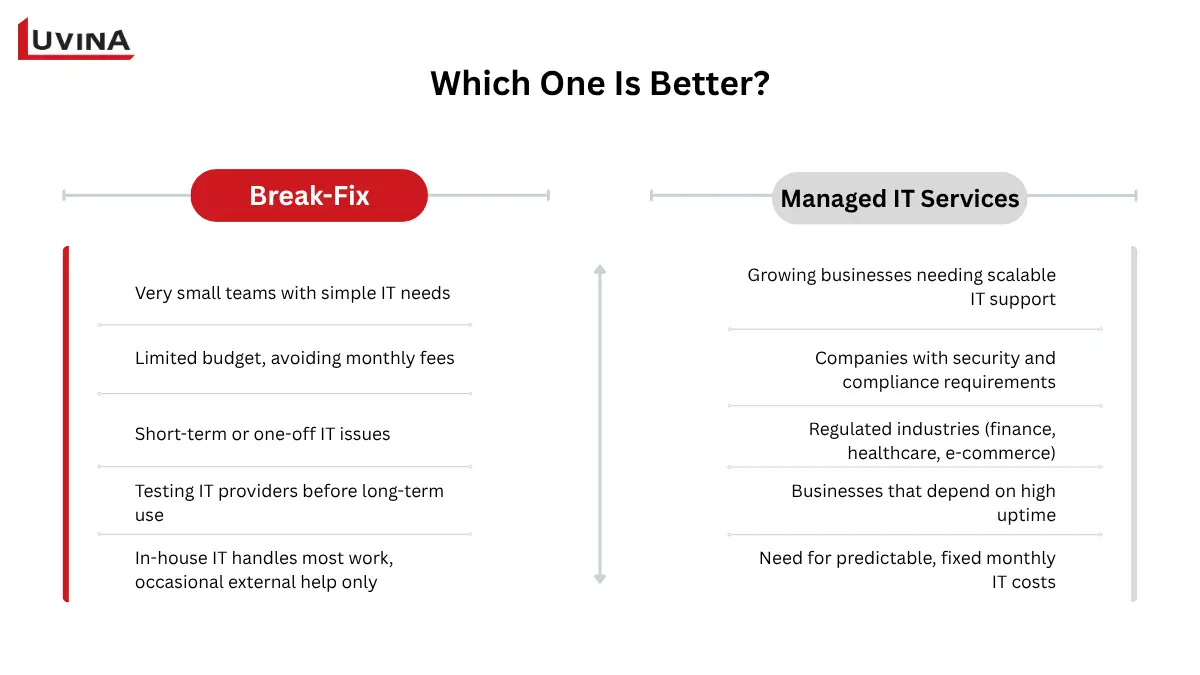
Each approach is suitable for different use cases
Break-fix solves problems after they happen, while managed IT services are designed to ensure those problems never occur in the first place.
When Break-Fix Makes Sense?
Break-fix can be suitable for businesses with simple, low-dependency IT environments. It works best when issues are rare and the impact of downtime is limited.
– Very small teams (e.g. under 5 users) with minimal systems
– Businesses with tight budgets that cannot commit to monthly fees
– Short-term needs such as one-off projects or urgent repairs
– Companies want to test a provider before a long-term contract
– Organizations with in-house IT that only need occasional external support
In these cases, IT is not critical to daily operations, so a reactive approach remains manageable.
When Managed IT Services Are the Better Choice?
In most cases, as businesses grow, the balance in managed IT services vs break fix shifts toward managed services. A proactive model becomes essential when IT plays a key role in operations and growth.
– Growing businesses that need scalable and consistent IT support
– Companies handling sensitive data require strong security and compliance
– Industries with strict regulations (finance, healthcare, e-commerce)
– Businesses that rely on high uptime for operations or customer experience
– Organizations that want predictable monthly IT costs without surprises
This approach helps maintain stability, reduce risk, and support long-term business goals.
In some cases, yes. Some providers offer hybrid options like block-hour packages or project-based support. This allows businesses to access IT help without committing to a full managed service plan. However, these are usually temporary solutions, often used as a transition step rather than a long-term strategy.
If your business depends on IT for daily operations, managed IT services are typically the better choice due to predictable costs, reduced downtime, and stronger security.
Hybrid and Tiered IT Support Approaches
When evaluating managed IT services vs break fix, not every business fits neatly into a fully proactive or fully reactive model. Many companies adopt hybrid or tiered approaches to balance flexibility, cost, and technical complexity.
Tiered IT Support Model
Tiered support is a structured system where IT issues are handled across multiple levels based on complexity. Each level has a clear role, helping streamline how problems are diagnosed and resolved.
– First-line support: Handles basic troubleshooting and common issues
– Second-line support: Manages more technical problems requiring deeper expertise
– Third-line support: Resolves advanced challenges handled by specialists
This model is typically used by medium to large businesses with complex IT environments. It improves efficiency by ensuring the right level of expertise is applied to each issue, although resolution time can be longer due to escalation between levels.
Hybrid IT Support Model
The hybrid model combines in-house IT teams with external service providers. Businesses manage certain tasks internally while outsourcing more complex or resource-intensive work.
– Internal team handles day-to-day operations and minor issues
– External provider supports advanced tasks, monitoring, or specialised needs
– Flexible setup that can adapt to changing business requirements
This approach offers a balance between control and expertise. It can be cost-efficient and highly customizable, but it requires strong coordination between internal staff and external partners to avoid delays or gaps in support.
In the broader context of managed IT services vs break fix, these models often act as a middle ground. They allow businesses to move beyond purely reactive support without fully committing to a complete managed services model.
Transition from Break-Fix to Managed Services
If you’re still weighing managed IT services vs break fix, the tipping point usually comes when short-term fixes no longer solve long-term problems.
These indicators suggest your current break-fix approach is no longer sustainable:
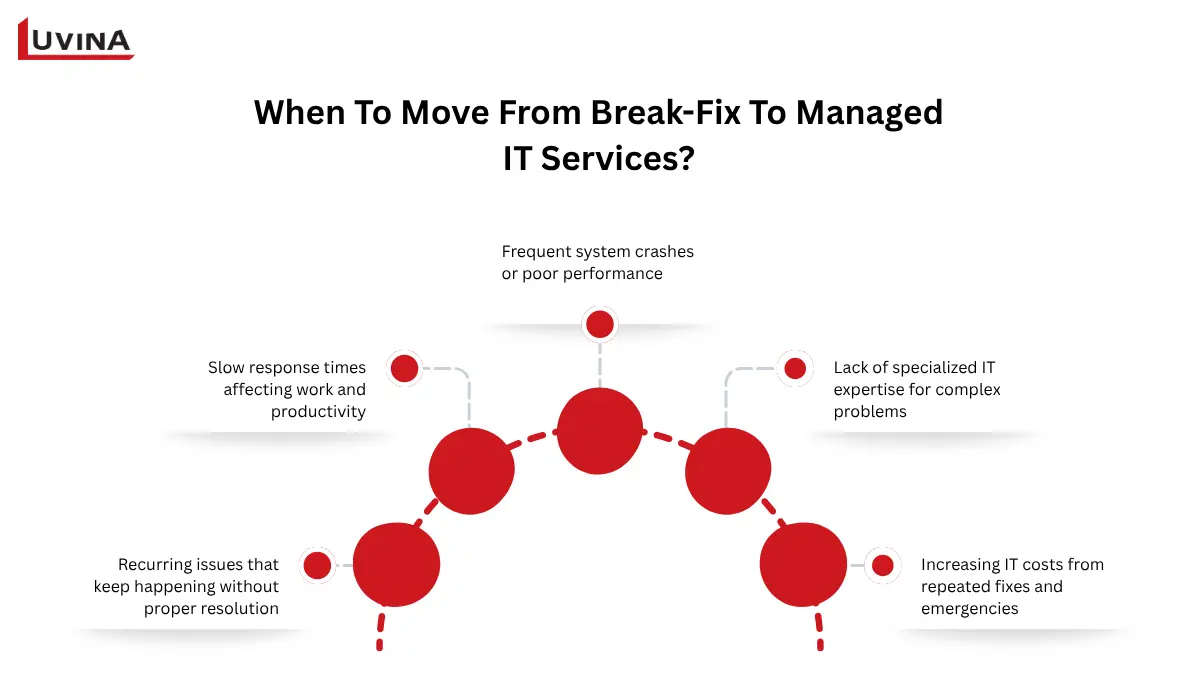
Signs you should switch to managed IT services
– Recurring IT issues that keep coming back instead of being fully resolved
– Slow response times that delay work and reduce productivity
– System performance problems like frequent crashes or slow networks
– Limited access to specialised expertise for complex environments
– Rising IT costs driven by repeated repairs and unexpected incidents
When these patterns appear, it means your IT is being managed reactively rather than strategically, and you need to move to managed IT services. A CompTIA study found that 46% of companies reduced their IT costs after switching to a managed service provider (MSP) model. Moving to managed services requires a structured approach to avoid disruption and maximise value:
– Review your actual IT costs over time, including downtime and productivity loss
– Define clear goals, such as fewer outages, stronger security, or predictable budgeting
– Choose a provider with proven experience and the ability to support your business needs
– Start with a phased rollout, focusing on critical services like monitoring or backup
– Schedule regular reviews to ensure IT performance aligns with business goals
In real-world scenarios of managed IT services vs break fix, companies that make the switch often gain better control, fewer disruptions, and more consistent long-term outcomes.
FAQ
1. Can break-fix ever be cheaper than managed services?
Yes, short term. But unexpected issues and downtime often make it more expensive over time.
2. Is 24/7 monitoring really necessary for my business?
Yes, for most businesses. Without it, you risk security gaps and undetected issues after hours.
3. What happens during the transition to managed services?
It typically includes assessment, planning, onboarding, and ongoing management to ensure smooth, proactive IT operations.
4. Can I negotiate managed services pricing?
Yes. Many providers allow flexibility, often within a 10–30% range of the initial quote.
5. How do I know if managed services are working?
Fewer issues, less downtime, and minimal need for emergency support are clear signs it’s working.
Conclusion
Choosing between managed IT services vs break fix ultimately depends on how critical IT is to your business operations. Many businesses are turning to managed IT services companies for a more structured and future-ready approach. With ongoing monitoring, faster issue resolution, and built-in security, managed services help ensure your IT supports – not slows down – your business.
If your business is experiencing recurring downtime, rising IT costs, or security concerns, it may be time to move beyond break-fix.
At Luvina Software, we help companies transition from reactive IT support to proactive managed services, ensuring stability, security, and predictable costs.
READY TO START A PROJECT?
Our experts are eager to explore your needs.

Read More From Us?
Sign up for our newsletter
Read More From Us?
Sign up for our newsletter