




A Practical Guide to Object-Oriented Software Engineering


Object-oriented software engineering has changed the way modern software systems are developed, created, and kept up-to-date. Industry research shows that object-oriented languages such as Java, C++, and C are used in over 70% of company software systems today, hence emphasizing the continued relevance of this method.
Object-oriented principles are applied in real-world engineering to support long-term system evolution in this article. You will discover how fundamental ideas like encapsulation and inheritance convert into maintainable systems, why teams keep relying on OOSE despite more modern paradigms, and how it measures against other development strategies.
What Is Object-Oriented Software Engineering?
Object-oriented software engineering (OOSE) is an approach that designs software as interacting objects that combine data and behavior to improve maintainability and scalability. Applying object-oriented programming ideas to the engineering process helps to build, maintain, and understand software more easily. Each object is developed from a class, which serves as a blueprint specifying what the object can do, whereas the object itself carries out those actions at runtime.
Core Principles of Object Orientation
The strength of object-oriented systems stems from a small set of well-defined principles – abstraction, encapsulation, inheritance, polymorphism – that guide the structure of software and the interaction between components. In object oriented software engineering, these 4 principles help developers manage complexity, reduce errors, and design systems that can evolve without becoming difficult to maintain.
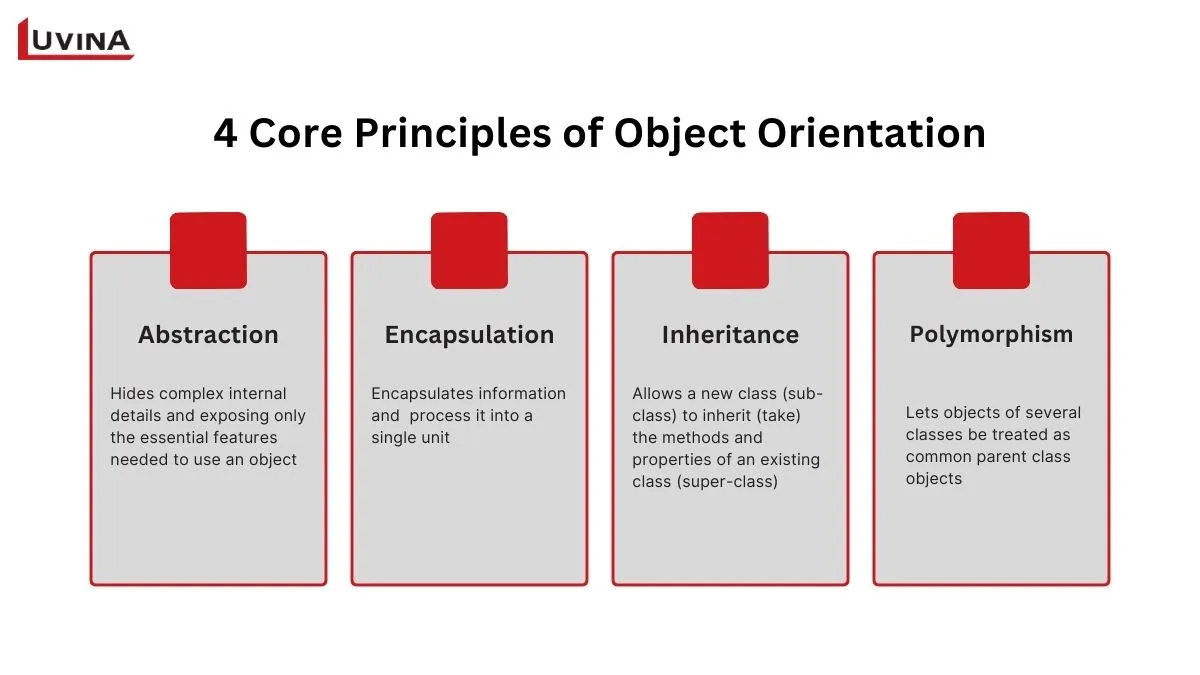
These four core principles form the foundation of object-oriented software engineering
1. Abstraction
Abstraction is the principle of focusing on what an object does rather than how it does it. It is the process of hiding complex internal details and exposing only the essential features needed to use an object. In object oriented software engineering, abstraction helps developers work with large codebases by reducing cognitive load. Instead of understanding every implementation detail, developers interact with clear and simple interfaces.
2. Encapsulation
The idea of encapsulating information and the means that process it into a single unit, known as an object, is encapsulation. It also limits direct access to the inside state of an object. Encapsulation acts as a protective barrier that prevents unintended data changes, improving security, data integrity, and system manageability.
Encapsulation hides an object’s internal state and exposes only controlled interfaces.
This allows developers to change internal implementations without affecting other system components, as long as the public interface remains stable.
As software evolves more often than it is rewritten, encapsulation plays a key role in long-term maintainability.
3. Inheritance
Inheritance allows a new class (subclass) to inherit (take) the methods and properties of an existing class (superclass). Object-oriented software engineering uses the concept of inheritance as a means of providing logical hierarchy for components in a common application and supporting the use of reusable code.
Inheritance enables code reuse by allowing child classes to extend or override parent behavior.
This reduces duplication, keeps related components consistent, and simplifies maintenance in large systems.
4. Polymorphism
Polymorphism lets objects of several classes be treated as common parent class objects. It lets the same method name act differently depending on the object invoking it.
Object orientation also includes supporting ideas beyond these four core principles, like syntax rules defined by programming languages, coupling between software modules, and relationships that describe how classes interact with one another.
Source:
https://www.fullstackfoundations.com/blog/oop-principles#principle-1-encapsulation
https://www.designgurus.io/blog/object-oriented-programming-oop
Object-Oriented Techniques Incorporated in Engineering
Object-oriented techniques translate object-oriented thinking into practical engineering workflows, helping teams analyze requirements, model behavior, and design scalable, maintainable systems.
| Technique | Main focus | Benefit | Typical use |
| Object-oriented analysis and design (OOAD) | Objects, relationships, behavior | Aligns system design with real requirements | Early analysis and system design in object-oriented software engineering |
| Object modeling technique (OMT) | Structure and dynamics | Clear view of system states and data flow | Pre-implementation modeling |
| Story-driven modeling (SDM) | Real-world scenarios | Improves understanding of object interactions | Validating behavior through examples |
| Responsibility-driven design (RDD) | Object responsibilities | Better encapsulation and separation of concerns | Large or behavior-focused systems |
| Fluent interfaces and method chaining | API readability | Clearer, more expressive code | Designing developer-friendly APIs |
| Object-oriented methodologies (objectory) | Full development lifecycle | Controls complexity in large projects | Enterprise-scale development |
| UML and visual modeling tools | Visual communication | Shared understanding of architecture | Team collaboration and documentation in object-oriented software engineering |
A summary table of commonly used techniques in OOSE
Source:
https://voer.edu.vn/m/phuong-phap-huong-doi-tuong-va-qua-trinh-phat-trienhe-thong-phan-mem/f51c58be?utm_source=chatgpt.com
https://www.geeksforgeeks.org/software-engineering/software-engineering-object-modeling-technique-omt
Pros and Cons of OOSE
OOSE is best suited for large or evolving systems where maintainability and reuse matter more than initial simplicity.
Like any engineering approach, object-oriented software engineering offers both advantages and limitations that teams should evaluate based on project context. The table below highlights why OOSE excels in long-term projects but may be excessive for small, simple applications.
| Aspect | Pros | Cons |
| System structure | Clear structure using objects makes large systems easier to organize | More classes can make the system feel bulky |
| Reusability | Reusable classes save time and reduce repeated code | Poor inheritance design leads to tight coupling |
| Maintainability | Changes stay local to specific objects or classes | Class dependencies can be hard to track |
| Scalability and flexibility | Easy to extend systems by adding new objects | Not suitable for simple or small problems |
| Productivity and collaboration | Work can be split by objects, improving collaboration | Requires solid design skills and planning |
| Data security | Encapsulation protects internal data | Extra abstraction may affect performance |
Advantages and disadvantages of the object-oriented approach
Source:
https://www.geeksforgeeks.org/cpp/benefits-advantages-of-oop
https://www.scaler.com/topics/oops-advantages
Object-Oriented vs. Other Approaches
The way code is structured will ultimately affect the scalability, maintainability, and productivity of a team as the size of the software system increases. By comparing object oriented software engineering to other methods, we can see the best places to apply it to maximize the value of the software engineer, and which instances would benefit more from other methodologies.
1. Procedural vs. Object-oriented
Procedural programming and object-oriented programming differ based on their primary focus of functionality (execution order for procedural) versus structural organization and individual responsibility (design for OOP). The following table lists several of the key differences between the two to represent them in a more global and general perspective.
| Dimension | Procedural programming | Object-oriented programming |
| Core design mindset | Focus on steps and procedures | Focus on entities and behavior |
| Data and logic | Data and functions are separate | Data and behavior are bundled into objects |
| System structure | Linear, function-based organization | Modular, class-based structure in object-oriented software engineering |
| Reuse and extension | Limited function reuse | Reuse and extension through inheritance |
| Scalability and maintenance | Harder to scale and maintain | Designed for long-term growth in object-oriented software engineering |
Comparison table of procedural and object-oriented approaches
– When to use procedural: Procedural programming works best for small, precisely specified programs or tools where the logic is simple and unlikely to vary often.
– When to use object-oriented: Medium to large systems modeling actual-world entities, necessitating regular changes, or engaging several developers, would benefit from object-oriented software engineering.
– Hybrid use: Many systems beginning with procedural logic slowly add object-oriented structures as complexity grows.
In practice, many modern systems adopt a hybrid approach, combining object-oriented structures with procedural or functional techniques to balance clarity, scalability, and performance.
2. Object-oriented vs. Functional
Functional programming focuses on the conversion/transformation of data, while OOP focuses on developing and maintaining long-lived objects/entities and their states. The following comparison illustrates this different level of detail:
| Dimension | Functional programming | Object-oriented programming |
| Primary abstraction | Functions | Objects |
| Data and state | Immutable data, minimal state | Encapsulated mutable state |
| Programming style | Declarative, result-focused | Imperative, behavior-focused |
| Code reuse | Function composition | Inheritance and polymorphism in object-oriented software engineering |
| Problem suitability | Data processing, parallel workloads | Domain-driven systems and applications in object-oriented software engineering |
What’s the difference between object-oriented and functional programming?
– When to use functional: For data processing, analysis, and parallel tasks needing immutability and predictability, functional programming is ideally suited.
– When to use object-oriented: Systems with long-lived entities, such as users, orders, or interfaces, where behavior and state interact, benefit object oriented software engineering.
– Hybrid use: Modern languages often blend both styles, which lets teams apply functional methods within an object-oriented software engineering environment when performance or clarity is improved.
Source:
https://www.designgurus.io/blog/object-oriented-programming-oop
https://www.analyticsvidhya.com/blog/2024/07/functional-programming-vs-object-oriented-programming
https://www.datacamp.com/tutorial/functional-programming-vs-object-oriented-programming
https://dev.to/lovestaco/understanding-programming-paradigms-structured-functional-and-object-oriented-programming-11j5
Common Patterns, Principles & Design Guidelines
Object-oriented software engineering helps long-term maintainability and manages complexity using well-known patterns and ideas. Rather than creating lessons and relationships based on instinct alone, developers use established standards to determine how dependencies are handled, how systems develop, and how responsibilities are distributed. Among these principles, SOLID principles and GRASP patterns form the most often applied bases in object-oriented design.
1. SOLID principles (open-closed, interface segregation)
SOLID is a collection of five object-oriented design ideas first presented by Robert C. Martin. SOLID gives precise direction on how to create stable, adaptable, easily extensible classes and modules in object-oriented software engineering as needs evolve.
SOLID aims at two fundamental objectives at a high level: preserving responsibility clearly and minimizing superfluous coupling between parts.
The 5 SOLID principles include:
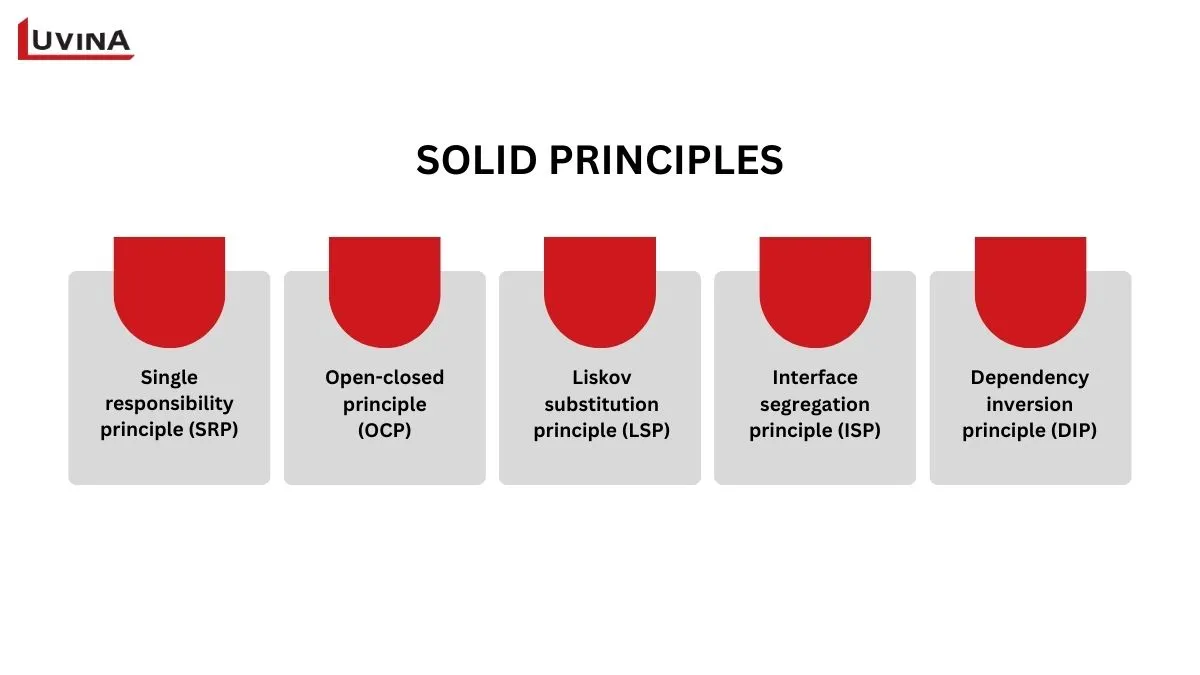
The 5 pillars of the SOLID design pattern
– Single responsibility principle (SRP): A class has one and only one justification for alteration. This helps students grasp material more simply and keeps classes on course.
– Open-closed principle (OCP): Though open for extension, software entities ought to be closed for change. Newly added behavior ought not alter already written code.
– Liskov substitution principle (LSP): Without compromising program correctness, subclasses have to be acceptable in place of their parent classes.
– Interface segregation principle (ISP): Client dependence on interfaces they do not use should not be forced upon them. Interfaces should be modest and precise.
– Dependency inversion principle (DIP): High-level modules should rely on abstractions, not actual implementations
Using SOLID in object oriented software engineering enables teams to create systems that are simpler to test, simpler to maintain, and safer to expand without causing regressions.
2. GRASP object-oriented design patterns
GRASP emphasizes how to delegate responsibilities to classes and objects, while SOLID specifies what good design ought to accomplish. Particularly helpful during Object-oriented analysis and design (OOAD), GRASP patterns help to evaluate the long-term effects of structural choices on system quality.
In object oriented software engineering, GRASP enables designers to address realistic concerns like where logic should reside and how objects should interact.
Among the main GRASP patterns are:
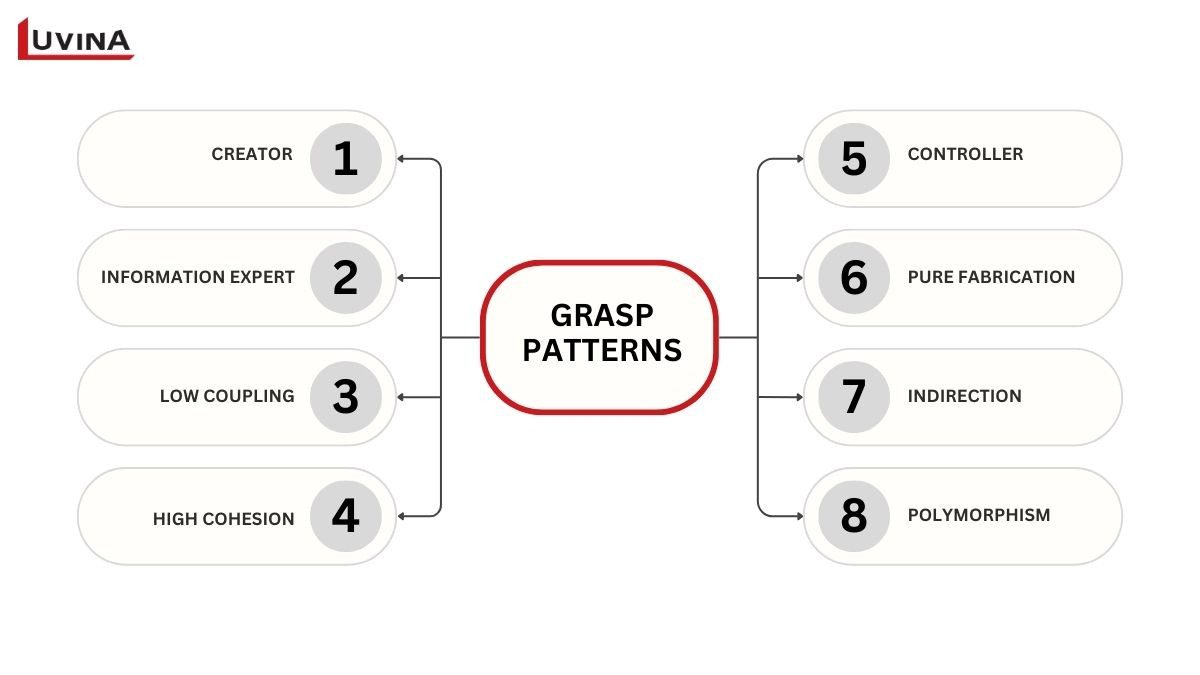
GRASP patterns are one of the commonly used design patterns in OOSE
– Creator: Allocate object creation to the class with the knowledge needed to make it.
– Information expert: Assign responsibility to the class with the information needed to finish the job.
– Low coupling: Increases flexibility and maintainability by lowering dependencies across classes.
– High cohesion: For clarity and focus, cluster connected tasks inside a class.
– Controller: Manage system events and coordinate processes using a particular class.
– Pure fabrication: Introduce non-domain classes when necessary to preserve low coupling and high cohesion.
– Indirection: Add layers in between to separate parts and improve flexibility.
– Polymorphism: Supports several implementations of the same behavior by inheritance or interfaces.
GRASP patterns support clean responsibility assignment and flexible object interaction taken together. Together with SOLID principles, they comprise a useful design toolkit that enhances object-oriented software engineering at the analysis, design, and implementation phases.
Source: https://www.geeksforgeeks.org/system-design/grasp-design-principles-in-ooad
Use cases of OOSE
Object-oriented software engineering is widely applied to systems that require clear structure, long-term maintainability, and the ability to scale as requirements evolve. The following use cases illustrate where object-oriented software programming delivers the most practical value in real-world systems.
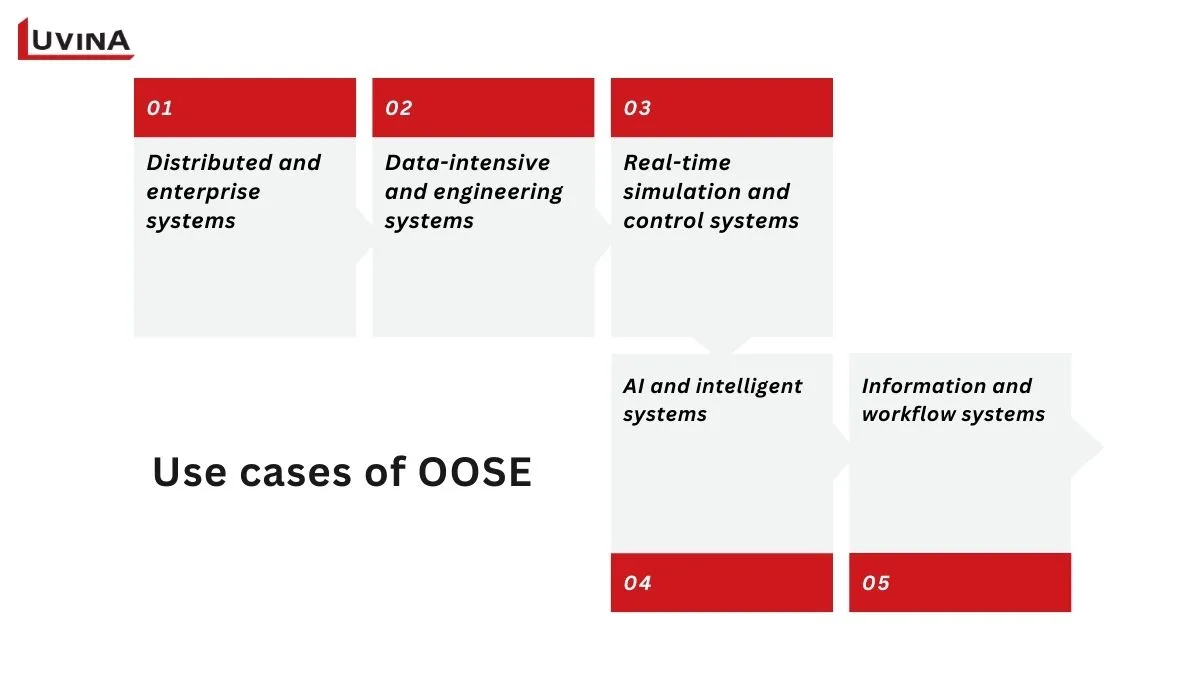
Object-oriented programming is applied across a wide range of use cases
Distributed and enterprise systems
Enterprise systems benefit from OOSE by modeling users, services, and transactions as reusable objects, making complex business rules easier to extend and maintain.
Data-intensive and engineering systems
Data-heavy systems like object-oriented databases and CIM/CAD/CAM applications handle sophisticated structures and connections. Object-oriented software engineering helps to match data and behavior in one single model, hence lowering complexity and enhancing consistency. Over time, this method helps engineers to understand, change, and scale their systems.
Real-time simulation and control systems
In real-time and simulation systems, OOSE supports predictable behavior by modeling time-sensitive components as well-defined objects with controlled state.
AI and intelligent systems
OOSE helps AI systems by organizing models, rules, and processing logic into modular, extensible components that evolve independently.
Information and workflow systems
Information-centric systems – hypertext platforms and workplace automation tools – handle user interactions, workflows, and documents. Object-oriented software engineering facilitates precise modeling of content, actions, and roles, therefore enhancing maintainability and allowing processes to be expanded without upsetting current functioning.
Source: https://www.quickstart.com/blog/software-engineering/10-applications-of-object-oriented-programming/
FAQ
1. What is object-oriented software engineering?
It is a programming approach that builds software around objects, combining data and behavior.
2. How is object-oriented coding different from other approaches?
It focuses on reusable objects, unlike procedural (functions) or functional (pure functions) programming.
3. What are the core principles of OOSE?
There are core principles of OOSE: Abstraction, encapsulation, inheritance, and polymorphism.
Conclusion
Object-oriented software engineering offers a methodical, organized approach to creating, maintaining, and building sophisticated software projects. OOSE remains a practical choice for building complex, evolving software systems where structure, maintainability, and scalability matter.
Having the appropriate technical advice is vital if your company is assessing OOSE for a new project or aiming to enhance an already existing system. From system design through implementation, Luvina assists teams in properly implementing object-oriented approaches by providing advice and development support. Luvina is available to provide customized advice and solutions meeting your particular business and engineering needs.
Resources
- https://examples.tely.ai/understanding-oop-programming-definition-evolution-and-benefits/
- https://www.institutedata.com/blog/object-oriented-programming/
- https://www.techtarget.com/searchapparchitecture/definition/object-oriented-programming-OOP
- https://www.fullstackfoundations.com/blog/oop-principles#principle-1-encapsulation
- https://www.designgurus.io/blog/object-oriented-programming-oop
- https://voer.edu.vn/m/phuong-phap-huong-doi-tuong-va-qua-trinh-phat-trienhe-thong-phan-mem/f51c58be
- https://www.geeksforgeeks.org/software-engineering/software-engineering-object-modeling-technique-omt
- https://aithietke.com/gioi-thieu-ve-object-oriented-analysis-and-design-va-cac-uml-diagrams-pho-bien-p1/
- https://www.designgurus.io/blog/object-oriented-programming-oop
- https://www.analyticsvidhya.com/blog/2024/07/functional-programming-vs-object-oriented-programming/
- https://www.datacamp.com/tutorial/functional-programming-vs-object-oriented-programming
- https://dev.to/lovestaco/understanding-programming-paradigms-structured-functional-and-object-oriented-programming-11j5
- https://www.geeksforgeeks.org/system-design/grasp-design-principles-in-ooad/
- https://www.quickstart.com/blog/software-engineering/10-applications-of-object-oriented-programming/
READY TO START A PROJECT?
Our experts are eager to explore your needs.


Read More From Us?
Sign up for our newsletter
Read More From Us?
Sign up for our newsletter