




Understanding the Software Reengineering Process Step by Step


The U.S. Government Accountability Office (GAO) finds that most of federal agencies’ total IT budgets – around 80% – are spent on maintenance of current systems, most of which are legacy technology, leaving a tiny fraction for development and innovation.
Though few completely understand the hidden cost, many businesses still carry out crucial business activities on aging software. These days, knowing the software reengineering process steps is vital not only as a technical activity but also as a strategic plan to lower expenses, improve flexibility, and enable long-term expansion. This article will show you software reengineering step-by-step guidance. You will discover the essence of every phase, its relevance, and how to stay clear of typical traps.
Software Reengineering Process Overview
Through analysis, redesign, and transformation into a more effective and maintainable form, the software reengineering process is a methodical approach to update already existing computer systems. Reengineering improvements or migrating legacy systems while retaining core business logic saves companies quality and flexibility with reduced risk and cost rather than starting over.
Generally speaking, companies select software reengineering for these objectives:
– Simpler design and cleaner feature set
– Better performance through code optimization
– Improved maintainability and process continuity
– Easier adoption of modern technologies
– Lower cost and reduced modernization risk
– Greater flexibility to add new features
The 6 activities of the software reengineering process are inventory analysis, reverse engineering, code and data restructuring efforts, document and design reconstruction, forward engineering, testing, confirmation, and deployment. In the following parts, we will examine every activity carefully so as to grasp how they combine in a comprehensive reengineering project.
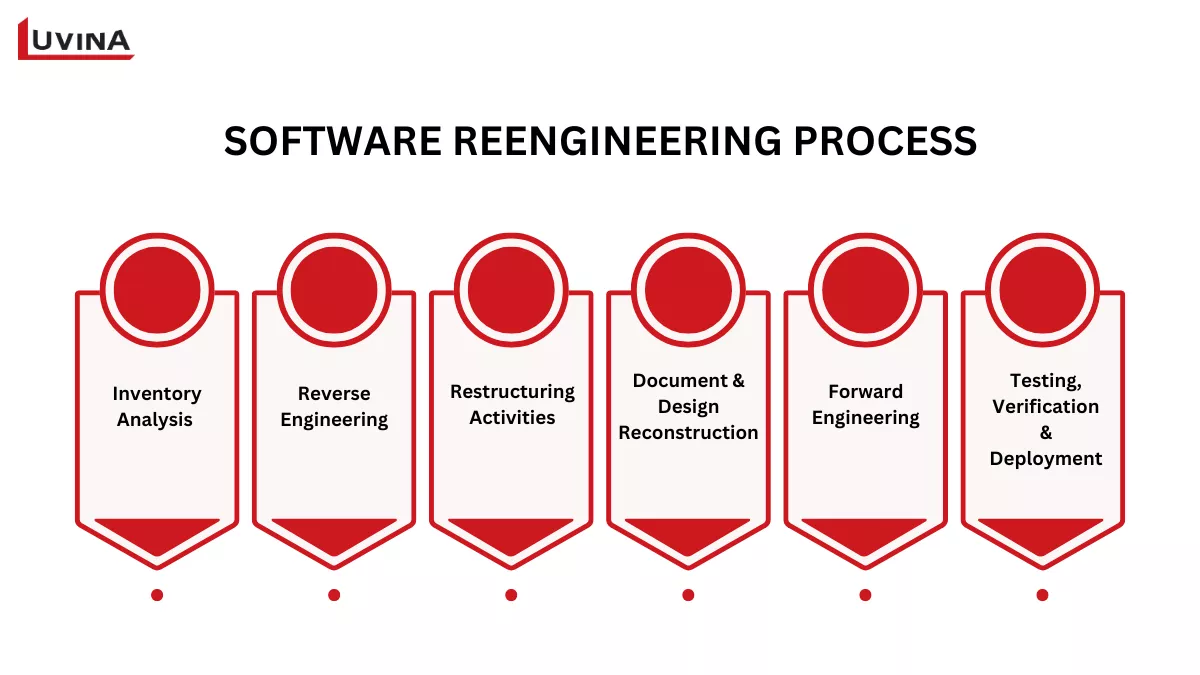
Software reengineering activities are covered in these six steps
1. Inventory Analysis in Software Reengineering
The first step in the software reengineering process is inventory analysis, which seeks to provide a thorough picture of all currently running software systems within a company. Usually presented as a systematic list or table, this inventory records important information about every application – active or no longer in use.
Applications in inventory analysis in software reengineering are assessed on business criticality, system life, current maintainability, and regional organizational considerations. Common data points include the system name, year of creation, history of modifications, effort spent on recent changes, last update date, runtime environment, and integration dependencies.
The main purpose of this step is to prioritize applications and select suitable candidates for reengineering. Systems that are outdated, poorly documented, or rarely updated are often given higher priority.
2. Reverse Engineering – Understanding the Legacy System
Focusing on reconstructing a clear and exact grasp of a legacy system when documentation is inadequate, obsolete, or at variance with the actual implementation, reverse engineering is a necessary phase in the software reengineering process. The aim is to retrieve essential information on system requirements, architecture, interfaces, data structures, and internal logic so teams can assess whether the system may be replaced, partly reutilized, or improved.
Knowing how data is presently organized, accessed, and processed across the system is also critical when rebuilding calls for major data modifications, as data reengineering in software engineering usually depends on this.
One of the main software reengineering activities, reverse engineering, combines thorough source code analysis, stakeholder interviews, and documentation reviews. Teams examine system behavior under genuine use cases as well as component interactions, data, and control flows.
3. Restructuring Activities (Code + Data)
As one of the key phases of software reengineering, restructuring efforts aim at raising the internal quality of a system without altering its outside behavior. This phase of the software reengineering process deals with accumulated technical debt resulting from a faulty first design or years of incremental adjustments. Especially before going to more complex changes like re-architecting, the main goal is to make the code base and data structures easier to understand, test, maintain, and evolve.
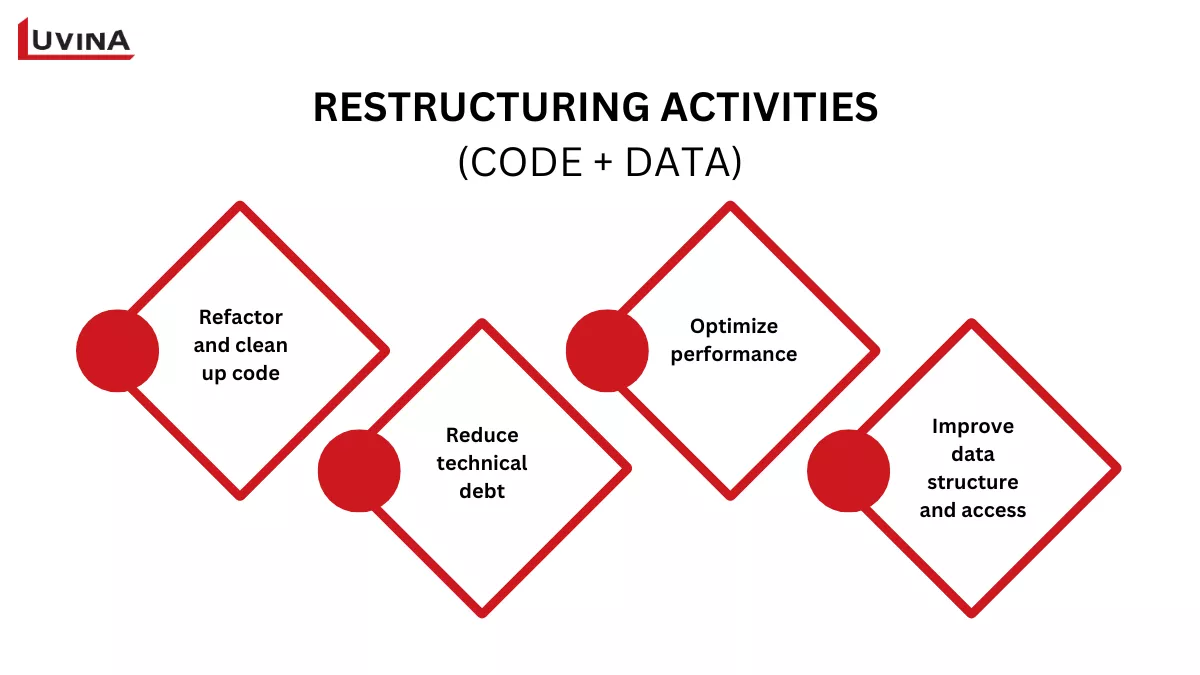
This is one of the most critical steps in the software reengineering process
Refactoring the current source code to increase readability, structure, and reliability is usually code restructuring. Simplifying complicated conditionals, deleting dead or obsolete code, maximizing sluggish or memory-intensive algorithms, and making sure the code meets recognized programming norms are among what developers do.
Data restructuring runs in parallel and builds on insights gained from reverse engineering. It includes analyzing current data models, identifying data components and relationships, and evaluating the quality of existing data architecture. Data schemas may be redefined, access patterns improved, and direct database dependencies removed in favor of cleaner interfaces.
4. Document & Design Reconstruction
Document and design rehabilitation aims to bring the implemented system into harmony with its recorded design. Particularly following reverse engineering and restructuring projects, this phase in the software reengineering process guarantees that documentation correctly portrays the application’s current condition. The aim is to capture what actually counts, not to record everything exhaustively.
To clarify application architecture, main modules, data flows, and design choices – including the trade-offs behind them – teams update current papers or create new ones. Developers, testers and stakeholders of different technological levels frequently utilize design architectural diagrams to increase understanding between parties, as well as to create flowcharts and create interface specifications.
Additionally, an example of design reconstruction is modifying an existing architecture to achieve future readability and reliability through software reengineering by redesigning an outdated module or preparing the overall system for new cloud-based environments.
5. Forward Engineering – Build the New System
Forward engineering is the part of the software reengineering process that creates software from refined designs and updated documentation. New components are developed along with improvements to existing components. The overall goal of forward engineering is to produce software that meets today’s technical and business goals. This step in the process is also referred to as either remodeling or restoring a legacy system, as it leverages knowledge gained about the legacy system to create improved versions of the original.
Through forward engineering, applications are developed by creating new source code for functions, classes, and modules to enable requested enhancements and add the new feature set. Code is written in the appropriate programming language, framework, and design pattern following the coding standard/style guidelines to produce clean, organized, and structured code. Correctness, maintainability, and stability of the software are ensured by unit testing.
6. Testing, Verification & Deployment
Testing, validation, and implementation are the final phases of the software reengineering process; therefore, they ensure that all requirements have been fulfilled, that the re-engineered system is ready for production use, is secure, and is stable when implemented into actual production environments. At this phase, it is shown that after making structural and functional changes to a software program, it will operate correctly under normal operational conditions, fulfilling the requirements specified for that software application.
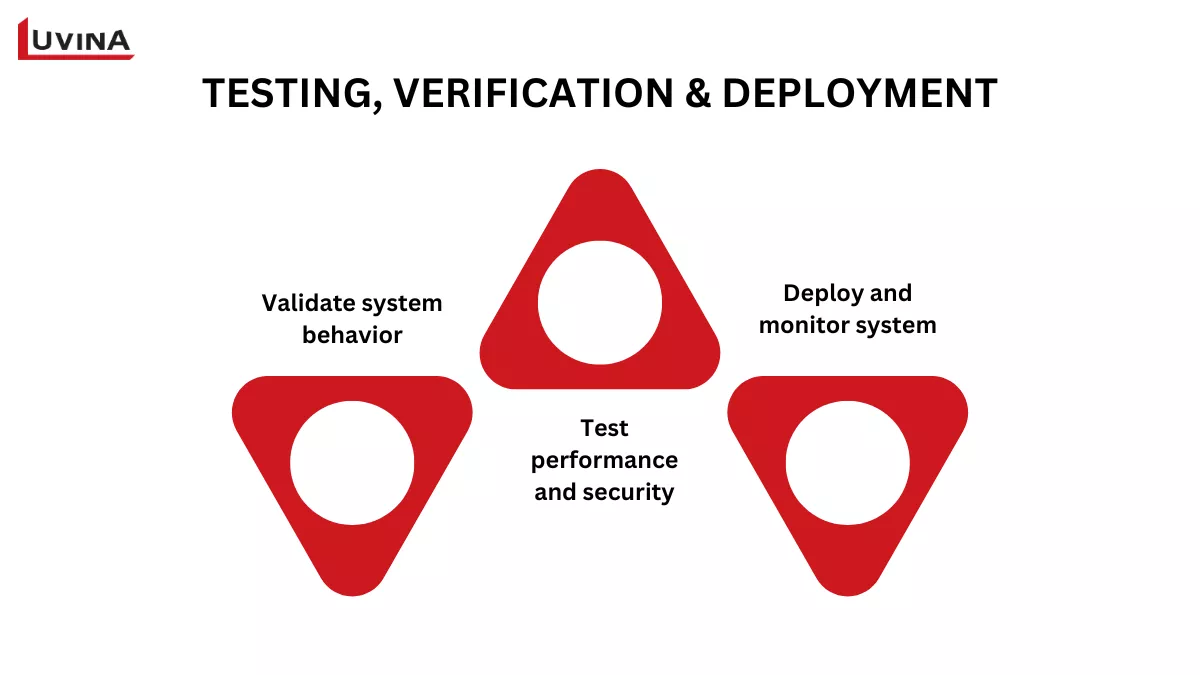
This final step ensures that the system operates effectively after the changes
Along with performance, load, and security testing to check system capacity and resilience, teams employ automated unit and integration tests to find regressions early. User acceptance testing and pilot input support confirm functional accuracy and usability. Usually done in phases with defined rollback strategies, deployment follows the software reengineering process. Monitoring then helps to quickly spot problems and enable ongoing improvement.
Software Reengineering Initiative – How to Start
Early awareness and appropriate planning before beginning the software reengineering process are key to a successful software reengineering initiative.
Legacy compatibility problems, performance and scalability restrictions, and expensive maintenance expenses resulting from repeated failures or complicated codebases are among the standard indications that set off the software reengineering activities.
Organizations should start by focusing on these preparatory actions:
– Study current documentation and code base to grasp the goals, structure, and technical debt of the system.
– Interview stakeholders to find future needs, present pain points, and business priorities.
– Evaluate the quality of the system across maintainability, reliability, performance, and functionality.
– Discover operational, budgetary, resource, and talent dangers as well as restrictions.
– Set achievable goals and scope consistent with corporate goals and continuity requirements.
– Plan a phased transition to reduce risk and keep system stability during modernisation.
Challenges & Common Pitfalls
Even with clear benefits, the software reengineering process often involves technical, operational, and organizational challenges.
| Challenge | Impact | Solution |
| Legacy system complexity | Hidden dependencies and unclear logic slow down the software reengineering process | Use reverse engineering to rebuild system understanding |
| Time, cost and scope misestimation | Delays, budget overruns, and uncontrolled scope | Plan realistically and execute in clear phases |
| Data and functionality preservation | Data loss or broken features during software migration | Validate requirements and test data continuously |
| Technical debt and outdated technologies | Increased instability and maintenance effort | Refactor incrementally and modernize critical components |
| Stakeholder and organizational resistance | Slow adoption and misaligned expectations | Engage stakeholders early and communicate benefits |
| Testing and system continuity | Regressions or downtime affecting operations | Automate testing and deploy via parallel environments |
Challenges in software reengineering and how to overcome them
Conclusion
Software reengineering is a strategic way to modernize legacy systems without disrupting what already works. Instead of rebuilding from scratch, businesses can preserve proven logic, reduce risk, and improve performance, scalability, and security through a well-planned software reengineering process. This approach helps extend the value of existing systems while keeping them aligned with changing business and technology demands.
If your current software is holding growth back, now is the right time to act. Talk to Luvina to assess your systems, define clear goals, and choose a safe, cost-effective path to modernization that supports long-term success.
Resources
- https://files.gao.gov/reports/GAO-25-107795/index.html
- http://productdevelop.blogspot.com/2012/06/inventory-analysis-activity-involved-in.html
- https://www.scrumexpert.com/knowledge/a-guide-to-software-reengineering-when-and-how/
READY TO START A PROJECT?
Our experts are eager to explore your needs.


Read More From Us?
Sign up for our newsletter
Read More From Us?
Sign up for our newsletter