




Technical Debt: What It Is and Why It Matters


Every software team has experienced this moment: adding a small feature suddenly takes days instead of hours, not because it’s complex, but because the codebase fights back. This silent resistance is often the result of technical debt – the accumulated cost of shortcuts, quick fixes, and postponed improvements made throughout a project’s life.
The Stripe (2018) Software Engineering Efficiency Report says that developers dedicate around one-third of their professional time to handling tech debt. Although some degree of tech debt is natural and even unavoidable, letting it get unbridled can delay delivery, lower code quality, and restrict a team’s adaptability. We will examine in the next parts what tech debt is, why it matters, and how to prevent technical debt effectively before it becomes a major constraint.
What is Technical Debt in Software Development?
Wikipedia says, technical debt (or “code debt”, “design debt”) is “a qualitative description of the cost to maintain a system that is attributable to choosing an expedient solution for its development.” Tech debt essentially refers to the “extra work” a team generates for the future by making shortcuts today. Such decisions may then seem logical, particularly when faced with extreme corporate pressure or strict deadlines. However, as the program evolves and changes, its effects become more pronounced.
Usually, refactoring code, fixing repeating problems, improving documentation, and modernizing parts of the system that no longer fulfill current needs make up the repayment. Tech debt can drag development, raise costs, and lower general system reliability if not addressed.
Why Technical Debt Happens?
Technical debt rarely appears overnight. It usually builds up through a series of small, seemingly reasonable decisions made under pressure during software development. Common causes include:
– Regular requirements changes force teams to modify features without sufficiently updating the system architecture.
– Tight deadlines drive developers to give delivery speed over clean, maintainable code top importance.
– Inconsistent technical ability among team members causes poor design and implementation choices.
– Teams deliberately take shortcuts to ship faster, especially when creating MVPs or fighting for market share.
– Old or unsupported technologies raise operational expenses and demand for maintenance.
– Early “temporary” decisions, like copying already written code with the intent to refactor later, are postponed indefinitely because of fresh deadlines.
From day one, these elements can gently bring technical debt into a project. Many of these decisions appear sensible now, yet their long-range effects become evident as maintenance expenses rise and growth slows.
Types of Technical Debt

Three main types of tech debt
Intentional technical debt
This type of tech debt results from planned decisions to give speed or short-term commercial objectives precedence over code quality. Teams intentionally embrace subpar solutions to meet deadlines, send MVPs, or capture market opportunities. Though these decisions may be recorded and apparent, if not handled later, they could result in covert defects, performance problems, or security hazards.
Unintentional technical debt
Often, under pressure, unintentional code debt arises. It comes from hasty development, inadequate testing, limited technological understanding, or growing system complexity. Because difficulties might go undetected for a long period, progressively rendering the programme more difficult to maintain and develop, this kind of debt is very dangerous.
Environmental technical debt
This is the type of tech debt that develops from outside events instead of internal code choices. Updates to the operating system, changes to third-party APIs, dependency updates, or new security demands all raise maintenance costs even when the starting codebase is well-created. Stable software can evolve into a weak system over time due to these outside changes.
Beyond intent, design debt can also be classified according to its technical focus:
– Architectural debt: Resulting from inflexible or not scalable design of the system
– Code debt: Resulting from hasty implementations and erratic coding methods
– Infrastructure and DevOps debt: Related to antiquated deployment methods and tools.
– Process debt: Stemming from poor documents, cooperation, or procedures
– Security debt: Resulting from prioritizing protection measures and patching.
How Technical Debt Affects Software Projects
Though early speed advantages may offer some short-term benefits, long-term effects that impact not just the codebase but also expenses, team productivity, and business results abound. The table below summarizes how these effects usually show themselves in software projects.
| Area of impact | How tech debt affects the project |
| Delivery speed and timelines | Development slows and deadlines are increasingly missed. |
| Maintenance and long-term cost | More effort goes into fixing and reworking code instead of building features. |
| Infrastructure and operations | Legacy systems and tooling increase operational complexity and cost. |
| Product quality | Performance issues and instability degrade user experience. |
| Team morale | Developers feel frustrated working in a fragile, high-risk codebase. |
| Business and strategic risk | Innovation slows, and severe debt can force costly system rewrites. |
Technical debt can significantly impact the overall efficiency of a system
Signs and Metrics to Identify Technical Debt
One major challenge is that code debt often remains hidden until it manifests through slower delivery, recurring defects, increased rework, and growing team frustration. To properly handle tech debt, these signals must be supported by quantifiable metrics. The following metrics enable groups to spot and keep track of tech debt:
| Metric | What it measures | How it signals technical debt |
| Cycle time | Time from commit to release | Longer cycles show rising delivery friction |
| Code complexity | Ease of understanding and modifying code | High complexity increases maintenance risk |
| Defect density | Defects relative to code size | Higher ratios indicate declining code quality |
| Code ownership | Number of contributors per code area | Diffused ownership leads to inconsistent changes |
| Code churn (rework) | Frequency of code rewrites or removals | High churn reflects unstable or rushed solutions |
| New vs. closed bugs | New bugs versus resolved bugs | More new bugs suggest short-term fixes |
| Legacy refactoring ratio | Refactoring time vs. new feature work | Heavy refactoring signals accumulated debt |
| Qualitative team signals | Feedback, reviews, and delivery delays | Repeated friction confirms hidden debt |
Key metrics for managing code debt
Strategies to Reduce Technical Debt
Common warning signals include more maintenance efforts, sluggish releases, or frequent rework; these point to the necessity to take action early instead of allowing problems worsen. The following solutions for design debt reduction strategies emphasize prevention and remediation:
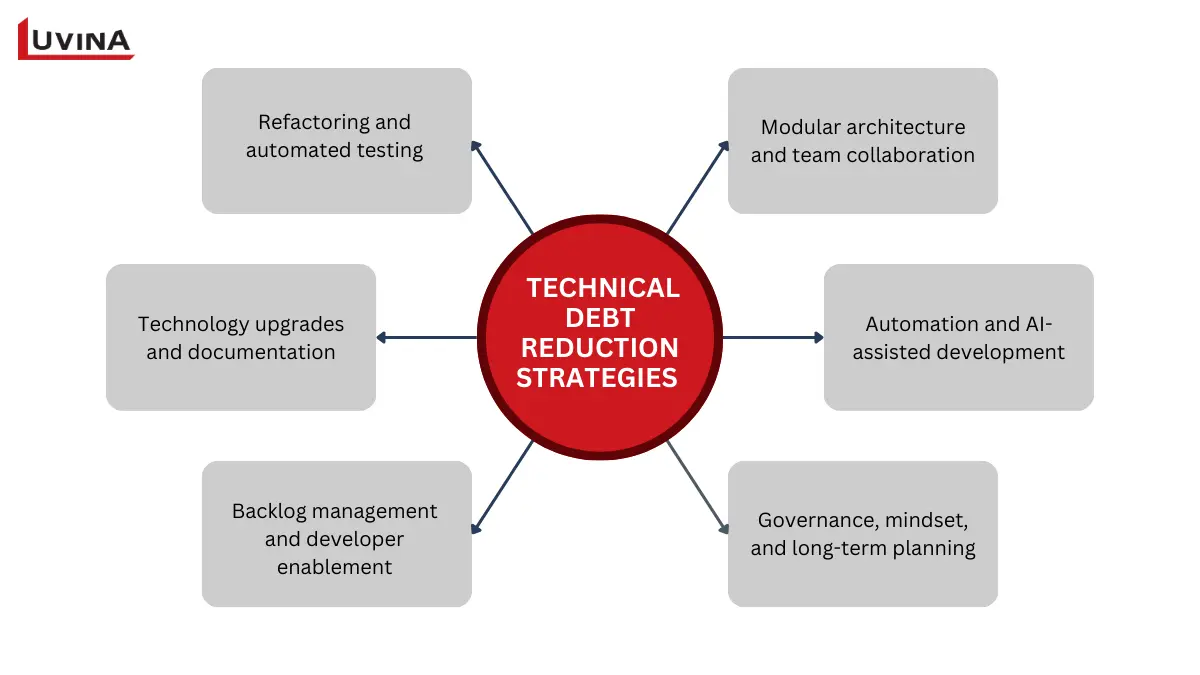
These strategies will help mitigate technical debt to some extent
Refactoring and automated testing
A basic technique in software re-engineering, refactoring enables teams to enhance internal code organization without altering system behavior. Refactoring straight lowers technical debt by simplifying complicated logic, removing duplication, and making design decisions crystal clear.
Automated testing helps this process by giving assurance that changes won’t break current capability, therefore enabling teams to refactor often rather than put off cleaning activities.
Technology upgrades and documentation
Old libraries, frameworks, and unsupported tools usually create more maintenance work and security concerns. Regular updates of technology stacks enable teams to reduce code debt resulting from legacy dependencies. Clear, current documentation helps this effort by making architectural choices visible, lowering onboarding time, and minimizing misunderstandings resulting in subpar execution decisions.
Modular architecture and team collaboration
Dividing systems into smaller, clearly specified modules lowers close coupling and restricts the growth of technical debt throughout the codebase. Modular architectures help one to isolate and test modifications. Code reviews and pair programming, among other methods, help to reinforce common standards, early detection of problems, and avoidance of poor solutions from getting fixed into important systems.
Backlog management and developer enablement
Tech debt ought to be treated like any other development activity; it should be evident. Teams may intentionally reduce technical debt rather than responding to crises by setting up a specialized backlog and assigning items priority based on impact.
Regular instruction and mentorship are also very important since they guarantee that developers have the knowledge necessary to begin writing tidy, maintainable code.
Automation and AI-assisted development
Automation has a major part in contemporary technical debt reduction strategies. Early identification of dangerous patterns and repeated repairs may be accomplished with automated testing, static analysis, and artificial intelligence-aided code review tools. These tools can speed growth and reduce the introduction of new code debt when used under appropriate human supervision.
Governance, mindset, and long-term planning
Organisational alignment is needed for successful code debt reduction. Governance structures, quality guidelines, and reasonable timelines help teams avoid hastily made decisions that endanger the quality of their code. Treating tech debt as an ongoing problem helps development teams to continually invest in long-term system health while also delivering business value.
Managing Technical Debt in Agile
Properly used, Agile offers a solid foundation for constantly lowering, managing, and making tech debt visible. Technical debt agile methods let teams early detect issues and resolve them before they grow into major structural concerns by means of short feedback loops, incremental delivery, and continuous reflection.
Agile advises teams to handle tech debt as an ongoing duty across the product lifecycle rather than as a one-time cleaning project. Without slowing down feature delivery, Agile teams can use the approaches shown below to regularly include code debt management into their daily sprints and routines.
– To avoid undervaluing the delivery scope, include technical debt effort in story point estimation.
– Treat design debt items as backlog priorities based on risk and impact.
– Set apart normal sprint capacity for refactoring and code cleanup.
– Avoid new debt by using continuous integration and automated testing.
– Promote joint code ownership to help to lower information silos.
– Regularly examine tech debt throughout retrospectives.
– Record known debt and clearly stated remediation strategies for the entire staff.
Tools & Practices for Tech Debt Tracking
You cannot manage what you cannot measure. Without consistent tracking, it is impossible to know whether design debt is growing quietly or staying under control. When teams take shortcuts to move faster, they must also measure the impact, effort, and risk created by those decisions.
The table below groups commonly used tools and practices based on the size of technical debt and how it should be tracked and managed.
| Size of debt | Tracking approach | Tools commonly used |
| Small – can be fixed immediately by an individual | Static code analysis and test quality checks | SonarQube, SonarGraph, Klockwork, CodeClimate, Teamscale, VS Code extensions |
| Test coverage monitoring | Codecov, IDE-based coverage tools | |
| Medium – handled through sprint planning | Project and backlog management | Jira, Hansoft, Squore |
| Static code quality analysis | SonarQube, SonarGraph, Klockwork, CodeClimate, Teamscale | |
| End-to-end debt visibility | Stepsize | |
| Large – requires quarterly planning with leadership | 360° technical debt management | Stepsize |
Design debt can be tracked using the following tools
Teams should first categorise debt by amount, then use a suitable tracking technique rather than treating all problems the same.
Technical debt is always controlled through measurement, visibility and consistent review cycles. If there are regular tracking processes in place that match the team’s delivery workflow and planning cycles, they will make better choices to find a good balance between speed and quality, as well as consider the future of the system.
Balancing New Features with Debt Reduction
One of the toughest decisions in software development is striking a balance between long-term code health and feature delivery. Shipping new capability boosts company value, but unmanaged shortcuts might finally drag teams down. Teams following a sustainable strategy must see feature development and debt reduction as two sides of the same coin rather than as competing demands.
Clear alignment and regular planning help teams to strike this equilibrium. Technical stakeholders as well as non-technical ones should be able to see, measure, and debate technical debt using data so that its effects on delivery schedules, bug rates, and maintainability are known.
In fact, effective teams use a few basic ideas:
– Keep a common backlog prioritizing newly added features together with debt-related activities.
– Set aside a predetermined amount of every sprint or cycle, depending on its severity, for debt reduction.
– Use tools and statistics to detect high-impact debt most affecting velocity and stability.
– During planning, clearly share trade-offs to meet stakeholder expectations.
– To get the system back in shape, schedule stabilization or refactoring-targeted sprint regularly.
Teams can keep producing worthwhile features without letting technical debt subtly compromise long-run productivity and product quality by including these habits in daily planning.
Conclusion
Unchecked, code debt silently raises maintenance expenses, stifles invention, and converts even little modifications into dangerous projects. This is why prevention should always come first over remediation, particularly during difficult projects like software migration, when concealed debt can greatly increase dangers. This entails concentrating on a small number of guiding ideas:
– Creating understandable, maintainable code
– Making sure there is enough test coverage to catch problems early and stop weak parts from spreading.
– Using agile engineering techniques to reduce needless complexity from the beginning.
Contact Luvina to discuss customized solutions if your team is planning re-engineering, migration, or modernizing projects and requires specialist help to appropriately manage technical debt!
Resources
- https://en.wikipedia.org/wiki/Technical_debt
- https://www.ibm.com/think/topics/technical-debt
- https://viblo.asia/p/technical-debt-no-ki-thuat-no-code-khong-chi-tra-bang-code-nwmGyEQMGoW
- https://glints.com/vn/blog/technical-debt-la-gi/#2_tac_hai_nghiem_trong_cua_technical_debt
- https://www.atoha.com/blogs/kien-thuc/technical-debt-no-ky-thuat-la-gi#cach_do_luong_no_ky_thuat
- https://www.atlassian.com/agile/software-development/technical-debt
- https://www.sonarsource.com/resources/library/technical-debt/#what-are-the-types-of-technical-debt
- https://waydev.co/measure-tech-debt/
- https://vfunction.com/blog/how-to-reduce-technical-debt
- https://www.codesee.io/learning-center/technical-debt-in-agile
- https://medium.com/swlh/tools-to-track-and-manage-technical-debt-a08fa6778c89
- https://www.ieee-tems.org/ieee-tems-leadership-briefs/balancing-technical-debt/
- https://stripe.com/files/reports/the-developer-coefficient.pdf
READY TO START A PROJECT?
Our experts are eager to explore your needs.


Read More From Us?
Sign up for our newsletter
Read More From Us?
Sign up for our newsletter