




Types of IT Outsourcing: Services, Models and How to Choose


IT outsourcing is not a single delivery model. A company may outsource a software development project, extend its internal team with external specialists, or rely on a provider to maintain existing applications and infrastructure.
Choosing the right approach involves three decisions: which IT services to outsource, how to structure the working relationship, and where the external team should be based. This guide explains the common service categories and engagement models, compares onshore, nearshore and offshore outsourcing, and outlines what to evaluate before choosing a provider.
Common IT Outsourcing Services
Companies most often outsource software development, testing, application support, cloud and infrastructure work, and data or AI projects. The right scope depends on which skills you lack, and which work is repeatable enough to hand over.
| Service | What it covers | Often outsourced when |
| Custom software development | Web, mobile and enterprise applications built to your requirements | You need specialist development capacity or skills not available in-house |
| Application maintenance and support | Bug fixes, updates, monitoring and user support for existing systems | You need ongoing maintenance, issue resolution, or support for existing applications. |
| QA and software testing | Manual and automated functional, performance and security testing | You need additional testing capacity, specialist testing skills, or independent quality checks. |
| Cloud and DevOps | Migration, infrastructure setup, CI/CD pipelines, monitoring | You need specialist expertise to improve cloud operations, automate deployment, or strengthen infrastructure reliability. |
| System integration and modernization | Connecting systems through APIs, upgrading or replacing legacy applications | Existing systems are difficult to integrate, maintain, or adapt to changing business needs. |
| Data and AI engineering | Data pipelines, analytics, machine learning and generative AI features | You need specialist support to build data pipelines, analytics capabilities, or AI-enabled applications. |
| UI/UX design | User research, prototyping and interface design | You need user research and product design expertise for a specific initiative or product. |
| IT infrastructure and security services | Service desk, network and endpoint management, security monitoring | You need external expertise or operational coverage for defined infrastructure and security functions. |
A project may combine several of these services. For example, modernizing a legacy application may require software development, system integration, cloud engineering, and QA. Define the business outcome first, then determine which capabilities your internal team can provide and where external expertise is needed.
IT Outsourcing Engagement Models
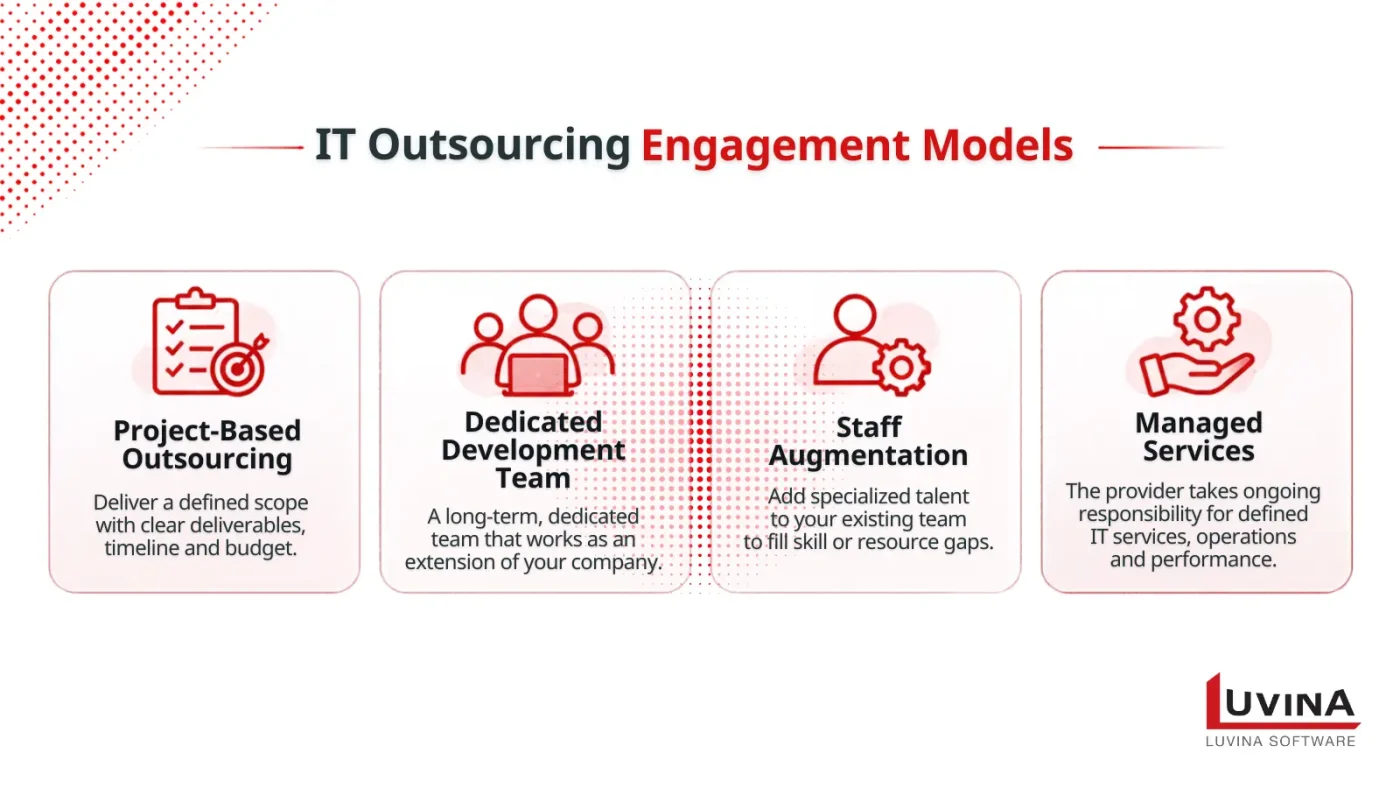
An engagement model defines how an external provider works with your business, how responsibilities are divided, and how delivery is managed. Four common models are project-based outsourcing, dedicated development teams, staff augmentation, and managed services.
Project-Based Outsourcing
The provider delivers a defined project against an agreed scope, timeline, budget, and acceptance criteria. Changes to requirements are managed through an agreed change-control process.
Best suited to: Projects with a sufficiently clear scope, such as developing a new application, upgrading a system, or completing a defined testing phase.
Key consideration: Agree on deliverables, dependencies, acceptance criteria and how scope changes will affect cost and timelines.
Dedicated Development Team
The provider assigns a team that works on your product or technology programme over an extended period of time. Team composition can be adjusted as requirements evolve.
Best suited to: Long-term product development, continuous enhancement or programmes that require sustained engineering capacity.
Key consideration: Define team responsibilities, technical leadership, reporting lines, delivery expectations, and how the team will work with your internal stakeholders.
Staff Augmentation
External specialists join your existing team to fill specific skill or capacity gaps. Your organization generally retains day-to-day direction and prioritization.
Best suited to: Teams that need additional developers, QA engineers or other specialists without immediately hiring permanent employees.
Key consideration: Your team must have enough management capacity to assign work, review output, and integrate external specialists into existing workflows.
Managed Services
The provider takes responsibility for defined ongoing services, operational activities, or agreed service outcomes. Delivery is usually governed by service levels, reporting, escalation procedures, and performance measures.
Best suited to: Application support, infrastructure operations, service desk functions or other recurring activities that need consistent operational ownership.
Key consideration: Specify service levels, responsibilities, escalation paths, security obligations, and how performance will be measured.
These models are not mutually exclusive. A business may use a dedicated development team for product evolution and managed services for application support. Choose based on scope, duration, control and delivery responsibility, not just the provider’s location.
Onshore, Nearshore and Offshore IT Outsourcing: How the Three Models Differ
The three models differ mainly in where your external team is based. Onshore outsourcing uses a provider in your own country; nearshore outsourcing uses a provider in a nearby country or region, often with similar working hours; and offshore outsourcing uses a provider farther away geographically, potentially with a larger time-zone difference.
| Onshore | Nearshore | Offshore | |
| Team location | Same country as the client | Neighboring country or a few hours’ difference | Distant country, different time zone |
| Main strengths | Same language, laws and business culture. Easy on-site workshops. Simpler compliance. | Real-time overlaps during working hours. Closer culture. Usually, lower rates than onshore. | Access to a broader or more specialized talent pool. Often the lowest rates. Scales quickly. |
| Main trade-offs | Highest rates. Smaller talent pool for specialist skills. | Language, legal, and IP terms may differ. Savings are smaller than offshore. | Limited overlap. Needs stronger project management and documentation. |
| Often fits when | Data is sensitive or regulated, or the work needs frequent in-person sessions. | You want daily collaboration at a lower cost. | You need scale or niche skills and can manage asynchronous work. |
Onshore outsourcing places the provider in the same country as the client. It can simplify in-person collaboration and may reduce some cross-border legal or operational considerations. However, local labor costs and the availability of specialist skills may limit its suitability for some projects.
Nearshore outsourcing uses a provider in a nearby country or region, often with substantial working hours overlap. This can make day-to-day collaboration easier while potentially offering cost advantages. Businesses should still assess language, contracting, data protection, and intellectual property requirements.
Offshore outsourcing uses a provider in a more distant location. It can expand access to specialist skills and delivery capacity and may reduce labor costs. The model works best when teams establish clear requirements, communication routines, quality controls, and documented handovers. Time-zone differences can also be an advantage for some support arrangements; provided responsibilities and escalation procedures are well defined.
For Singapore businesses, Vietnam offers an nearshore delivery option with a relatively small time-zone gap. Singapore operates on UTC+8, while Vietnam uses UTC+7, creating a one-hour difference. This allows teams to maintain substantial overlap during standard business hours, making it easier to coordinate meetings, review deliverables, clarify requirements, and resolve issues in real time.
How AI Is Changing IT Outsourcing and Why Businesses Still Need It
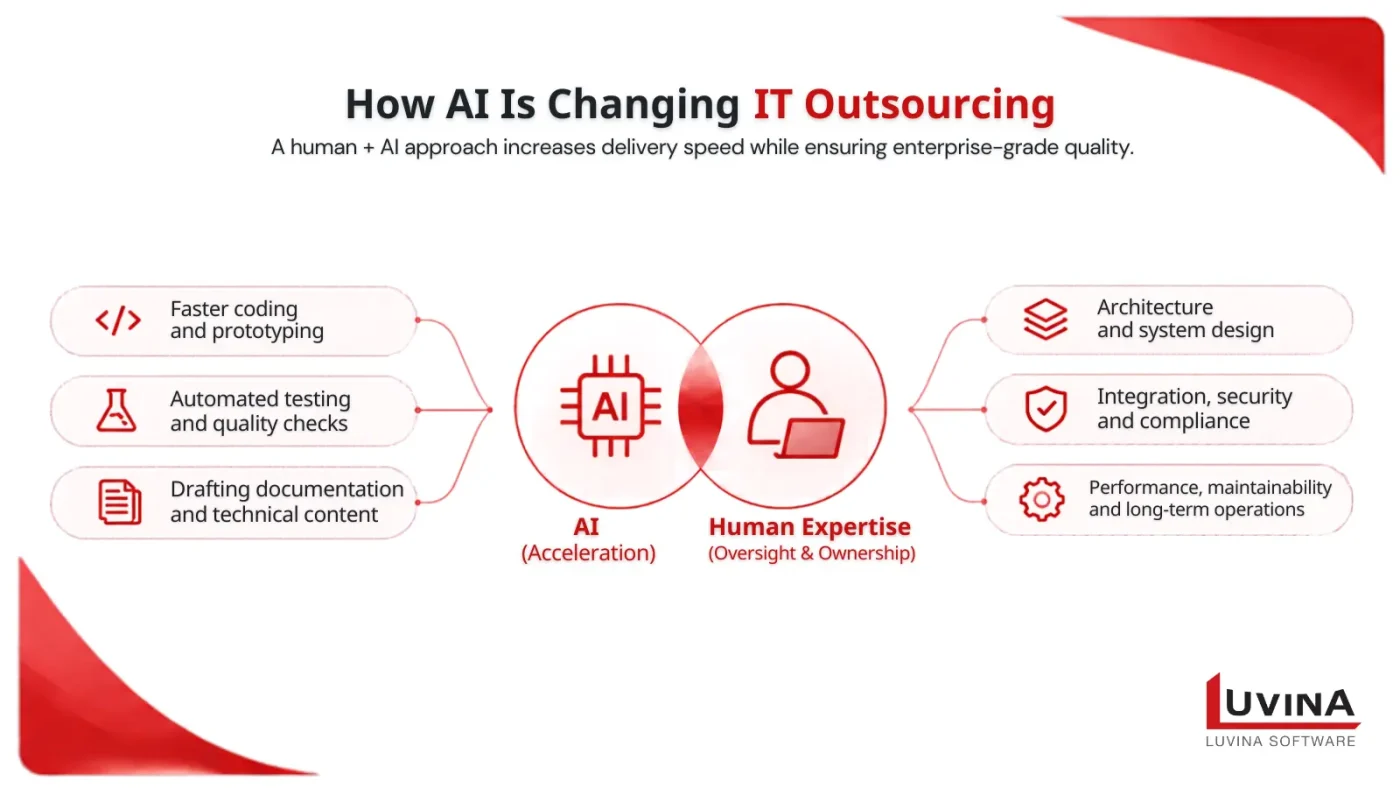
AI is changing how software is built, tested, and maintained. AI coding assistants can help developers generate code, identify potential issues, write tests, and produce documentation. These capabilities can reduce effort for certain engineering tasks and change how outsourcing providers estimate, organize and deliver work.
However, faster development does not automatically mean simpler projects. Building and operating enterprise software still involves business logic, legacy systems, data dependencies, security requirements, and complex integrations. AI can accelerate parts of the process, but businesses still need engineering expertise to ensure that the final solution works reliably in their operating environment.
The Shift from Coding Capacity to Engineering Capabilities
As AI takes on more repetitive development tasks, the value of outsourcing is increasingly tied to capabilities beyond writing code. Businesses may need specialists who can:
- Integrate complex systems: Connect new applications with existing ERP, CRM and legacy platforms while maintaining reliable data flows.
- Design scalable architectures: Make technical decisions that account for performance, maintainability, security and future business requirements.
- Build data and AI capabilities: Prepare data pipelines, integrate AI models, and develop applications that use enterprise data responsibly.
- Manage quality and security: Review AI-generated code, validate system behavior, identify vulnerabilities and ensure solutions meet business requirements.
For businesses, this means evaluating outsourcing providers not only by the number of developers they can supply, but also by their ability to solve complex engineering problems.
AI-Enabled Delivery Still Requires Engineering Oversight
AI-generated code and test outputs are not automatically production-ready. They need to be reviewed and validated against the application’s architecture, business rules, security requirements, and performance expectations.
This is particularly important when working with enterprise environments involving legacy applications, sensitive data, or mission-critical processes. Errors in these areas can affect multiple systems and business operations.
An effective outsourcing partner should therefore have clear practices for using AI tools, reviewing generated outputs, protecting client data, and maintaining accountability for delivery quality.
Outsourcing Is Evolving, Not Disappearing
AI does not remove the need for external engineering capabilities. Instead, it changes what businesses should expect from an outsourcing engagement.
Research suggests that AI coding assistants can improve software development productivity, although the impact varies by task and working context. A 2026 study published in Management Science, based on field experiments involving 4,867 developers across Microsoft, Accenture and a Fortune 100 company, reported an average 26.08% increase in completed tasks among developers using AI coding assistants.
Organizations may still need external specialists to fill skill gaps, modernize existing systems, integrate AI into business applications, or maintain platforms over time. They may also need flexible delivery capacity without committing permanent hiring for every technical requirement.
The key is to choose a partner that combines engineering expertise with responsible AI adoption. Rather than focusing only on development capacity or hourly rates, businesses should assess how a provider uses AI to improve delivery efficiency while maintaining code quality, security and long-term system reliability.
However, faster task completion does not automatically translate into lower total project costs or better long-term software outcomes. Enterprise applications still require architecture decisions, integration with existing systems, security validation, code review, and ongoing maintenance. Businesses should therefore evaluate outsourcing partners based on how effectively they combine AI-assisted delivery with engineering oversight and accountability.
How to Choose the Right IT Outsourcing Model
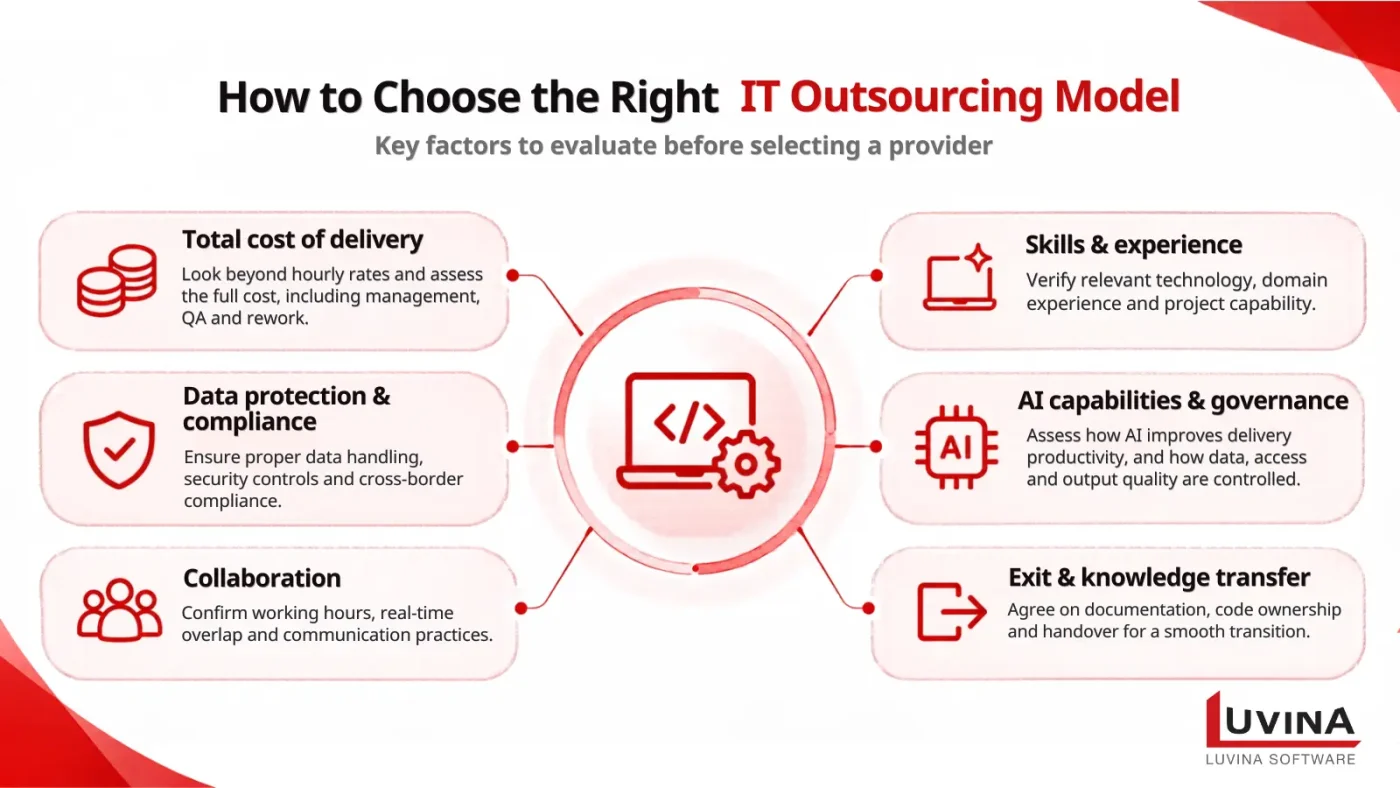
Choosing the right IT outsourcing model requires more than comparing costs and technical capabilities. As AI changes how software is developed and maintained, businesses should also consider how providers use AI to improve delivery efficiency while maintaining quality, security and accountability. Evaluate the following factors before selecting a partner.
Data Protection and Cross-Border Compliance
Assess how personal and business data will be accessed, processed, stored, and transferred across borders. Singapore’s Personal Data Protection Act (PDPA) requires comparable protection for personal data transferred outside Singapore under Section 26. In Vietnam, Law No. 91/2025/QH15, effective from 1 January 2026, and Decree No. 356/2025/ND-CP establish the applicable data protection framework. Review the provider’s security controls, contractual safeguards, data processing responsibilities, and relevant cross-border transfer requirements before engagement.
Collaboration
Determine how much real-time collaboration your project requires for meetings, reviews, decision-making, and incident response. Consider time-zone differences, communication practices and the provider’s actual working hours to ensure sufficient overlap and avoid delays in day-to-day coordination.
Skills and Experience
Evaluate the provider’s technical expertise, industry knowledge, and experience with projects of similar complexity. Review relevant case studies, client references, and the proposed team’s capabilities to verify that the provider can meet your technical and business requirements.
AI Capabilities and Governance
Evaluate how the provider uses AI to improve software development, testing, and support. Consider whether AI-assisted practices can increase delivery efficiency, reduce repetitive work, and support faster development without compromising code quality or system reliability.
Also clarify what code and data can be submitted to AI tools, how access and retention are controlled, whether client information may be used for model training, and how AI-generated outputs are reviewed and validated before release.
Exit and Knowledge Transfer
Establish clear arrangements for documentation, code ownership and knowledge transfer from the beginning. Define handover procedures and responsibilities to ensure business continuity if you decide to change providers or bring development activities back in-house.
Combining Different Outsourcing Models
Consider combining outsourcing models when a single approach cannot meet all your requirements. For example, your internal team can retain product ownership and architecture while a nearshore or offshore team handles development and testing. This allows you to maintain strategic control while extending engineering capacity.
Why Consider Vietnam for IT Outsourcing?
Vietnam is an attractive option for businesses seeking additional software engineering capacity, specialized technical skills and long-term development support. For Singapore companies, its relatively competitive engineering costs and one-hour time-zone difference can also support efficient collaboration.
According to the 2026 Asia Tech Salary Index by Second Talent, median monthly remote contractor rates in Vietnam are lower than in Singapore across junior, mid-level, senior and lead engineering categories. These figures are indicative benchmarks, not guaranteed outsourcing rates. Actual costs depend on team composition, technical requirements, provider experience, and engagement model. Businesses should compare total delivery costs rather than developer rates alone.
However, cost and location are only part of the decision. Businesses should also assess a provider’s technical expertise, industry experience, delivery processes, quality assurance, security practices, and ability to support long-term requirements.
Luvina’s IT Outsourcing Capabilities
For Singapore businesses looking to extend engineering capacity or modernize existing applications, Luvina offers support across software development, system integration, application maintenance and AI engineering. Engagements can be structured according to project scope, team composition and the level of delivery ownership required.
FAQs
What are the main types of IT outsourcing?
IT outsourcing can be categorized by service, engagement model, and delivery location. Common services include software development, application maintenance, software testing, cloud and DevOps, system integration, data and AI engineering. Common engagement models include project-based outsourcing, dedicated development teams, staff augmentation, and managed services. Businesses can also choose onshore, nearshore or offshore delivery depending on their budget and collaboration needs.
What is the difference between staff augmentation and a dedicated development team?
Staff augmentation adds individual specialists to an existing internal team, with the client typically managing their daily work. A dedicated development team provides a structured group of professionals for ongoing development activities. Staff augmentation suits short-term skill or resource gaps, while dedicated teams are more suitable for long-term projects requiring consistent engineering capacity.
Is offshore outsourcing cheaper than nearshore outsourcing?
Offshore outsourcing can offer lower engineering costs because providers operate in markets with different labor costs. However, total expenses also depend on communication, project management, technical expertise, and delivery quality. Businesses should compare the total cost of delivery rather than developer rates alone.
Why do Singapore companies outsource IT services to Vietnam?
Vietnam offers Singapore businesses access to engineering talent and potentially more competitive development costs. The one-hour time difference (Singapore UTC+8, Vietnam UTC+7) also allows substantial overlap during business hours, supporting real-time collaboration. However, companies should assess the provider’s technical capabilities, security practices, and cross-border data protection arrangements before outsourcing.
Will AI replace IT outsourcing?
AI is unlikely to eliminate IT outsourcing but will change the capabilities businesses expect from providers. AI tools can accelerate coding, testing and documentation, while complex tasks such as system integration, legacy modernization, security, and long-term maintenance still require engineering expertise. Businesses will increasingly need partners who combine AI-assisted development with quality control and technical accountability.
Conclusion
There is no single best IT outsourcing model for every business. The right choice depends on the services you need, how much control you want to retain, who is responsible for delivery, and which location best fits your collaboration, security and budget requirements.
If Vietnam is a potential delivery location for your project, evaluate providers based on technical expertise, delivery processes, security practices and long-term support—not cost alone. Luvina is one option to assess these requirements.
Source
https://pubsonline.informs.org/doi/10.1287/mnsc.2025.00535
https://ieeexplore.ieee.org/document/11121676
https://link.springer.com/article/10.1007/s10664-026-10889-1
Read More From Us?
Sign up for our newsletter
Read More From Us?
Sign up for our newsletter