




What Is Refactoring? When, Why, and How to Refactor Code


McKinsey claims that 70% of the software utilized by Fortune 500 fModern software seldom breaks because of missing features; rather, it becomes too challenging to modify. Teams often lag as products increase in complexity due to disorganized logic, duplicated code, and outdated architectures that are no longer suited for new demands. The Stripe Developer Coefficient Report indicates that engineers spend roughly 42% of their time addressing technical debt and maintenance, rather than developing new capabilities. That lost time immediately affects delivery speed, system stability, and long-term company value. This is where what is refactoring becomes a practical question.
Therefore, what does code refactoring mean in actual development? We’ll examine in this article when refactoring is needed, why it is so important in sustainable software development, and how to successfully refactor code without introducing new dangers.
What Is Refactoring?
“In computer programming and software design, code refactoring is the process of restructuring existing source code – changing the factoring – without changing its external behavior.” This definition from Wikipedia explains what is refactoring at its core. Simply put, refactoring (a software re-engineering approach) is the practice of improving the internal structure of code while keeping its functionality exactly the same. No new features are added, and nothing is removed – the software behaves as it did before.
Rapid repairs, duplicated logic, ambiguous naming, or inconsistent structure often cause code to become more difficult to understand and maintain as software changes. Over time, refactoring keeps the codebase clean and addresses these problems.
For several reasons, sustainable software development benefits greatly from refactoring programming:
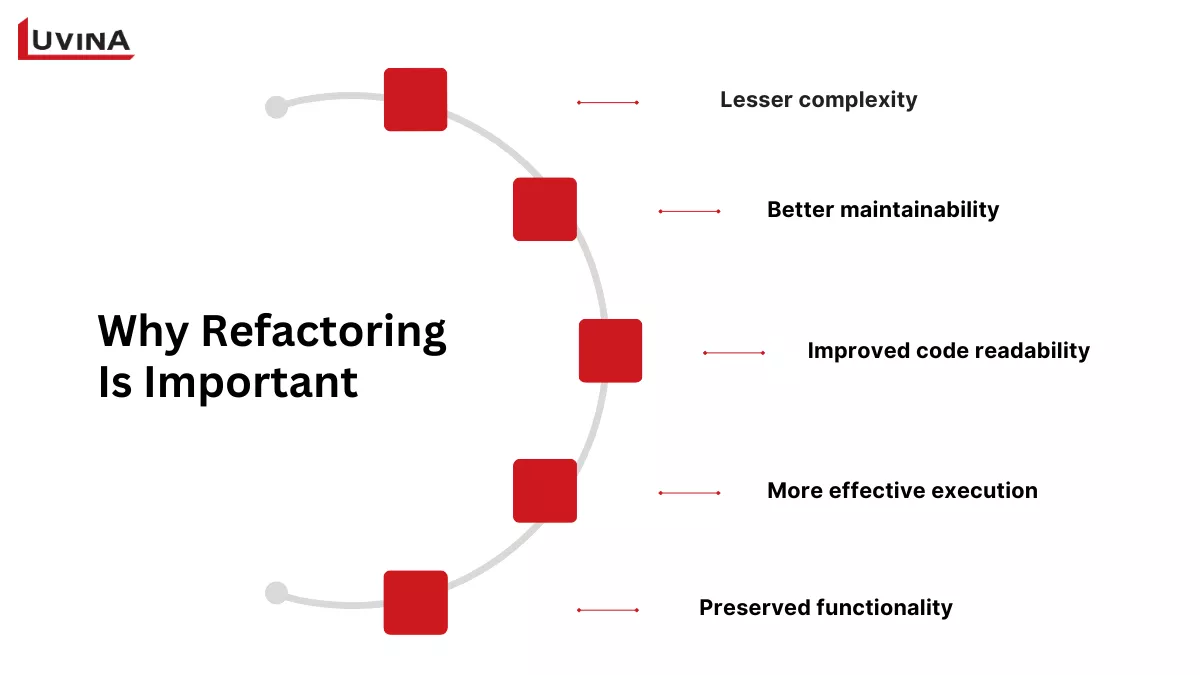
These benefits help clarify what is refactoring
– Lesser complexity: Simpler code is simpler to read, especially in extensive or long-lived projects
– Better maintainability: Well-ordered code makes it simpler to debug, upgrade, and develop over time.
– Improved code readability: Developers find their way across the code more readily thanks to better naming and structure.
– More effective execution: Though not a performance optimization, easier code nevertheless boosts general efficiency.
– Preserved functionality: Refactoring enhances internal quality without altering the behavior of the software.
Refactoring vs. Code Optimization vs. Rewrite
Teams usually ask themselves while enhancing a current codebase: should they refactor, optimize, or rewrite? Although their code modifications might be comparable, their goals and effects are very distinct. Once you know what is refactoring and how it fits into contemporary development methods, including software engineering refactoring, this difference becomes particularly crucial.
Different software reengineering approaches are summarized below to help clarify when and why each should be employed.
| Refactoring | Code optimization | Rewrite | |
| Goal | Improve code structure and readability | Improve performance (speed, memory, efficiency) | Replace the existing system |
| Functionality change | No | No | Yes (often significant) |
| Main focus | Maintainability, clarity, and reduced technical debt | Runtime efficiency and resource usage | New architecture, technology, or features |
| Risk level | Low | Medium | High |
| Cost and effort | Gradual, budget-friendly | Targeted, tool-driven | High upfront investment |
| Impact on users | Minimal or none | Usually none | Often noticeable changes |
| Typical use case | Ongoing improvement, team collaboration | Performance-critical parts of the system | Major scalability, security, or business shifts |
Comparison table between Refactoring, Code Optimization, and Rewrite
You can make wise decisions, lower risk, and concentrate effort where it offers the most long-term value by clearly knowing what is refactoring and noting how it differs from optimization and rewriting.
>> Read more: Software Re-Engineering and Modernisation Explained
When Should You Refactor Code?
Knowing what is refactoring is only the first step; understanding the right timing is just as important. Here are the common scenarios when software refactoring code is beneficial:
– Before adding new features to make integration easier.
– After fixing bugs to prevent similar problems and make future debugging easier.
– When code smells appear, such as duplicates or overly complex methods.
– When code is too complex to understand or maintain, applying what is refactoring principles.
– When adding new features is cumbersome due to the current structure.
– When performance is slow or inefficient.
– When bugs occur frequently in certain areas of the code.
– When coding standards are inconsistent across the project.
– When testing is difficult because of interdependent code.
– When code is hard to read or understand.
Code Refactoring Techniques
Though knowing what is refactoring is essential, applying the appropriate methods guarantees that code gets more modular, simpler to maintain, and cleaner. Various code refactoring techniques address different problems. The following table shows the most often used techniques.
| Technique | How does it work? |
| Extract method | Break large methods into smaller, single-purpose methods for clarity |
| Rename variable | Give meaningful names to variables to improve understanding |
| Simplify conditionals | Refactor complex or nested conditionals into simpler logic |
| Remove dead code | Eliminate unused functions or outdated code to keep the codebase clean |
| Abstraction | Generalize classes or methods to hide complexity and improve reusability |
| Composition | Split large code blocks into smaller, manageable pieces using extraction or inlining |
| Moving features | Move attributes or methods between classes to reduce dependencies and improve cohesion |
| Red-green-refactor | Iterative TDD approach: write failing test, implement minimal code, refactor for clarity |
| Simplification | Reduce parameters, combine repeated logic, or replace conditionals with polymorphism |
| Inline method | Replace small method calls with the method body to simplify the code |
Some of the most common code refactoring techniques
Refactoring Examples
Imagine a banking system serving millions of customers every day, yet trapped in years of messy code. Or an online store struggling to handle sudden traffic spikes because its code can’t keep up. These are the genuine problems developers encounter. The following are actual examples of refactoring demonstrating how teams handled complicated, untidy code and converted it into efficient, scalable, high-performing systems. Every instance shows that refactoring fixes actual issues, raises maintainability, and enables firms to run efficiently.
Legacy system modernization
A major bank modernized its core platform by gradually breaking a monolithic system into microservices. Performance improved, reliability increased, and customers experienced no downtime. This shows clearly how what is refactoring can enable large-scale system upgrades.
Microservice transformation
An online retailer split a single large application into independent services to handle growing traffic. Careful planning of service boundaries ensured a smooth transition.
Balancing technical improvements with business continuity
A software company upgraded critical systems with small, controlled refactoring steps, keeping the system live and stable. This example highlights how what is refactoring maintains operational continuity during technical changes.
Data science optimization
Refactoring programming can yield great performance improvements even in data-heavy applications, as optimizing an ECDF function for avocado price analysis decreased processing time from several seconds to under one second.
Maintaining team motivation
A business gamified a drawn-out refactoring project, monitoring success and honoring milestones like quicker load times and fewer bugs. This shows how what is refactoring might also boost team productivity and participation.
Best Practices for Code Refactoring
Done carelessly, Refactoring can seem like tidying a sloppy house: it wastes time and frustrates. However, when done properly, it turns complicated code into something simple, understandable, and manageable. Knowing what is refactoring is starts only; following the established refactoring best practices below guarantees every modification offers genuine value.
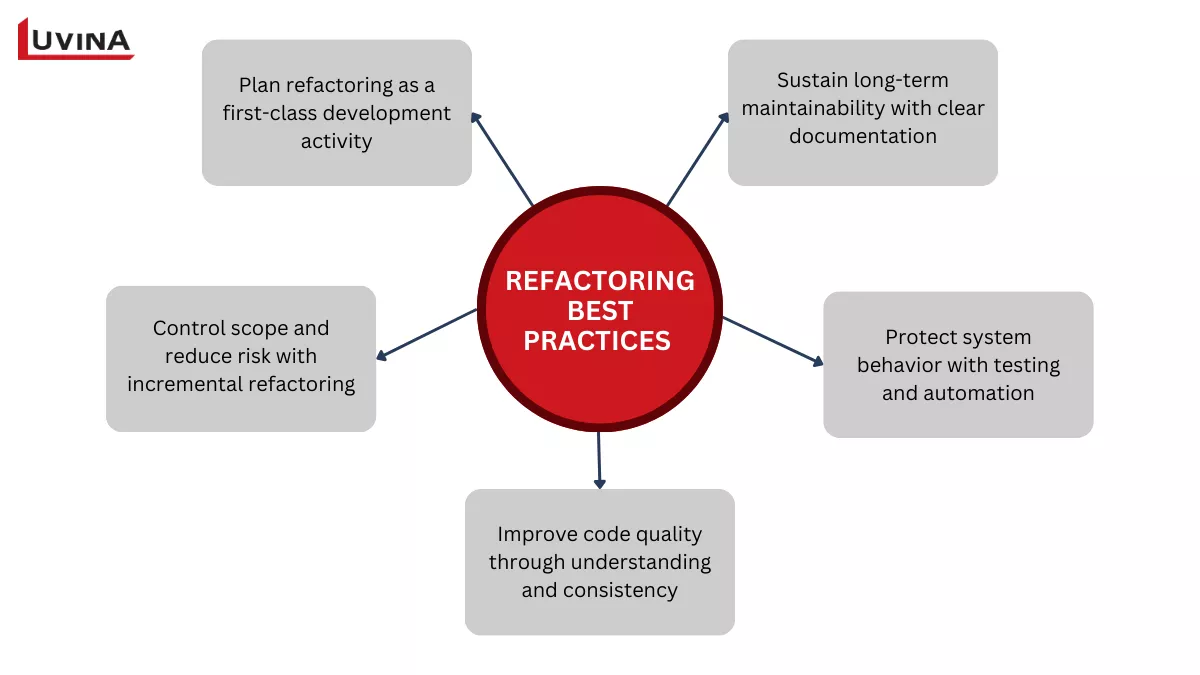
Proper code refactoring using these best practices
– Arrange devoted time for refactoring, define the scope and schedule.
– Refactor before including new capabilities to help to lower technical debt.
– For safer, more manageable modifications, take modest, phased steps.
– Establish defined aims to prevent unintentional changes.
– Test often to make sure behavior stays right.
– Automate repetitive activities to save time and boost efficiency.
– Deal with flaw corrections independently from refactoring efforts.
– Before making modifications, fully grasp the code.
– Now and then, rewrite to stop technical debt from building up.
– Simplify and maximize the codebase by eliminating duplicate code.
-Follow coding standards and design principles to maintain structure.
– Document changes to facilitate future refactoring cycles.
– Time refactoring strategically, e.g., during maintenance cycles or before major updates.
Code Refactoring Tools
Teams rarely depend only on manual modifications to grasp what is refactoring is in real-world development. Early detection of structural problems, safe transformations, and maintenance of big codebases without breaking current behavior are all made possible by contemporary code refactoring tools. Most frequently used instruments are shown in the table below:
| Tool | Typical use | Main value |
| IntelliJ IDEA | JVM-based languages | Built-in refactoring actions like rename, extract, move, and safe delete |
| Eclipse | Java development | Supports method extraction, interface refactoring, and signature changes |
| Visual Studio | .NET development | Provides automated renaming, inlining, and code restructuring |
| ReSharper | Visual Studio plugin | Advanced refactoring suggestions and code-quality improvements |
| SonarQube | Code quality analysis | Identifies code smells, duplication, and maintainability issues |
| PMD | Static code analysis | Detects structural problems and refactoring opportunities |
| JArchitect | Java architecture analysis | Visualizes dependencies and guides large-scale refactoring |
| NDepend | .NET architecture analysis | Helps refactor complex dependencies and legacy code |
| RuboCop | Ruby linting and formatting | Enforces consistent structure and cleaner code patterns |
Code refactoring tools help make the reengineering process easier
How Refactoring Fits into Agile & SDLC
Seeing how refactoring fits into the entire software development lifecycle (SDLC) depends on knowing what is refactoring. Phases of SDLC include design, implementation, testing, deployment, and maintenance, together with requirements gathering. Though every stage has different objectives, refactoring is essential in guaranteeing code remains neat, maintainable, and flexible all the way through.
Design/ architecture phase
Planning the architecture of the application is the main priority at this point. Early detection of design flaws or inefficiency might lead to refactoring. A selected design pattern, for instance, could need modification; a quick refactor can avoid difficulties before starting code. Understanding what is refactoring here helps to lower future technical debt.
Implementation/ coding phase
This is where refactoring is most effective. Constant modifications are made to improve performance, maintainability, and readability as developers write code. Including what is refactoring throughout implementation guarantees the codebase does not grow too complicated, even as more functionality is added. Moreover, later on in the cycle, it simplifies debugging and testing.
Agile methodology and iterative development
Refactoring is a component of every agile sprint. Engineers continuously enhance the current code as they work on user stories and features. This approach enables teams to address evolving demands, preserve code quality, and stop technical debt buildup. Integrating what is refactoring into Agile processes helps companies preserve the flexibility and sustainability of their codebase.
Other SDLC approaches
Refactoring fits naturally in ordered SDLC models even outside Agile. Usually done after significant milestones or during maintenance phases, code cleanup and optimization in Waterfall or iterative models is often carried out. Independent of approach, frequent or intermittent refactoring promotes long-term software health and scalability.
Refactoring Mistakes to Avoid
Even with an awareness of what is refactoring is, developers can still make errors that diminish its advantages. Watch for these major errors:
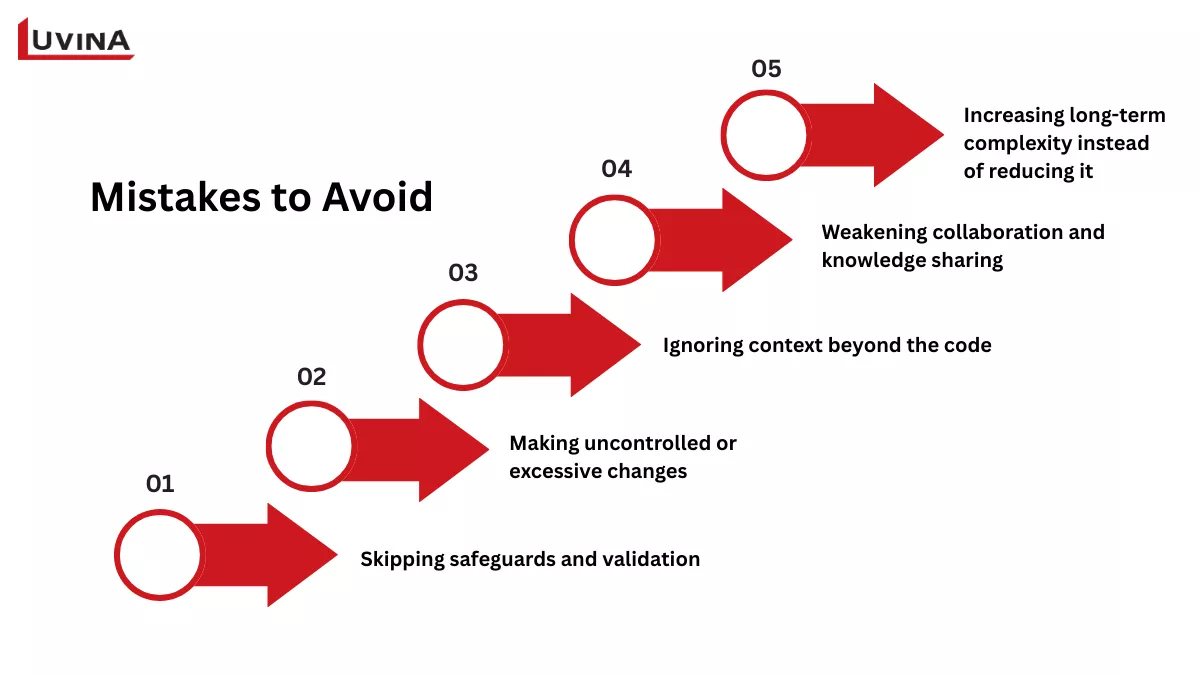
Things to avoid when implementing software engineering refactoring
– Skipping tests: Refactoring without unit or integration tests before refactoring can present fresh problems.
– Changing too much at once: Big, concurrent changes are difficult to control and might result in mistakes.
– Ignoring documentation: Ignoring documentation results in confusion and inconsistencies.
– Overlooking business context: Refactoring without regard for user requirements could destroy essential features.
– Premature optimization: Code optimized without an actual need adds to complexity and maintenance difficulty.
– Unconsidered interface changes: Unconsidered modifications to public interfaces could affect other systems or outside users.
– Poor team communication: Bad team communication might cause code clashes or redundant efforts.
– Keeping old code fragments: Leaving “just in case” unused code adds mess to the codebase.
– Ignoring performance: Refactoring modifications that degrade performance could hurt the system worse than the underlying issue.
– Refactoring without purpose: Alterations made without a defined objective add needless complexity.
– Losing focus on goals: Always remember what is refactoring – enhancing readability, maintainability, and structure – not only changing code.
Conclusion
We have examined throughout this article what is refactoring, how it differs from code optimization and rewriting, the best practices to follow, typical errors to avoid, practical examples, and software that speeds up the process. Including refactoring in your development process helps teams lower technical debt, improve collaboration, support smoother software migration, and ensure code quality over time. For expert guidance on refactoring, contact Luvina today.
Resources
- https://stripe.com/files/reports/the-developer-coefficient.pdf?utm_source=chatgpt.com
- https://en.wikipedia.org/wiki/Code_refactoring
- https://www.ibm.com/think/topics/code-refactoring
- https://www.sonarsource.com/resources/library/refactoring/#refactoring-tools-and-software
- https://medium.com/@jagtapmahesh0811/code-refactoring-vs-optimization-e09152edf2bb
- https://www.docuwriter.ai/posts/code-refactoring-examples#learning%20from%20real-world%20refactoring%20succe-%20storie-
- https://medium.com/@marumanemogoswane/the-art-of-code-refactoring-3890ac51df9c
READY TO START A PROJECT?
Our experts are eager to explore your needs.


Read More From Us?
Sign up for our newsletter
Read More From Us?
Sign up for our newsletter