




5 Things to Know Before Application Management OutsourcingApplication Management Outsourcing Guidelines


Many businesses see application management outsourcing as a great way to tap into expert skills in today’s fast-changing tech world. As companies depend heavily on applications, managing them through outsourcing is essential for maintaining smooth and secure operations. What exactly does application management outsourcing entail? What are the benefits and challenges it presents? Should your company consider this service? We’ll address all these questions in the following article.
What is Application Management Outsourcing (AMO)?
Application management outsourcing is related to hiring an external company to take care of applications of a business. This usually includes developing, maintaining, enhancing, and supporting the application. By relying on specialized application management outsourcing providers, businesses can make sure their applications run smoothly, and securely, and meet their evolving needs.
This approach can cut down operational costs, improve service quality, and let internal IT teams focus on key business activities and strategic goals. Plus, application management outsourcing offers access to the latest technologies and industry best practices, ensuring ongoing improvement and innovation in managing applications.
Reasons for Businesses to Outsource Their Application Solutions
As technology advances, the business market becomes increasingly competitive. In this context, application management outsourcing becomes a crucial factor for businesses to adapt flexibly.
Application management outsourcing allows businesses to delegate the responsibility of managing and maintaining software applications to specialized service providers. This provides businesses access to a diverse pool of expertise through skilled teams.
These experts deliver high-quality services and ensure efficient management of applications. Additionally, using professional application management services enables businesses to scale IT resources comfortably without being limited by internal capabilities. This scalability and flexibility are essential for handling varying workloads and adapting to changing business needs.
Partnering with specialized providers also enhances risk management, as they have expertise in implementing security measures and compliance protocols, reducing the risk of data breaches and minimizing downtime. Outsourcing partners often lead in technological advancements, introducing new tools and best practices to improve application performance. Many also offer 24/7 support to ensure continuous monitoring and maintenance, minimizing downtime and addressing issues promptly.
Another benefit of outsourcing application management is cost savings. Outsourcing helps organizations reduce expenses related to hiring, training, and maintaining an internal IT team.
>> Also read: 7 Key Benefits Of Application Management Services
What Does Application Management Outsourcing Include?
The scope of application management outsourcing can vary depending on the applications, business requirements, and responsibilities a company wants to transfer to an external provider. In general, AMO covers the activities needed to keep business applications stable, secure, efficient, and aligned with changing business needs.
Common application management outsourcing services include:
- Application monitoring and support: Monitoring application performance and availability, handling user requests, and responding to incidents to keep applications running smoothly.
- Corrective maintenance: Identifying and fixing bugs, errors, and application failures that affect business operations.
- Performance optimization: Analyzing application performance and improving slow processes, resource usage, databases, or other components that may affect system efficiency.
- Feature enhancement: Improving existing functions or developing new features when business requirements change.
- Security and compliance support: Applying security updates, managing vulnerabilities, and helping applications meet relevant security and regulatory requirements.
- Application integration: Maintaining and improving connections between applications, databases, APIs, cloud services, and third-party systems.
- Documentation and knowledge management: Updating technical documents, operating procedures, system specifications, and other information needed for long-term maintenance.
- Application modernization: Gradually improving outdated applications through technology upgrades, refactoring, cloud migration, or other modernization activities.
The scope may also extend to application development and maintenance outsourcing, where the external provider is responsible not only for maintaining existing applications but also for developing new features or applications. In practice, the boundaries between development, maintenance, and application management can overlap, especially in long-term outsourcing relationships.
The exact scope should therefore be clearly defined between the business and the provider before the service begins.
Application Management Outsourcing Models
There is no single application management outsourcing model that works for every business. Companies can choose a model based on the size of their application portfolio, internal IT capabilities, budget, required expertise, and desired level of control.
Full application management outsourcing
Under this model, a provider takes responsibility for most or all application management activities within the agreed scope. This may include monitoring, maintenance, support, enhancements, reporting, and continuous improvement.
Full outsourcing can be suitable for businesses that want to reduce the operational workload of internal IT teams and rely on a specialized provider for day-to-day application management.
Selective application management outsourcing
Instead of outsourcing the entire application portfolio, businesses can transfer only specific applications, functions, or activities to an external provider.
For example, a company may keep strategic applications in-house while outsourcing legacy system maintenance, application support, testing, or specific technical areas.
Selective outsourcing gives businesses more control and can be a practical way to start application management outsourcing before expanding the partnership.
Onshore, nearshore, and offshore outsourcing
Application management services can also be classified according to where the provider’s team is located.
- Onshore outsourcing: The provider operates in the same country as the client. Communication and cultural alignment may be easier, but costs are usually higher.
- Nearshore outsourcing: Services are delivered from a nearby country or region, providing a balance between cost, time-zone compatibility, and communication.
- Offshore outsourcing: Services are delivered from a more distant location, often providing access to a larger talent pool and lower operating costs. However, businesses need clear communication processes and governance to manage differences in time zones, language, and working practices.
- Hybrid model: Businesses combine onsite, onshore, nearshore, or offshore resources depending on the requirements of each activity.
Application Management Outsourcing Challenges
Application management outsourcing can be very beneficial for businesses, but it also comes with some challenges.
Lack of communication and coordination
For application management outsourcing to work well, your business and the service provider need to communicate effectively and coordinate closely. Problems can arise due to different time zones, cultures, and ways of communicating.
- Tip: Make sure to set up clear ways to communicate and keep detailed records so everyone understands the processes and information.
Security and compliance Issues
Outsourcing application management means sharing your sensitive data with external providers, which increases the risk of security breaches.
- Tip: Ensure that providers follow strict security protocols and comply with relevant regulations. Set clear security requirements and conduct regular audits to protect your systems and data.
Service quality
The performance of outsourced application management providers may not always meet your standards. Poor service can negatively affect application performance and user satisfaction.
- Tip: Specify detailed service level agreements (SLAs), set performance metrics, and regularly monitor these metrics to maintain quality.
Dependency on the provider
Dependency is inevitable when you choose application management outsourcing. This reliance becomes more apparent if the provider’s performance declines or if you need to terminate the partnership.
- Tip: Prepare an exit strategy, including knowledge transfer plans, technology handover, and backup resources.
Hidden costs
While application management outsourcing can save costs, hidden expenses can undermine these savings. Hidden costs may include service transition costs, expenses related to unexpected issues, and relationship management costs.
- Tip: Carefully analyze the total costs and maintain a detailed budget to account for any hidden expenses.
Loss of Control
Using application management outsourcing services can make your business feel less in control of its IT operations. This can lead to misalignment between IT services and business goals or slow responses to changing needs.
- Tip: Build a strong governance structure, clearly define roles and responsibilities, and actively participate in management and decision-making to maintain control and alignment.
Choose the right Application Management Outsourcing Provider
The quality and effectiveness of application management heavily depend on choosing the right outsourcing service providers. To select the right provider, here are some criteria you should consider:
- Business requirements: Understand exactly what your company needs from application management outsourcing. What services are you looking for? What’s the project about? What are your long-term goals? The clearer you are, the easier it will be to find the right provider.
- Provider’s expertise and experience: Look at the provider’s past work to see if they have managed similar applications before. Check if they have relevant industry certifications that show they have the skills needed for your technology and applications.

- Security and compliance capabilities: Make sure the application management outsourcing provider follows security practices and meets all relevant regulations and standards. This helps protect your sensitive data and ensures you stay on the right side of the law.
- Service Level Agreements (SLAs): Check the provider’s SLAs to know what level of service you can expect. Look at some key factors like response times, resolving issues times, and performance standards.
- Technical capabilities: Check out the provider’s technical skills, including the tools and methods they use. Ensure they’re using the latest technology and can easily work with your existing systems.
- Scalability and flexibility: The application management provider should have the capacity to scale services according to your company’s needs.
- Cost: Clarify the cost structure and ensure it fits within your budget. Also, consider the overall value provided, meaning the balance between cost and the quality of services received, rather than just focusing on the price.
- Communication and collaboration: The success of application management outsourcing depends heavily on communication. Therefore, the service provider must have effective communication processes and tools to facilitate clear and transparent collaboration. Cultural compatibility is as important as communication and collaboration. The provider’s work ethic and business practices should align with your company’s values to ensure a harmonious and effective partnership.
- Exit strategy: Develop a clear exit strategy. This includes understanding the process for transitioning services back in-house or to another provider if necessary, to minimize dependence on a single provider.
How to Transition to an Application Management Partner
Moving application management responsibilities from an internal team or an existing vendor to a new application management partner requires careful preparation. A rushed transition may result in lost knowledge, unresolved incidents, or disruptions to business operations.
A structured transition usually includes the following steps:
1. Assess the current application environment
Start by identifying the applications that will be outsourced and collecting information about their architecture, technologies, dependencies, users, current issues, and business importance.
Applications should also be classified according to factors such as criticality, complexity, security requirements, and expected support levels.
2. Define the outsourcing scope and responsibilities
Clearly determine which responsibilities will remain with the internal team and which will be transferred to the application management partner.
The scope may include application support, maintenance, monitoring, feature development, testing, documentation, modernization, or a broader application development and maintenance outsourcing arrangement.
A responsibility matrix can help prevent gaps or duplicated work between both parties.
3. Establish SLAs and performance metrics
Before the transition starts, both parties should agree on measurable service expectations.
These may include application availability, incident response time, resolution time, SLA compliance, backlog levels, user satisfaction, and other service-specific KPIs.
Critical applications normally require stricter service levels than low-priority internal systems.
Here is a sample SLA and KPI Metrics for Application Management Outsourcing for your reference.
| Metric | Example target | What it measures |
| Application availability | 99.9% per month | Whether critical applications remain available during the agreed service period |
| P1 / Critical incident response time | Within 15 minutes | How quickly the provider acknowledges a business-critical issue |
| P1 / Critical incident restoration time | Within 4 hours | How quickly critical service can be restored or a workaround provided |
| P2 / High incident response time | Within 30 minutes | Response speed for serious but non-critical issues |
| SLA compliance rate | ≥95% | Percentage of tickets or incidents handled within agreed SLA targets |
| Mean Time to Restore (MTTR) | Track monthly and improve over time | Average time required to restore service after an incident |
| First-time resolution rate | ≥70% where applicable | Percentage of requests resolved without repeated escalation or reopening |
| Change success rate | ≥95% | Percentage of application changes completed without rollback or major incidents |
| Ticket re-open rate | <5% | Whether reported issues are being resolved effectively |
| User satisfaction | ≥4/5 | Satisfaction of users receiving application support |
4. Transfer knowledge
Knowledge transfer is one of the most important parts of an AMO transition.
The existing team should provide the new provider with relevant source code, system architecture, operating procedures, known issues, access information, technical documents, release processes, and business rules.
If documentation is incomplete, the new provider may need to conduct application analysis or reverse engineering before taking full responsibility.
5. Run a controlled transition period
Instead of transferring responsibility immediately, businesses can use a phased transition.
The new application management partner may first observe the existing team, then work alongside them, and gradually take ownership of application management activities.
This approach gives both sides time to identify knowledge gaps and operational risks before entering steady-state service.
6. Move to steady-state operations
Once the transition criteria are met, the provider takes responsibility for the agreed services.
Regular reporting, service reviews, escalation procedures, and communication meetings should continue throughout the partnership.
7. Continue improving the applications
Application management should not stop at resolving incidents and keeping systems available.
The business and provider should regularly review technical debt, recurring issues, application performance, security, automation opportunities, and modernization priorities.
This helps turn application management from a reactive support activity into a process of continuous improvement.
2026 Trends in application management outsourcing
According to predictions, application management outsourcing will continue to evolve to meet the needs of businesses and drive technological advancements. Here are some key trends that are expected to dominate the application management outsourcing field in the future:
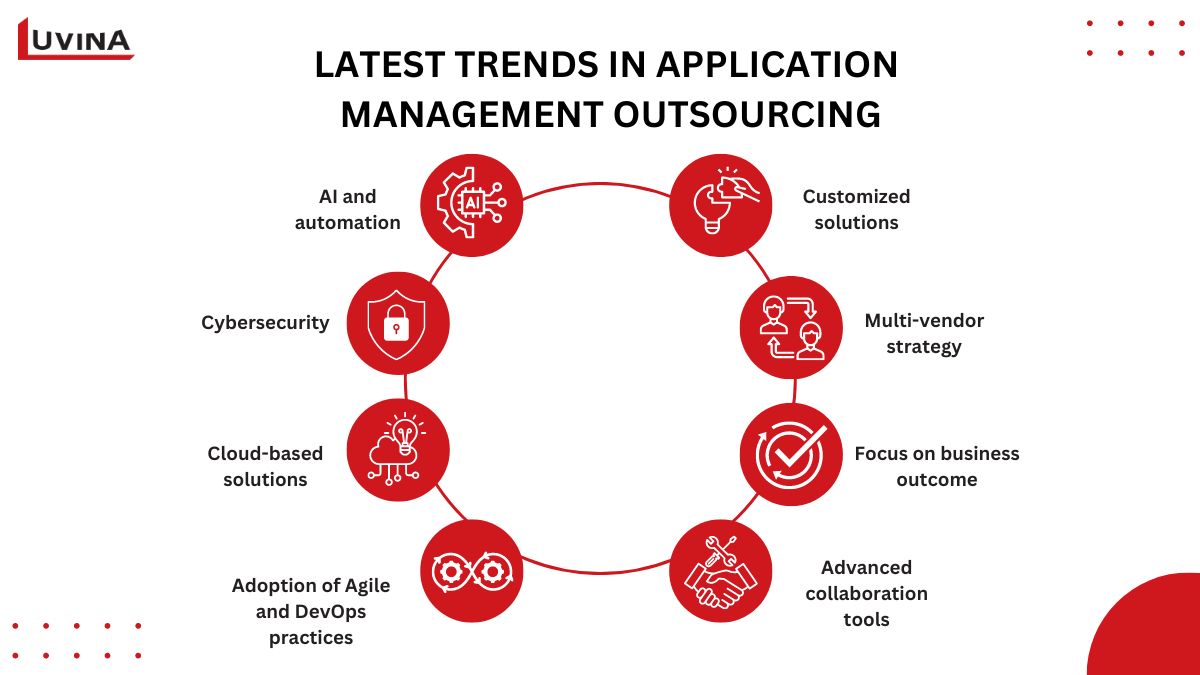
- More use of AI agent and Automation: Application Management processes will increasingly integrate AI and automation for less human intervention, improved performance, cost savings and faster processing. However, the increasing amount of AI-related errors and security vulnerability issues is raising the demand for a solid AI-usage monitor for AMS service providers.
- Focus on Cybersecurity: Security measures that are advanced shall be integrated into application management outsourcing services for data protection purposes. The providers will prioritize creating strong security protocols, continuous system monitoring, adherence to industry regulations that protect sensitive data and applications.
- Cloud-based solutions: Application management outsourcing providers will move towards cloud computing for greater scalability, flexibility, and ease of integration with other cloud services.
- Adoption of Agile & DevOps practices: These practices allow for shorter development cycles, continuous delivery as well as better alignment between development and operations teams all aimed at enhancing efficiency in application management.
- Customized solutions: Tailoring solutions to business specific needs is now being emphasized by providers.
- Multi-vendor strategy: Increasingly, more and more companies now prefer to have multiple service providers to reduce risks and accommodate the strengths of various vendors. This strategy will, therefore, allow companies to derive greater benefits in technology and skill areas.
- Focus on business outcomes: Instead of merely focusing on IT metrics, outsourcing providers for application management now focus more on giving business outcome value, whether it pertains to revenue growth or customer satisfaction.
- Advanced collaboration tools: Advanced collaboration tools will be there to back up providers and businesses regarding coordination and communication, making project management and operations run smoothly.
How can Luvina help?
Managing applications over the long term requires more than fixing bugs when problems occur. Applications need regular analysis, maintenance, enhancement, documentation, and sometimes modernization to continue supporting changing business requirements.
As an application management partner, Luvina supports businesses across these activities through software maintenance, application support, development, migration, and modernization services.
Luvina’s software maintenance services focus on three main areas:
- System analysis: Analyzing applications to identify problems, understand root causes, and find opportunities to improve maintenance efficiency and system performance.
- Feature enhancement and development: Improving existing functions and developing additional features according to changing business requirements.
- Reverse engineering and documentation: Analyzing existing or legacy applications when technical information is incomplete and creating the documentation needed for future maintenance and development.
For businesses requiring a wider scope, these capabilities can also support application development and maintenance outsourcing, where application enhancement and development continue alongside long-term maintenance.
Luvina can provide different collaboration models depending on project requirements, including Offshore Development Center (ODC), dedicated teams, staff augmentation, Time & Material, and project-based outsourcing. This allows businesses to select a model based on the level of control, flexibility, and resources they require.
Application modernization can also be incorporated into the management process when existing systems become difficult to maintain. Luvina provides software migration and modernization services covering areas such as technology upgrades, application restructuring, data migration, and cloud migration.
For ongoing operations, Luvina has a team of more than 750 IT professionals and provides 24/7 troubleshooting upon project requirements. Its software maintenance services follow ISO 9001 quality management practices, while ISO 27001 supports information security and intellectual property protection.
Rather than treating application management only as day-to-day maintenance, businesses can work with Luvina to maintain existing applications, improve them over time, and plan modernization when business or technology requirements change.
Related Posts:
- SAP Application Management Services
- Application Configuration Service – Key To Boost Efficiency
- Application Performance Management At Your Fingertips
READY TO START A PROJECT?
Our experts are eager to explore your needs.

Read More From Us?
Sign up for our newsletter
Read More From Us?
Sign up for our newsletter