




AI in Fashion Industry: Revolutionizing Style & Innovation


AI in fashion industry is no longer a distant promise; it is the engine driving a high-tech creative revolution. Recent McKinsey analysis reveals that Generative AI alone could add $150 billion to $275 billion to the operating profits of the apparel, fashion, and luxury sectors within the next three to five years. From accelerating the ‘sketch-to-shelf’ cycle to hyper-personalizing the customer journey, AI is transforming fashion from a traditional craft into a data-driven powerhouse of innovation.
This huge figure shows that AI is not just a disruptive force but also creates value for the fashion industry. AI’s potential to reshape the fashion landscape is extremely diverse, from trend forecasting and optimizing the supply chain to customizing the shopping experience.
While the following article discusses artificial intelligence’s influence on the development process of fashion products, join us to discover how such superior technology can influence one of the biggest industries in the world.
How is AI in fashion industry?
It is believed that AI in fashion industry is one of the most effective transformative forces that impresses change in each and every aspect and stage of the field, right from design to production, sales, and optimization of customer experience. The following are some of the areas where AI is being used in the fashion industry.
1. Personalized marketing & shopping experience
Today, in the age of e-commerce, the power of personalization has landed squarely in the hands of retailers, and AI will help businesses get ahead. Using AI, brands can create shopping experiences and marketing no one ever imagined. To do so, AI may use critical customer data: past purchases, browsing history, social network activity, or any other source useful for building highly targeted marketing campaigns with personalized recommendations.
These personalized recommendations and marketing campaigns will increase customer engagement and boost sales. Not only are large retailers like Asus, Alibaba, and Amazon leveraging AI in fashion industry, but small businesses are also using it to personalize their customers’ experiences.
>> See more: AI Personalization E-commerce
2. Trend forecasting
Fashion and trends have always moved in tandem, but AI is now accelerating this cycle to unprecedented speeds. According to the AI in Fashion Market Report 2026 by Research and Markets, the global AI fashion market is projected to reach $2.47 billion by 2026, growing at a staggering CAGR of 40.8%. This growth reflects the increasing reliance on AI in fashion industry to mitigate the risks of fast-changing consumer tastes.
Fashion and trends always go hand in hand. That is why one of the most popular applications of AI in the fashion field is trend forecasting. Major players in fashion trend forecasting widely use artificial intelligence to track shopping behaviors, consumer psychology, customer preferences, social media trends, market fluctuations, and global events to make accurate predictions. From there, fashion brands can design suitable collections.
3. Automated ad buying
AI in fashion retail runs programmatic advertising. Expanding on the thought: AI performs real-time buying of ad spaces, targets customer segments, and optimizes ad spending independently. With such capabilities, most fashion brands are now leveraging AI in heavy-duty advertising campaigns to drive greater customer engagement, higher conversions, and more customer loyalty for the ultimate maximization of ROI.
4. Chatbots
Chatbots are among the applications of artificial intelligence in the fashion industry, which directly impacts customer experience. The AI-driven chatbot will be able to engage customers and answer their queries, thus offering suggestions for personalized recommendations that uplift the shopping experience and encourage customer interaction. The response speed will almost be instantaneous, hence on time, clearing up many customer queries and ensuring that customers feel safe due to timely support.
>> Read more: Enterprise AI chatbot development service
Examples and use cases of AI in the fashion industry
The fashion industry keeps changing with time, and the incorporation of AI into it hastens the process of growth. AI has proved to be strong ammunition that can bring holistic changes and help the industry overcome the challenges before it. From independent boutiques to global giants, AI in fashion industry applications are proving their worth across the entire value chain.
The following are some of the applications and examples of AI in fashion industry.
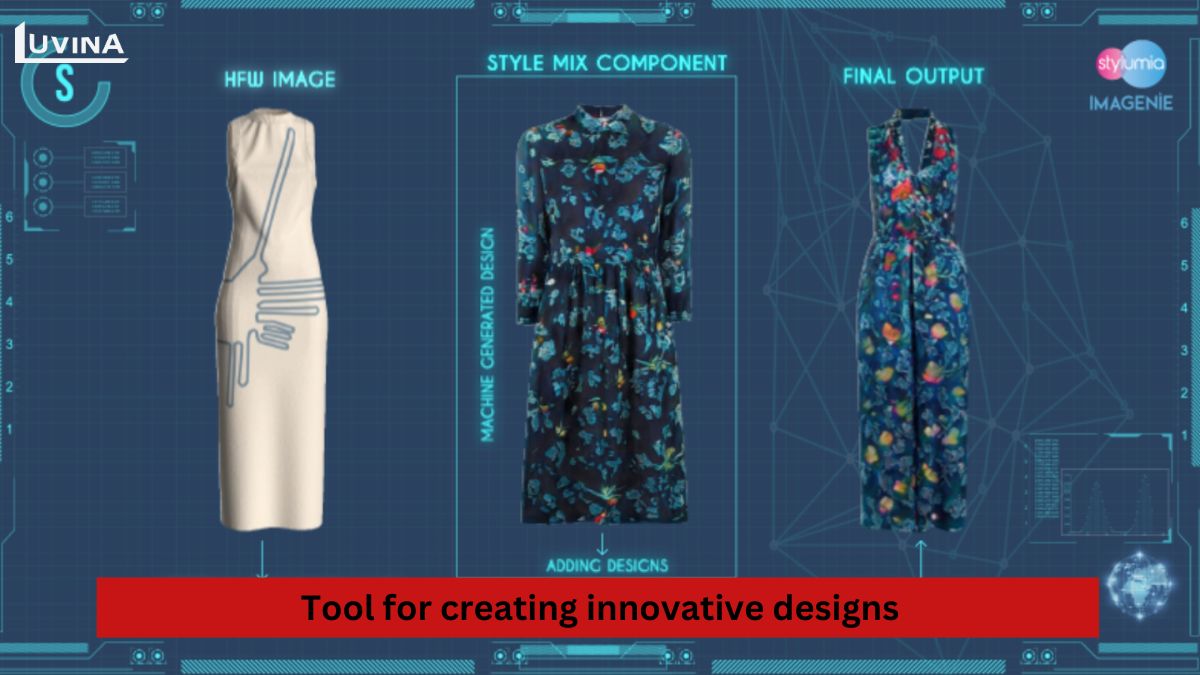
1. Creative ideas for designs
Currently, most companies in the fashion sector are focused on manual clothing design. However, AI is seen as an effective way of taking over design in situations where human designers cannot work. In fact, AI design tools for clothes use image data from past products of a brand or from other designers in combination with data relating to customer preference and current fashion trends. Although experiments have shown that AI still has limitations in design, with the rapid development of AI in the clothing industry, designs created by AI will soon become practical. As these tools evolve, AI in fashion industry will move from simple assistance to full-scale creative partnership.
2. Fashion virtual try-on
By utilizing advanced algorithms and computer vision technology, AI can create extremely realistic and personalized virtual experiences for customers. By combining AI and AR (augmented reality), many fashion brands today not only offer highly engaging online shopping experiences but also reduce the likelihood of returns. The feature of virtual fitting gives realistic images of trying on clothes that help customers make better choices. Certain try-on aspects that find support from AI in fashion industry include:
- Accurately measuring and analyzing body sizes using images and videos uploaded by users.
- Creating virtual fitting rooms for users to see how they would look in the clothes.
- Simulating the movement of clothing items on a virtual avatar for a more realistic view of the actual garments’ movement.
- Providing personalized product recommendations to enhance customer satisfaction based on purchase history, user preferences, and style choices.
- Analyzing the facial expressions and emotions during the time of fitting in order to take feedback from users on various styles, refine recommendations, and understand customers better.
- Virtual fitting is to be embedded on all three platforms: web, mobile applications, and social media, to provide a similar shopping experience for customers.
3. Fashion business operations
AI is no longer a supporting tool; it is becoming the operating system of modern fashion businesses. For instance, AI can predict fashion purchasing trends. It does this by analyzing vast data sources, social media trends, and sales information to predict upcoming trends. This would help the fashion business make informed decisions over their new collections, making sure they provide products that address current styles and emerging trends. Moreover, it would help fashion industries enhance effective marketing in revenue optimization, customer satisfaction, and inventory control with proper planning.
A critical breakthrough lies in demand forecasting and inventory control. According to the 2025 Fashionbi report on AI-Powered Sustainability, implementing AI for demand forecasting allows retailers to reduce excess inventory by 10% to 20%. This efficiency is a cornerstone of sustainable fashion, directly addressing the global crisis of nearly 100 million tons of textile waste generated annually. By optimizing product selection, quantity, and store placement, AI helps businesses avoid costly overstocking and stockouts, effectively maximizing profitability while minimizing their environmental footprint. By streamlining these back-end processes, AI in fashion industry solutions provide a direct path to both profitability and sustainability.
Beyond the supply chain, AI is revolutionizing visual merchandising across both physical and digital storefronts. By analyzing individual customer preferences alongside global fashion trends, AI-driven engines can deliver hyper-personalized outfit combinations and style recommendations, creating a truly engaging and seamless shopping experience.
4. Fashion e-commerce
Driven by radical shifts in consumer shopping habits, fashion e-commerce has emerged as one of the most dynamic and fastest-growing digital niches. According to Omnisend’s Shopify Statistics 2026, the “Fashion & Apparel” category now holds the largest market share on the platform, with over 100,000 active stores as of late 2025. Crucially, a vast majority of these merchants have already integrated AI-driven personalization tools to catalyze their sales growth. The dominance of this sector shows that AI in fashion industry is the primary driver of digital sales growth today.

AI’s primary role in this sector is enhancing the customer journey through hyper-relevant product recommendations. By performing real-time analysis of browsing history, click-through rates, and past purchases, AI engines understand unique style preferences, suggesting related items that resonate with each individual shopper. This not only increases the probability of conversion but also fosters long-term brand loyalty.
Beyond recommendations, AI is revolutionizing product discovery through Advanced Search Capabilities:
– Visual Search: Leveraging Computer Vision, AI allows users to upload images to find identical or similar garments, bypassing the limitations of text-based queries.
– Natural Language Processing (NLP): Customers can now describe items in conversational terms (e.g., “a breathable linen blazer for a summer wedding”), and AI will return highly accurate results.
These innovations ensure an extremely seamless and user-friendly experience, allowing shoppers to find exactly what they need in the vast sea of digital fashion.
>> Read more: Artificial intelligence in e-commerce examples
5. Fashion Marketing
Marketing in the fashion industry increases sales, coverage, and customer experience. There is no excuse why the artificial intelligence fashion industry cannot be applied to marketing. In fact, AI in fashion industry enables a level of demographic targeting that was previously impossible. With AI’s help, businesses involved in the fashion sector can design customized marketing strategies, adapt content, suggest products, and run promotions according to customer preferences.
Besides, AI can also analyze shopping history, preferences, and customer behavior for loyalty program offerings that enhance customer engagement and foster loyalty in that customers feel valued and receive benefits in line with their shopping patterns.
The most excellent way in which AI is used in fashion marketing is in building a retargeting campaign. AI will study the customer’s behavior and preferences through customer interaction tracking on a fashion brand website or app. After that, AI in fashion industry would create retargeting campaigns based on insights into the products customers are interested in.
Such may include serving ads to customers who have visited the website or engaged with certain products and did not buy. AI ensures that all the ads being retargeted will directly appeal to customer interests and increase conversion rates.
6. AI technologies trend in fashion
AI Fashion Week, New York, has shown that AI in fashion industry indeed has a bright future. Moreover, Ray-Ban and Meta announced the production of AI-powered smart eyeglasses. If you are a fashion enthusiast or a designer ready to push creative limits, you should closely follow the development of AI in fashion industry. Here are three AI trends that are foreseen to keep making waves in this area:
7. AI & ML
AI and machine learning already hold a strong position in the current fashion industry. In the future, though, AI will be widely used for portfolio management, allowing fashion companies to analyze customer data, optimize product recommendations, and streamline inventory. By using techniques like generative adversarial networks, AI can create stylish fashion designs and even produce fully innovative outfits.
Machine learning algorithms will also be widely used in image recognition to identify patterns and objects in images, and recognize clothing styles and colors, which will be very useful for detecting counterfeit items.
8. Computer vision
In recent years, computer vision has been widely used to personalize fashion recommendations for online shoppers. By analyzing user data and preferences, retailers can suggest products that match each individual’s style, increasing customer engagement. Additionally, currently, computer vision is also heavily used in fashion design to support AI, optimize supply chains, and analyze stores in real-time.
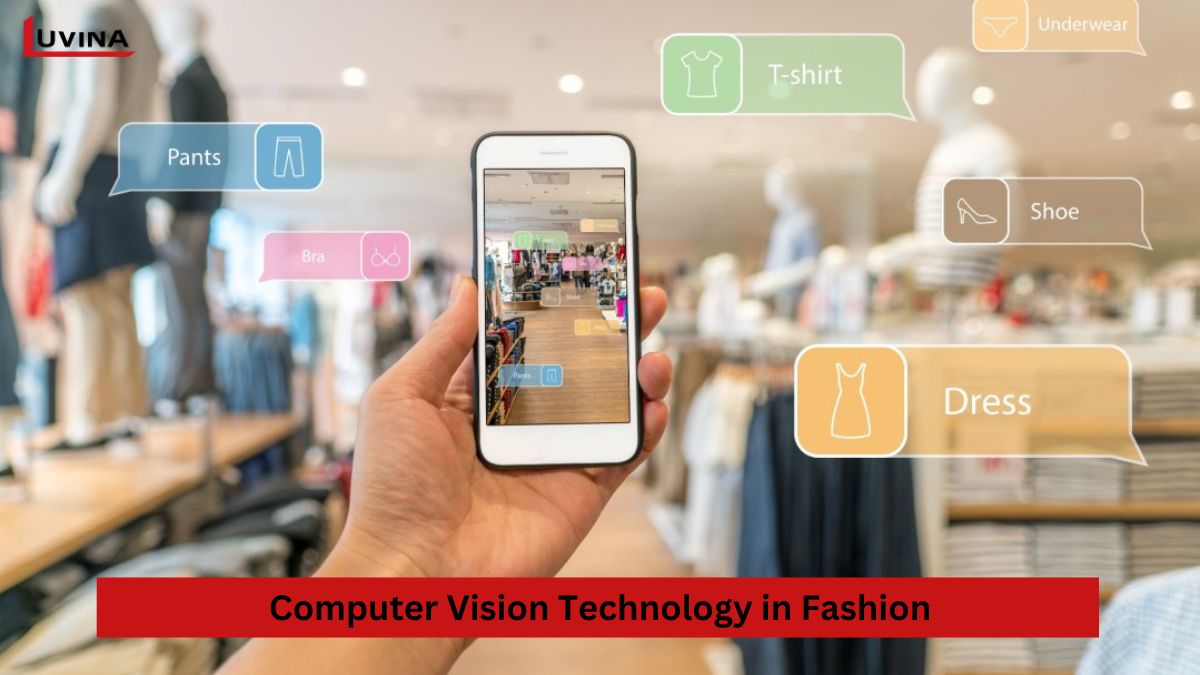
In the future, this emerging AI in the fashion industry will create new trends in many areas of fashion. For example, 3D models and virtual prototypes will allow designers to visualize and test designs before actual production, reducing waste and cost. Based on these models, AI can generate designs and styles, and even help create marketing content to cut down on creative process time. Computer technology will also play an important role in creating sustainable fashion.
This integration of visual data is a cornerstone of modern AI in fashion industry.
9. Generative AI and deep learning
Generative AI is no longer a futuristic concept; it is the #1 trend reshaping the creative process in 2026. Models such as Stable Diffusion, Midjourney, and DALL-E have become essential tools for designers.
- Rapid Pattern Generation: Instead of weeks of manual drawing, designers can use text prompts to generate thousands of unique fabric patterns, textures, and prints in seconds.
- Instant 3D Prototyping: AI now integrates with 3D design software (such as CLO 3D or Browzwear) to convert 2D sketches into realistic 3D models. This allows brands to visualize how a fabric drapes or moves before a single physical sample is cut, drastically reducing textile waste.
Real-world Success Stories
To see how these technologies translate into profit, look at these industry leaders:
Stitch Fix: This personal styling service uses AI algorithms to curate clothing boxes for millions of users. Their AI analyzes over 90 data points per customer to predict what they will keep, resulting in higher retention rates.
Zara (Inditex): Zara uses AI-powered micro-trends analysis to shorten its supply chain cycle to just 2-3 weeks, ensuring its stores always carry the most “viral” styles seen on social media.
Nike: With “Nike Fit,” the brand uses computer vision and AI to scan a user’s foot via a smartphone camera and recommend the perfect shoe size with sub-millimeter accuracy, significantly lowering return rates.
Casablanca & Revolve: These brands have already launched entire ad campaigns featuring “AI models” and Midjourney-generated environments, saving thousands of dollars on physical photo shoots and travel.
Key Cost Factors to Build an AI Fashion Application
Developing a custom AI solution for fashion is a significant investment. While prices vary, the budget is primarily driven by these key factors. Understanding these costs is essential for any business looking to lead in the AI in fashion industry:
- Data Acquisition & Labeling: AI is only as good as its data. High costs are associated with gathering millions of high-resolution fashion images and “labeling” them (e.g., tagging a “V-neck silk floral dress”) so the machine understands the context.
- Training Infrastructure (Compute Power): Training large models like Generative AI or Computer Vision requires massive GPU power. Most companies pay for cloud infrastructure (AWS, Google Cloud, or Azure) regularly.
- Model Complexity & Customization: Using a pre-built API is cheaper, but building a “Fine-tuned” model that understands a specific brand’s unique aesthetic requires expert AI engineers and longer development cycles.
- Integration with Legacy Systems: Connecting a new AI tool to existing e-commerce platforms (such as Shopify or Magento) and ERP systems (for inventory management) often requires complex backend engineering.
- Maintenance & Continuous Learning: AI models “drift” over time as fashion trends change. Costs include regular updates to the training data to ensure the AI doesn’t recommend last year’s styles.
Conclusion
In a dynamic, ever-evolving industry like fashion, AI will have a transformative impact, ushering in a new era. AI in fashion retail will empower designers to explore new boundaries and use modern tools to create unimaginable possibilities.
Although the AI transition is still in its early stages, the potential of AI in the fashion industry is immense. This will be a prime example of how technology can drive innovation and significant growth while ensuring sustainability and a customer-focused approach.
Related Posts:
- AI POC: Effective AI Testing Solutions for Business
- AI Solutions for E-commerce
- Distinguishing Personalization and Customization in E-commerce
- Top Artificial Intelligence Development Companies
READY TO START A PROJECT?
Our experts are eager to explore your needs.

Read More From Us?
Sign up for our newsletter
Read More From Us?
Sign up for our newsletter