




Exploring 7+ Different Fields of Artificial Intelligence


The different fields of artificial intelligence define the innovation. Each provides features that enable computers to think, reason, and make decisions. In this article, we explore the main AI fields and branches, their real-world applications, and how businesses can benefit from each.
Let’s examine 7+ major AI domains shaping the future of technology.
How/ways to classify AI fields
Exploring the different fields of artificial intelligence requires first understanding the difference between branches or subfields and fields. Although these words are occasionally used interchangeably, they reflect opposing viewpoints on artificial intelligence.
– Artificial intelligence fields: The general classification of artificial intelligence systems is based on their capabilities, goals, or breadth.
– Branches or subfields: Each addressing particular issues and creating focused methods, specialized fields inside artificial intelligence include natural language processing, computer vision, or robotics.
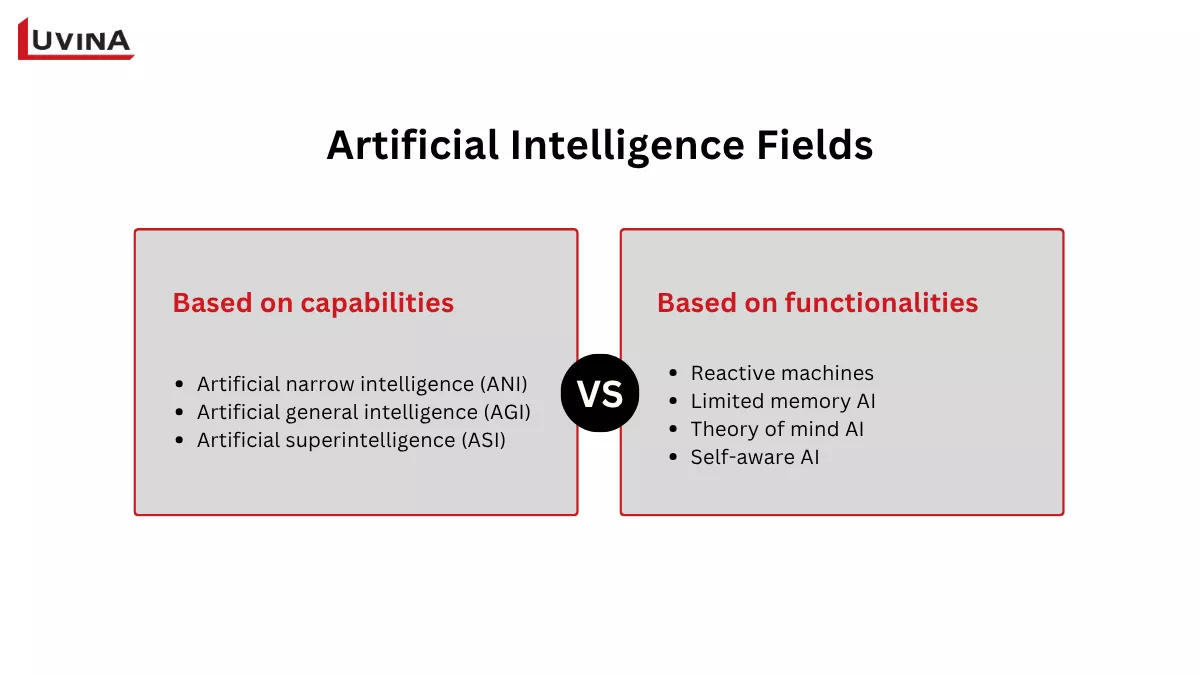
2 basic methods usually present themselves for artificial intelligence classification: one based on capabilities and one based on functionalities.
1. Classification based on capabilities
Classifying AI by its capabilities focuses on the system’s intellectual capacity and adaptability. The main different fields of artificial intelligence under this approach include:
– Artificial narrow intelligence (ANI): Also known as Weak AI, artificial narrow intelligence (ANI) belongs to one of the artificial intelligence fields and concentrates on carrying out a single task, such as recommendation engines (Netflix) or virtual assistants (Siri, Alexa). ANI represents one of the core fields of AI in today’s applications.
– Artificial general intelligence (AGI): A theoretical type of AI technology, AGI could perform any intellectual task that a human can do. While it is not yet realized, AGI is considered a critical area of artificial intelligence for future innovation.
– Artificial superintelligence (ASI): Another hypothetical idea, ASI would exceed human intelligence in every field. Combining learning, reasoning, and maybe self-awareness, this is the most developed area of artificial intelligence.
2. Classification based on functionalities
This method classifies AI based on how systems interact with data and the environment. Key different fields of artificial intelligence in this category include:
– Reactive machines: These AI systems respond only to present inputs and cannot retain memory. Examples include IBM Deep Blue and early recommendation engines. Reactive machines demonstrate a foundational field of AI for task-specific operations.
– Limited memory AI: Capable of using past data temporarily, this type of AI technology powers generative AI tools like ChatGPT, virtual assistants, and self-driving cars. Limited memory AI represents a practical area of artificial intelligence in modern applications.
– Theory of mind AI: Still in development, this field of AI aims to understand human emotions, intentions, and social interactions. Emotion AI is an emerging example of this artificial intelligence field.
– Self-aware AI: A theoretical level of AI that incorporates the advanced nature of Super AI and Theory of Mind AI. Self-aware AI would hold conscious thought and self-reflection.
Key AI subfields and their business applications
As we delve into the different fields of artificial intelligence, it is important to recognize that aside from the primary spheres, there are also some branches of AI. Every branch depicts a field in which artificial intelligence tools share basic techniques, even if particular systems vary in complexity or capabilities. Two systems, for example, could both fall under the deep learning branch even if one shows more advanced reasoning and the other is reactive.
We will discuss some significant branches of AI below and highlight their distinct characteristics and business-oriented applications.
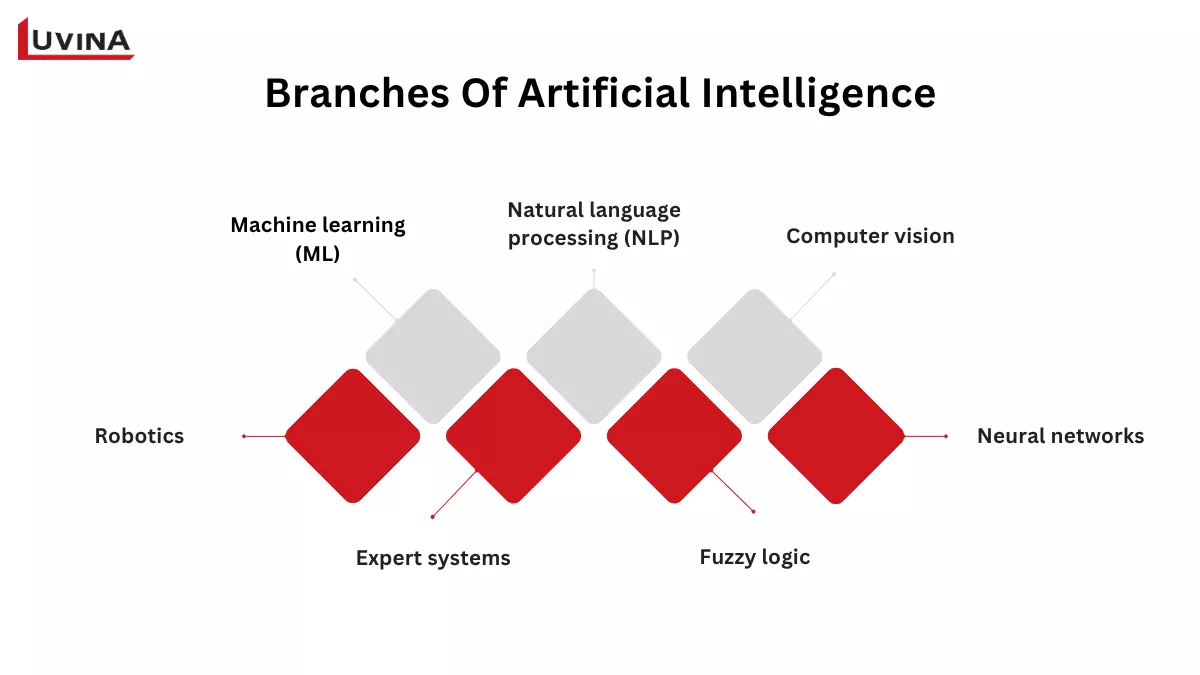
1. Machine learning (ML)
Machine learning (ML) is a key branch of AI that trains machines to learn from data rather than following fixed instructions. By analyzing patterns, ML systems improve decision-making and generate insights automatically, making it a vital AI field for business applications.
Building logical models for future inference starts with collecting historical data – including past experiences and instructions – in machine learning, 3 main methods exist:
– Supervised learning: Machines are trained with labeled data to predict outcomes. One example is shown in several images tagged as cats or not cats so that a computer can learn to detect cats in pictures. This technique is akin to directing a youngster through illustrations. Examples include fraud detection, sales forecasting, product demand prediction, inventory management,…
– Unsupervised learning: Machines find patterns and structure on their own from unlabeled data. For example, given a group of pictures, the computer can classify related ones without first understanding the categories. Examples: market basket analysis, consumer segmentation, …
– Reinforcement learning: Comparable to teaching a pet. The machine uses trial and error to learn, getting rewards for proper behavior and penalties for errors. It finds frequent application in video game artificial intelligence and robotics. Example: Increase delivery routes in logistics, personal suggestions engines, recommendation systems,…
Machine learning is a much more complicated branch of artificial intelligence and is a significant strand within different fields of artificial intelligence due to its ability to automatically learn and evolve.
2. Natural language processing (NLP)
Natural Language Processing (NLP) is an AI subfield that enables machines to understand, analyze, and respond to human language. By combining ML, deep learning, and linguistics, NLP can interpret text and speech, capturing meaning and sentiment. This capability makes NLP a crucial AI branch for applications like chatbots, sentiment analysis, and translation.
Teaching computers to manage the nuances of human language – including different intonations, stress, and accents in speech – is the NLP process.
This artificial intelligence subfield has some uses as follows:
– Virtual chatbots: Via natural-language processing, virtual chatbots can analyze customer requests in context, with the ability to provide accurate answers over time.
– Spam detection: NLP capabilities through text classification enable companies to automate the screening of phishing and spam email, protecting business networks as well as consumers.
– Sentiment analysis: NLP is capable of identifying sentiment and emotion through the analysis of reviews, social media messages, and comments.
– Text analysis: Businesses use NLP to analyze online content and inform of consumer opinions. For instance, looking at reviews helps to show which products are doing well and where changes have to be made.
– Machine translation: NLP drives translation programs like Google Translate, therefore facilitating worldwide communication.
– Text summarization: NLP compresses long documents into summaries that still retain essential data.
3. Computer vision
One well-known artificial intelligence different types branch, computer vision, lets computers decode and interpret visual data from photographs and movies. As one of the different fields of artificial intelligence, this branch enables machines to “see,” identify, and interpret what they are seeing, therefore creating several practical uses in several sectors.
Applying machine learning algorithms to visual data helps computers identify objects, faces, animals, and other features. With enough training data, algorithmic models let systems learn about the context of images and can precisely differentiate between several photos. Using mathematical operations, techniques like convolutional neural networks (CNNs) divide images into pixels, give labels, forecast, and categorize what the system observes.
Among computer vision’s several business uses:
– Object tracking: Keep an eye on people or objects in videos. Found in logistics, security, and retail.
– Image classification: Auto-arrange photographs according to categorizations. Used in social media and e-commerce.
– Facial recognition: Spot people for safe access or customized experiences in retail and finance.
– Image recognition: Identify persons or things in photographs. Used for social media tagging and quality checks in manufacturing.
– Video analysis: Analyze footage to detect unusual events. Useful in security and smart cities.
– Medical imaging: Analyze X-rays or MRIs to assist diagnosis, improving speed and accuracy in healthcare.
4. Robotics
One of the many subfields on the list of artificial intelligence, robotics uses engineering and artificial intelligence to create machines able to do jobs autonomously or semi-autonomously. As one of the different fields of artificial intelligence, robotics enables businesses to automate repetitive, hazardous, or challenging work, so increasing efficiency and safety in many sectors.
Robots are programmed devices that automatically carry out action sequences. While some have embedded control mechanisms driven by artificial intelligence and neural networks, others are externally managed.
Companies are using robots in useful ways to enhance customer experiences and streamline processes:
– Automation: Robots can do things like put cars together or pack stuff up in factories. This makes things faster and cuts down on mistakes.
– Drones: These flying robots can find their own way around to deliver packages, take pictures from the sky, or keep an eye on things. They use computers to spot things and figure out the best way to go.
– Helper robots: These robots are made to give a hand to people who have disabilities or who are older. They can help with everyday stuff and make life better.
5. Expert systems
As one of the main types of artificial intelligence with examples, expert systems simulate human decision-making to address difficult issues. These systems use a knowledge base and a structured set of rules to give precise solutions in particular industries, in a list of different fields of artificial intelligence.
Utilizing if-then inference rules to evaluate data and make judgments, an expert system is meant to carry out a single task like that of a human specialist. In fields needing accurate, data-driven advice – medical diagnosis, financial risk analysis, information management – they find widespread use.
Among some applications for expert systems:
– Medical assessment: Aid physicians in assessing patients’ symptoms for quicker and more accurate treatment.
– Financial services: Evaluate risk and provide investment solutions to facilitate more informed decision-making in companies.
6. Fuzzy logic
Knowing how many AI are there enables companies to see the need for fuzzy logic among other AI solutions. One major field of artificial intelligence, fuzzy logic, addresses reasoning under uncertainty; thus, it distinguishes itself in different fields of artificial intelligence. This method lets computers make judgments based on incomplete or incorrect data, quite like human thinking, unlike conventional binary logic.
Instead of just assigning a yes or no value, this branch assesses the degree to which a statement is true using a four-part systematic framework:
– Rule-based: Includes every if-then instruction defining system conduct.
– Fuzzification: Changes crisp inputs into fuzzy values.
– Inference engine: Determines the degree of match of inputs to rules.
– Defuzzification transforms hazy results into clear, practical decisions.
In commerce, fuzzy logic is used as follows:
– Control systems: Employed in automobiles and home appliances. Nissan uses fuzzy logic, for instance, to modify braking depending on wheel dynamics, acceleration, and vehicle speed. It helps to maximise performance for both washing machines and air conditioners.
– Decision-making: Supporting uses ranging from industrial automation to intelligent urban systems, fuzzy logic allows for more flexible decisions in unclear situations.
7. Neural networks
Inspired by the human brain, artificial neural networks (ANNs), also known as neural networks, are a major subdiscipline of artificial intelligence. Deep learning uses these structures and imitates how biological neurons signal one another.
There are several levels of nodes in these networks: an output layer, one or more hidden layers, and an input layer. Every node, or artificial neuron, links to others with predetermined weights and thresholds. A node that produces more than its threshold starts and forwards data to the level below.
Companies are finding creative applications for neural networks:
– Deep learning helps voice assistants to comprehend spoken instructions precisely.
– From patterns found in already available data, neural networks produce fresh content, including music, photographs, or text. Businesses employ this for marketing campaigns, product design, and creative content creation.
Why each field matters for business?
Each branch of AI helps businesses solve different problems. For example, computer vision can read images, machine learning can find patterns, and expert systems can give smart recommendations. Together, they create solutions that learn and adapt.
Knowing the main different fields of artificial intelligence helps companies pick the right tools for their needs. It also explains how many artificial intelligences there are, so businesses understand what each type can do and where it can be applied.
Using the right AI branches lets companies work smarter and faster. Staying aware of these technologies helps businesses apply AI safely and creatively, gaining benefits across different industries.
Choosing the right AI fields for your business
Which AI branch to choose is heavily determined by your company’s scale, ambitions, and available means. Below is a basic roadmap to begin with.
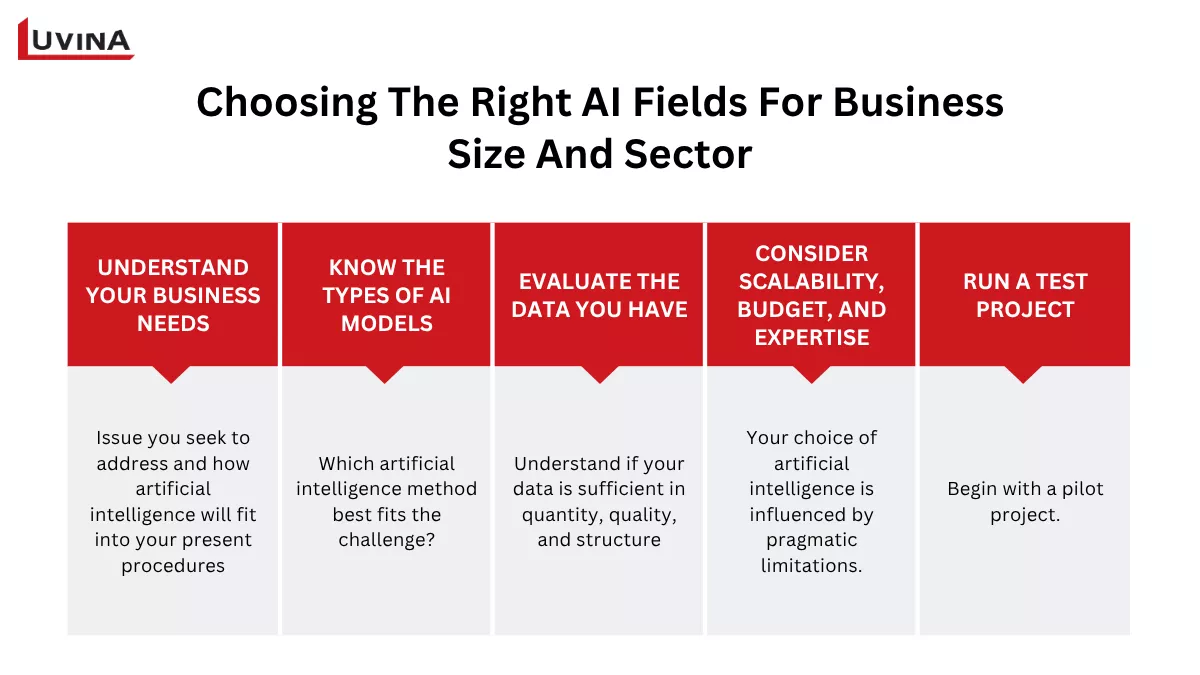
1. Understand your business needs
Begin by inquiring about the issue you seek to address and how artificial intelligence will fit into your present procedures. A clear aim lets you decide which of the different fields of artificial intelligence matches your company’s objectives.
Predictive analytics is the best way, for instance, if you want to automatically forecast sales using past information. Natural language processing (NLP) can power chatbots to respond to frequently asked questions if you are trying to alleviate the burden of client service. E-commerce platforms can develop recommendation engines based on prior browsing and purchasing habits to tailor customers’ shopping experience, and manufacturers can use image recognition technology to identify product defects.
2. Know the types of AI models
Once you have figured out your objectives, you next want to know which artificial intelligence method best fits the challenge. Understanding the appropriate model among several categories of artificial intelligence assists you in efficiently implementing AI since distinct problems call for different strategies. Your company’s type of data management and the complexity of the issue should guide your model selection.
– Supervised learning: Uses labeled data to identify and eliminate fraudulent transactions.
– Unsupervised Learning: Segments customers and finds patterns in unlabeled data.
– Reinforcement Learning: Provides better decisions in dynamic environments, such as supply chain management.
– Specialized models: Transformers (text analysis) or GANs (image creation) are specialized models.
3. Evaluate the data you have
Artificial intelligence projects are built on data. Before making a model selection, you must understand if your data is sufficient in quantity, quality, and structure. Supervised learning models will require labeled data, while unsupervised learning can be completed with unlabelled data. The volume and quality of the data will impact the reliability and accuracy of your AI models.
If you find that your dataset is small, consider creating synthetic data or looking for external databases with data. One example is Pandas, an open-source data preparation and cleaning tool. Another example is DataRobot, which is open source, too, and mainly helps prepare data for AI and machine learning. Knowing the different areas of artificial intelligence can help you decide what model(s) to use when you have data.
4. Consider scalability, budget, and expertise
Your choice of artificial intelligence is also influenced by pragmatic limitations. If your company expects data volume to increase, scalability is absolutely vital. Budget decides if you can afford a custom-built solution or should use pre-trained APIs. Expertise matters because technical skills are necessary to maintain and optimize AI systems. Teams without experience might have to work with AI development companies.
5. Run a test project
Begin with a pilot project to evaluate performance on real-world data before deploying artificial intelligence throughout the company. This helps you find flaws, improve the model, and verify that it achieves your goals. Constant monitoring guarantees the model changes to suit circumstances and keeps its accuracy across time.
Performance tracking and direction of improvements are provided by tools like TensorFlow Model Analysis. Choosing a pilot project suited to the different fields of artificial intelligence guarantees that you check the most suitable AI solutions for your own business needs.
Challenges in implementing different AI fields
Many artificial intelligence endeavors face issues that stem from the organization, operation, or data, not the AI algorithms. Understanding the different domains of artificial intelligence and their specialized requirements can help organizations anticipate these issues, build more stable systems, and embed solutions in existing practices.
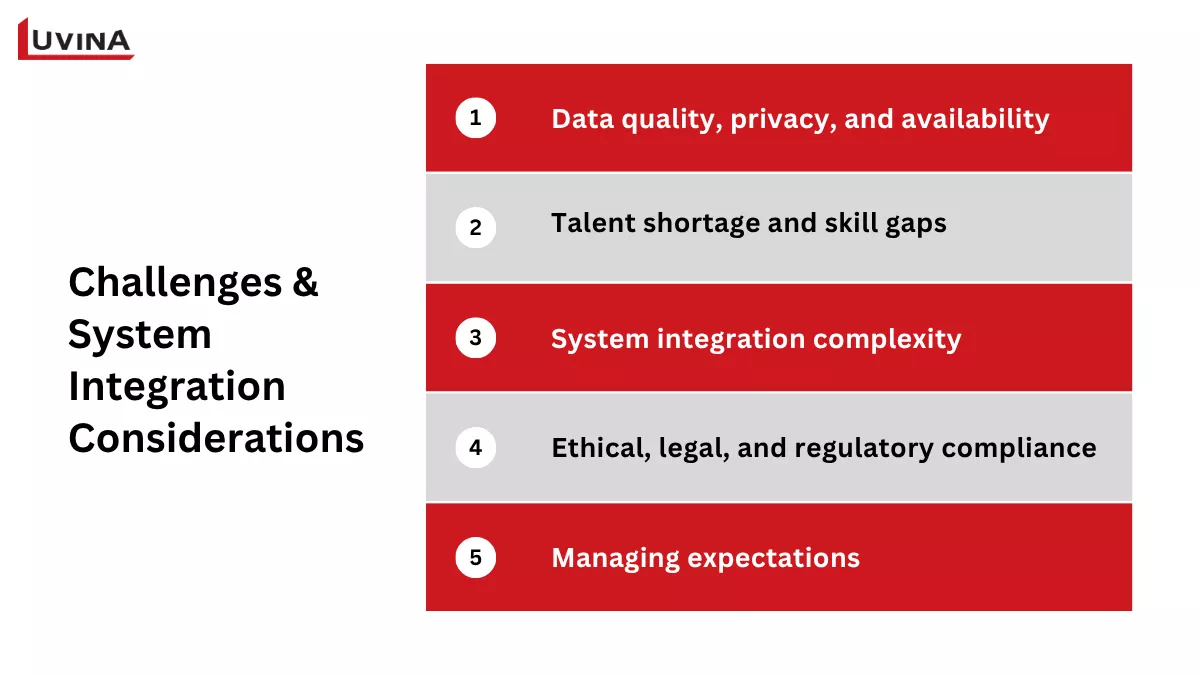
1. Data quality, privacy, and availability
Bad data quality, divided sources, missing values, or obsolete records can undercut artificial intelligence algorithms. When important data is kept in silos or legacy systems, availability problems emerge. Further complicating data access and usage are privacy rules, including GDPR or HIPAA. Even different fields of artificial intelligence can fail unless these problems are addressed.
Solution: Early audit and standardization of data, filling in of missing values, and development of governance guidelines that strike a compromise between access and compliance. Start with legal and data privacy teams to make sure models meet legal requirements.
2. Talent shortage and skill gaps
Developing artificial intelligence systems calls for domain experts, data scientists, engineers, and analysts. It’s challenging to find and keep all of the necessary talent. A lack of qualified personnel might cause project delays, price increases, or compromises. Particularly impacted are initiatives in different fields of artificial intelligence.
Solution: Build blended teams integrating inside and outside knowledge. Collaborate with trustworthy AI providers for cross-functional skill coverage. Enhance current personnel’s skills and use low-code systems or AutoML solutions to cut reliance on great experience.
3. System integration complexity
Often failing following prototyping, AI models find integration with legacy systems, siloed applications, or rigid workflows impossible. Technical debt results from accurate forecasts that cannot integrate into CRM, ERP, or other corporate systems.
Solution: Early on, involve IT and DevOps teams. To connect artificial intelligence components to current systems, use modular architectures and APIs. Ensure performance matches real-world operations by testing models in the whole company context.
4. Ethical, legal, and regulatory compliance
AI’s prejudiced or unclear judgments expose companies to legal, reputational, and ethical hazards. Especially dangerous in high-stakes situations are non-transparent systems.
Solution: Engage legal and compliance teams throughout design and implementation. Sources of document data, model assumptions, and fairness inspections. If at all feasible, use interpretable models; otherwise, use explainable tools for black-box models. Knowing the different fields of artificial intelligence helps one to properly customize compliance initiatives.
5. Managing expectations
Stakeholders may anticipate results from AI immediately or as if by some sort of magic, and may become disappointed if outcomes are not delivered quickly. Projects could become stalled, or individuals may lose interest in AI materials if what they anticipate doesn’t align with reality.
Solution: Set formal KPIs, realistic deadlines, and clearly defined, attainable targets. Tell the project teams about the possibilities of artificial intelligence and its constraints. Constantly track work and KPIs; give continuous input; and maintain realistic expectations aligned with the actual results.
Future trends
As different fields of artificial intelligence keep developing, the future of AI seems full of possibilities. Emergent new branches of AI emphasize ethics, transparency, and cross-industry integration. Companies may plan and integrate artificial intelligence successfully if they understand these trends.
– Explainable AI allows users to see how decisions are made, clarifying the “black box” nature of deep learning.
– AI ethics focuses on reducing bias and promoting fairness in AI systems. Organizations are prioritizing ethical considerations in all applications of different fields of artificial intelligence.
– Industry integration illustrates how artificial intelligence models are utilized in specific fields such as healthcare, 3D printing, or engineering simulations, where these models combine different branches of AI to generate value.
– New applications are emerging that blend robotics, computer vision, natural language processing, and predictive analytics in fundamentally new ways to create hybrid applications that increase efficiency and innovation.
– Responsible AI use centers on the conscious deployment of AI systems to optimize the benefits to society while decreasing the negative risks.
FAQ
1. Which industries benefit most from AI?
Automotive, healthcare, retail, and aerospace use AI for automation, predictive maintenance, and personalized services.
2. What is the most popular AI subfield?
Machine Learning, powering applications like image recognition, NLP, and autonomous systems.
3. How fast is AI progressing?
AI is advancing rapidly due to algorithm improvements and more efficient hardware.
4. Which AI sub-areas will be important in the future?
Explainable AI, Quantum AI, and advanced Machine Learning will drive trust and problem-solving.
5. Can AI replace human jobs completely?
No, AI enhances human capabilities and shifts job roles rather than fully replacing them.
Conclusion
The different fields of artificial intelligence are changing how business and industry work, from NLP and computer vision to deep learning in engineering. Knowing these helps firms pick the right tools and use them well.
Luvina provides AI solutions across manufacturing, public services, and automation, tailored to your business needs. Our experts support implementation, provide technical guidance, and ensure measurable results. Contact Luvina today to discover how AI fields like ML, NLP, and computer vision can optimize your operations.
Resources
- https://www.aiacceleratorinstitute.com/what-are-the-top-7-branches-of-artificial-intelligence/
- https://iabac.org/blog/the-branches-of-artificial-intelligence
- https://www.neuralconcept.com/post/major-fields-of-artificial-intelligence-and-their-applications#link10
- https://www.ibm.com/think/topics/artificial-intelligence-types
- https://www.linkedin.com/pulse/how-choose-right-ai-model-your-business-needs-dmytro-romanchenko-djpuf/
- https://sam-solutions.com/blog/ai-implementation-strategy/
READY TO START A PROJECT?
Our experts are eager to explore your needs.

Read More From Us?
Sign up for our newsletter
Read More From Us?
Sign up for our newsletter