




Software Architecture in Software Engineering Fundamentals


Software architecture in software engineering is the invisible structure that makes modern software feel simple, fast, and reliable to end users.
This guide explains what software structure is, how it differs from design, and which styles and patterns help teams build sustainable systems.
What is Software Architecture?
Software architecture in software engineering is the fundamental structure of a software system. As a part of the design phase of the Software Development Life Cycle (SDLC), it specifies the system’s organizational layout, its components, and their interplay.
Design architecture software engineering is not just about structure. It defines the system’s behaviour, how its components communicate with one another, and how they are linked together as a whole. Without a defined archiưtecture, systems often become expensive to modify, hard to scale, and risky to maintain.
With good architecture defined, you can build an environment where your teams can effectively work together, make technical decisions that are aligned with your company’s strategic objectives, and provide value to all of your stakeholders.
Software Architecture vs Software Design
2 concepts – software structure and software design – are closely related, but they operate at different levels of abstraction and serve different purposes within the development process. In software architecture in software engineering, architecture defines the overall structure and guiding principles of a system, while design focuses on how that structure is implemented through concrete technical decisions.
At a high level, software structure addresses the “what” and “why” of a system. It organizes major components, defines their relationships, and determines how the system interacts with its environment. In contrast, software design deals with the “how.” It translates architectural decisions into detailed solutions, including classes, interfaces, functions, and design patterns.
The table below summarizes the key differences between software structure and software design
| Aspect | Software structure | Software design |
| Scope | Defines the structure of the entire system | Focuses on individual modules or components |
| Level | High-level system structure | Implementation-level details |
| Main focus | What the system is and how it is organized | How the system is built |
| Purpose | Guides and constrains design decisions | Enables developers to implement the system |
| Timing in SDLC | Defined early in the design phase | Refined after the architecture is established |
| Uncertainty | Manages technical and business uncertainty | Reduces uncertainty in implementation |
| Patterns | Uses architecture styles in software engineering, such as microservices, event-driven, or serverless | Uses design patterns such as creational, structural, and behavioral |
| Outcome | A stable blueprint for the system | Detailed specifications for coding |
The key differences between software architecture and software design
Core Components of Software Structure
Based on a group of components and structures that specify how a system is set up and how it operates over time, software architecture in software engineering is constructed. Even as demands change, these components interact to guarantee the system is understandable, scalable, and maintainable.
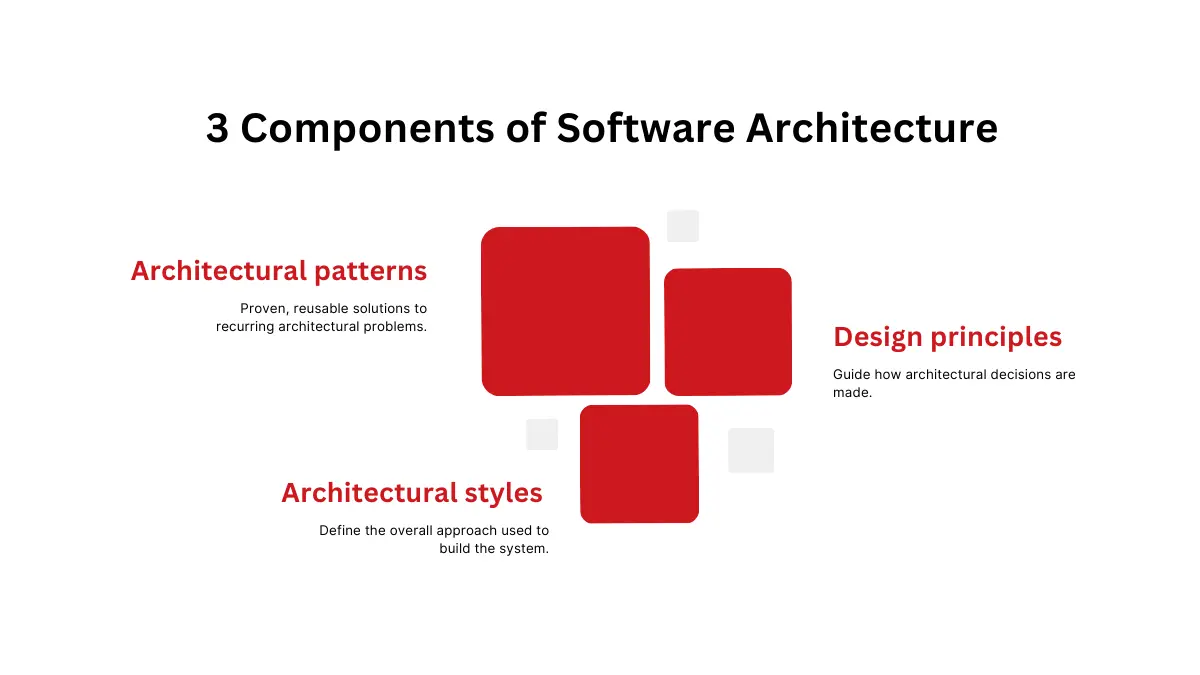
Software architecture is built on architectural patterns, design principles, and architectural styles
Architectural patterns
These solutions, proven and recyclable, address architectural issues constantly present. Architects may arrange systems in a way that is simpler to understand, create, and maintain using patterns like tiered architecture, microservices, or event-driven architecture.
Design principles
Architectural choices are steered by design philosophies. Keep the design neat and coherent by following principles like SOLID, DRY (Don’t Repeat Yourself), and KISS (Keep It Simple). They improve maintainability, cut pointless complexity, and make the system simpler to extend without introducing risk.
Architectural styles
The general method employed in the construction of the system is defined by architectural genres. Methods like client–server, peer-to–peer, or pipe-and-filter explain the distribution of parts and their interaction.
Software architecture in software engineering rests on patterns, ideas, and styles taken together that enable systems to operate consistently and adapt to changes.
Key Software Architecture Styles in Engineering
Choosing the right architectural style affects how a system scales, handles data, and adapts to future change. Each style addresses different trade-offs in complexity, performance, and maintainability.
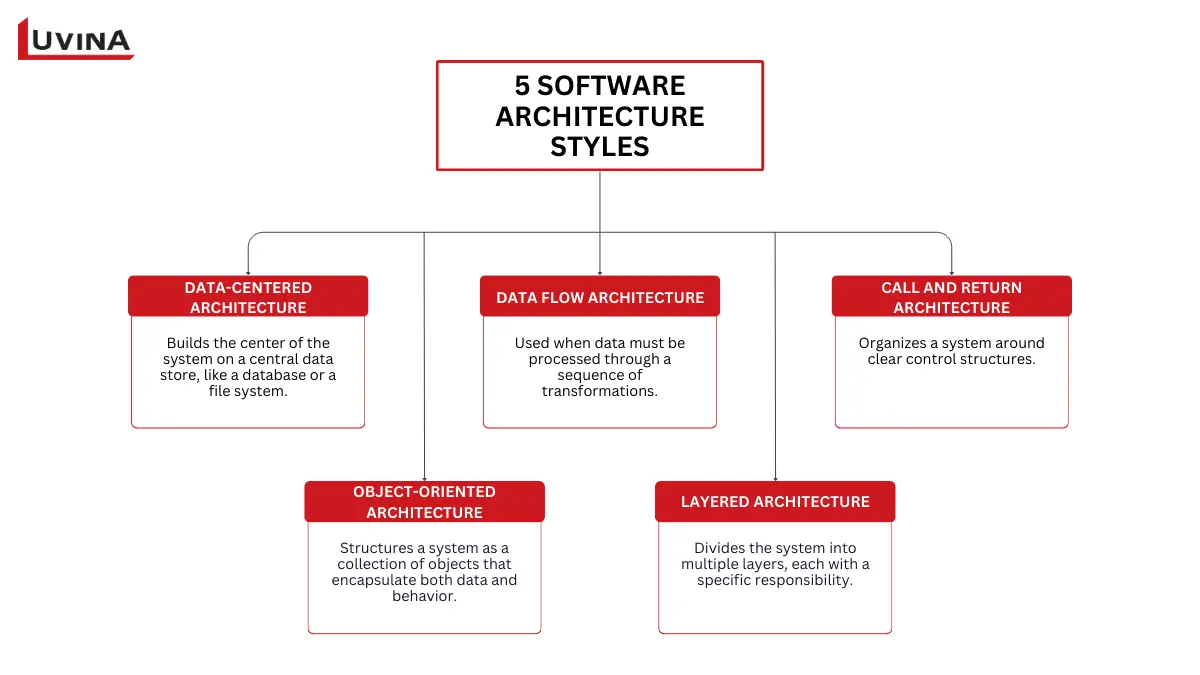
Software architecture in software engineering is often built using these styles
1. Data-centered architecture
Data-centered architecture builds the center of the system on a central data store, like a database or a file system. Other elements serve as independent consumers reading, updating, adding, or deleting information from this common source.
Changes to one client typically do not influence others because client components are weakly linked. Systems needing data consistency and shared access would benefit from this design.
2. Data flow architecture
Data flow architecture is used when data must be processed through a sequence of transformations. Input data passes through a series of components, commonly called filters, which process the data step by step. Pipes connect these filters and carry data between them. This style of software architecture in software engineering is effective for systems focused on data processing, computation, or transformation workflows.
3. Call and return architecture
Call and return architecture organizes a system around clear control structures. The most traditional form is the main program and subprogram model, where a central program controls execution by invoking other components hierarchically.
A distributed variation of this approach is the remote procedure call architecture, where components are located on different machines but communicate as if they were part of a single program. Within the context of software architecture in software engineering, this style is valued for its simplicity and ease of modification.
4. Object-oriented architecture
Object-oriented architecture structures a system as a collection of objects that encapsulate both data and behavior. Each object is responsible for managing its own state and operations, while communication between objects happens through message passing.
5. Layered architecture
Layered architecture breaks the system into several levels, each with a particular function. While upper layers usually manage user interface and application logic, lower layers handle core services and system-level activities. Every layer depends only on the tiers below. This method separates problems and streamlines testing and maintenance since it is among the most popular architecture styles in software engineering.
Architecture Patterns
Architecture patterns provide proven structures for solving recurring system-level problems. Selecting the right pattern helps constrain complexity, supports future change, and ensures the system remains aligned with business goals.
The table below summarizes some of the most widely used architecture patterns, frequently adopted across software architecture in software engineering to address different system requirements and operational contexts.
| Architecture pattern | Description | When to use? | |
| Traditional patterns | Layered (N-tier) | A widely used pattern in software architecture in software engineering that organizes the system into hierarchical layers with clear separation of responsibilities. MVC (Model-view-controller) is a typical example of this pattern, using a three-layer approach. | – Need fast development timelines- High maintainability and testability required- Traditional business applications |
| Client-server | Separates clients that request services from servers that process data and logic. | – Web-based applications- Centralized data management- Improved security and control | |
| Microkernel (Plugin) | Maintains a minimal core system with extendable plugins , widely used in Content Management Systems. | – High extensibility required- Workflow-oriented systems- Enterprise applications | |
| Modern patterns | Event-driven | Uses events to trigger asynchronous processing in independent components. | – Complex workflows- Asynchronous data flow- Interactive user interfaces |
| Microservices | A modular approach within software architecture in software engineering, splitting systems into small, independently deployable services. | – Large or growing systems- Independent deployment needed- Migrating from monolithic architecture | |
| Cloud-native | Builds loosely coupled services optimized for cloud scalability and resilience. | – Cloud-first systems- High availability requirements- Variable workloads | |
| Space-based | Distributes data and processing to avoid central bottlenecks and handle concurrency. | – High traffic systems- Unpredictable user load- Scalability and concurrency challenges |
Architecture patterns and their suitable use cases
How to Design Software Architecture (Best Practices)
Across software architecture in software engineering, good design focuses on long-term quality while still supporting fast delivery and evolving business needs. The following best practices highlight how to build effective architectures:
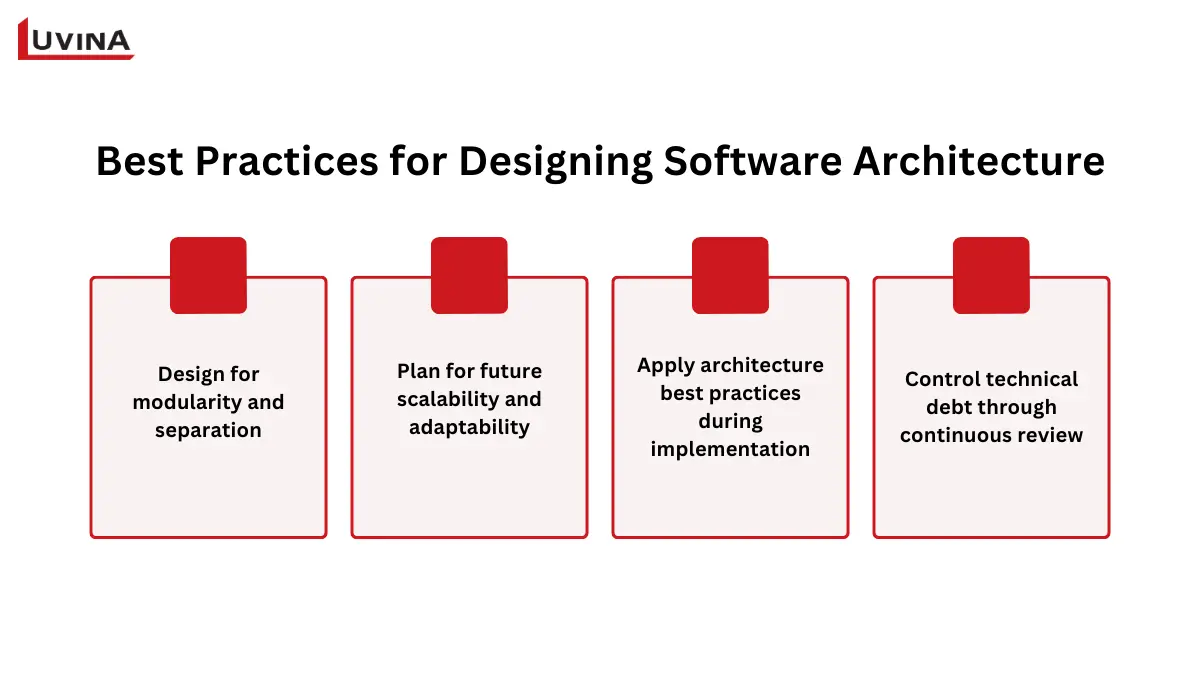
To design software structure, don’t overlook these tips
Design for modularity and separation
Structure the system into independent modules or services, each handling a clear functional domain. Inside each module, organize components into layers such as API, service, and persistence. Avoid circular dependencies and keep interactions unidirectional to reduce coupling and improve stability – an essential architectural principle.
Plan for future scalability and adaptability
Architecture should help technology, user base, and workload expansion. Avoid design decisions that obstruct future cloud migration or confine portability. Plan for both horizontal and vertical scaling with the use of standard tools so the system can grow without significant revision.
Apply architecture best practices during implementation
Regular use of established architectural patterns, thorough documentation, and rigorous testing techniques ensures quality preservation. Fast, dependable delivery is further supported by CI/CD pipelines, which also help to maintain the structure in line with its initial aims.
Control technical debt through continuous review
Regularly assess if the system still complies with the intended layout. Early treatment of architectural challenges helps to avoid technical debt from obstructing development. Long-term reliability and wise decision-making are guaranteed; continuous assessment is a basic discipline in software architecture in software engineering.
Common Mistakes
Working with software architecture in software engineering causes even seasoned teams to fall into common mistakes. Though they sometimes don’t lead to instant failure, these errors steadily undermine maintainability, security, and scalability over time. The most often made errors, why they are damaging, and how to effectively fix them are summarized below.
| Mistake | Impact | Solution |
| Neglecting scalability | System performance and reliability drop as usage grows. | Plan for horizontal scaling and capacity growth from the start. |
| Tight coupling between components | Changes propagate across the system, slowing development. | Use clear interfaces, dependency injection, and loose coupling. |
| Choosing the wrong architectural style | Unnecessary complexity increases cost and maintenance effort. | Base design architecture, software engineering decisions on real constraints and team maturity. |
| Ignoring security early | Higher exposure to vulnerabilities and compliance risks. | Embed security by design as part of software architecture in software engineering, and apply defense-in-depth principles. |
| Overengineering | The system becomes hard to understand and evolve. | Keep solutions simple and evolve architecture incrementally. |
| Poor documentation | Knowledge silos form, hurting collaboration and onboarding. | Maintain decision-focused documentation throughout the project. |
| Premature optimization | Engineering effort is wasted on non-critical problems. | Measure performance first, then optimize proven bottlenecks. |
| Lack of testability | Low confidence releases and fragile systems over time. | Design components for isolation and testability when applying software architecture in software engineering, enabling safer releases and more resilient systems. |
| No plan for evolution | The system resists change and requires costly rewrites. | Separate concerns clearly and design components to be easily testable. |
Common pitfalls and how to address them
Software Architecture in SDLC
Software structure is not a one-time activity. Throughout the Software Development Life Cycle, this is a relentless framework guiding the design, building, testing, deployment, and upkeep of a system. System design specifies the technical ideas and architectural choices guiding every stage to guarantee long-term viability and consistency, even though SDLC offers a structured, phase-based perspective of software development.
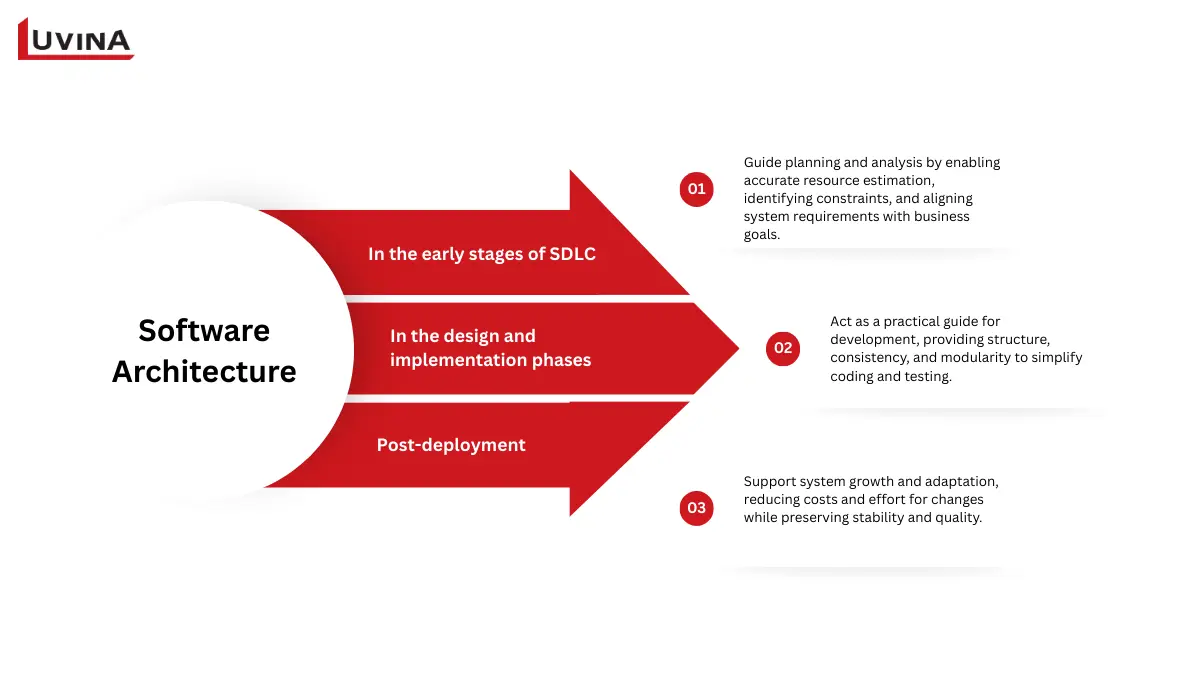
Software architecture plays a crucial role in multiple stages of the SDLC
In the early stages of SDLC
Planning and analysis are much affected by architectural thought. Clear design choices enable teams to better estimate resources, pinpoint technical limitations, and match system needs to corporate objectives. From the beginning, architecture frames conversations around scalability, security, and maintainability rather than only emphasizing characteristics. This early alignment fosters a shared knowledge among stakeholders and lowers hazards later in the lifecycle.
In the design and implementation phases
Software architecture in software engineering serves as a practical compass for development teams during the design and implementation phases. Architectural patterns and structural restrictions offer parameters that help to control code and maintain consistency. Focusing on building features inside a familiar structure allows developers to lower complexity and raise productivity. Modular and well-arranged designs also make testing easier by enabling component isolation, testing independently, and validation more quickly.
Post-deployment
After deployment, architecture becomes the key factor that supports maintenance and long-term evolution. A well-structured system reduces the effort required to fix issues, apply updates, and introduce new features. When responsibilities are clearly defined and components are loosely coupled, changes can be made without large-scale rewrites.
Case Studies
Real-world examples given below demonstrate how architectural choices directly affect scalability, security, and system robustness. Every case emphasizes a unique application of software architecture in software engineering in practice.
Case study 1: Amazon Web Services (AWS) – Global scalability and availability
AWS is constructed on a very fault-tolerant and highly scalable architecture that enables millions of people all around. Its design stresses elasticity, redundancy, and regional isolation, therefore enabling high availability while automatically scaling services.
AWS lowers downtime and guarantees consistent performance even under erratic demand by spreading workloads over several availability zones. This example shows how software architecture in software engineering lets platforms expand internationally without lowering dependability.
Case study 2: Netflix – Microservices for continuous delivery
Operating at a huge scale, Netflix provides streaming material to consumers throughout several devices and locations. To enable frequent updates and quick innovation, Netflix chose a microservices architecture. Every service can be created, implemented, and scaled separately, therefore minimizing overall system-wide risk during modifications. This architectural strategy lets Netflix keep continuous delivery while deftly managing traffic surges.
Case study 3: E-commerce platform – Black Friday scalability
Millions of users accessing the platform at once caused a major e-commerce site to experience enormous traffic spikes during Black Friday. Maintaining fast response times while avoiding downtime was the main difficulty.
The design team revamped the system, utilizing cloud-based auto-scaling and microservices from AWS. Availability, latency, and throughput were among the indicators meticulously monitored.
The result showed backing for more than 5,000 transactions per second, 99.98% uptime, and an average response time of 250ms during peak hours. This example shows how design decisions directly impact commercial results, highlighting the value of software architecture in software engineering.
Case study 4: Financial services system – Security and compliance
To satisfy demanding legal standards and rising security concerns, a financial institution had to update its infrastructure. Following architectural flaw detection, the system was rebuilt with multi-factor authentication, end-to-end encryption, and a zero-trust approach. Important measures included system lag, mistake rates, and security flaws.
By 80%, the new design reduced vulnerabilities, so decreasing error rates and boosting performance, therefore allowing the firm to pass compliance tests confidently.
Conclusion
Strong architectural decisions lay the foundation for scalable, secure, and adaptable software systems. If you’re ready to apply these insights to real projects, now is the time to take the next step.
Explore Luvina‘s professional architectural consulting services or continue your learning journey with our in-depth guides on scalable system design. The long-term success of your software starts with the architectural choices you make today.
Resources
- https://www.geeksforgeeks.org/software-engineering/fundamentals-of-software-architecture/
- https://200lab.io/blog/software-architecture-la-gi
- https://www.geeksforgeeks.org/system-design/difference-between-software-design-and-software-architecture/
- https://medium.com/@dulanjayasandaruwan1998/day-1-understanding-the-basics-of-software-architecture-4fd476195a48
- https://www.linkedin.com/pulse/software-architecture-styles-engineering-hammad-maqbool-liqsf/
- https://vfunction.com/blog/what-is-software-architecture/#toc-heading-5
- https://www.linkedin.com/pulse/common-mistakes-software-architecture-how-avoid-them-patterns-elie-wekff/
- https://medium.com/@vinycius.dasilva/the-synergy-between-software-architecture-and-sdlc-a-modern-engineering-perspective-8b1b8e9771c3
- https://www.linkedin.com/pulse/inside-software-architecture-practice-key-metrics-case-studies-ipw2e/
READY TO START A PROJECT?
Our experts are eager to explore your needs.

Read More From Us?
Sign up for our newsletter
Read More From Us?
Sign up for our newsletter