




Managed IT Services for Manufacturing for Modern Factories


In manufacturing, a few minutes of downtime can mean thousands of dollars in lost revenue. Yet many factories still treat IT as a back-office function, until systems fail and production stops.
Modern manufacturing doesn’t just depend on machines. It depends on connected systems: ERP, MES, IoT, and supply chain platforms working in real time. When those systems fall out of sync, production slows, decisions lag, and risks increase.
That’s why managed IT services for manufacturing are no longer optional, but a core part of keeping operations running smoothly.
In this article, we’ll explore how managed IT services are helping modern factories stay efficient, secure, and ready for what’s next.
What Are Managed IT Services for Manufacturing?
Managed IT services for manufacturing is the practice of outsourcing IT management, maintenance, and support to a specialized provider who handles these functions on behalf of a manufacturing business
Unlike traditional IT support, which reacts after problems occur, managed services are proactive. Providers continuously monitor systems, identify risks early, and resolve issues before they impact production. This shift is especially important in manufacturing, where even small disruptions can lead to delays, increased costs, or halted operations.
For manufacturers, the value is clear: technology systems stay stable, secure, and aligned with operational goals. Instead of spending time troubleshooting IT issues, teams can focus on production, innovation, and delivering consistent output.
The Manufacturing IT Challenges
As manufacturing operations become more complex, IT is expected to support everything. But in reality, many businesses struggle to keep up. This is exactly why managed IT services for manufacturing are becoming increasingly important. Below are the most common IT challenges manufacturers face today:
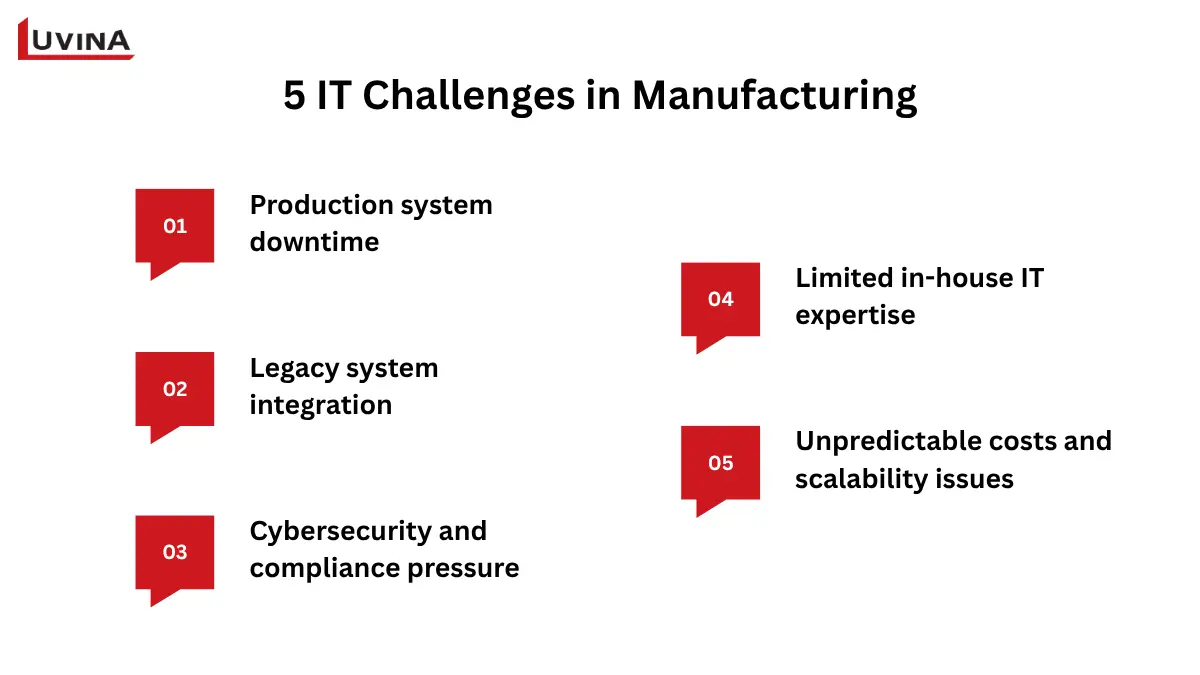
The manufacturing industry faces many IT-related challenges
Production system downtime
Downtime can stop production instantly, causing delays and financial loss. Without proactive support like managed IT services for manufacturing, many businesses react only after issues occur, leading to greater disruptions.
Legacy system integration
Outdated systems are still widely used but are difficult to integrate with modern technologies. They often create security risks and slow performance. Effective IT solutions for manufacturing industry focus on connecting old and new systems without interrupting operations.
Cybersecurity and compliance pressure
Manufacturers handle sensitive data and face increasing cyber threats. At the same time, stricter regulations require better data protection. Weak security can lead to breaches, penalties, and operational risks.
Limited in-house IT expertise
In-house IT teams are often small and overloaded. They manage daily tasks but have little time for innovation or system improvements, which limits growth.
Unpredictable costs and scalability issues
IT costs can be hard to control, especially with unexpected issues or upgrades. Businesses also need systems that scale with growth, a challenge without a structured IT approach.
What makes manufacturing IT unique is the convergence of IT and OT (Operational Technology). Unlike other industries, system failures here don’t just affect data — they directly impact physical production.
This creates a higher level of risk, where even minor IT issues can lead to production delays, safety concerns, or supply chain disruption.
Types of IT Services for Manufacturing Companies
Manufacturers need multiple IT functions working together to keep operations stable, secure, and scalable. With managed IT services for manufacturing, these services are integrated into a single, proactive system instead of being handled separately.
| Service type | Description |
|---|---|
| Network and infrastructure management | Keeps networks, servers, and connectivity stable to avoid disruptions in daily operations. |
| Cloud services and data management | Supports data storage, backup, and system scalability through cloud or hybrid environments. |
| Manufacturing application support | Maintains and optimizes ERP and production systems to improve workflow and efficiency. |
| Cybersecurity and threat management | Protects systems with monitoring, encryption, and threat detection – often included in managed IT services for manufacturing. |
| Backup and disaster recovery | Ensures data is backed up, secured, and quickly recoverable after disruptions or attacks. |
| IoT and sensor integration | Connects machines and devices for real-time monitoring and better production control. |
Some types of IT solutions for the manufacturing industry
>>> Read more: 10 types of managed services
How Managed IT Services Solve Manufacturing Problems
Manufacturing IT challenges are complex, but they are not unsolvable. With the right approach, managed services for manufacturing companies can shift from being a constant risk to a reliable support system.
Proactive monitoring
Proactive monitoring reduces unplanned downtime by identifying anomalies before they escalate into system failures.
System integration
Manufacturing often depends on multiple platforms, such as ERP, manufacturing execution systems, and supply chain tools. Managed services help connect these systems so data flows smoothly across operations, reducing errors and improving efficiency. At the same time, they strengthen industrial cybersecurity, protecting both IT systems and production equipment from growing threats.
Predictive maintenance and supply chain management
By monitoring equipment health and system performance, businesses can plan maintenance before breakdowns occur. In parallel, critical systems like vendor portals and logistics platforms are kept stable to ensure uninterrupted operations.
A practical example comes from our team at Luvina, which has worked with manufacturing companies in Vietnam, Malaysia, and Japan. With over 2 years of experience in factory system maintenance, Luvina has helped clients optimize operational costs by up to 30%. More recently, our company has begun integrating AI into maintenance processes, enabling more accurate predictions and further improving both cost efficiency and response speed.
Flexibility
With managed IT services for manufacturing, businesses can scale support up or down based on production cycles, expansion plans, or market shifts without the burden of hiring or restructuring internal teams. This is especially valuable during complex situations like adding new production lines or integrating systems after mergers.
Specifically, managed services give manufacturers access to advanced capabilities without requiring in-house expertise.
Managed IT Services vs. In-House IT: A Manufacturing Decision Framework
Many manufacturers still rely on in-house IT because it feels familiar and offers a sense of control. But modern environments are more complex than ever, with cloud systems, IoT devices, ERP, and OT all connected. This makes it harder for small internal teams to maintain visibility, respond quickly, and keep systems secure. As a result, more businesses are evaluating managed IT services for manufacturing as a more scalable and reliable alternative.
The decision often comes down to cost, expertise, and performance. While in-house IT may seem straightforward, the reality includes hidden expenses, skill gaps, and reactive workflows. On the other hand, managed services offer structured support, proactive monitoring, and predictable pricing. The table below highlights the key differences:
| Inhouse IT | Managed services | |
|---|---|---|
| Cost structure | Salaries, benefits, tools, and training create high and variable costs | Fixed monthly managed IT services cost, easier to plan and control |
| Expertise | Limited to a small team, often stretched thin | Access to a full team of specialists across cloud, security, ERP, and OT |
| Coverage | Mostly business hours, limited after-hours support | 24/7 monitoring and support with fast escalation |
| Response time (MTTD and MTTR) | Slower detection and resolution due to limited resources | Faster detection (minutes) and resolution (hours) with proactive systems |
| System monitoring and patching | Inconsistent due to workload and staffing gaps | Continuous monitoring and high patch compliance rates |
| Scalability | Difficult to scale with growth, requires hiring and training | Flexible support that scales with production needs |
| Downtime impact | Higher risk due to a reactive approach | Reduced downtime through proactive maintenance |
| Cost predictability | Unpredictable due to incidents, turnover, and upgrades | Stable and predictable budgeting model |
| Business continuity | Often limited backup and recovery planning | Built-in backup, disaster recovery, and resilience planning |
What advantages do managed IT services have over building and maintaining an in-house team?
Beyond visible costs, in-house IT also comes with hidden challenges. High turnover, long hiring cycles, and ongoing training requirements slow down operations and increase risk. When staff leave, critical system knowledge is lost, and recovery takes time. At the same time, cybersecurity talent shortages continue to drive up costs and make hiring more difficult.
In contrast, managed IT services for manufacturing provide consistent coverage through dedicated teams. They reduce burnout risks, improve monitoring, and ensure systems stay updated even as technology evolves. By shifting from a reactive to a proactive model, manufacturers can reduce downtime, improve performance, and gain better control over long-term IT spending.
ERP, MES & IoT Integration: The Managed IT Advantage
A machine sends a signal. MES reacts, but ERP updates are too late. Small delays like this can quickly turn into production errors. The issue isn’t the systems; it’s the lack of connection between them.
In many factories, ERP, MES, and IoT systems exist, but they don’t fully communicate. This creates delays, inconsistencies, and manual workarounds.
Managed IT services act as the integration layer that ensures:
– Data consistency across systems
– Real-time synchronization
– Reliable system performance under production load
Below are the key advantages:
– No more data silos: Connect ERP, MES, and IoT for one unified data flow.
– Real-time decisions: Instant data sync helps teams react faster on the shop floor.
– Less downtime: Predict issues early using combined IoT and MES data.
– Stable performance: Optimized infrastructure keeps systems running without lag.
– Stronger security: Protect both IT and production systems in one environment.
– Easy to scale: Add new tech and systems without breaking existing workflows, supported by managed IT services for manufacturing.
Security & Compliance for Manufacturing Operations
For many manufacturers, compliance starts as a requirement, but quickly becomes a daily operational burden. Security is a continuous process that requires both technical control and operational consistency. That’s where managed IT services for manufacturing help turn complex requirements into structured, manageable systems. Below are the key security and compliance benefits:
| Benefit | Description |
|---|---|
| End-to-end protection across IT and OT | Covers both business systems and production equipment to reduce overall risk. |
| Network segmentation for risk control | Separates production systems from office networks while maintaining necessary connectivity. |
| Continuous monitoring and threat detection | Tracks unusual activity in real time to detect threats early. |
| Access control and data protection | Limits system access to authorized users, protecting sensitive data and IP. |
| Regular security assessments | Identifies vulnerabilities early with tailored IT solutions for manufacturing industry. |
| Compliance support and audit readiness | Maintains audit trails, documentation, and processes aligned with regulations. |
| Disaster recovery and business continuity | Ensures fast recovery from cyberattacks, failures, or disruptions. |
| Reduced internal workload | Outsourcing security allows teams to focus on operations instead of IT management. |
Security and compliance benefits of managed IT services for manufacturing
Measuring ROI: What Manufacturers Can Expect
The shift to managed IT services for manufacturing changes the entire ROI equation: from reactive, unpredictable costs to a structured model where performance and spending are easier to control.
A simple way to understand this is by comparing how value is created across below key factors:
| Factor | Managed IT model | ROI impact |
|---|---|---|
| Cost | Fixed monthly cost | Better budgeting and cash flow |
| Downtime | Proactive monitoring, fast response | Lower production loss |
| Labor and expertise | Full team of specialists included | Higher efficiency, no hiring cost |
| Tools and licensing | Optimized and consolidated tools | Reduced waste (often significant savings) |
| Security | Continuous monitoring and protection | Lower risk of costly incidents |
| Scalability | Flexible, scales with demand | Controlled growth without cost spikes |
Managed IT services have a positive impact on ROI
According to industry reports, unplanned downtime in manufacturing can cost between $5,000 and $50,000 per hour, depending on scale.
At the same time, companies adopting proactive IT models report up to:
– 30–50% reduction in downtime
– 20–40% improvement in operational efficiency
What matters most is consistency. Instead of dealing with sudden costs like hardware failures or security incidents, manufacturers move to a stable cost model with built-in monitoring, maintenance, and protection.
Beyond direct savings, managed IT services for manufacturing also reduce downtime, automate routine tasks, and provide real-time operational data. This gives leaders clearer visibility into production, costs, and performance, making ROI not just measurable, but sustainable over time.
Selecting the Right Managed IT Services Provider for Manufacturing
Choosing the right partner is critical. Not all managed IT services companies understand manufacturing environments, so each criterion below helps you evaluate real capability:
– Industry experience: Look for proven experience with manufacturing systems like ERP, MES, and OT.
– Security capabilities: Your provider should offer strong, multi-layered security and apply the same standards internally to avoid becoming a weak point.
– Scalability: Services should grow with your business. Make sure they can support new production lines, systems, or locations without disruption.
– Responsiveness: Fast response is non-negotiable. Delays in support can quickly turn into production downtime.
– Communication: They should explain complex issues in simple terms. Clear communication helps your team make faster decisions.
– Proactive approach: Avoid providers who only react. With managed IT services for manufacturing, continuous monitoring and early issue detection are essential to keep operations stable.
The right choice ensures you get the full value of managed IT services for manufacturing, not just basic IT support.
For manufacturing, choosing the wrong IT provider is not just a technical risk; it’s an operational risk.
A provider without manufacturing experience may:
– Misunderstand production workflows
– Disrupt critical systems during deployment
– Fail to integrate IT and OT environments properly
Implementation: From Selection to Ongoing Partnership
Implementation is where strategy meets reality. Without a clear process, even the best tools can create more disruption than value. With managed IT services for manufacturing, the focus shifts to a controlled, step-by-step transition that protects production while building long-term capability.
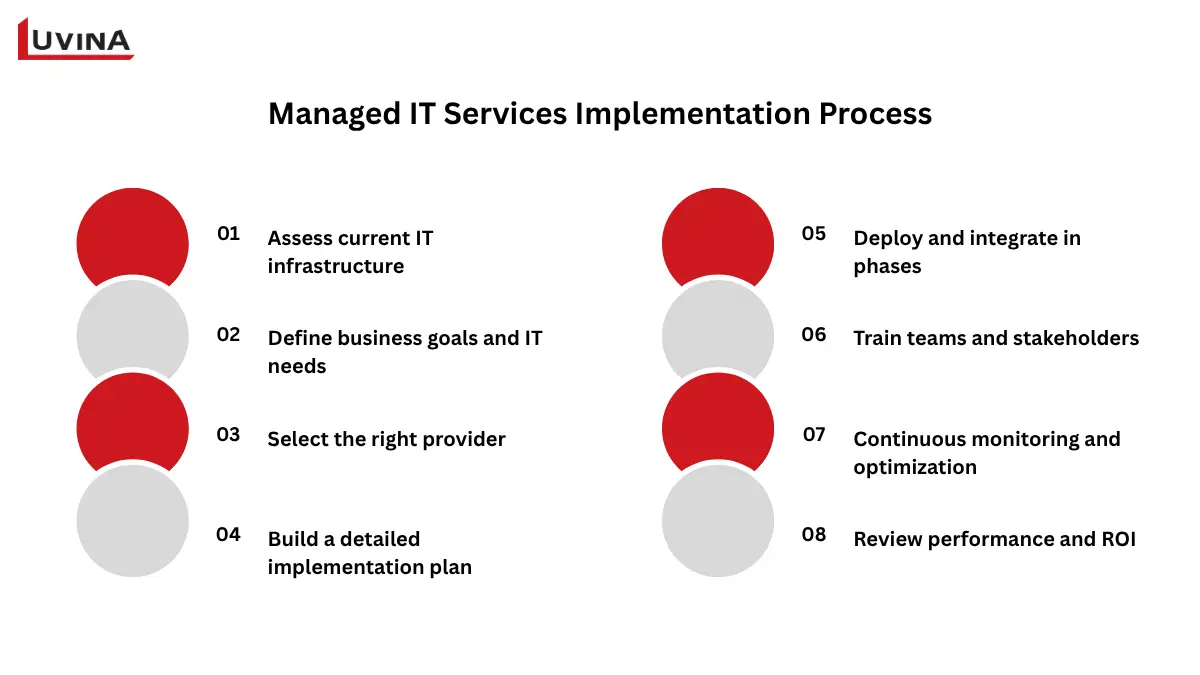
Steps to implement managed IT service
Assess current IT infrastructure
This step requires mapping how systems actually interact across the factory – from ERP and MES to network layers and data flows. The goal is to identify hidden risks, legacy bottlenecks, and dependencies that could affect integration.
Define business goals and IT needs
Instead of vague goals, manufacturers need specific outcomes: reduce downtime by X%, improve system uptime, or enable real-time production tracking. This step connects IT decisions directly to operational priorities, ensuring the implementation is not just technical but strategic.
Select the right provider
At this stage, the provider becomes part of your operation, not just a vendor. Beyond technical skills, they must understand production environments, compliance requirements, and system interdependencies. This is critical for making managed IT services for manufacturing work effectively in real-world conditions.
Build a detailed implementation plan
A strong plan defines timelines, milestones, system dependencies, and fallback scenarios. It must include data migration strategies, integration sequences, and risk mitigation plans. Most importantly, it should be designed to avoid disrupting live production environments.
Deploy and integrate in phases
Systems are rolled out gradually, testing each layer before moving forward. This phased approach reduces risk, ensures compatibility, and allows teams to adapt without interrupting daily operations.
Train teams and stakeholders
Training should be practical and role-based, covering both daily usage and issue handling. This reduces reliance on IT teams and speeds up adoption across departments.
Continuous monitoring and optimization
After deployment, the real work begins. Systems are continuously monitored for performance, security, and stability. Issues are identified early, and improvements are made over time to keep everything aligned with production needs.
Review performance and ROI
Regular reviews measure uptime, cost efficiency, and operational impact. These insights help refine the system and ensure long-term value. With managed IT services for manufacturing, this becomes an ongoing cycle of improvement rather than a one-time implementation.
FAQ
1. How much do managed IT services cost for a manufacturing company?
Costs vary based on system complexity, company size, and risk level. Most manufacturers pay a fixed monthly fee, typically ranging from moderate to higher tiers depending on service scope.
2. Will managed IT services slow down our critical manufacturing systems?
No. They are designed to improve speed and stability. Only poorly planned implementations may cause short-term issues.
3. Can we transition to managed services without shutting down production?
Yes. A phased rollout and parallel operations allow systems to transition without interrupting production.
4. Do managed IT services work for small manufacturing companies?
Yes. They give small manufacturers access to advanced technology and expertise without the cost of a full in-house IT team.
Conclusion
Manufacturing today requires IT that can keep up with production speed, data flow, and constant change. While managing this internally is increasingly complex, managed IT services for manufacturing have become a practical solution. By shifting to a proactive model, businesses can reduce downtime, improve security, and create a more predictable cost structure.
If you’re looking for a partner who understands manufacturing environments, Luvina can help. Contact us to explore how we can support your operations.
Resources
- https://www.indeed.com/career-advice/career-development/it-for-manufacturing
- https://www.projectmanagertemplate.com/post/managed-it-services-for-manufacturing-driving-efficiency
- https://www.linkedin.com/pulse/manufacturing-cfo-guide-managed-roi-cost-control-2025-teplinskiy-lqs0e
READY TO START A PROJECT?
Our experts are eager to explore your needs.

Read More From Us?
Sign up for our newsletter
Read More From Us?
Sign up for our newsletter