




RPA vs Traditional Automation: Key Differences Explained


Many enterprises struggle with automation because they choose the wrong approach for the wrong processes.
When comparing RPA vs traditional automation, the real question isn’t which technology is better, but which one fits your business processes, systems, and long-term strategy.
Traditional automation has powered enterprise systems for decades through APIs and backend integration. Meanwhile, Robotic Process Automation (RPA) has emerged as a faster, more flexible approach that works across systems without requiring major infrastructure changes.
So how do you decide between them?
In this guide, we break down:
- – Key differences between RPA and traditional automation
- – Cost, scalability, and implementation trade-offs
- – When to use each approach (and when to combine them)
- – How intelligent automation is changing the landscape
Understanding RPA
Before comparing RPA vs traditional automation, you should understand what is RPA first. Robotic Process Automation (RPA) is a type of automation that uses software “bots” to mimic how humans interact with digital systems. Instead of relying on complex back-end coding, these bots operate on the user interface – clicking, typing, copying data, and completing tasks just like a person would. What makes RPA different from legacy automation is how RPA works across systems without requiring major changes to existing infrastructure.
In practice, RPA works by observing human actions, translating them into automated workflows, and then executing those workflows independently. This means tasks that once required constant human involvement can now run continuously, with greater consistency and speed. As businesses continue evaluating RPA vs traditional automation, RPA stands out as a more agile and scalable solution for today’s dynamic operational needs.
Traditional Automation Defined
Traditional automation is the use of predefined rules and scripts to handle repetitive tasks with minimal human involvement. It connects systems at the back-end through APIs, allowing applications to communicate and exchange data efficiently. This method is commonly used for tasks like data entry or order processing, where processes are stable and predictable. In the context of RPA vs traditional automation, this back-end integration is a key difference, as traditional automation does not rely on user interface interactions.
Traditional automation is also closely linked to Business Process Automation (BPA), which focuses on optimizing entire workflows across an organization. This is where the RPA vs BPA comparison becomes relevant, as BPA represents a broader, more structured approach built on traditional automation foundations.
RPA vs Traditional Automation: Key Differences
When comparing RPA vs traditional automation, the core difference lies in how each approach is designed and applied. Traditional automation focuses on back-end integration using APIs and custom code, making it reliable for stable, rule-based processes. In contrast, RPA uses software bots that interact directly with user interfaces, mimicking human actions across multiple systems.
Another key difference is in implementation and scalability. Traditional automation often requires significant development time, deep technical expertise, and ongoing IT involvement. RPA, however, can be deployed faster using low-code or no-code tools, reducing dependency on developers. This distinction is often highlighted in discussions like RPA vs scripting automation, where RPA simplifies automation without sacrificing performance.
To make these differences clearer, the table below provides a side-by-side comparison based on key business and technical factors:
| Traditional automation | RPA | |
|---|---|---|
| Implementation time | Months to years | Weeks |
| Flexibility | Low, rule-based | High, adaptable |
| Setup complexity | High (requires coding) | Low (drag-and-drop tools) |
| Integration | API-based, needs system changes | Works across apps without changes |
| Scalability | Costly and complex | Easy and cost-efficient |
| Maintenance | Requires IT specialists | Minimal IT involvement |
| Human-like interaction | No | Yes (via UI) |
| Error reduction | Moderate | Significant improvement |
Short comparison table: RPA vs traditional automation
The Cost Comparison
When evaluating RPA vs traditional automation, cost is often one of the most critical factors for decision-making.
Traditional automation usually requires a high upfront investment in development, as it depends heavily on custom coding, system integration, and skilled developers. While the initial setup can sometimes appear manageable, long-term maintenance becomes expensive. Any system change often requires reprogramming, and businesses may face additional costs if key technical staff leave or systems need major updates.
RPA follows a different cost structure. It typically involves licensing or subscription fees, along with initial setup costs for configuring bots and training staff. However, one of the key benefits of robotic process automation is its adaptability. Once deployed, RPA bots can be updated or scaled with less effort, reducing dependency on continuous development work. This makes RPA more cost-effective over time, especially in environments where processes frequently change.
Here is a simplified comparison:
| Traditional automation | RPA | |
|---|---|---|
| Initial setup | High development cost (custom code) | Moderate (tools + setup) |
| Licensing | Low or none | Ongoing subscription fees |
| Maintenance | High (requires developers) | Lower (easier updates) |
| Scalability cost | Expensive to expand | Cost-efficient scaling |
| Training | Less frequent but technical | Required for tools and management |
| Long-term cost | Increases over time | More cost-effective overall |
Differences in the pricing model of each approach
When to Choose RPA
RPA is most suitable in the following scenarios:
- Your business uses multiple software systems that do not easily integrate
- Tasks are repetitive, rule-based, and consume significant manual effort (e.g., data entry, form processing)
- You need a fast deployment without changing the existing infrastructure
- Building APIs is too expensive or not feasible
- You prefer low-code or no-code solutions that reduce dependency on IT teams
- Processes involve large volumes of data but follow simple logic
- Industries like banking, insurance, logistics, or healthcare, where reducing human error and improving efficiency are critical.
One common challenge with RPA is UI dependency. If an application interface changes frequently, bots may require reconfiguration and monitoring to maintain reliability.
When to Choose Traditional Automation (BPA/APIs)
Not every automation need requires flexibility; some demand stability, control, and deep system integration. In cases where processes are predictable and rarely change, traditional automation becomes a more suitable choice. This is where the conversation shifts – RPA vs traditional automation isn’t about which is better overall, but which fits your system architecture and long-term goals.
Traditional automation (including BPA and API-based integration) is the right choice when:
- Processes are stable, clearly defined, and do not change frequently
- Your IT team can handle coding, scripting, and system-level integrations
- Deep integration with legacy systems is required
- Both systems already have APIs or can be equipped with APIs
- High processing speed and system reliability are critical
- You are dealing with large volumes of data that require consistent, error-free execution
RPA vs APIs: The Increasingly Critical Distinction
Many enterprises are now moving from standalone RPA toward hyperautomation, where RPA, AI, APIs, and workflow orchestration are combined into a unified automation ecosystem.
The difference between RPA and APIs comes down to how automation interacts with systems: front-end vs back-end. APIs enable direct system-to-system communication through the back-end, allowing applications to exchange data quickly and reliably. RPA, in contrast, operates on the front-end, mimicking human actions on the user interface to complete tasks. When viewed through the broader lens of RPA vs traditional automation, this distinction explains why RPA is often used for task-level automation, while APIs are preferred for deeper system integration.
RPA becomes especially valuable when APIs are unavailable or difficult to build. This is where the robotic automation benefits over legacy tools are most visible—faster deployment, less dependency on coding, and the ability to automate without changing infrastructure. Meanwhile, APIs are designed for environments where systems need to communicate directly, making them ideal for handling large volumes of structured data with speed and consistency.
| RPA | APIs | |
|---|---|---|
| Interaction layer | Front-end (UI-based) | Back-end (system integration) |
| Functionality | Mimics human actions to automate tasks | Connects systems and automates data exchange |
| Data handling | Works with structured & semi-structured data | Requires structured data via APIs |
| Implementation | Low-code/no-code, quick to deploy | Requires development and system design |
| Scalability | Scales by adding bots | Handles high-volume parallel processing |
| Maintenance | Affected by UI changes | Stable with version-controlled updates |
| Cost | Lower upfront, scales with usage | Higher initial development cost |
What is the difference between RPA and APIs?
The choice between RPA vs traditional automation (APIs) depends on your specific use case.
– RPA is the right option when you need to automate manual, repetitive tasks across systems that lack APIs or cannot be easily integrated.
– APIs are more suitable when automation must be embedded directly into the system architecture, especially for real-time data exchange and high-performance requirements.
Importantly, many organizations do not choose between the two—they combine them. APIs handle system connectivity and data flow, while RPA executes tasks across interfaces. This hybrid approach allows businesses to automate end-to-end processes more effectively, balancing flexibility with reliability.
Many enterprises initially adopt RPA to achieve quick wins, then gradually replace some automations with APIs or workflow orchestration for better long-term maintainability.
Intelligent Automation vs RPA
Automation is evolving, from systems that simply follow rules to systems that can learn and decide. If RPA handles execution, then Intelligent Automation (IA) brings in intelligence by combining RPA with AI, Machine Learning (ML), NLP, and OCR. This shift changes how businesses think about automation itself. In many ways, the conversation is no longer just about choosing tools, but redefining strategy, moving beyond RPA vs traditional automation toward something more adaptive and future-ready.
Instead of treating automation as a set of fixed instructions, IA allows systems to process both structured and unstructured data, recognize patterns, and continuously improve performance. That’s where the gap between task automation and decision automation becomes clear. If you’ve ever compared intelligent automation vs RPA, the difference is simple:
RPA = “doing,” AI = “thinking,” and IA = the combination of both
This evolution also explains why newer comparisons like RPA vs AI agent are gaining attention. RPA bots are designed to replicate human actions step by step, but AI agents go further. They can interpret information, generate insights, and take actions more autonomously. When these capabilities are combined within IA, businesses gain systems that are not only faster but also smarter and more resilient.
Looking at the bigger picture, automation has progressed through clear stages: from basic scripts, to RPA-driven efficiency, and now to intelligent, end-to-end automation. If RPA vs traditional automation was once about efficiency and cost, IA shifts the focus to adaptability, decision-making, and continuous improvement.
Intelligent Automation expands what’s possible. The result is a new generation of automation – one that doesn’t just follow instructions, but actively supports smarter business decisions.
Decision Framework: RPA vs Traditional Automation
Choosing between automation approaches isn’t always a binary decision. In many cases, the right answer lies in understanding your business context, and sometimes even combining both. Instead of asking “which is better,” a more practical way is to follow a structured framework that helps you evaluate RPA vs traditional automation based on real needs.
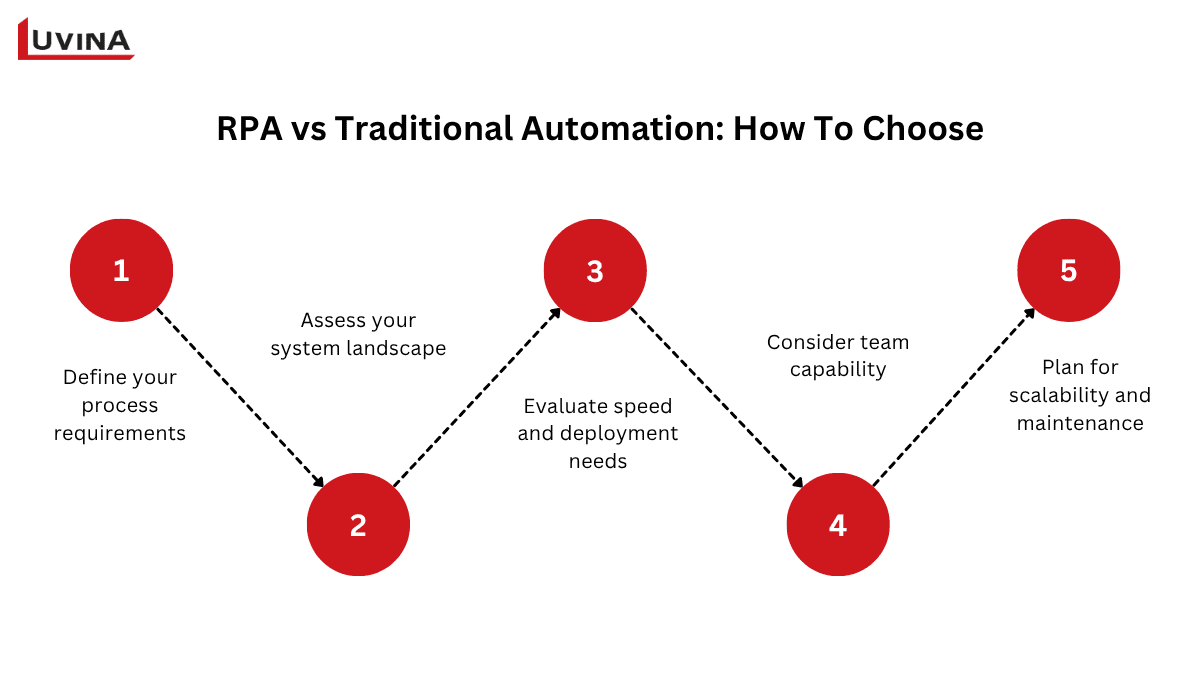
Steps to choose between RPA and traditional automation
Step 1. Define your process requirements
Start with clarity: is your process simple and repetitive, or complex and logic-heavy? If tasks are rule-based but stable, traditional automation may be sufficient. If they involve multiple systems or frequent changes, RPA is often a better fit.
Step 2. Assess your system landscape
Look at your existing systems. If APIs are available and deep integration is required, traditional automation works well. If systems are disconnected or lack APIs, RPA can bridge the gap by working directly on the interface.
Step 3. Evaluate speed and deployment needs
If you need quick results, RPA has the advantage with faster setup and lower technical barriers. Traditional automation typically requires more time for development, testing, and deployment.
Step 4. Consider team capability
Your team’s skill set matters. Strong development resources can support API-based automation. If you want to reduce dependency on coding, RPA’s low-code approach is more accessible.
Step 5. Plan for scalability and maintenance
Think long-term. Traditional automation is stable but harder to scale and update. RPA is easier to expand across processes, but it may require monitoring when interfaces change.
Key factors to keep in mind when considering RPA vs traditional automation
– Budget: RPA often has lower initial setup costs, while traditional automation may require higher upfront investment
– Timeline: For faster deployment, RPA is typically the better choice
– Process complexity: Fixed, logic-heavy workflows suit traditional automation; dynamic processes suit RPA
– Integration needs: RPA works well across multiple platforms without deep integration
– Maintenance and growth: Consider how easily the solution can adapt as your business evolves
– Hybrid potential: In many real-world cases, combining both approaches delivers better results
Decisions around RPA vs traditional automation should be driven by how well each approach aligns with your systems, team, and long-term goals. A flexible mindset, rather than a fixed choice, often leads to the most effective automation strategy.
The Hybrid Approach: Using Both Together
In practice, automation is rarely an either-or choice. Many organizations achieve better results by combining approaches – using APIs or BPA for core system integration, and RPA for the “last mile” where systems are fragmented or lack connectivity.
A common strategy is to start with RPA as a quick solution. Bots can automate manual tasks immediately without changing existing systems. At the same time, businesses can build API-based integration in parallel for long-term stability. Once the integration is complete, RPA can be scaled down or “retired,” leaving behind a more optimized and fully connected process. This staged approach balances speed and sustainability.
The hybrid approach also creates a more balanced automation strategy. Instead of choosing between flexibility and stability, organizations can leverage both: using RPA for speed and adaptability, and traditional automation for deep integration and long-term performance.
Industry-Specific Considerations
Each sector has different requirements in terms of system complexity, data volume, and process stability. That’s why decisions around RPA vs traditional automation should always consider how automation is applied within specific operational environments, rather than relying on a one-size-fits-all approach.
| Industry | How they help | RPA use cases | Traditional automation use cases |
|---|---|---|---|
| Banking and Finance (BFSI) | RPA helps connect legacy systems quickly and reduce manual errors, while traditional automation ensures stability for high-volume financial operations | Customer onboarding, KYC, fraud detection, invoice processing | Batch processing, trade reconciliation, core ledger updates |
| Healthcare | RPA speeds up administrative tasks, allowing staff to focus on patient care; traditional automation supports structured, backend processes | Patient scheduling, insurance claims, EHR data transfer | Pharmacy logistics, lab systems, billing management |
| Manufacturing | Traditional automation dominates core operations, while RPA acts as a connector between systems | Invoicing, purchase orders, freight auditing (office-level tasks) | Production lines, supply chain, ERP workflows |
| Retail and Logistics | RPA enables fast scaling during peak demand; traditional automation ensures operational consistency | Inventory tracking, shipment scheduling, reporting | Warehousing systems, conveyor belts, parcel sorting |
| Insurance | RPA works effectively across multiple legacy systems, while traditional automation maintains secure, high-volume processing | Policy renewals, underwriting support, claims processing | Core policy administration systems |
How should different industries choose?
Example:
A logistics company uses RPA to extract shipment data from emails and update systems automatically. At the same time, APIs connect warehouse systems for real-time inventory updates. This combination improves both speed and accuracy.
Across industries, the pattern remains consistent: RPA supports flexibility and quick deployment at the process level, while traditional automation ensures stability and performance at the system level. This reinforces the idea that RPA vs traditional automation is best evaluated based on industry-specific needs and use cases.
RPA vs Traditional Automation (Quick Summary)
- Use RPA when you need speed, flexibility, and cross-system automation without heavy development
- Use traditional automation when you need deep system integration, stability, and high-performance processing
- Combine both when building a scalable, long-term automation architecture
FAQs – Commonly Asked Questions About RPA
1. Is RPA cheaper than traditional automation?
Yes. RPA is usually cheaper and faster to implement at the initial stage.
2. Can RPA replace traditional automation entirely?
No. They serve different purposes and are often combined in a hybrid approach.
3. How long does RPA implementation take vs traditional automation?
RPA can be deployed in weeks, while traditional automation typically takes longer.
4. Should we use RPA or APIs for system integration?
It depends on your systems and goals. A common approach is API-first, using RPA when needed.
5. Can we start with RPA and migrate to traditional automation later?
Yes. Many businesses begin with RPA and transition to API-based automation over time.
Conclusion
If you look at the debate from a practical angle, RPA vs traditional automation is less about choosing a winner and more about understanding the strengths of each. Traditional automation works best for stable, high-volume processes that require precision and consistency. RPA stands out in dynamic environments where speed, adaptability, and cross-system interaction are critical.
If your priority is quick wins and operational efficiency → start with RPA
If your priority is system-level optimization and long-term architecture → invest in APIs/traditional automation
If your goal is end-to-end transformation → combine both
Choosing between RPA and traditional automation is not just a technical decision. It directly impacts cost, scalability, and operational efficiency.
At Luvina, we help businesses:
– Identify the right automation approach (RPA, APIs, or hybrid)
– Design scalable automation architecture
– Implement solutions aligned with long-term business goals
Talk to our experts to find the right strategy for your organization. to see how RPA can deliver measurable ROI for your operations.
Resources
- https://www.rockeye.africa/rpa-vs-traditional-automation-why-robotic-process-automation-is-the-future/
- https://www.ibm.com/think/topics/rpa
- https://www.automationanywhere.com/rpa/intelligent-automation-vs-rpa
- https://www.blueprism.com/resources/blog/rpa-vs-apis/
READY TO START A PROJECT?
Our experts are eager to explore your needs.

Read More From Us?
Sign up for our newsletter
Read More From Us?
Sign up for our newsletter