




RPA vs AI Agent: What’s the Difference?


Not long ago, business automation mostly meant one thing: software bots handling repetitive tasks like copying data, processing invoices, or updating spreadsheets. Today, the conversation has shifted from simple automation to intelligent systems that can analyze information, make decisions, and even complete multi-step workflows on their own. That’s why the topic of RPA vs AI agent is becoming increasingly important for modern businesses
So, what exactly is the difference between RPA and AI agents? When should businesses use one over the other? And can they work together rather than compete? In this article, we’ll simply break down the key differences, use cases, and benefits of both technologies.
What Is Robotic Process Automation (RPA)?
Robotic Process Automation (RPA) is a technology that uses software bots to automate repetitive, rule-based tasks in digital systems. These bots mimic human actions such as clicking, typing, copying data, filling forms, or transferring information between applications. Businesses commonly use RPA for tasks like data entry, invoice processing, email management, appointment booking, and system monitoring.
One of the biggest strengths of RPA is its ability to handle structured data and predictable workflows with high speed and accuracy. In the discussion of RPA vs AI agent, RPA is often the better choice for stable processes that require consistency rather than decision-making. However, RPA has clear limitations, such as scalability, struggling with unstructured data (images, reports, or emails containing mixed content), or being unable to think, learn, or adapt to unexpected situations.
What Are AI Agents? (Definitions & Categories)
AI agents are intelligent software systems designed to complete tasks, make decisions, and interact with users or digital systems with minimal human intervention. Unlike traditional automation tools that only follow fixed instructions, AI agents use technologies such as Large Language Models (LLMs), machine learning, and natural language processing (NLP) to understand context, reason through problems, and adapt to changing situations.
One of the biggest differences in the RPA vs AI agent discussion is that AI agents can handle dynamic and less predictable tasks that traditional automation struggles with. Today, AI agents focus on specific domains or defined tasks rather than possessing full human-like intelligence. Examples include AI customer service chatbots, virtual assistants like Siri or Google Assistant, predictive analytics tools, and deep research systems that can generate detailed reports from high-level instructions. AI agents may also introduce governance challenges related to hallucinations, explainability, and data privacy, especially in regulated industries.
AI agents can generally be grouped into 3 categories:
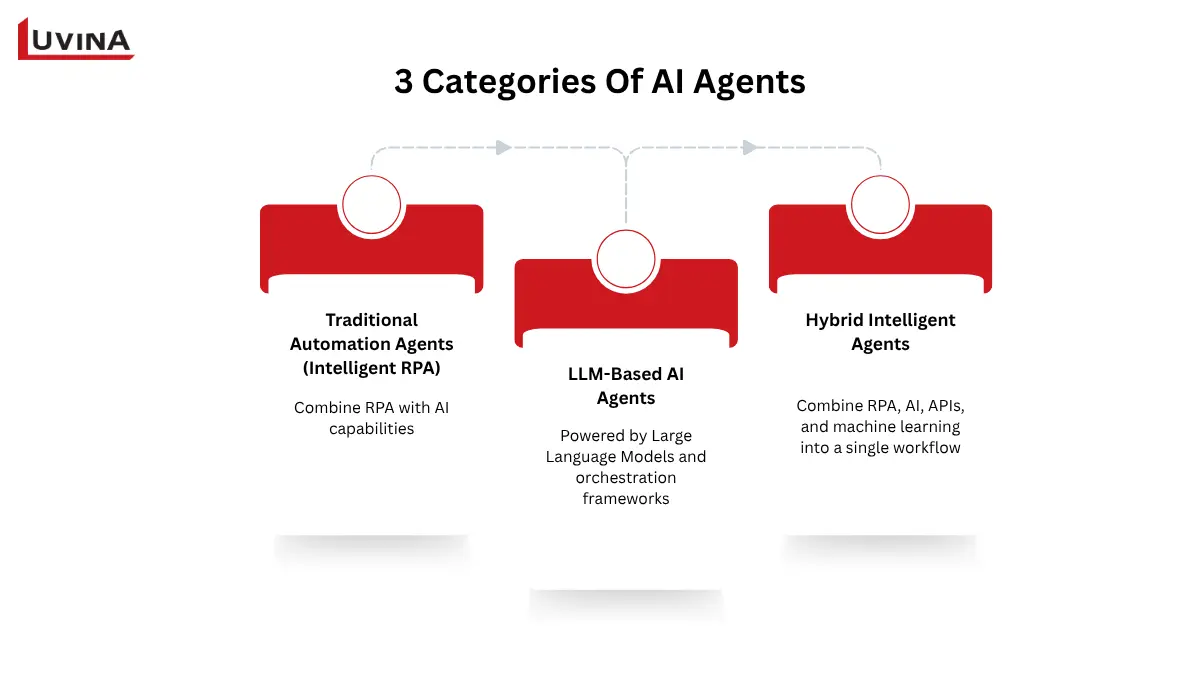
AI agents can be divided into these 3 categories
– Traditional Automation Agents (Intelligent RPA): Combine RPA with AI capabilities to make automation more flexible.
– LLM-Based AI Agents: Powered by Large Language Models and orchestration frameworks such as LangChain or Microsoft AutoGen.
– Hybrid Intelligent Agents: Combine RPA, AI, APIs, and machine learning into a single workflow. This approach helps bridge the difference between RPA vs AI agent by combining the speed of automation with the adaptability of AI.
Comprehensive Comparison: RPA vs AI Agents
Many enterprises adopt a human-in-the-loop approach where AI agents suggest actions while RPA executes only after approval.
Although both technologies focus on automation, they are built for very different purposes. RPA is designed to automate repetitive and rule-based tasks, while AI agents are created to handle dynamic workflows that require reasoning, adaptability, and decision-making.
Intelligence and flexibility
In the debate around RPA vs AI agent, the biggest distinction lies in intelligence and flexibility. RPA bots strictly follow predefined rules and workflows. They work best in stable environments where processes rarely change. In contrast, AI agents can analyze context, learn from data, interact naturally with users, and adapt to new situations with minimal human intervention.
Data handling
Another major point in the difference between RPA and artificial intelligence is data handling. RPA mainly processes structured data such as forms, spreadsheets, and databases. AI agents, however, can work with structured, semi-structured, and unstructured data, including emails, PDFs, images, reports, and natural language conversations.
Speed and performance
RPA often delivers faster and more predictable execution for repetitive tasks because it follows fixed workflows without deviation. AI agents may require more processing time due to reasoning and contextual analysis, but they provide greater flexibility for multi-step and evolving tasks.
Accuracy and error handling
RPA can achieve very high accuracy in stable environments, but even small workflow or interface changes may cause failures. AI agents are generally more resilient because they can adapt to changing inputs and learn from feedback over time. This adaptability is one reason many organizations are shifting their focus toward RPA vs AI agent comparisons when planning long-term automation strategies.
Below is a detailed comparison table highlighting the key differences between RPA and AI agents across multiple business and technical areas:
| RPA | AI Agents | |
|---|---|---|
| Capability and adaptability | Rule-based automation with limited flexibility | Goal-driven systems that can learn, adapt, and make decisions |
| Speed and performance | Fast and efficient for repetitive tasks | Better for complex workflows, but may require more processing time |
| Accuracy and error handling | Highly accurate in stable environments but sensitive to workflow changes | More adaptable to changing inputs and unexpected scenarios |
| Learning curve and team skills | Easier for business teams to adopt and manage | Requires AI, ML, NLP, and orchestration expertise |
| Scalability and flexibility | Scales well for repetitive tasks but requires reprogramming for changes | More flexible and scalable for evolving business processes |
| Data requirements | Best for structured data | Handles structured, semi-structured, and unstructured data |
| Human interaction | Limited contextual understanding | Supports conversational and context-aware interactions |
| Decision-making | Follows predefined if/then rules | Performs reasoning and contextual decision-making |
The difference between RPA and AI Agents
When to Choose RPA
One of the biggest benefits of robotic process automation is its ability to reduce manual work while maintaining high accuracy and compliance across large volumes of repetitive operations. In many discussions around RPA vs AI agent, RPA stands out as the more practical solution for stable workflows that do not require reasoning, contextual understanding, or independent decision-making.
Choose RPA in these scenarios:
– Automating repetitive back-office tasks such as data entry, invoice processing, and record updates
– Moving structured data between systems with fixed workflows
– Generating compliance or regulatory reports where consistency and auditability are critical
– Handling financial reconciliations, payroll updates, or inventory management processes
– Integrating legacy systems that lack modern APIs or direct integrations
– Automating tasks with predefined rules and minimal workflow changes
– Reducing human errors in high-volume operational processes
– Improving efficiency for processes that require identical execution every time
RPA is especially valuable for businesses that prioritize reliability, predictability, and operational consistency.
When to Choose AI Agents
In the broader conversation around RPA vs AI agent, AI agents are especially valuable for goal-driven workflows that require judgment, problem-solving, and continuous adaptation instead of repetitive execution.
Choose AI agents in these scenarios:
– Handling unstructured data such as emails, contracts, reports, PDFs, or customer conversations
– Automating workflows that require decision-making and contextual understanding
– Building intelligent customer support systems with personalized interactions
– Analyzing customer sentiment, intent, or behaviour across multiple channels
– Managing complex processes like loan approvals, contract analysis, or fraud detection
– Supporting dynamic pricing, recommendations, or predictive analytics
– Generating summaries, insights, or personalized responses from large amounts of content
– Detecting anomalies or exceptions that fall outside predefined rules
– Automating multi-step workflows that require planning and autonomous actions
– Adapting to new data formats or workflow changes without constant reprogramming
Compared with traditional automation approaches like RPA vs machine learning, AI agents offer much greater flexibility because they can improve over time through learning and feedback loops. They are particularly effective in situations where processes change frequently or where human-like reasoning is required.
Can RPA and AI Agents Work Together? (Hyperautomation Strategy)
The future of automation is not about choosing one technology over another. Many modern businesses combine RPA vs AI agent to build smarter, end-to-end automation workflows. Instead of competing, these technologies complement each other by handling different parts of a business process.
This combined model is often called Intelligent Process Automation (IPA) or hyperautomation. Comparing hyperautomation vs RPA, hyperautomation goes beyond simple task automation by integrating AI, machine learning, NLP, analytics, and RPA into a unified workflow.
A hybrid automation model works especially well when workflows contain both predictable and dynamic elements. Common examples include:
– Data extraction: RPA processes structured forms, while AI agents interpret unstructured documents or emails
– Automated email responses: AI agents understand intent and personalize replies, while RPA sends standardized follow-up actions
– Customer service workflows: AI chatbots interact with customers, then RPA retrieves order details or updates systems
– Insurance claims processing: AI agents analyze uploaded documents, while RPA handles repetitive validation and record updates
– IT support automation: AI agents diagnose issues, while RPA performs password resets or routine maintenance tasks
– Supply chain management: AI predicts disruptions or demand changes, while RPA updates inventory systems and purchase orders
This is where the practical value of RPA vs AI agent becomes much clearer. Businesses do not always need to replace RPA with AI. Instead, AI agents can enhance existing automation systems by adding intelligence, adaptability, and contextual understanding to structured workflows already powered by RPA.
Organizations building long-term automation strategies should focus on combining the strengths of both technologies. As businesses scale automation initiatives, the conversation around RPA vs AI agent is shifting toward orchestration rather than replacement. Companies that successfully combine both technologies can achieve faster response times, improved scalability, lower operational costs, and more intelligent end-to-end business processes.
RPA vs AI Agent: Cost & ROI Comparison
While both RPA and AI agents can reduce manual work and improve operational efficiency, their pricing models, maintenance needs, and long-term ROI structures are very different.
In many RPA vs AI agent evaluations, RPA is often more cost-effective for repetitive, high-volume workflows, while AI agents provide stronger long-term value for dynamic and decision-based processes. The right choice depends on workflow complexity, scalability requirements, and expected business outcomes.
Implementation costs
RPA generally has lower upfront implementation costs (no-follow) and faster deployment timelines for simple automation projects. AI agents typically require larger initial investments because they involve machine learning models, orchestration frameworks, prompt engineering, and testing processes.
| RPA | AI agents | |
|---|---|---|
| Platform licensing | $8,000 – $15,000 per bot annually | $20,000 – $50,000 annually for enterprise deployment |
| Development costs | $5,000 – $15,000 per process automation | $15,000 – $30,000 for setup, training, and integrations |
| Infrastructure | Moderate server and orchestration requirements | Higher computing resources for AI and ML operations |
| Training and expertise | $2,000 – $5,000 per developer | $10,000 – $20,000 for AI-specific expertise and knowledge transfer |
The implementation costs of these two automation approaches differ significantly
Ongoing operational costs
Besides implementation costs, the operational costs of RPA and AI agents are also significantly different:
| RPA | AI agents | |
|---|---|---|
| Maintenance burden | High due to UI and workflow changes | Lower because AI systems can adapt dynamically |
| Annual maintenance | 20 – 30% of the initial development cost | 10 – 15% of the initial implementation cost |
| Reprogramming needs | Frequent manual updates required | Reduced manual intervention through learning capabilities |
| Per-transaction cost | Very low after deployment | Higher due to API and model usage costs |
| Scalability | Linear scaling with additional bots | Better economies of scale over time |
Operational costs should also be carefully considered
RPA usually delivers the strongest ROI for stable, high-volume processes because once bots are built, transaction costs become extremely low. AI agents are more economically beneficial for workflows involving reasoning, judgment, and unstructured data, even though their execution costs may be higher.
As the conversation around RPA vs AI agent continues to evolve, many organizations are adopting hybrid automation models to maximize ROI.
| Choose RPA if… | Choose AI Agents if… |
|---|---|
| Processes are repetitive | Workflows require reasoning |
| Data is structured | Data is unstructured |
| You need fast ROI | You need adaptability |
Implementation Complexity & Organizational Readiness
In many RPA vs AI agent projects, RPA is often easier to deploy because it follows predefined rules and works well with structured workflows. AI agents, meanwhile, require stronger data infrastructure, governance, and AI expertise due to their reasoning and adaptive capabilities.
Another important factor in the discussion around RPA vs AI agent adoption is organizational maturity. RPA works best in companies with stable, well-documented processes, while AI agents require businesses to manage unstructured data, support continuous optimization, and build trust in AI-driven decision-making.
AI agent projects also require prompt optimization, monitoring, and evaluation frameworks to ensure reliable outputs over time.
| RPA | AI Agent | |
|---|---|---|
| Implementation complexity | Lower complexity with rule-based workflows | Higher complexity due to AI models and orchestration |
| Deployment time | 8-19 weeks per process | 7-14 weeks per agent |
| Required skills | RPA developers, process analysts | AI, ML, NLP, orchestration expertise |
| Maintenance | Frequent manual updates | Continuous refinement and optimization |
| Governance | Basic IT governance | Advanced AI and data governance |
The key differences lie in implementation requirements and deployment complexity
Real-World Case Studies
Real business results show how RPA and AI agents create measurable impact across industries. In many real-world RPA vs AI agent implementations, organizations do not completely replace one technology with another.
Case Study 1: Financial Services
Vietcombank
The bank applied RPA to automate credit-processing workflows and reduce manual paperwork. As a result, processing time for loan applications reportedly decreased by up to 60% compared to traditional manual operations. The automation initiative also helped improve customer response times while minimizing operational errors.
HSBC
HSBC implemented software robots to automate financial reconciliation and data-processing tasks across multiple systems. This reduced thousands of hours of repetitive work annually, allowing employees to focus more on higher-value analysis and strategic activities instead of manual processing.
Case Study 2: Insurance Claims Processing
A U.S.-based Fortune 500 insurance carrier specializing in auto insurance and workers’ compensation faced growing pressure inside its claims mailroom. To solve this challenge, the company deployed an AI agent named “Roxy” as a digital coworker. The AI system automatically analyzed incoming claims documents, identified state-specific requirements, and sent the correct acknowledgment responses to policyholders.
The results were significant:
– 99% straight-through processing rate
– 60% increase in processing throughput
– Faster claim handling and improved customer experience
– 246% ROI achieved within six months
The success of the project encouraged the company to deploy another AI agent focused on document indexing and claims classification. This example clearly highlights how advanced AI-driven workflows can go beyond traditional automation capabilities in modern RPA vs AI agent environments.
Case Study 3: Manufacturing Operations
Manufacturing companies are increasingly combining RPA with AI technologies to build more adaptive operational systems. In many factories, RPA automates repetitive administrative tasks such as inventory updates, production reporting, and order processing, while AI systems handle demand forecasting, anomaly detection, and predictive maintenance.
This hybrid model improves real-time decision-making and enables businesses to monitor equipment performance more effectively. AI-powered analytics can identify operational risks or maintenance issues early, while RPA ensures backend systems are updated automatically and consistently.
The growing shift toward hybrid automation also reflects the broader evolution of intelligent automation vs robotic process automation. Rather than relying on standalone rule-based automation, businesses are integrating AI and RPA to create more scalable, intelligent, and resilient operational workflows.
Decision Framework
Choosing between RPA, AI agents, or a hybrid automation model should start with a clear understanding of your business processes, technical capabilities, and long-term goals. In many RPA vs AI agent decisions, businesses achieve better outcomes by combining short-term operational efficiency with long-term scalability and adaptability.
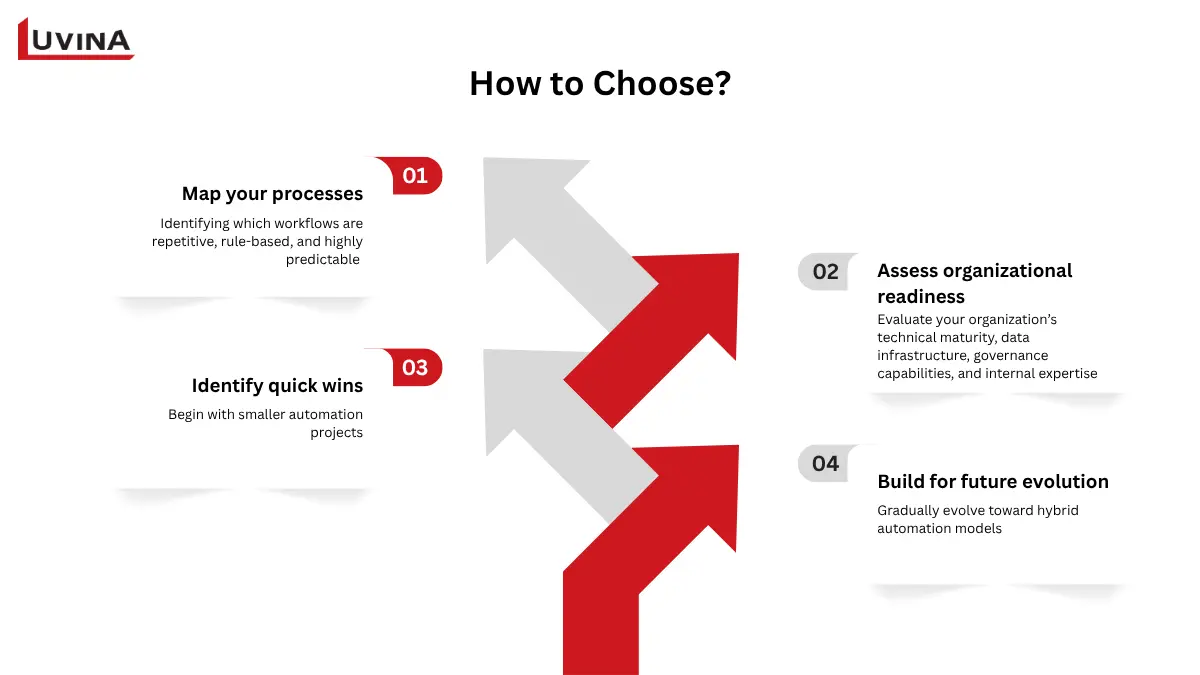
Steps to choose between RPA vs AI Agent
Step 1: Map your processes
Start by identifying which workflows are repetitive, rule-based, and highly predictable versus those requiring reasoning, contextual understanding, or decision-making. Structured tasks such as data entry, invoice processing, or system updates are often ideal for RPA, while customer interactions, document interpretation, and dynamic workflows are better suited for AI agents.
This process mapping stage is essential for understanding the difference between RPA and artificial intelligence in real operational environments.
Step 2: Assess organizational readiness
Evaluate your organization’s technical maturity, data infrastructure, governance capabilities, and internal expertise. Companies with stable workflows and limited AI resources may adopt RPA more easily, while AI agent initiatives usually require stronger data management, AI governance, and specialized technical skills.
Another important factor in successful RPA vs AI agent adoption is organizational culture. Teams must be prepared to trust automation systems and adapt workflows around new technologies.
Step 3: Identify quick wins (Typically RPA)
Most organizations begin with smaller automation projects that can generate fast ROI and operational improvements. RPA is often the preferred starting point because it is faster to deploy, easier to manage, and highly effective for repetitive administrative processes.
Quick-win projects may include:
– Invoice and payroll processing
– Data migration between systems
– Compliance reporting
– Customer record updates
– Automated notifications and approvals
These projects help businesses build automation experience before expanding into more advanced AI-driven workflows.
Step 4: Build for future evolution
Automation strategies should be designed with long-term scalability in mind. Rather than choosing only one technology, many organizations gradually evolve toward hybrid automation models where RPA manages structured execution tasks while AI agents handle reasoning, analysis, and contextual decision-making.
Common Misconceptions Addressed
As AI adoption grows rapidly, many businesses misunderstand the relationship between RPA and AI agents. Some believe RPA is becoming obsolete, while others assume AI agents can completely replace traditional automation. In reality, both technologies solve different business problems and often create the strongest results when combined.
As AI adoption grows rapidly, many businesses misunderstand the relationship between RPA and AI agents. Some believe RPA is becoming obsolete, while others assume AI agents can completely replace traditional automation. In reality, both technologies solve different business problems and often create the strongest results when combined.
Myth 1: “AI Agents Will Replace RPA”
One of the biggest misunderstandings in the RPA vs AI agent discussion is the belief that AI agents will eliminate the need for RPA. While AI agents are highly effective for reasoning, contextual understanding, and handling unstructured workflows, many business processes still rely heavily on repetitive, rule-based execution.
RPA remains extremely valuable for tasks requiring speed, consistency, compliance, and predictable outputs. Processes such as invoice handling, payroll updates, data migration, and backend system operations often do not need advanced AI decision-making to deliver strong business value.
Myth 2: “RPA Is Outdated”
Another common misconception in the evolving RPA vs AI agent landscape is that RPA is becoming obsolete. In reality, RPA is evolving into a foundational layer for intelligent automation rather than disappearing.
Today, many organizations use RPA as the operational backbone for enterprise workflows. RPA acts as the “digital hands” that execute repetitive tasks across systems, while AI technologies provide contextual understanding and decision-making capabilities. Instead of replacing RPA, AI is increasingly enhancing it through more adaptive and intelligent automation workflows.
Myth 3: “You Have to Choose One or the Other”
Many companies assume automation requires choosing either RPA or AI agents, but modern enterprises increasingly combine both technologies. In fact, the most effective automation strategies often emerge from hybrid models rather than isolated solutions.
In many enterprise RPA vs AI agent implementations, RPA handles repetitive execution tasks while AI agents manage reasoning, analysis, exception handling, and unstructured data processing. This combination allows businesses to automate end-to-end workflows more efficiently while balancing speed, intelligence, and scalability.
Future of Automation Technology
The automation market is rapidly evolving from simple task execution toward intelligent, adaptive automation ecosystems. In the broader RPA vs AI agent landscape, this shift is changing how organizations approach automation strategies.
The global RPA market is still expected to grow significantly and could reach around $13 billion by 2026. In Vietnam, RPA has already been widely adopted across banking, insurance, and logistics industries for operational efficiency and compliance management.
One of the biggest future trends is the evolution of RPA into hyperautomation. Rather than operating as standalone bots, RPA systems are increasingly being combined with technologies such as NLP, OCR, machine learning, and analytics to process more complex workflows and unstructured data. This transformation is reshaping the traditional RPA vs AI agent conversation into a broader discussion about intelligent automation ecosystems.
Between 2025 and 2030, many experts expect AI agents to become a central layer in digitally mature organizations. Instead of only automating execution tasks, AI agents will increasingly support governance, forecasting, analysis, decision-making, and even product innovation.
Ultimately, the future of automation lies in Intelligent Automation — the convergence of RPA, AI agents, IoT, and data analytics into a continuous cycle of data collection, decision-making, execution, learning, and optimization. This integrated model is expected to become the foundation for next-generation digital transformation strategies across industries.
FAQs
1. What is the difference between RPA and AI agents?
RPA automates repetitive, rule-based tasks using structured data, while AI agents can reason, learn, and handle unstructured data and dynamic workflows.
2. Is AI replacing RPA?
No. AI is enhancing RPA, not replacing it. RPA still plays an important role in repetitive and predictable processes.
3. Can RPA and AI agents work together?
Yes. Many businesses combine RPA and AI agents in hybrid automation models, where AI handles decision-making and RPA executes repetitive tasks.
4. Which is cheaper: RPA or AI agents?
RPA is usually cheaper for simple, high-volume tasks. AI agents may cost more upfront but can deliver better long-term value for complex workflows.
5. Are AI agents better than RPA?
Not necessarily. RPA is better for stable, rule-based tasks, while AI agents are better for adaptive and decision-driven workflows.
6. What skills do I need to implement RPA?
Key skills include process mapping, workflow analysis, RPA platform knowledge, basic coding, and exception handling.
7. What’s hyperautomation?
Hyperautomation combines RPA, AI, machine learning, and analytics to automate end-to-end business workflows more intelligently.
8. Which technology should I invest in first?
Most organizations start with RPA for quick ROI and stable automation, then expand into AI-driven automation as their digital maturity grows.
Conclusion
The difference between RPA and AI agents is not about which technology is better, but which one fits a specific business need. In many modern RPA vs AI agent strategies, businesses achieve the best results by using both technologies together rather than treating them as competing solutions. By combining the reliability of RPA with the adaptability of AI agents, businesses can build smarter, more scalable, and future-ready automation systems.
Successful automation strategies require more than deploying bots or AI models. Businesses need the right balance between process optimization, integration architecture, governance, and long-term scalability.
Luvina helps enterprises design automation strategies that combine RPA, APIs, and AI technologies into scalable business workflows aligned with operational goals.
Resources
- https://www.blueprism.com/resources/blog/agentic-ai-vs-rpa-vs-ai-agents-comparing/
- https://www.techtarget.com/searchenterpriseai/tip/Compare-AI-agents-vs-RPA-Key-differences-and-overlap
- https://www.linkedin.com/pulse/rpa-vs-ai-agents-automation-spectrum-from-john-rhodes-jxqoc/
- https://www.linkedin.com/pulse/rpa-vs-ai-agents-accounting-which-better-modern-finance-teams-fav8c/
- https://www.ey.com/en_gl/insights/financial-services/emeia/how-a-nordic-insurance-company-automated-claims-processing
- https://www.roots.ai/case-studies/insurance-claims-automation-ai-agent-straight-through-processing
- https://www.smartflow.ie/post/using-robotic-process-automation-in-the-manufacturing-industry
READY TO START A PROJECT?
Our experts are eager to explore your needs.

Read More From Us?
Sign up for our newsletter
Read More From Us?
Sign up for our newsletter