




What Is Factory Automation? Complete Beginner’s Guide


Imagine walking into a factory where machines communicate with each other, production lines run with minimal human intervention, and errors are detected before they even happen. That is no longer a vision of the future. It is the reality of modern manufacturing today.
As manufacturers face rising labor costs, stricter quality standards, and increasing market demands, adopting industrial automation technology has become a practical strategy for staying competitive. So, what is factory automation, and why are so many manufacturers investing in it?
In this beginner’s guide, we will explore the core types of factory automation, how automation systems work in real manufacturing environments, and the key benefits businesses can gain from implementing them.
What Is Factory Automation?
Factory automation is the use of technologies, machines, software, and control systems for manufacturing process automation and to reduce the need for manual work. The main goal is to improve productivity, reduce operational costs, maintain product quality, and streamline production processes.
Factory automation can be applied across the entire production cycle. Depending on the needs of a business, automation may support only one specific operation or cover the entire factory with minimal human involvement.
Why Manufacturers Invest in Automation
When businesses first started exploring what is factory automation, the goal was relatively simple. Manufacturers wanted machines and control systems to handle repetitive production tasks more accurately and consistently than manual operations. Over time, automation evolved from supporting individual machines to managing entire production lines with minimal human intervention.
Modern factories now combine robotics, sensors, industrial software, and automated manufacturing systems to streamline production activities from material handling to packaging and quality control. However, not every factory requires the same level of automation. Some businesses only automate repetitive tasks, while others build fully connected smart factories. To better understand what is factory automation in real manufacturing environments, let’s look at the 4 main types of factory automation systems commonly used today.
| Type | Characteristics | Best use cases | Examples |
|---|---|---|---|
| Fixed automation | Designed for repetitive and high-volume production with minimal variation | Mass production with stable demand | Automotive assembly lines, conveyor systems, paint processes, bottling plants |
| Programmable automation | Production settings can be changed through software reprogramming | Batch production and customized manufacturing | CNC machining centers, robotic welding cells, pick-and-place robots |
| Flexible automation | Supports fast product changeovers with minimal downtime | Mixed-model production and dynamic industries | Flexible manufacturing systems (FMS), AGVs, smart assembly lines |
| Integrated automation | Connects multiple systems and processes into one unified operation | Smart factories and connected manufacturing environments | SCADA systems, MES platforms, IoT-enabled production systems, PLM software |
The 4 main types of factory automation
How Factory Automation Works
Common industrial automation technologies include programmable logic controllers (PLCs), SCADA systems, MES platforms, industrial IoT sensors, and edge computing infrastructure.
To better understand what is factory automation, it is important to look at the core technologies behind modern production systems. The core components of factory automation typically include:
– Robotics and mechanical systems: Industrial robots, cobots, hydraulic systems, and pneumatic systems automate repetitive production tasks.
– Sensors and data collection: Sensors continuously collect real-time production data, such as temperature, pressure, speed, object detection, and material levels in real time and send it to control systems for analysis.
– Software and control systems (The “brain” of the factory): PLCs, industrial PCs, and AI systems coordinate machine operations and manage workflows automatically.
– AI and advanced analytics: AI tools analyze production data, optimize performance, and reduce downtime.
In real manufacturing environments, automation can operate in several ways. As part of digital transformation in manufacturing, modern automation systems connect machines, sensors, and software platforms into a centralized production environment. Sensors collect operational data, control systems analyze the information, and machines automatically adjust their actions based on real-time conditions. This helps manufacturers improve production accuracy, maintain stable quality, and optimize factory performance more efficiently.
Today, when businesses discuss what is factory automation, the focus is no longer only on replacing manual labor. Instead, automation helps create smarter factories where humans, machines, and digital systems work together to improve productivity, consistency, and operational flexibility.
Key Benefits of Factory Automation
Understanding what is factory automation also means understanding why so many manufacturers continue investing in automation technologies. Today, many companies use factory automation systems to streamline production workflows, reduce repetitive manual tasks, and build more scalable manufacturing operations. While the initial investment can be significant, the long-term operational benefits often deliver a strong return on investment.
Some of the biggest benefits of factory automation include:
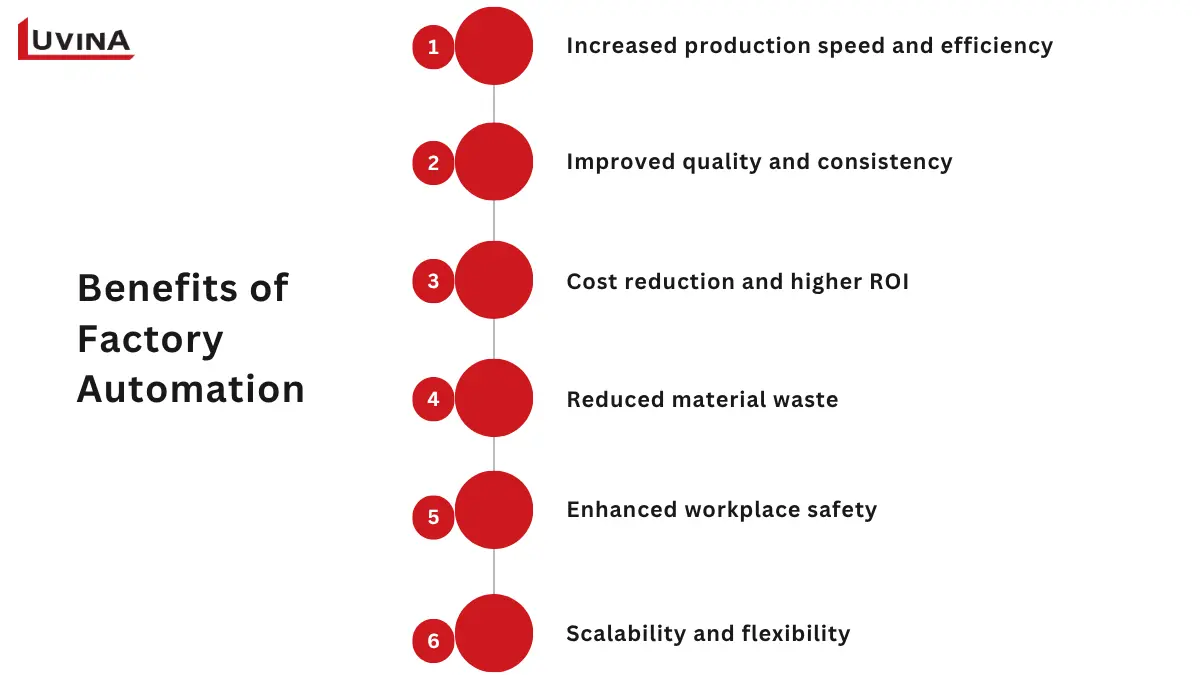
The key benefits of industrial automation technology
Increased production speed and efficiency
Automated systems can operate continuously without breaks, helping manufacturers increase output, reduce bottlenecks, and shorten production cycles.
Improved quality and consistency
For businesses researching what is factory automation, one major advantage is production accuracy. Automated machines perform repetitive tasks with consistent precision, reducing human error and maintaining stable product quality.
Cost reduction and higher ROI
Automation reduces downtime, labor costs, production errors, and material waste. Over time, these improvements help manufacturers lower operating costs and improve profitability.
Reduced material waste
Precise process control and automated material handling help minimize scrap, rework, and unnecessary resource consumption.
Enhanced workplace safety
Automation systems can handle hazardous tasks such as heavy lifting, chemical processing, or high-temperature operations, reducing workplace risks for employees.
Scalability and flexibility
Modern automation systems can adapt more easily to changing production demands, product variations, and growing operational requirements.
Factory Automation Examples Across Industries
To better understand what factory automation looks like in the real world, it is helpful to look at how different industries apply automation technologies in daily operations. While not every production process requires full automation, many industries rely heavily on automated systems to improve efficiency, maintain product quality, and handle large-scale production demands.
Today, advances in robotics, industrial software, and smart factory automation allow manufacturers to automate everything from assembly and quality inspection to packaging and material handling.
Automotive manufacturing
For companies exploring what is factory automation, the automotive sector is one of the clearest real-world examples. The automotive industry is one of the earliest adopters of factory automation. Modern production lines use automated systems to manufacture engine blocks, transmissions, dashboards, seats, and vehicle bodies with high precision.
Today, the industry operates more than 1 million industrial robots globally, with the US automotive sector using over 1,200 robots per 10,000 workers. These robots commonly handle welding, painting, assembly, and material handling tasks with speed and consistency that manual operations cannot easily achieve.
Electronics and semiconductor manufacturing
Electronics manufacturing relies heavily on automation because many components are extremely small and require precise positioning. One common example is printed circuit board (PCB) production, where automated systems place and assemble tiny electronic components with high accuracy.
Design files are uploaded directly into production systems, allowing machines to automatically configure tools and manufacturing instructions. This combination of industrial automation technology and robotics helps manufacturers improve speed, reduce defects, and maintain stable product quality throughout high-volume production.
Food and beverage production
The applications of automation in food and beverage play a key role in defining what is factory automation. Manufacturers use automation to improve production efficiency while maintaining strict hygiene and quality standards. Automated systems are commonly applied in packaging, material handling, cooking, mixing, and quality inspection processes.
Unlike many industries that focus on a limited product range, food manufacturers often need to switch between multiple products using the same production equipment. Automation allows these changes to happen quickly with minimal downtime.
Pharmaceutical and medical device manufacturing
Pharmaceutical and medical device production requires extremely high levels of accuracy, cleanliness, and quality control. Automation is widely used to manufacture surgical tools, implants, diagnostic equipment, and other sensitive medical products that require precise production standards.
Automated systems help maintain sterile manufacturing conditions while reducing human error during delicate production processes. In these industries, automation also improves product consistency and supports strict regulatory compliance requirements.
Implementing Factory Automation: Practical Considerations
Understanding what is factory automation is only the first step. Successfully implementing automation requires careful planning, realistic budgeting, and a clear understanding of production goals.
Below are some of the most important considerations when implementing factory automation systems.
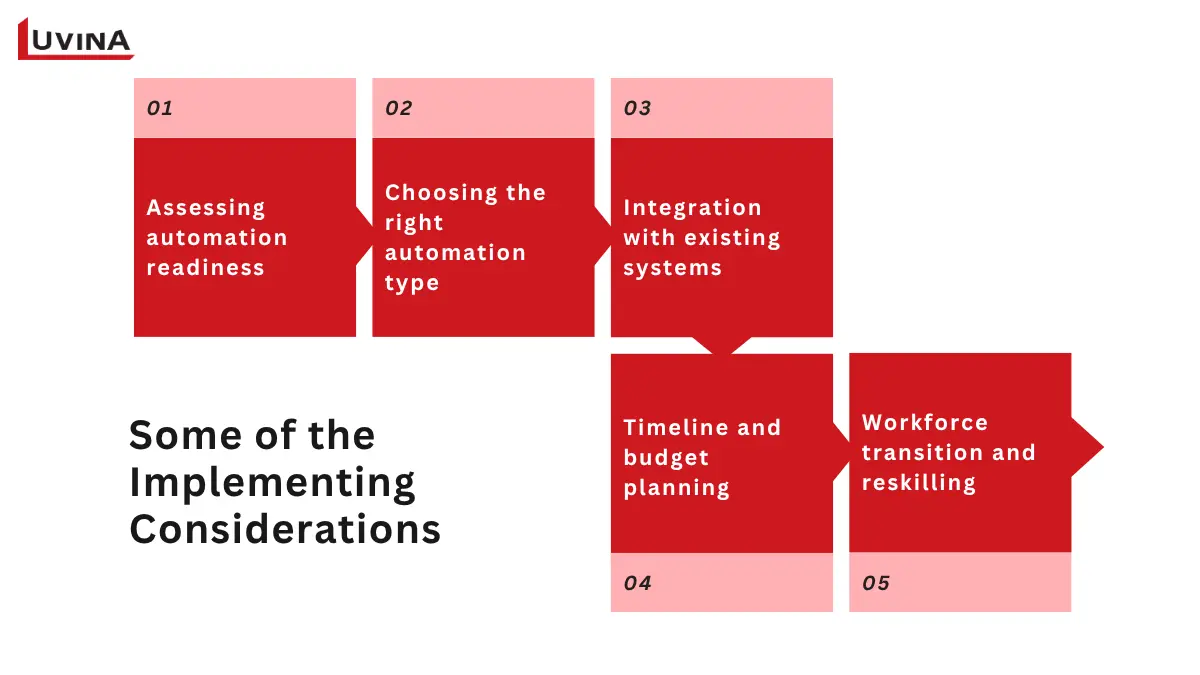
Understanding the key implementation considerations after learning what is factory automation
Assessing automation readiness
Before adopting automation, manufacturers should evaluate current production processes to identify bottlenecks, repetitive tasks, quality issues, and safety risks. This helps businesses prioritize the areas where automation can deliver the greatest operational impact.
Common assessment questions include:
– Which production stages slow down operations the most?
– Where do defects or quality issues frequently occur?
– Which tasks involve repetitive or hazardous work?
– What production volume justifies automation investment?
For companies researching what is factory automation, defining clear ROI goals is also important. Automation strategies should support measurable objectives such as increasing production capacity, improving product quality, reducing downtime, or lowering operating costs.
Choosing the right automation type
Different production environments require different automation approaches. Selecting the right system depends largely on production volume, product variety, and operational complexity.
– Fixed automation works best for high-volume and repetitive production.
– Programmable automation supports batch production with changing product configurations.
– Flexible automation allows quick product changeovers with minimal downtime.
– Integrated automation connects multiple systems across the factory into one centralized environment.
Choosing the right automation model helps manufacturers balance efficiency, scalability, and long-term operational flexibility.
Integration with existing systems
Integrating new automation technologies with existing factory equipment can be complex, especially when older systems use outdated communication protocols or limited connectivity features.
To ensure smooth operations, manufacturers often work with automation engineers and system integration specialists who can connect machines, sensors, and software platforms into a unified production environment. Modern industrial automation technology also focuses heavily on scalable and modular architectures, allowing factories to expand automation capabilities without replacing entire systems.
Timeline and budget planning
One important factor often overlooked when discussing what is factory automation is the realistic timeline and investment required for implementation. Automation equipment is often highly specialized and may need to be customized for specific production lines or operational requirements.
In addition to equipment costs, manufacturers should also plan for:
– System design and engineering cost
– Software integration cost
– Operator training and workforce upskilling cost
– Maintenance and system monitoring cost
Experienced automation engineers can help businesses reduce costs by using existing technologies where possible while still building scalable and future-ready systems.
Workforce transition and reskilling
Automation implementation also affects employees and daily production workflows. Successful manufacturers usually focus on reskilling workers rather than simply replacing manual labor.
Common workforce transition strategies include:
– Training employees to operate and monitor automated systems
– Involving workers in automation planning processes
– Clearly communicating new responsibilities and career paths
– Gradually implementing automation to allow adaptation over time
Common Challenges in Factory Automation
Even though automation delivers major operational advantages, implementation often comes with technical and organizational challenges. After learning what factory automation is and before investing in automation technologies, manufacturers need to pay close attention to several common implementation challenges below:
| Challenge | Description |
|---|---|
| High initial capital investment | High upfront cost of equipment, software, system integration, and infrastructure upgrades. Automation systems are often highly specialized and may require customized engineering for specific production environments. |
| Integration and compatibility issues | Many factories still use legacy systems that are difficult to connect with modern automation platforms and newer production technologies. |
| Technical expertise and skills gaps | Advanced automation systems require employees with technical skills to operate, monitor, and maintain automated production environments effectively. |
| Change management and workforce resistance | Businesses implementing factory automation initiatives usually find employee adaptation a major challenge. Workers may resist automation due to concerns about workflow changes, skill requirements, or job displacement. |
| Cybersecurity and data privacy risks | Modern factories using industrial automation technology rely heavily on connected systems and operational data, increasing the need for stronger cybersecurity and access control measures. |
Be ready to overcome the challenges of adopting new technologies
The Future of Factory Automation
Factory automation continues to evolve as manufacturers adopt smarter and more connected production technologies. In the coming years, automation will focus not only on improving efficiency but also on enabling predictive decision-making, human-machine collaboration, and more sustainable manufacturing operations.
If you’re trying to understand the future direction of what factory automation is, there are several emerging technologies expected to play a major role in transforming modern factories that you need to know:
AI and machine learning integration
AI and machine learning technologies are becoming increasingly important in automated manufacturing environments. These systems can analyze large amounts of production data collected from machines and sensors to optimize workflows, detect abnormalities, and predict equipment failures before they happen.
This predictive maintenance approach helps manufacturers reduce downtime, lower maintenance costs, and improve equipment lifespan. AI also supports faster operational decision-making by continuously analyzing real-time factory performance data.
Collaborative robotics (Cobots)
Collaborative robots, also known as cobots, are designed to work safely alongside human operators in shared production environments. Unlike traditional industrial robots that often require safety barriers, cobots use advanced sensors and safety features to interact more closely with workers.
For companies exploring what factory automation beyond traditional robotics is, cobots represent a more flexible and human-centered automation approach. They are commonly used for repetitive, physically demanding, or precision-based tasks while allowing employees to focus on higher-value activities.
Sustainability and green automation
Sustainability is becoming a major focus in modern manufacturing. Automated systems help manufacturers reduce material waste, optimize energy consumption, and improve production efficiency through more accurate process control.
Many factories now use automation technologies to support environmentally responsible operations while maintaining high production performance. As a result, automation is increasingly connected to long-term sustainability goals and operational efficiency strategies.
Digital twins and virtual simulation
Digital twin technology creates virtual models of machines, production lines, or entire factories. These virtual environments allow manufacturers to simulate production scenarios, monitor system performance in real time, and test operational improvements before applying them to actual production systems.
Combined with IoT connectivity and robotic process automation in manufacturing, digital twins help businesses improve planning accuracy, reduce operational risks, and optimize factory performance without interrupting production activities. The integrated model is expected to become the foundation for next-generation digital transformation strategies across industries.
FAQs
1. What are the main types of factory automation?
The 4 main types are fixed automation, programmable automation, flexible automation, and integrated automation. Each type supports different production needs and operational complexity.
2. How much does factory automation cost?
Factory automation costs can range from around $50,000 for small projects to over $500,000 for large-scale systems, depending on equipment, software, integration complexity, and production scale. Industrial robots alone may cost between $50,000 – $150,000 per unit.
3. What are the biggest benefits of factory automation?
Factory automation improves productivity, product quality, operational efficiency, workplace safety, and long-term cost savings.
4. Can small manufacturers benefit from factory automation?
Yes. Automation helps small manufacturers improve efficiency, maintain consistent quality, reduce manual work, and stay competitive.
5. How long does factory automation implementation take?
Small automation projects may take a few weeks, while large and complex systems can require several months.
6. What is the difference between factory automation and Industry 4.0?
Factory automation focuses on automating production tasks, while Industry 4.0 integrates machines, AI, and IoT to create smarter, more data-driven manufacturing systems.
Conclusion
In practice, many factories begin automation gradually, starting from repetitive production bottlenecks before expanding into fully connected smart factory environments. After exploring the full picture of factory automation, it is clear that automation is no longer only about replacing manual labor with machines. Modern automation focuses on building connected, flexible, and data-driven production environments that can adapt to changing business demands and improve overall operational performance.
At Luvina, we help manufacturers accelerate digital transformation through tailored managed IT services for manufacturing and automation solutions. With strong expertise in industrial systems, software development, and smart manufacturing technologies, our team supports businesses in building scalable and future-ready production operations.
Ready to modernize your factory operations? Contact Luvina today!
Resources
- https://www.linkedin.com/pulse/what-factory-automation-comprehensive-oijuc/
- https://vksapp.com/blog/ultimate-guide-factory-automation
- https://www.iqsdirectory.com/articles/factory-automation.html
READY TO START A PROJECT?
Our experts are eager to explore your needs.

Read More From Us?
Sign up for our newsletter
Read More From Us?
Sign up for our newsletter