




Understanding the Difference Between Software Development and Software Engineering


Hiring the wrong person for a technical role can quietly slow down product delivery, increase technical debt, and create scalability problems later. Yet many businesses still confuse software development and software engineering because the two terms are often used interchangeably.
Understanding these distinctions is important for companies planning to hire the right talent, structure development teams, and scale digital products effectively. In this article, we will break down software development and software engineering from both technical and business perspectives.
What Is Software Development?
To better understand the difference between software development and software engineering, it is important to first define software development.
As defined by Wikipedia,
“Software development is the process of conceiving, specifying, designing, programming, documenting, testing, and bug fixing involved in creating and maintaining applications, frameworks, or other software components.”
The main focus of software development is building specific features and applications. Software developers, also known as programmers, work directly with source code to implement functionalities, improve user experience, and fix issues throughout the product lifecycle. Different software development methodologies can also influence how teams manage coding, testing, collaboration, and release cycles.
Core responsibilities and skills of software developers typically include:
- Building and maintaining application features
- Writing, debugging, and testing source code
- Working with programming languages such as Python, Java, JavaScript, Swift, and Kotlin
- Using frameworks like React, Angular, and Node.js
- Managing databases and version control systems such as Git, GitHub, and GitLab
Within the Software Development Life Cycle (SDLC), developers are mainly responsible for coding, debugging, and unit testing. This implementation-focused role is one of the key distinctions between software development and software engineering.
What Is Software Engineering?
After understanding software development, the next step in exploring the difference between software development and software engineering is to examine software engineering, which takes a broader and more systematic approach to building software systems.
Wikipedia defines software engineering as:
“Software engineering is a systematic engineering approach to the development of software. It involves the application of engineering principles to software design, development, operation, and maintenance.”
Software engineering takes a broader and more systematic approach to software creation than software development. Rather than focusing solely on building features, software engineering emphasizes the design, deployment, operation, and long-term maintenance of software systems.
Software engineers, also known as systems architects or technical leads in some organizations, are responsible for ensuring systems remain scalable, reliable, secure, and maintainable as business demands grow.
Unlike software developers who mainly focus on implementation, software engineers are more involved in technical strategy and long-term system performance.
Core responsibilities and skills of software engineers typically include:
- Designing a scalable system architecture
- Working with algorithms and data structures
- Managing DevOps practices and CI/CD pipelines
- Using technologies such as Docker and Kubernetes
- Optimizing system performance, monitoring, and reliability
- Supporting long-term scalability and maintainability
This engineering-driven mindset is one of the major differences between software development and software engineering, especially for enterprise systems, cloud platforms, and large-scale applications.
| Aspect | Software Development | Software Engineering |
| Focus | Building features | Designing systems |
| Goal | Deliver functionality | Ensure scalability |
| Scope | Application level | System level |
| Main concern | User needs | Long-term reliability |
| Typical role | Developer | Engineer |
Software Development vs Software Engineering at a Glance
Key Differences Between Software Development and Software Engineering
Understanding the difference between software development and software engineering becomes much easier when comparing their responsibilities, priorities, and long-term goals side by side. While both roles contribute to building digital products, they approach software creation from different perspectives. Software development focuses more on building features and applications, while software engineering takes a broader approach centered around system architecture, scalability, and reliability.
The table below compares the difference between software development and software engineering key areas, such as responsibilities, technical focus, required skills, and career progression.
| Criteria | Software Development | Software Engineering |
| Main goal | Deliver product features | Build scalable systems |
| Scope of Work | Focuses on building features, applications, and user-facing functionality | Covers the entire software system lifecycle, including architecture and infrastructure |
| Focus Optimization | Prioritizes speed, usability, and rapid feature delivery | Prioritizes scalability, reliability, security, and maintainability |
| Main concern | User functionality | System performance |
| Time horizon | Short-to-mid term delivery | Long-term system sustainability |
| Skills | Programming languages, frameworks, databases, and version control | System design, algorithms, DevOps, cloud infrastructure, performance engineering |
| Education/Certificates | Often based on practical coding experience, bootcamps, or self-learning | Typically involves formal engineering or computer science education and technical certifications |
| Role in Projects | Implements product requirements and application features | Designs technical strategy and oversees system architecture decisions |
| Typical environment | Startups, agile teams | Enterprise & large-scale systems |
Comparison between software development and software engineering across key technical and career criteria.
Scope of Work
Software development focuses on delivering specific functionalities and applications, whereas software engineering encompasses the entire software lifecycle. Developers may work on individual components, but engineers are responsible for designing the complete architecture of systems.
Focus Optimization
Another key distinction lies in the focus on optimization. Software engineering prioritizes scalability, reliability, and long-term system performance, while software development emphasizes rapid feature delivery and faster iteration cycles. Both disciplines optimize for different business and technical outcomes depending on project goals.
Skills & Toolsets
A major distinction lies in the technical skills and toolsets each role is expected to master. While software developers focus more on application implementation and feature delivery, software engineers typically require a broader understanding of system architecture, infrastructure, and long-term scalability.
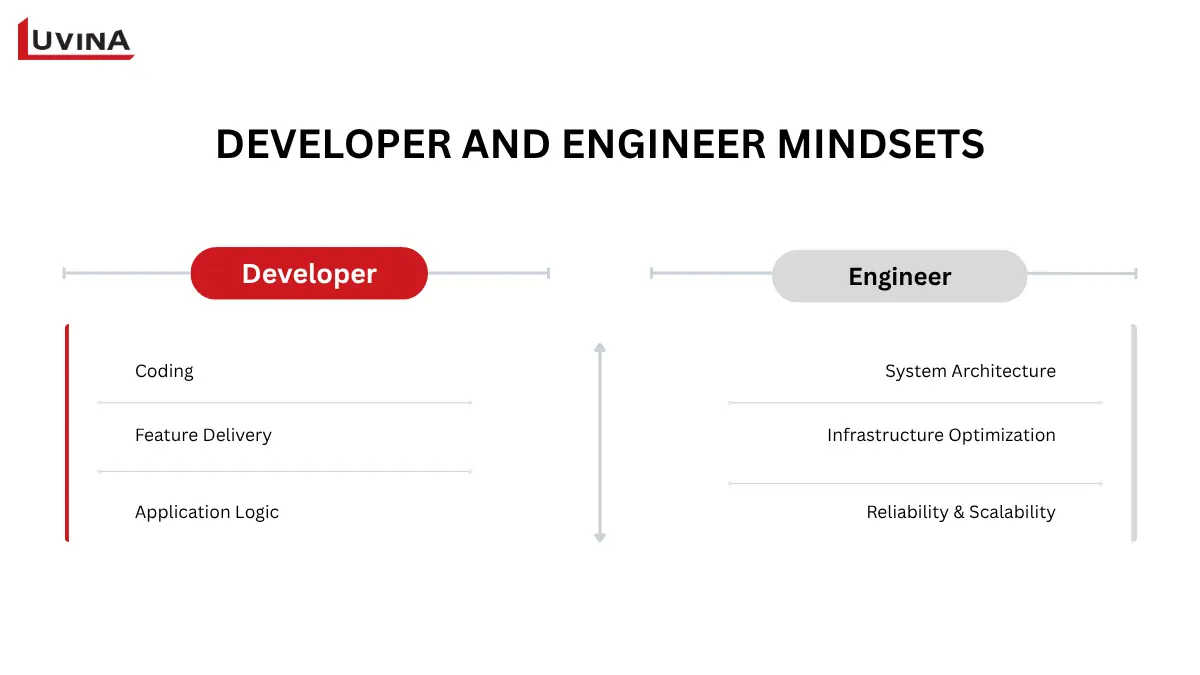
Comparison of technical priorities and problem-solving approaches between developers and engineers
Software Developer Skills & Toolsets
Software developers mainly focus on coding, feature development, and application-level problem-solving. Common skills and tools include:
- Programming languages such as Python, JavaScript, Java, Swift, and Kotlin
- Front-end and back-end frameworks, including React, Angular, Node.js, Spring Boot, and .NET
- Mobile development frameworks such as Flutter and React Native
- Database management using SQL, MySQL, PostgreSQL, MongoDB, and ORM tools
- Version control systems, including Git, GitHub, and GitLab
- API integration and third-party service implementation
- Unit testing, debugging, and application maintenance tools
Software Engineer Skills & Toolsets
Compared to software developers, software engineers usually work at a broader system level. Their responsibilities often involve designing scalable architectures, optimizing infrastructure, and maintaining system reliability. Common skills and tools include:
- System design and architecture patterns, such as microservices and event-driven architecture
- Algorithms and data structures for scalable system performance
- DevOps practices, including CI/CD pipelines and infrastructure automation
- Containerization and orchestration technologies such as Docker and Kubernetes
- Cloud platforms, including AWS, Azure, and Google Cloud
- Performance engineering, load testing, and system monitoring tools
- Security engineering, infrastructure reliability, and disaster recovery planning
- Logging and observability platforms such as Grafana, Prometheus, and ELK Stack
While there is often overlap between the two roles, software engineering generally requires a stronger focus on scalability, maintainability, and long-term operational efficiency across the entire software ecosystem.
Education/Certificates
Educational paths can diverge significantly between the two roles, further reflecting the difference between software development and software engineering in both technical depth and career specialization. Software engineers typically pursue degrees in computer science or engineering, often supplemented by certifications that validate their expertise in system architecture or other advanced topics. In contrast, developers can come from various educational backgrounds and may seek proficiency through programming boot camps, online courses, or self-study.
Real-World Examples: Software Development vs Software Engineering
Real business scenarios clearly demonstrate the difference between software development and software engineering in modern digital products. In practice, companies rarely rely on only one capability. Instead, both roles often work together at different stages of product growth and system complexity.
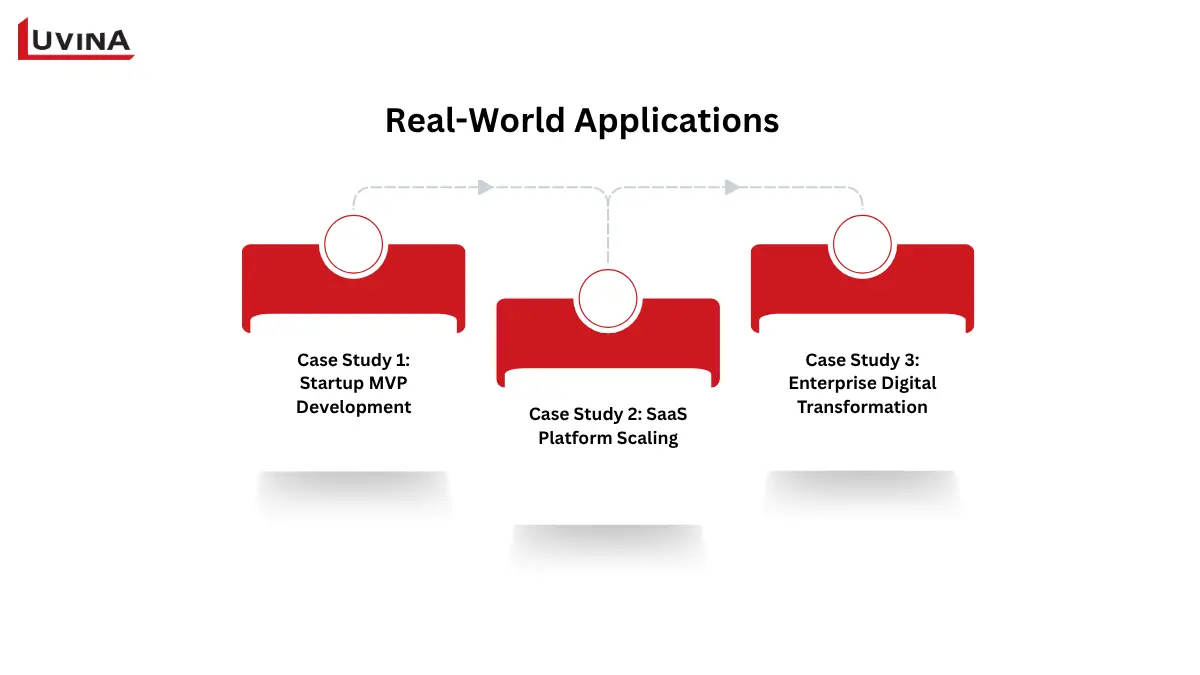
Business use cases for software development and software engineering
Case Study 1: Startup MVP Development
Many early-stage startups prioritize software development when launching a new product. During the MVP phase, the primary goal is rapid feature delivery, faster iteration, and quick market validation.
For example, a startup building a food delivery app may focus on:
- Mobile app development
- User registration and payment features
- API integration
- UI/UX implementation
- Bug fixing and feature releases
At this stage, software developers play the central role because speed to market is more important than large-scale infrastructure optimization.
Case Study 2: SaaS Platform Scaling
As SaaS platforms grow, software engineering becomes increasingly important. Companies handling millions of users must ensure scalability, reliability, uptime, and long-term system maintainability.
For example, platforms such as Netflix, Spotify, or Uber require strong software engineering practices to support:
- Distributed system architecture
- Cloud infrastructure scalability
- Load balancing and traffic management
- System monitoring and reliability
- Security and disaster recovery
In these environments, software engineers are responsible for designing systems that can maintain performance and stability under massive workloads.
Case Study 3: Enterprise Digital Transformation
Large enterprises often require both software development and software engineering capabilities simultaneously. Software developers focus on building business applications and implementing new features, while software engineers manage architecture modernization, infrastructure optimization, and long term scalability.
For example, banks, fintech companies, and global enterprises often combine:
- Rapid application development
- Cloud migration initiatives
- DevOps and CI/CD implementation
- Enterprise security engineering
- Performance optimization across distributed systems
This hybrid approach reflects the growing relationship between software development and software engineering in modern enterprise environments. Rather than operating separately, both roles increasingly work together to support faster innovation and scalable digital transformation.
Are the Two Terms Interchangeable?
In the ongoing discussion around the difference between software development and software engineering, one common question is whether the two terms can actually be used interchangeably. In reality, many companies use “software developer” and “software engineer” almost synonymously, especially in job titles and hiring descriptions. However, the distinction becomes more important depending on company size, system complexity, and long-term technical requirements.
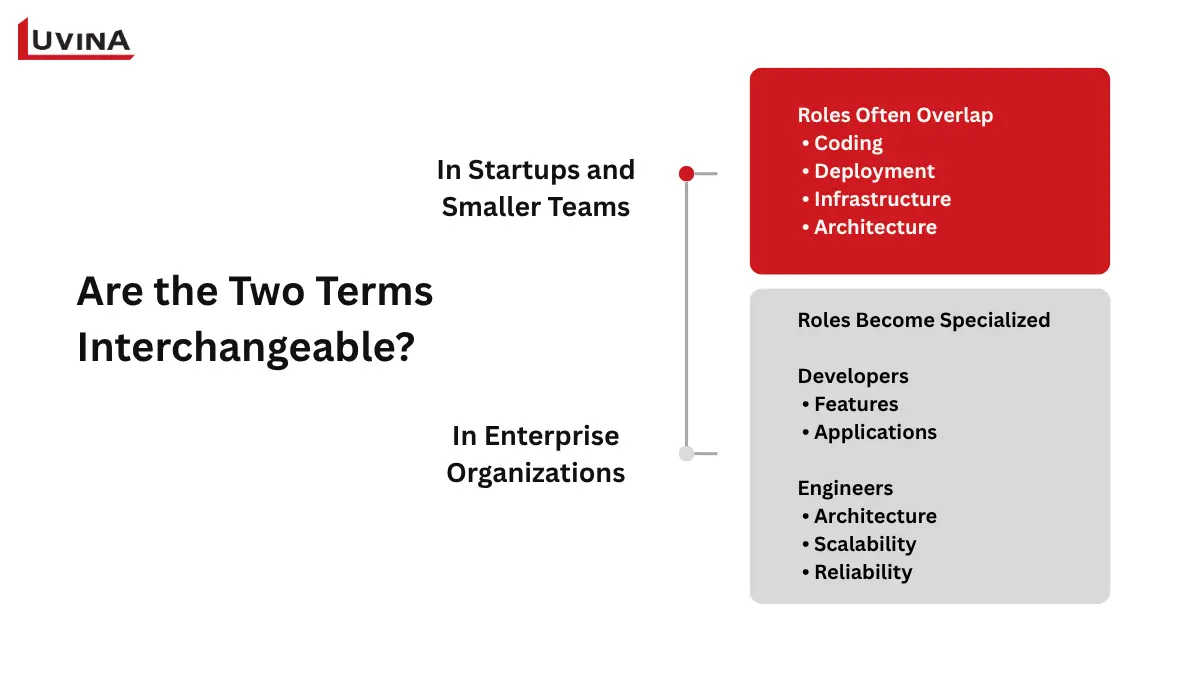
The Relationship Between Software Development and Software Engineering Across Organizational Models
In Startups and Smaller Teams
In startup environments, the line highlighted in the difference between software development and software engineering is often blurred. Software developers are frequently expected to handle responsibilities beyond coding, including infrastructure setup, deployment, scalability planning, and even technical architecture decisions. This flexibility allows startups to move quickly, iterate faster, and operate with leaner teams.
As products scale, however, the lack of a clear engineering structure can sometimes create technical debt or operational challenges. This is where software engineering practices become increasingly important.
In Enterprise Organizations
In larger enterprises, roles are often separated based on seniority, specialization, and technical responsibility. Software engineers may focus on system architecture, infrastructure strategy, security, and scalability, while software developers concentrate more on feature implementation and application delivery.
This separation helps enterprises manage complex systems more efficiently, especially when working with distributed platforms, cloud infrastructure, or mission-critical applications.
The Impact of the AI Era
The rise of AI-powered development tools is rapidly reshaping the difference between software development and software engineering. AI can now automate many routine tasks across both roles, including code generation, testing, debugging, documentation, and infrastructure monitoring.
As AI adoption grows, the boundary between software developers and software engineers is becoming less defined. Developers are no longer limited to writing code manually. Many are evolving into AI-augmented builders who use AI tools to prototype features faster, improve productivity, and accelerate software delivery.
At the same time, new concepts such as prompt engineering are becoming more common in modern development workflows. However, prompt engineering is not the same as software architecture or software engineering. While effective prompting can improve AI outputs and development speed, it does not replace the engineering expertise required for system scalability, infrastructure design, security, reliability, and long-term maintainability.
This shift is reshaping the discussion around the difference between software development and software engineering. Developers are becoming more versatile with AI-assisted workflows, while software engineers are increasingly focused on system architecture, platform reliability, security, governance, and scalability across complex environments.
In the AI era, successful technology teams will likely combine both development and engineering capabilities, balancing rapid AI-assisted execution with strong architectural and problem-solving skills.
What This Means for Your Business
Understanding the difference between software development and software engineering is not only important for technical teams. It also directly impacts hiring strategy, project scalability, outsourcing decisions, and long-term business growth. Choosing the right combination of software developers and software engineers can help businesses reduce technical risks, accelerate delivery timelines, and build more sustainable digital products.
When You Need a Software Engineer
Businesses typically need software engineers when building large-scale or technically complex systems that require long-term scalability and architectural planning. This is one of the clearest examples of the difference between software development and software engineering, as software engineers are responsible for designing system architecture, optimizing infrastructure, improving reliability, and ensuring platforms can support future business growth efficiently.
This is especially important for enterprise systems, SaaS platforms, cloud native applications, fintech products, and other environments where performance, scalability, and security are critical business requirements.
When You Need a Software Developer
Software developers are often the better choice when businesses need rapid feature development, MVP creation, or specialized applications delivered within shorter timelines. Compared to software engineering roles, software developers are typically more execution focused and closely involved in building user-facing functionalities quickly and efficiently.
This approach is commonly used in startups, product validation stages, or agile development environments where speed to market is a top priority.
Optimal Team Structure
For many organizations, the most effective approach is not to choose between software development and software engineering, but to combine both capabilities within a single team structure. This is where the difference between software development and software engineering becomes strategically important for long-term product scalability and operational efficiency. A scalable model often includes one experienced software engineer or systems architect leading the technical direction, supported by a team of software developers responsible for implementation and feature delivery.
This structure helps businesses balance long-term system reliability with fast product execution and continuous feature iteration.
But what if the project is large enough, but you don’t have the budget for such an ideal team structure?
From a business perspective, the table below summarizes which role is more suitable depending on project goals, technical complexity, and growth expectations.
| Business Situation | What you need |
| Building a large-scale SaaS platform | Software engineer |
| Designing scalable cloud infrastructure | |
| Optimizing system performance and reliability | |
| Managing enterprise architecture and security | |
| Developing an MVP quickly | Software developer |
| Launching a mobile or web application fast | |
| Building long-term, scalable digital products | Both software developers and software engineers |
| Scaling products after rapid growth | |
| Supporting full lifecycle software outsourcing |
Suitable roles for different business situations
In reality, many modern businesses need both capabilities instead of choosing only one. Software developers help accelerate feature delivery and product execution, while software engineers ensure systems remain scalable, reliable, and maintainable as the business grows. This balance becomes increasingly important in the AI and cloud era, where companies must move quickly without sacrificing long-term system stability.
Outsourcing Considerations
When choosing an outsourcing partner, businesses should evaluate more than just coding capabilities. A strong technology partner should possess expertise in both software development and software engineering to support the full software lifecycle from architecture planning and infrastructure design to development, deployment, and long-term maintenance.
As software systems become more complex in the AI and cloud era, businesses increasingly need balanced teams that combine rapid software development with strong engineering foundations.
Whether you need rapid product development, enterprise-scale architecture, or a dedicated team that combines both capabilities, choosing the right balance between developers and engineers is critical for long-term success.
Luvina Software helps organizations build scalable products by providing experienced software engineers, dedicated development teams, and end-to-end software development services.
FAQs
1. What is the main difference between software development and software engineering?
Software development focuses on building features and applications, while software engineering focuses on designing scalable, reliable, and maintainable systems.
2. Is software engineering harder than software development?
Software engineering is often considered more complex because it involves architecture, scalability, infrastructure, and long-term system performance.
3. Is a software engineer higher than a developer?
Not always. Software engineers usually handle broader system architecture and scalability responsibilities, while developers focus more on feature implementation.
4. Can a software developer become a software engineer?
Yes. Many software engineers start as developers before expanding their skills in architecture, DevOps, and system design.
5. Can software developers do software engineering?
Yes. Many developers gradually move into software engineering through hands-on experience with scalable systems and infrastructure.
6. Do software engineers write code?
Yes. Software engineers still write code, but they also work on architecture, system reliability, and technical planning.
7. Do startups need software engineers?
Yes, especially when products start scaling and systems become more complex.
8. Which role is better for SaaS companies?
Most SaaS companies need both software developers and software engineers to balance rapid delivery with scalability.
9. Which role pays more?
In many markets, software engineers often earn higher salaries because they handle broader technical responsibilities and large-scale systems.
10. Can AI replace software developers?
No. AI can assist with coding and testing, but human expertise is still essential for architecture, problem-solving, and business logic.
Conclusion
Modern RPA is no longer limited to simple task automation. Today, enterprise automation combines RPA, AI agents, OCR, APIs, and orchestration platforms into connected intelligent workflows. While AI handles reasoning and decision-making, RPA remains the operational layer that executes actions across enterprise systems reliably and at scale.
Ready to scale automation effectively? Partner with Luvina to build the right RPA roadmap for your business.
Resources
- https://www.ibm.com/think/topics/sdlc
- https://www.coursera.org/gb/articles/software-developer-vs-software-engineer
- https://www.geeksforgeeks.org/blogs/difference-between-software-engineer-and-software-developer/
- https://en.wikipedia.org/wiki/Software_development
READY TO START A PROJECT?
Our experts are eager to explore your needs.

Read More From Us?
Sign up for our newsletter
Read More From Us?
Sign up for our newsletter