




PLM vs PDM: Key Differences, Use Cases, and How They Work Together


Product Data Management (PDM) controls design and engineering data, while Product Lifecycle Management (PLM) governs product data, processes, and decisions across the entire lifecycle. PDM can be used as a standalone solution, integrated with PLM, or included within a PLM platform.
Choose PDM when your priority is engineering file control. Choose PLM when you need cross-functional lifecycle governance. Many manufacturers use both to combine established CAD and PDM workflows with broader enterprise processes.
This guide explains the differences between PLM vs PDM, how PDM and PLM software work together, where ERP and PIM fit, and how to determine which approach best suits your business.
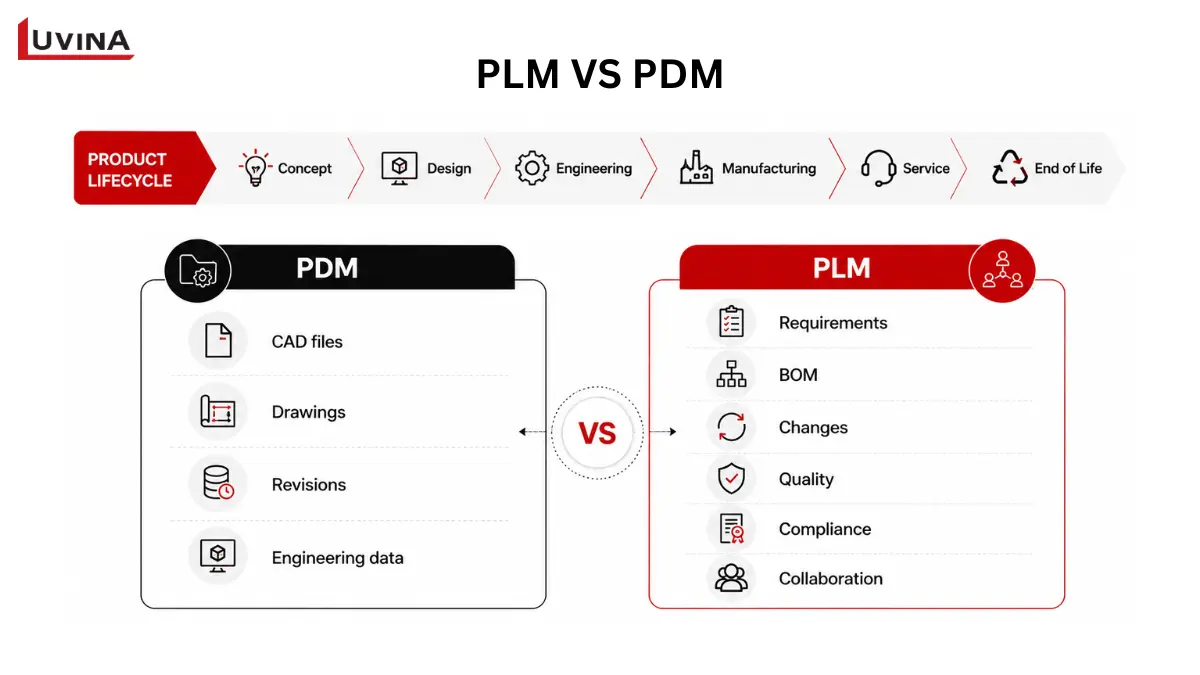
PLM vs PDM Overview
PLM vs PDM at a Glance
PDM manages the accuracy and control of engineering data, while PLM manages how product information and decisions move across the product lifecycle. Although they are closely related, they serve different purposes. The comparison below highlights the most important differences at a glance.
| Category | PDM (Product Data Management) | PLM (Product Lifecycle Management) |
|---|---|---|
| Primary purpose | Control engineering files, revisions, and design data | Govern product data, processes, and decisions across the lifecycle |
| Scope | Engineering and product design | Enterprise-wide product lifecycle management |
| Typical data | CAD models, drawings, assemblies, specifications, revisions, documents, metadata | Requirements, product structures, EBOM, configurations, ECR/ECO, quality, compliance, supplier, and service data |
| Main users | Design engineers, CAD users, engineering managers | Engineering, product, manufacturing, quality, sourcing, service, and compliance teams |
| Workflows | File approval, revision control, engineering collaboration | Change management, NPI, quality, compliance, and cross-functional approvals |
| Lifecycle reach | Primarily design and engineering | Concept through end of life |
| Integrations | Mainly CAD tools and engineering applications | CAD, ERP, MES, quality systems, service platforms, and PIM |
| Implementation effort | Typically, faster with a departmental focus | Broader implementation involving people, processes, and enterprise systems |
| Best fit | Organizations that need reliable engineering data control | Organizations that need end-to-end product lifecycle governance |
PLM vs PDM Comparison
While both systems manage product-related information, their responsibilities are different.
PDM focuses on engineering data accuracy and version control, while PLM provides a broader governance framework that connects product development with downstream business processes. Understanding this distinction makes it easier to decide whether PDM, PLM, or a combination of both best fits your organization.
What Is PDM Software?
Product Data Management (PDM) software is a system or capability that controls engineering and design data throughout the product development process. Its primary role is to ensure the right people can access the right product information while maintaining version accuracy, traceability, and collaboration across engineering teams.
A typical PDM software solution manages CAD models, engineering drawings, assemblies, specifications, technical documents, metadata, file relationships, and design revisions. By organizing these assets in a controlled environment, PDM reduces the risk of duplicate files, outdated designs, and revision errors that can delay product development.
Data PDM Manages
PDM organizes both engineering files and the information associated with them. Common data types include:
- CAD models, drawings, and assemblies
- Technical specifications and supporting documents
- Metadata such as part numbers, authors, and release status
- File relationships and product structures
- Design versions and officially released revisions
This structured approach helps engineering teams maintain a single, reliable source for design data throughout the development process.
A while features vary by vendor, most PDM software provides the following core capabilities:
- Check-in and check-out
- Version and revision control
- Access permissions
- Advanced search
- Workflow management
- Engineering collaboration and design review
These capabilities are primarily used by:
- Design engineers
- CAD users
- Engineering managers
- PDM administrators
These capabilities help engineering teams collaborate more efficiently while maintaining accurate and controlled product data.
Where PDM’s Scope Usually Ends
PDM is generally focused on engineering and product design rather than enterprise-wide product lifecycle management. While many modern PLM platforms include PDM capabilities, others integrate with an existing CAD-focused PDM solution. The exact packaging depends on the software vendor and deployment architecture.
As products become more complex and change processes begin to involve manufacturing, quality, sourcing, or compliance teams, organizations often extend PDM with PLM to support broader lifecycle governance.
What Is PLM Software?
Product Lifecycle Management (PLM) software is both a business discipline and the technology that supports it. It governs the product record and the processes that manage products from concept to end of life across engineering, manufacturing, quality, service, and other business functions. This broader lifecycle approach is why PLM software for manufacturing is commonly used to connect product data, workflows, and decisions across the organization.
A typical PLM solution manages product requirements, product structures, engineering changes, quality, compliance, and service information across the product lifecycle. This creates a governed product record with end-to-end traceability for cross-functional teams.
Processes PLM Governs
PLM supports workflows that extend beyond engineering and connect the entire product lifecycle. Common processes include:
- Requirements management
- Product structure and configuration management
- Engineering change management
- New product introduction
- Quality and compliance management
- Supplier collaboration
- Service lifecycle management
These processes create end-to-end traceability, allowing organizations to track how product information evolves from initial requirements to retirement.
Core PLM Capabilities and Users
A modern PLM platform provides capabilities such as:
- Product data and lifecycle governance
- Workflow and approval management
- Change and configuration management
- Requirements traceability
- Cross-functional collaboration
- Compliance and audit support
- Enterprise system integration
PLM is used by a wide range of stakeholders, including:
- Engineering teams
- Product managers
- Manufacturing teams
- Quality teams
- Sourcing and procurement
- Service organizations
- Compliance specialists
Because PLM supports multiple business functions, it acts as a common platform for product-related decisions across the organization.
Is PDM Part of PLM?
Often, yes. PDM is commonly a foundational capability within a PLM platform because engineering data management is essential to broader lifecycle governance. However, software packaging and deployment vary by vendor. Some organizations use a standalone PDM system that integrates with PLM, while others adopt a PLM platform with built-in PDM capabilities.
Aras Innovator PLM, for example, includes integrated PDM capabilities for CAD data management while extending governance across engineering, manufacturing, quality, and service.
PLM vs PDM: 7 Key Differences That Matter Most
Although PDM and PLM share some capabilities, they are designed for different levels of product management. Understanding where they differ helps organizations choose the right solution or determine when both systems should work together.
| Comparison Area | PDM | PLM |
|---|---|---|
| 1. Scope | Engineering data | Entire product lifecycle |
| 2. Data | CAD files & revisions | Product record & lifecycle data |
| 3. Users | Engineering teams | Cross functional teams |
| 4. Workflows | Design approvals | Enterprise lifecycle processes |
| 5. BOM & Changes | Engineering structures | Lifecycle impact & governance |
| 6. Integration | CAD tools | ERP, MES, Quality, Service, PIM |
| 7. Implementation | Department focused | Enterprise wide transformation |
Key Differences Between PLM and PDM
1. Scope and Lifecycle Reach
PDM focuses on engineering data, while PLM governs the entire product lifecycle.
PDM primarily supports product design by managing CAD files, revisions, and engineering documentation. PLM extends beyond engineering to connect activities from product concept through manufacturing, service, and end of life.
→ Manufacturers with cross-functional product processes typically benefit from PLM’s broader lifecycle governance.
2. Data and Object Model
PDM is file-centric, while PLM manages a broader product record.
The biggest difference lies in the type of information each system manages. PDM organizes engineering files and their metadata, while PLM manages a broader product record that includes requirements, product structures, configurations, engineering changes, quality records, and compliance information.
→ A broader product record improves traceability across multiple business functions.
3. Users and Collaboration
PDM serves engineering teams, while PLM supports enterprise-wide collaboration.
The user base also differs significantly. PDM is mainly used by design engineers, CAD users, and engineering managers. PLM connects engineering with manufacturing, quality, sourcing, service, suppliers, and other stakeholders involved in the product lifecycle.
→ Cross-functional collaboration becomes easier as more teams work from the same governed product information.
4. Workflow and Decision Control
PDM manages engineering workflows, while PLM governs enterprise decisions.
Workflow complexity increases as organizations move from PDM to PLM. PDM focuses on revision control, file approvals, and engineering releases, while PLM also governs engineering changes, New Product Introduction (NPI), quality processes, compliance, and cross-functional approvals.
→ Standardized workflows help reduce delays and improve coordination between departments.
5. BOM, Configuration, and Change Impact
Both systems support product structures, but PLM provides a broader lifecycle context.
This is one area where PDM and PLM often overlap. PDM can manage engineering structures and revisions, while PLM connects configurations, engineering changes, and product structures with downstream business processes. Ownership of EBOM, MBOM, and related objects depends on the organization’s operating model and system architecture.
→ Better change impact analysis helps teams understand how engineering updates affect manufacturing and other downstream activities.
6. Integration and Digital Thread
PDM integrates mainly with CAD, while PLM connects enterprise systems.
Integration requirements become much broader with PLM. PDM commonly integrates with CAD tools and engineering applications, while PLM typically connects ERP, a custom manufacturing execution system, quality systems, service platforms, and PIM to support a continuous digital thread.
→ Connected systems improve product data consistency while reducing manual handoffs between teams.
7. Implementation Horizon
PDM is usually quicker to deploy, while PLM requires broader organizational change.
Implementation effort is another major difference. PDM projects typically focus on engineering teams and can often be deployed more quickly. PLM initiatives usually involve process standardization, governance, integration, data migration, and user adoption across multiple departments.
→ Successful PLM adoption depends as much on process alignment and organizational readiness as on software implementation.
These differences show that PDM and PLM are designed to solve different business challenges rather than replace one another. In many manufacturing environments, the greatest value comes from using each system for the role it performs best. The next section explains how PDM and PLM work together to support a connected product lifecycle.
How PDM and PLM Software Work Together
PDM and PLM are complementary rather than competing systems. PDM manages engineering data and revisions, while PLM governs broader product information, lifecycle processes, and released product structures. Together, they support a connected digital thread for digital transformation in manufacturing.
A standalone PDM system is not always necessary. Some PLM platforms include built-in PDM capabilities, while others integrate with an existing PDM solution.
A design change from CAD to the factory
A typical engineering change may follow these steps:
- PDM controls CAD revisions, engineering files, and design approvals.
- PLM manages the Engineering Change Request (ECR) or Engineering Change Order (ECO), coordinates reviews, and approves the released product structure.
- ERP receives the approved item and BOM to support production planning, procurement, inventory, and execution.
- PIM updates customer-facing product information if specifications, descriptions, or other commercial attributes have changed.
Each system performs a different role while maintaining a governed flow of product information across the lifecycle.
Define the system of record before integrating
Before integrating PDM, PLM, ERP, and PIM, define the system of record for each type of product data. Clear ownership helps prevent duplicate data, inconsistent updates, and integration conflicts.
A common approach is to assign ownership based on the type of information each system is designed to manage:
- PDM: CAD files and design revisions
- PLM: EBOM and released product structures
- ERP: MBOM, item master, costs, and inventory
- PIM: Customer-facing product attributes and channel content
This is a common implementation pattern rather than a universal architecture. Actual ownership should align with your business processes, operating model, and platform capabilities.
PDM vs PLM vs ERP vs PIM: A Full System Comparison
PDM, PLM, ERP, and PIM each serve a different role in managing product information. PDM controls engineering data. PLM governs the product lifecycle. ERP supports operational execution. PIM manages customer-facing product content.
These systems are typically integrated to maintain a consistent flow of product information across the business. This often requires a well-planned ERP development to support reliable data exchange between engineering and operational systems.
As product complexity increases, so does investment in the systems that manage it. According to CIMdata, the global PLM market reached $88.3 billion in 2025, growing 9.9% over 2024, and is projected to grow 8.0% in 2026, reaching approximately $132 billion by 2030. This growth indicates continued investment in PLM capabilities that support governed product information and cross-functional collaboration across engineering and operational functions.
The comparison below reflects a common implementation pattern rather than a universal architecture. Actual ownership depends on each organization’s products, business processes, and platform design.
Comparison Table: Purpose, Data, Users, and Downstream Consumers
| System | Primary Purpose | Typical Data | Main Users | Typical Downstream Consumers |
|---|---|---|---|---|
| PDM | Control engineering files and design revisions | CAD models, drawings, assemblies, metadata, versions, revisions | Design engineers, CAD users, engineering managers | PLM, engineering teams |
| PLM | Govern the product lifecycle and product decisions | Requirements, EBOM, configurations, ECR/ECO, quality, compliance | Engineering, manufacturing, quality, sourcing, service | ERP, MES, suppliers, service teams |
| ERP | Plan and execute business and operational processes | Item master, MBOM, inventory, procurement, production, finance | Operations, manufacturing, procurement, finance | Shop floor systems, logistics, finance |
| PIM | Enrich and distribute customer-facing product content | Product descriptions, specifications, images, marketing attributes, translations | Marketing, ecommerce, sales, channel teams | Ecommerce sites, marketplaces, distributors, partners |
Comparing PDM, PLM, ERP, and PIM
Typical Product-Data Flow
Although product data often flows from engineering to manufacturing, the process is rarely one way. Instead, each system owns a specific part of the product record while exchanging trusted information with the others.
A typical workflow may look like this:
- PDM manages engineering files and design revisions during product development.
- PLM governs released product structures, engineering changes, and lifecycle approvals.
- ERP uses approved items and BOMs for procurement, production planning, inventory, and financial operations.
- PIM publishes approved customer-facing information to websites, catalogs, marketplaces, and partner channels.
- Feedback from manufacturing, service, customers, or sales can trigger engineering changes that flow back through PLM and PDM, creating a continuous improvement cycle rather than a one-way data pipeline.
When each system has clearly defined ownership and well-governed integrations, organizations can maintain consistent product information while supporting collaboration across engineering, manufacturing, operations, and commercial teams.
When Is PDM Enough, and When Do You Need PLM?
Choosing between PDM and PLM depends on your product complexity, business processes, and collaboration needs. For many manufacturers, the answer is not choosing one over the other, but selecting the right role for each system.
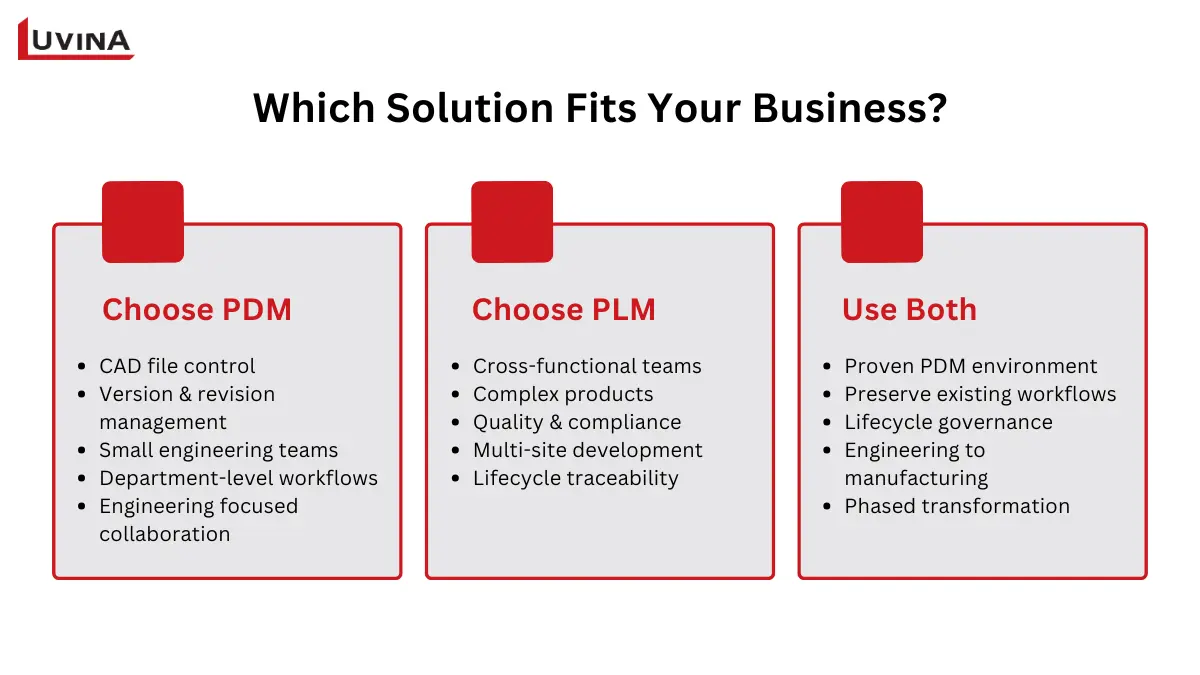
Choosing Between PDM, PLM, or Both
Choose PDM when…
PDM is often the right choice if your priorities are:
- Managing CAD files, drawings, and design revisions
- Supporting a small or centralized engineering team
- Maintaining accurate version and revision control
- Running engineering workflows within a single department
- Improving engineering collaboration without broader process changes
PDM is often a practical starting point for small manufacturers with relatively simple products and limited engineering workflows. It provides the core capabilities needed to control engineering data without the broader investment required for enterprise lifecycle management.
Expand to PLM when…
PLM becomes more valuable when your organization needs to:
- Coordinate product changes across multiple departments
- Manage configurable or highly complex products
- Meet quality, compliance, or regulatory requirements
- Improve lifecycle traceability from concept to end of life
- Standardize product development across multiple sites
As organizations grow, product development often becomes more collaborative and process-driven. Medium and large manufacturers may benefit from adopting PLM as lifecycle governance, change management, and cross-functional coordination become increasingly important.
Use both when…
Many organizations gain the most value by combining both systems when they:
- Already have a mature CAD and PDM environment
- Want to preserve existing engineering workflows
- Need PLM to govern product structures and engineering changes
- Require enterprise collaboration across engineering, manufacturing, quality, sourcing, and service
This approach allows organizations to preserve proven engineering workflows while extending lifecycle governance across the business.
Self-Assessment Checklist
If you answer “Yes” to several of the questions below, your organization may benefit from expanding beyond a standalone PDM solution.
- Are your products highly complex or available in multiple variants?
- Do you need to maintain evidence for quality or regulatory compliance?
- Do engineering changes require approval from multiple departments?
- Do product teams collaborate across multiple sites?
- Do suppliers need controlled access to product information?
- Is it difficult to understand the downstream impact of engineering changes?
- Do product data handoffs between engineering and ERP create delays or errors?
- Do you need consistent lifecycle governance beyond engineering?
Your answers can help determine whether PDM alone is sufficient or whether PLM, or a combination of both, is a better long-term fit.
Practical Path to Move from PDM to PLM
Moving from PDM to PLM does not have to happen all at once. A phased implementation helps reduce risks, improve user adoption, and deliver value more quickly.
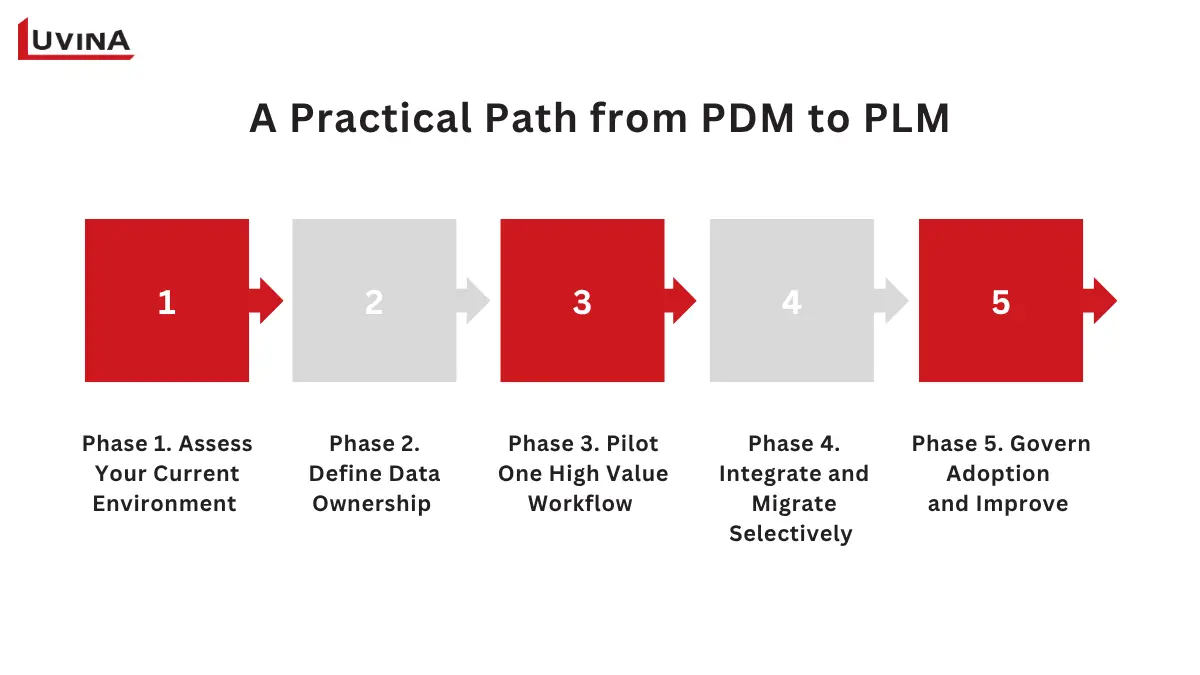
PDM to PLM Implementation Roadmap
Phase 1. Assess Your Current Environment
Review existing PDM capabilities, engineering workflows, integrations, and business challenges to identify the highest priority gaps.
Phase 2. Define Data Ownership
Determine which system should own engineering files, product structures, operational data, and customer-facing information before building integrations.
Phase 3. Pilot One High Value Workflow
Start with a business process such as engineering change management or New Product Introduction (NPI). Validate the workflow before expanding to additional use cases.
Phase 4. Integrate and Migrate Selectively
Connect PLM with PDM, ERP, and other business systems where needed. Migrate only the data required to support future operations.
Phase 5. Govern Adoption and Improve
Monitor adoption, collect user feedback, and continuously refine processes as business requirements evolve.
Measure Success with the Right Metrics
Track outcomes that reflect both operational efficiency and user adoption, including:
- Engineering search time
- Duplicate or obsolete file incidents
- Change cycle time
- Release to ERP errors
- BOM reconciliation effort
- New Product Introduction (NPI) lead time
- User adoption
These metrics provide a practical way to evaluate implementation progress and identify opportunities for continuous improvement.
Implementation Considerations
Transitioning from PDM to PLM often requires more than deploying new software. Organizations may need support with system assessment, workflow customization, data migration, and integration between PLM, PDM, and ERP.
Luvina provides Aras PLM consulting and integration services to help manufacturers plan and implement these changes while minimizing disruption to existing engineering and business operations.
FAQs
1. What is the main difference between PDM and PLM?
The main difference is scope. PDM focuses on controlling engineering data such as CAD files, drawings, and design revisions. PLM has a broader role by governing product information, processes, and decisions across the entire lifecycle. While PDM supports engineering teams, PLM connects engineering with manufacturing, quality, sourcing, service, and other functions.
2. Is PDM part of PLM?
Often, yes. PDM is commonly considered a foundational capability within PLM because managing engineering data is an important part of product lifecycle governance. However, the relationship depends on the software architecture. Some organizations use standalone PDM integrated with PLM, while others use a PLM platform with built-in PDM capabilities.
3. Does PLM replace PDM software?
Not automatically. Whether PLM replaces, integrates with, or includes PDM depends on the existing systems and business requirements. Some manufacturers keep their established CAD-focused PDM environment and add PLM for broader lifecycle management. Others adopt a PLM platform that already provides the required PDM functionality.
4. How do PDM, PLM, and ERP work together?
PDM, PLM, and ERP support different stages of product development and operations. PDM manages engineering files and revisions. PLM governs released product structures, changes, and lifecycle workflows. ERP uses approved product data for planning, production, procurement, inventory, and financial execution.
5. What is the difference between PDM, PLM, and PIM
PDM manages engineering data used to design and develop products. PLM governs product information and processes throughout the lifecycle. PIM focuses on customer-facing product content, such as specifications, descriptions, and digital assets used across websites, catalogs, marketplaces, and partner channels.
Conclusion
PDM helps maintain accurate engineering data, while PLM connects product information, processes, and decisions across the lifecycle. ERP supports operational execution, and PIM manages customer-facing product content. Choosing the right architecture starts with understanding where data is created, managed, and shared across systems.
Before selecting a solution, map your current data ownership and system handoffs. If you need support with PLM, PDM, or enterprise system integration, Luvina can help assess your requirements and explore a suitable implementation approach.
Resources
- https://www.cimdata.com/en/news/item/30471-cimdata-publishes-plm-market-and-solution-provider-market-report
- https://dailycadcam.com/cimdata-publishes-2026-plm-market-solution-provider-analysis-report/
READY TO START A PROJECT?
Our experts are eager to explore your needs.

Read More From Us?
Sign up for our newsletter
Read More From Us?
Sign up for our newsletter