




What Is Forward Engineering? Process, Examples, and AI


Forward engineering is the process of transforming higher-level requirements, specifications, or designs into a working software implementation. It describes the direction of engineering work from abstract concepts to executable systems, rather than a specific methodology.
Unlike reverse engineering, which analyzes an existing system to recover its design or specifications, forward engineering focuses on turning those designs into a functional solution. This article explains how forward engineering works, how it differs from reverse engineering and software re-engineering, and how it is applied in software development, UML, database engineering, AI, and legacy modernization.
What Is Forward Engineering in Software Engineering?
In software engineering, forward engineering describes the process of transforming requirements, specifications, or system designs into a working software implementation. Instead of defining a particular development methodology, it describes the direction of engineering work, moving from higher levels of abstraction to an executable system.
This engineering approach is not limited to building software from scratch. It can also be applied after redesigning an existing application, generating code from UML models, deploying database schemas, or modernizing legacy systems. If development starts with a defined specification or design and progresses toward implementation, it follows the principles of forward engineering.
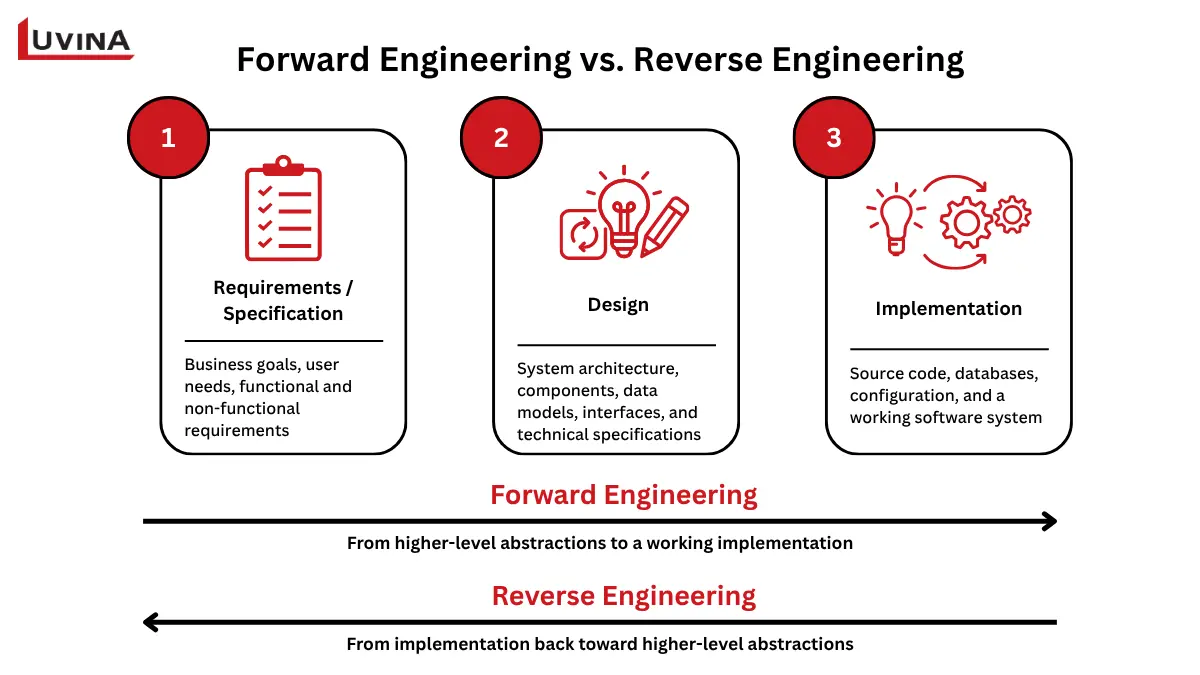
Forward engineering vs. reverse engineering across three levels of software abstraction
How Forward Engineering Maps to the SDLC
Forward engineering fits naturally into the Software Development Life Cycle (SDLC) because both describe how software is planned, built, and delivered.
A typical flow includes:
- Requirements and analysis: Define business goals, user needs, and technical requirements.
- Design: Plan the system architecture, database, APIs, user interface, and other technical components.
- Implementation: Develop the application based on the approved design.
- Testing: Verify that the software works correctly and meets both functional and non-functional requirements.
- Deployment: Release the application to users or the production environment.
This flow is useful for understanding the concept, but real projects are rarely this linear. In Agile teams, requirements, design, development, and testing often happen across multiple iterations. Even though these activities are repeated, they still represent the core stages of the software development life cycle.
Common Forms of Forward Engineering
Forward engineering is used in different development approaches. The starting point may vary, but the goal is always to turn a design into a working solution.
Conventional software development
This is the most common example. A team starts with business requirements, creates the system design, develops the application, tests it, and then deploys it.
Model-to-code generation
In Model Driven Development (MDD), developers create UML models before writing code. CASE tools can then generate source code templates from those models, helping development teams save time and keep the design consistent throughout the project. Sparx Enterprise Architect is one example of a tool that supports this workflow.
Database forward engineering
The same idea also applies to database development. Instead of creating database objects manually, engineers design the database model first and then generate the required Data Definition Language (DDL) scripts automatically.
Round-Trip Engineering
Software continues to change after it is released. New features, bug fixes, and changing business needs often require updates to both the design and the source code.
Round-trip engineering helps keep these updates consistent. When a design model changes, the related code can be updated. Likewise, changes made in the code can also be reflected in the design model. This allows both versions to stay aligned as the project evolves.
This is different from simply performing forward engineering and reverse engineering as separate activities. Round-trip engineering is an ongoing process that keeps designs and implementation in sync throughout the software lifecycle. As a result, teams can reduce inconsistencies, maintain more accurate documentation, and simplify future maintenance.
Forward Engineering vs. Reverse Engineering vs. Re-engineering
Although these terms are often used together, they describe different goals and directions in software engineering. Forward engineering focuses on building a system from requirements and designs. Reverse engineering helps teams understand an existing system without necessarily changing it. Software re-engineering goes one step further by improving or transforming an existing system to meet new business or technical needs.
In practice, these approaches are not mutually exclusive. A modernization project, for example, often combines reverse engineering to understand the current system with forward engineering to build the new solution.
Key Differences at a Glance
| Criteria | Forward Engineering | Reverse Engineering | Software Re-engineering |
| Starting point | Requirements, specifications, or system designs | An existing application or software product | An existing software system |
| Direction | From design to implementation | From implementation to higher level understanding | From an existing system to an improved or redesigned system |
| Primary goal | Build a working solution | Understand how the system works | Improve, modernize, or transform the system |
| Does it modify the existing system? | Creates a new implementation based on a design | No. The goal is to analyze and understand the system rather than modify it | Yes. The system is updated, restructured, or rebuilt to improve quality, maintainability, or functionality |
| Typical output | Working application, source code, database schema | Documentation, architecture diagrams, design models, recovered specifications | Modernized application, refactored codebase, updated architecture |
| Common use cases | New software development, model-driven development, database deployment | Legacy system analysis, security assessment, interoperability, documentation recovery | Legacy modernization, platform migration, performance improvement |
| Example | Building an ERP system from approved requirements | Recovering the architecture of an undocumented legacy application | Migrating a legacy banking system to a cloud native architecture |
Although each approach has a different goal, they are not mutually exclusive. In many software projects, especially modernization initiatives, reverse engineering, forward engineering, and re-engineering are often used together to achieve different objectives.
How They Work Together in Modernization
In many modernization projects, these three approaches work together rather than replacing one another.
A common workflow often looks like this:
- Reverse engineering: Analyze the existing application to understand its architecture, business logic, dependencies, and undocumented behavior.
- Define the target design: Create updated requirements, system architecture, and technical specifications for the new solution.
- Forward engineering: Develop and deploy the new implementation based on the approved design.
Not every modernization project follows this exact sequence. However, this approach is commonly used because it helps development teams understand the current system before deciding how to redesign or replace it. It also reduces the risk of losing important business rules hidden in legacy applications.
If you’d like to explore this topic in more detail, see our guide on software re-engineering vs. reverse engineering.
Common Misconceptions
Some common misconceptions can make these concepts more confusing than they need to be.
Forward engineering always means building software from scratch.
Not necessarily. Forward engineering describes the direction of development rather than the type of project. It can be used for both new software and modernization projects, as long as development starts with a defined design or specification.
Reverse engineering is easier or requires less technical expertise.
This is a common misconception. Reverse engineering often requires deep knowledge of software architecture, programming languages, system dependencies, and business logic. Understanding a large legacy system can be just as challenging as building one.
Forward engineering is the same as software development.
The two concepts are closely related, but they are not identical. Software development covers the entire lifecycle of creating and maintaining software, including planning, testing, deployment, and maintenance. Forward engineering refers specifically to the process of moving from requirements and design toward implementation.
Forward Engineering in the Age of AI
As AI becomes an integral part of software development, it is increasingly used to support forward engineering activities. AI can help development teams turn requirements and designs into working software faster, modernize legacy systems more efficiently, and accelerate the development of AI-powered applications.
These are related ideas, but they are not the same. Understanding the difference helps avoid confusion and gives a clearer picture of how AI is changing forward engineering today.
AI-Assisted Specification to Implementation
One of the biggest changes in recent years is the use of AI coding assistants and coding agents to speed up software development. Instead of writing every line of code manually, developers can use AI to turn requirements or system designs into implementation much faster.
Depending on the task, AI can help generate:
- Source code
- Unit and integration tests
- API documentation
- Infrastructure as Code (IaC) configurations
- Configuration files
- Technical documentation
This reduces repetitive work and allows development teams to focus more on system design and business logic. However, AI does not replace software engineers.
Architectural decisions, security requirements, coding standards, compliance, and code reviews still require human judgment. Development teams remain responsible for validating AI-generated outputs before they become part of a production system.
If you would like to learn more about how AI supports different stages of the software development lifecycle, read our guide on AI in software development.
GenAI Forward Engineering for Legacy Modernization
GenAI is also changing how organizations modernize legacy systems.
Instead of translating legacy code directly into a new programming language, many teams first use AI to analyze the existing application and recover business rules, functional requirements, and system behavior. These insights then become the foundation for designing a new solution before development begins.
A typical workflow includes:
- Analyze the legacy system to identify business rules, application behavior, and dependencies.
- Create functional specifications and the target system design.
- Build a new implementation based on the new design.
This extra design step prevents the new application from simply copying outdated architecture or technical limitations from the legacy system. Instead, teams can preserve valuable business knowledge while adopting modern architectures, technologies, and development practices.
Building AI Native Products
Another use of the term forward engineering in AI has appeared more recently among technology vendors and consulting firms.
In this context, forward engineering describes the process of creating AI native applications from business requirements. Rather than modernizing an existing system, organizations start with a business problem and design new AI capabilities using technologies such as Large Language Models (LLMs), Retrieval Augmented Generation (RAG), or AI agents.
Although this usage is becoming more common, it should be viewed as an application of the broader forward engineering concept rather than its original software engineering definition. The engineering direction remains the same, moving from requirements and design toward implementation, but the product being built is AI-driven.
Forward Engineering vs. Forward Deployed Engineering (FDE)
Do not confuse forward engineering with Forward Deployed Engineering. These two terms sound similar, but they refer to different concepts.
- Forward engineering is the process of turning requirements or designs into a working implementation.
- Forward Deployed Engineering (FDE) is an engineering role in which developers work closely with customers to design, build, and deploy solutions for their specific business needs.
Despite the similar names, FDE is a job role, not a software engineering process.
When Should You Use Forward Engineering? A Decision Framework
Choosing the right engineering approach depends on your project’s starting point and objective. If you’re unsure whether to use forward engineering, reverse engineering, or re-engineering, these three questions can help you decide.
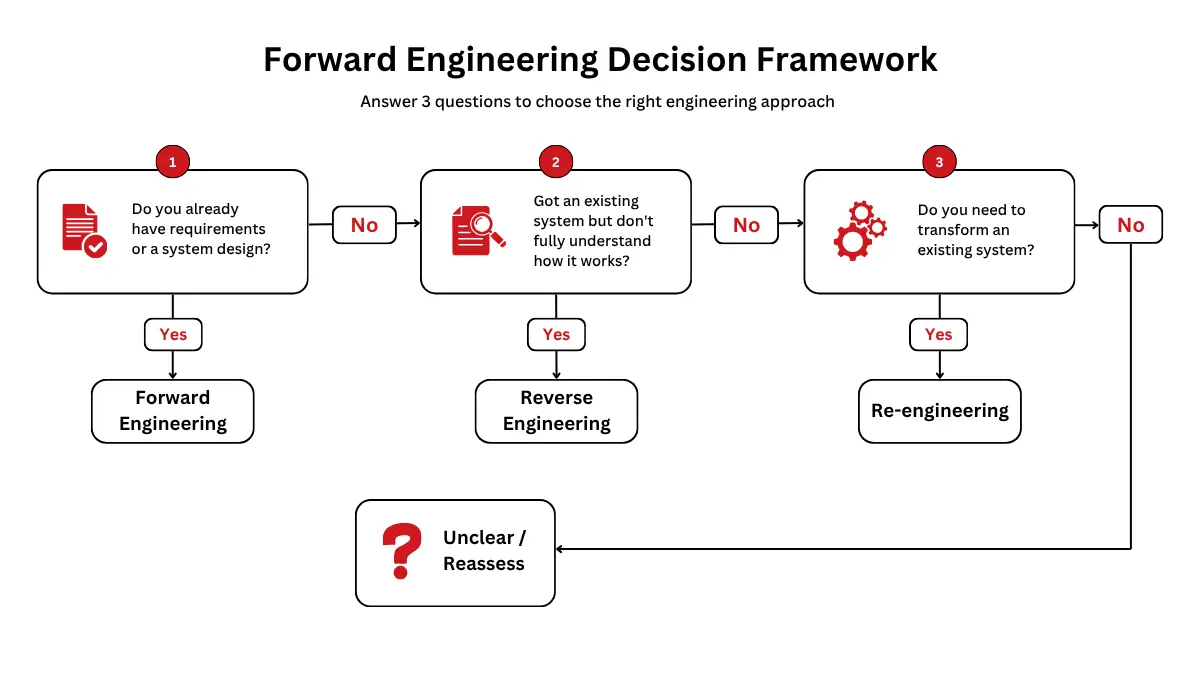
3 questions to determine the right software engineering approach
1. Do you already have requirements or a system design?
If the answer is yes, forward engineering is usually the right approach.
At this stage, the project’s direction is already clear. The goal is to turn approved requirements, system designs, or technical specifications into a working application. This is the most common scenario for:
- Developing a new software product
- Adding new features to an existing application
- Building a solution from an approved architecture
- Generating code from UML models
- Deploying a database schema from a completed data model
- Implementing a new system based on recovered business specifications
2. Do you have an existing system but don’t fully understand how it works?
If the answer is yes, start with reverse engineering.
Many organizations work with legacy applications that have limited documentation or outdated architecture. Before making changes, development teams need to understand how the system works, identify dependencies, and recover important business rules.
Once that knowledge is available, the project can move into forward engineering to build or extend the new solution.
3. Do you need to transform an existing system?
If the answer is yes, software re-engineering is often the better choice.
Re-engineering is typically used when an application needs significant improvements, such as migrating to a new platform, modernizing its architecture, improving maintainability, or replacing outdated technologies. In many projects, this involves both reverse engineering to understand the current system and forward engineering to implement the redesigned solution.
Forward engineering plays an important role in these projects, but it is usually only one part of the overall modernization effort.
When Forward Engineering Alone Is Not Enough
Forward engineering works best when the project starts with clear requirements and a well-defined design. However, it may not be enough if important information about the existing system is missing.
Additional analysis is often needed when:
- The legacy system has little or no documentation.
- Critical business rules exist only in the source code.
- System dependencies are unclear.
- The project involves a high-risk migration.
- Existing behavior must be preserved while moving to a new platform.
In these situations, reverse engineering or a broader re-engineering approach helps reduce risk before development begins.
This framework is not a strict rule, but it provides a practical way to choose the right starting point. In many real-world projects, software teams combine multiple approaches to deliver the best outcome.
Real World Examples of Forward Engineering
Forward engineering can be applied in many software development scenarios. While the technologies and project goals may differ, the core idea remains the same: start with a defined design or specification and turn it into a working implementation.
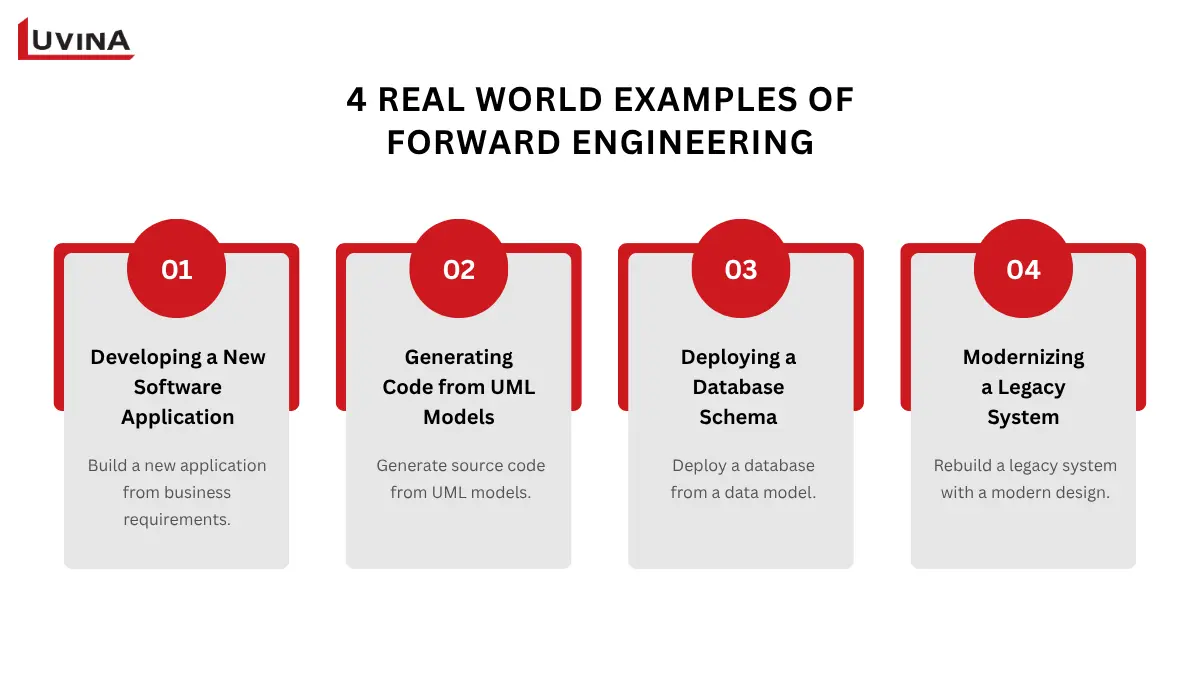
Common examples of forward engineering
Example 1. Developing a New Software Application
A company plans to build a new customer portal to improve its online services.
Starting point: Business requirements and functional specifications
Direction: Requirements → System architecture and API design → Implementation
Output: A tested and deployed web application
This is the most common example of forward engineering. Once the requirements are approved, the development team designs the system architecture, builds the application, validates it through testing, and deploys it to production.
Example 2. Generating Code from UML Models
Some development teams use Model Driven Development (MDD) to reduce repetitive coding and keep software designs consistent.
Starting point: UML class diagrams or other software models
Direction: UML models → Generated source code skeletons → Developer implementation
Output: A working application based on the original software model
Many CASE tools can automatically generate code templates from UML models. Developers then complete the business logic and continue development while keeping the design and code aligned throughout the project.
Example 3. Deploying a Database Schema
Forward engineering is also widely used in database development.
Starting point: ER diagram or database schema design
Direction: Data model → Generated DDL scripts → Live database schema
Output: A database ready for application development
For example, MySQL Workbench allows developers to generate SQL scripts directly from a database model and deploy the schema to a database server through its Forward Engineering feature.
Example 4. Modernizing a Legacy System
Forward engineering also plays an important role in legacy modernization projects.
Starting point: Existing source code and business logic
Direction: Existing application → Recovered functional specifications → Target system design → New implementation
Output: A modern application built on an updated architecture
Instead of rebuilding a legacy system line by line, development teams first identify the business rules that need to be preserved. These insights are then used to design and develop a new solution using modern technologies.
For an example of how legacy systems can be modernized, explore Luvina’s COBOL to Java modernization case study. It shows how a legacy application was analyzed, redesigned, and rebuilt on a modern technology stack while preserving core business functionality.
FAQs
1. What is forward engineering in software engineering?
Forward engineering is the process of turning requirements, specifications, or system designs into a working software solution. It moves from planning and design toward implementation.
2. What is an example of forward engineering?
One common example is generating a database schema from a completed data model. Another is building a software application from approved business requirements and system designs.
3. What is the difference between forward engineering and reverse engineering?
Forward engineering starts with requirements or designs and builds a working system. Reverse engineering starts with an existing system to understand its design, architecture, or business logic.
4. Is forward engineering the same as software development?
No. Forward engineering is a part of software development that focuses on moving from requirements and design to implementation, while software development covers the full lifecycle, including planning, testing, deployment, and maintenance.
5. How is AI used in forward engineering?
AI can support forward engineering by helping generate code, tests, and documentation from requirements or designs, but developers are still responsible for architecture, code quality, security, and validation.
Conclusion
Forward engineering turns requirements and designs into a working solution, while reverse engineering helps teams understand an existing system. Software re-engineering combines these approaches to modernize and improve existing applications.
Today, forward engineering covers not only traditional software development but also model-driven development, database engineering, and AI-assisted implementation.
If you’re planning a new software project or a legacy modernization initiative, learn how Luvina’s software development services can help you deliver it successfully.
Resources
- https://www.cs.cmu.edu/~aldrich/courses/654-sp05/ReengineeringTaxonomy.pdf
- https://sparxsystems.com/enterprise_architect_user_guide/17.1/teams___collaboration/developer.html
- https://dev.mysql.com/doc/workbench/en/wb-forward-engineering-live-server.html
- https://www.thoughtworks.com/radar/techniques/genai-for-forward-engineering
- https://newsletter.pragmaticengineer.com/p/forward-deployed-engineers
READY TO START A PROJECT?
Our experts are eager to explore your needs.

Read More From Us?
Sign up for our newsletter
Read More From Us?
Sign up for our newsletter