




Mastering Software Development Quality Assurance Best Practices at Scale


Delivering high-quality software is no longer just a technical objective. It directly impacts customer satisfaction, release velocity, operational costs, and business growth. As development teams adopt Agile, DevOps, and AI-assisted workflows, implementing effective software development quality assurance best practices has become essential for reducing defects, accelerating releases, and maintaining product reliability.
This guide explores the core principles of software quality assurance, the differences between QA, QC, and testing, and the best practices modern engineering teams use to build quality into every stage of software development.
What Is Software Quality Assurance (SQA)?
Software Quality Assurance (SQA) is a structured approach to ensuring software meets quality standards, business requirements, and user expectations throughout the software development lifecycle. According to the American Society for Quality (ASQ), quality assurance focuses on providing confidence that quality requirements will be met through well-defined processes.
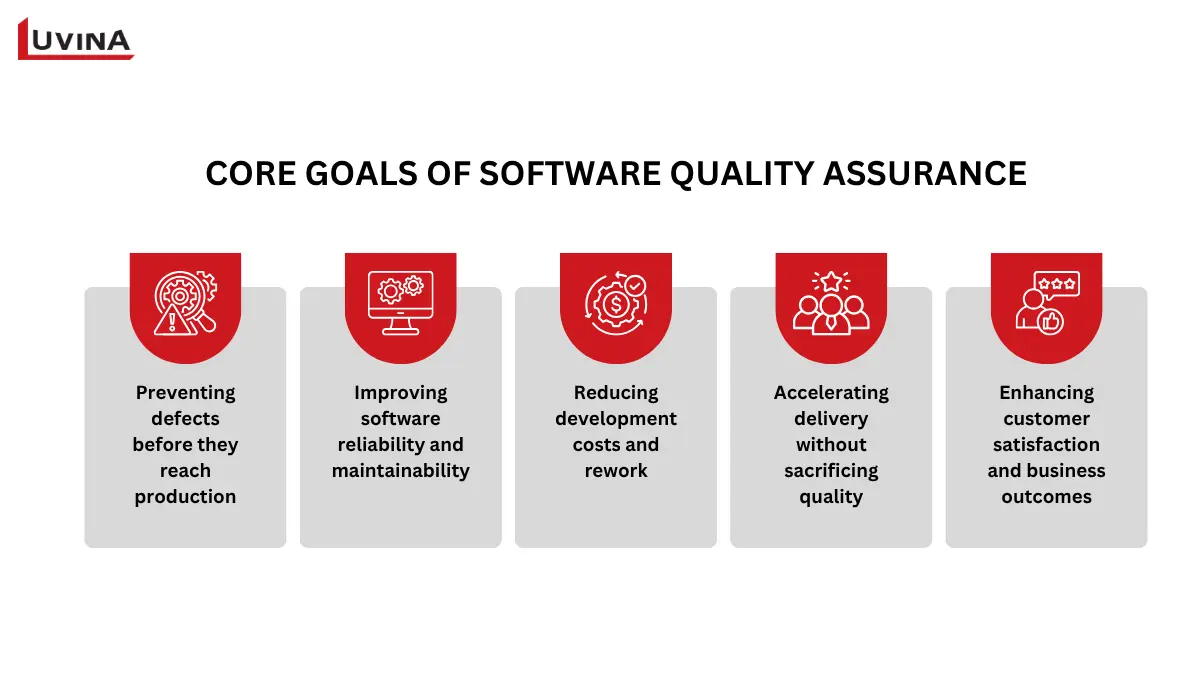
5 Core Strategic Goals of Software Quality Assurance
The primary goals of software quality assurance include:
- Preventing defects before they reach production
- Improving software reliability and maintainability
- Reducing development costs and rework
- Accelerating delivery without sacrificing quality
- Enhancing customer satisfaction and business outcomes
Common QA activities include requirements reviews, test planning, code reviews, automated testing, performance testing, and continuous quality monitoring.
QA vs. QC vs. Testing: What’s the Difference?
Although the terms Quality Assurance (QA), Quality Control (QC), and Software Testing are often used interchangeably, they represent different aspects of software quality management.
Understanding the differences between these disciplines is essential when implementing software development quality assurance best practices across modern engineering teams.
| Aspect | Quality Assurance (QA) | Quality Control (QC) | Software Testing |
| Primary Objective | Prevent defects | Identify defects | Verify functionality |
| Focus Area | Processes and standards | Product quality | Application behavior |
| Approach | Proactive | Reactive | Reactive |
| Timing | Throughout the SDLC | After development activities | During validation and verification |
| Key Activities | Process improvement, audits, reviews | Inspections, defect tracking | Unit, integration, system, and E2E testing |
| Ownership | Entire project team | QA team and reviewers | QA engineers and developers |
| Outcome | Higher process quality | Improved product quality | Confirmed software functionality |
Key Differences Between QA, QC, and Software Testing
For example, code reviews and coding standards are part of QA because they help prevent issues early. QC focuses on finding defects in completed features, while testing verifies that the software works as expected. In practice, effective teams use QA, QC, and testing together to improve software quality and reduce delivery risks.
Why QA Best Practices Matter
In modern software development, effective QA practices directly influence development costs, release speed, customer satisfaction, and long-term business performance. Organizations that invest in software development quality assurance best practices consistently achieve higher software quality.
Key benefits include:
- According to IBM Systems Sciences Institute, defects found in production cost significantly more to fix than those identified during requirements or design.
- AI-powered QA tools help automate repetitive testing tasks and improve testing efficiency.
- Strong QA reduces rework, shortens time to market, and improves customer satisfaction.
- Shift Left Testing helps teams find issues earlier and reduce QA cycle time.
10 Software Development Quality Assurance Best Practices for Modern Engineering Teams
Effective software development quality assurance best practices go beyond testing software before release. They help teams build quality into every stage of development, from requirements and design to testing and deployment. The following best practices can help improve software quality, reduce risks, and accelerate delivery.
1. Shift Testing Left
Shift Left Testing means starting testing activities earlier in the software development lifecycle. Instead of waiting until development is complete, QA teams get involved during requirements gathering, solution design, and sprint planning.
Early QA involvement helps teams identify requirement gaps, unclear acceptance criteria, and potential risks before code is written. As a result, defects can be prevented rather than detected later when fixes become more expensive and time-consuming.
Shift Left Testing is especially important in Agile and DevOps environments where rapid release cycles require continuous feedback and collaboration across teams.
To learn more about how testing fits into the development process, read our guide on 6 steps of software testing life cycle.
Benefits of Shift Left Testing
| Traditional Approach | Shift Left Approach |
| QA starts after development | QA starts during requirements and design |
| Defects discovered late | Defects identified earlier |
| Higher remediation costs | Lower defect resolution costs |
| Longer release cycles | Faster delivery cycles |
| More rework | Less rework |
Key Differences Between Traditional Testing and Shift Left Testing
Key practices include:
- Involving QA during requirement reviews
- Participating in sprint planning sessions
- Reviewing user stories and acceptance criteria early
- Automating tests as early as possible
- Providing continuous feedback throughout development
When quality is built into the process from the start, teams can reduce rework, improve delivery predictability, and accelerate release cycles.
2. Define Clear, Testable Requirements
Even the most skilled development teams struggle when requirements are vague or incomplete. This is a common challenge when implementing software development quality assurance best practices. Unclear requirements can lead to misunderstandings, inconsistent implementation, and defects that surface later in development.
A strong quality assurance process starts with requirements that are specific, measurable, and testable. Every user story should include clear Acceptance Criteria and align with the team’s Definition of Done (DoD).
Examples of Vague vs. Testable Requirements
| Vague Requirement | Testable Requirement |
| Users should be able to log in quickly | Users can log in within three seconds under normal operating conditions |
| The page should load fast | The page loads within two seconds for 95% of users |
| The system should be secure | User passwords are encrypted according to approved security standards |
Real Examples of Poor vs. Well-Defined Requirements
How to Create Testable Requirements
- Define measurable acceptance criteria
- Review requirements collaboratively across teams
- Identify edge cases early
- Document business rules clearly
- Ensure traceability between requirements and test cases
Clear requirements reduce ambiguity and create a shared understanding among product managers, developers, QA engineers, and stakeholders. This significantly improves software quality and reduces costly rework later in the project.
3. Implement Test-Driven Development (TDD)
Test-Driven Development (TDD) is a software development approach where tests are written before the actual code. This ensures that every feature is designed with testability in mind from the beginning, which is a core principle in software development quality assurance best practices, rather than being adjusted after implementation.
TDD helps teams improve code quality, reduce bugs, and minimize long-term technical debt by forcing developers to clearly define expected behavior before writing logic.
Key Practices in TDD
- Write a failing test before implementing functionality
- Implement minimal code to pass the test
- Refactor code while keeping tests passing
- Repeat the cycle for each feature
- Maintain high test coverage for core logic
TDD ensures that software is built with quality in mind from the start, improving maintainability and reducing regression risks in complex systems.
4. Automate Regression and Repetitive Tests
Automating regression and repetitive test cases is a critical part of modern QA strategies. It allows teams to focus manual effort on exploratory testing and user experience validation, while automation handles predictable and repetitive scenarios.
Regression, smoke, and sanity tests are ideal candidates for automation because they are frequently executed and require consistent results across builds.
Many teams also follow the Test Pyramid approach when building automation frameworks. The model helps balance test coverage, execution speed, and maintenance effort by prioritizing:
- A larger number of unit tests for fast and reliable feedback
- A moderate number of integration tests to validate interactions between components
- A smaller number of end-to-end tests to verify critical user journeys while minimizing maintenance costs
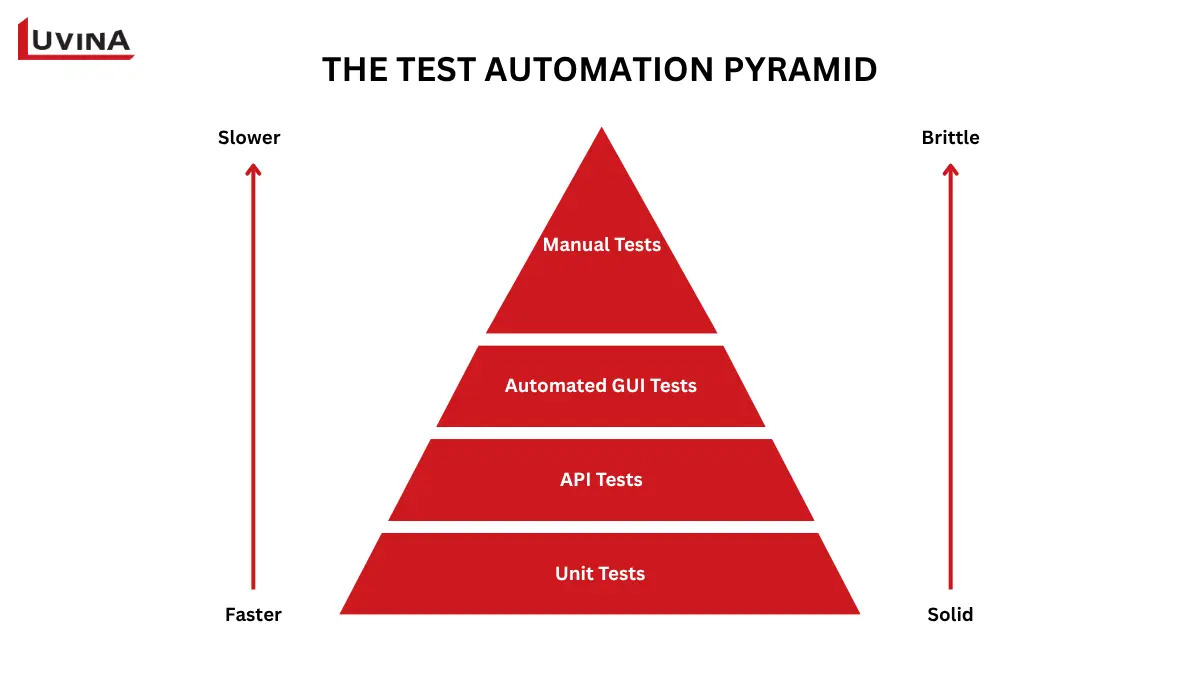
Recommended Distribution of Automated Tests in the Test Pyramid
For organizations scaling their QA capabilities, adopting software development quality assurance best practices, automation is often a core part of modern software testing strategies.
What should be automated versus tested manually in QA processes
| Automated Testing | Manual Testing |
| Regression tests | Exploratory testing |
| Smoke tests | UX and usability testing |
| Sanity tests | Edge case exploration |
| Repetitive functional tests | Visual and experience validation |
What to Automate vs. What to Test Manually
Key Practices for Test Automation
- Automate high-frequency regression test cases
- Prioritize stable and repeatable scenarios
- Maintain and update test scripts regularly
- Integrate automation into CI/CD pipelines
- Avoid automating unstable or frequently changing features
Effective test automation increases testing efficiency, reduces human error, and enables faster feedback loops across the development lifecycle.
5. Integrate QA Into CI/CD Pipelines
The development team increasingly embeds QA directly into CI/CD pipelines to ensure that every code change is automatically validated. In this approach, quality checks are not a separate phase but an integral part of the delivery workflow.
When CI/CD is properly implemented, every commit triggers an automated test suite. If any test fails, the build is blocked immediately, preventing defective code from moving further down the pipeline.
Typical CI/CD QA Pipeline Flow
Code changes are validated through a structured pipeline that ensures quality at every stage. To achieve continuous delivery without friction, integrating automated testing within this workflow is recognized as one of the most critical software development quality assurance best practices.
A standard pipeline flow operates through the following structured stages:
| Stage | QA Activity |
| Build | Compile and package the application |
| Unit tests | Validate individual functions and components |
| Integration tests | Verify interaction between modules |
| Staging deployment | Deploy to the staging environment |
| E2E tests | Validate full user workflows |
CI/CD QA Pipeline Stages and Validation Activities
Key Practices for QA in CI/CD
- Run automated tests on every commit
- Fail fast when issues are detected
- Maintain fast and stable test suites
- Separate unit, integration, and E2E testing layers
- Continuously monitor pipeline performance
Integrating QA into CI/CD pipelines helps teams detect issues earlier, reduce release risks, and maintain consistent software quality across rapid development cycles.
6. Apply Risk-Based Testing
Risk-Based Testing is a QA approach that prioritizes testing efforts based on the potential impact and likelihood of failure. Instead of treating all features equally, teams focus more on critical areas that directly affect business outcomes and system stability.
This approach is especially important in complex systems where full test coverage is not always feasible due to time or resource constraints.
Key Practices in Risk-Based Testing
- Identify high-impact business modules early
- Create a risk matrix based on severity and probability
- Prioritize test cases for critical features first
- Allocate more testing effort to high-risk areas
- Continuously update risk assessment during development
Risk-Based Testing helps teams optimize QA resources while ensuring that the most critical parts of the system receive the highest level of attention, reducing the likelihood of severe production issues.
7. Conduct Regular Code Reviews
Code review is one of the earliest and most effective forms of quality assurance in software development. It helps detect issues before code reaches testing stages and ensures consistency across the codebase.
Modern engineering teams combine automated static analysis tools such as SonarQube with manual peer review to improve code quality and maintainability.
Key Practices in Code Review
- Review code early and frequently
- Combine automated static analysis with manual review
- Focus on logic, readability, and maintainability
- Enforce coding standards consistently to align with the team’s core software development quality assurance best practices
- Encourage constructive feedback among team members
Regular code reviews improve code quality, reduce defects early, and strengthen collaboration between developers and QA engineers.
8. Use Multiple Testing Types
Effective software quality assurance requires a combination of different testing types to ensure both functional and non-functional aspects of the system are validated.
Each testing type plays a different role in ensuring overall system reliability and user experience.
Key Testing Types
- Unit testing: individual functions or modules
- Integration testing: interaction between modules
- System testing: full application validation
- End-to-end testing: real user journeys
- Performance testing: evaluates speed, scalability, and stability under load
- Security testing: identifies vulnerabilities and validates application security controls through techniques such as Static Application Security Testing (SAST) and Dynamic Application Security Testing (DAST)
- Accessibility testing: ensures compliance with accessibility standards and improves usability for all users
As organizations adopt DevSecOps practices, security testing is increasingly integrated into CI/CD pipelines rather than being performed only before release. This allows teams to identify vulnerabilities earlier, reduce security risks, and maintain compliance without slowing down delivery.
Using multiple testing types ensures broader coverage and helps teams detect issues at different layers of the application, from individual components to complete user workflows. Designing a multi-layered testing strategy is essential to executing comprehensive software development quality assurance best practices in fast-paced environments.
9. Track QA Metrics and KPIs
Effective software quality assurance is not possible without measurement. Tracking QA metrics and KPIs helps teams understand software quality trends, identify bottlenecks, and continuously improve testing efficiency.
By monitoring the right indicators, teams can move from reactive debugging to proactive quality improvement.
Key QA Metrics and KPIs
- Defect density: number of bugs per 1,000 lines of code
- Test coverage: percentage of code covered by tests, with a target of over 80 percent for critical paths
- Mean Time to Detect (MTTD) and Mean Time to Resolve (MTTR)
- Escaped defects: number of bugs found in production
Tracking these metrics consistently helps teams improve quality visibility, reduce production issues, and make more data-driven decisions.
10. Foster QA Developer Collaboration
Quality assurance is most effective when it is shared across the entire development team. QA should not be seen as the final checkpoint or the bug reporting team, but as a partner involved throughout the development lifecycle.
When QA and developers collaborate closely from sprint planning to delivery, teams can identify issues earlier, reduce misunderstandings, and improve overall software quality. Shared ownership of quality improves collaboration, reduces defects, and helps teams deliver more reliable software.
QA Best Practices for Agile and DevOps Teams
Modern Agile and DevOps environments require QA to be continuous rather than a separate phase after development. Quality is built into every stage of delivery, with testing running in parallel with development instead of being treated as a final step.
In these environments, QA engineers are also active participants in team ceremonies, ensuring quality is considered from planning to release.
Key QA Practices in Agile and DevOps
- Continuous testing in parallel with development, not after development is completed
- QA participates in sprint planning, daily standups, and retrospectives
- Definition of Ready (DoR) requires clear acceptance criteria before development starts
- Shift-right testing practices such as production monitoring using Real User Monitoring (RUM) and A/B testing
- DevSecOps practices integrate security testing into CI/CD pipelines to identify vulnerabilities continuously throughout development
These practices help teams shorten feedback loops, detect issues earlier, and maintain high software quality in fast release cycles. They also help development teams deliver software more reliably and with fewer production issues.
Essential QA Tools Every Software Team Should Use
A strong software quality assurance strategy relies on the right set of tools across different stages of the testing lifecycle. Each category supports a specific aspect of quality assurance, from test management to production monitoring.
| Category | Purpose | Popular Tools |
| Test management | Organize test cases, track execution, and manage QA workflows | Jira, TestRail |
| UI automation | Automate end-to-end and regression UI testing | Selenium, Playwright |
| API testing | Validate backend services and API reliability | Postman |
| Performance testing | Measure system performance under load and stress conditions | JMeter |
| Code quality | Analyze code structure, maintainability, and detect issues early | SonarQube |
| CI/CD | Automate build, test, and deployment pipelines | Jenkins, GitHub Actions |
| AI-powered QA | Enhance test generation, defect prediction, and intelligent test optimization |
Essential QA Tools by Category
Using the right combination of tools across these categories helps teams improve efficiency, increase test coverage, and ensure consistent software quality across the development lifecycle.
Most Common QA Pitfalls in Software Development
Even well-structured QA processes can fail if teams repeat common mistakes that reduce testing effectiveness and product quality. Recognizing these pitfalls early helps organizations build more mature and reliable software quality assurance practices.
Common QA Mistakes
- Testing only at the end of the development cycle
- Limited test coverage that ignores edge cases
- No performance or security testing strategy
- Missing documentation and requirement traceability
- Poorly maintained automation and flaky tests
Avoiding these mistakes helps teams catch issues earlier, reduce release risks, and improve software quality. Combined with strong software development quality assurance best practices, it creates a more reliable and efficient development process.
FAQs
1. What are software quality assurance best practices?
Methods to prevent defects and ensure software quality across the development lifecycle, including shift left, automation, CI/CD, and code reviews.
2. What is the difference between QA and software testing?
QA prevents defects through process improvement, while testing finds defects in the product.
3. How do you implement QA in agile development?
By involving QA early, defining clear acceptance criteria, running continuous testing in CI/CD, and collaborating throughout each sprint.
4. What tools are commonly used in software QA?
Test management, automation, API testing, performance tools, CI/CD tools, and code quality tools.
5. Why is shift-left testing important?
It helps detect defects early, reducing cost, rework, and improving delivery speed.
Conclusion
Strong software quality is not achieved by chance. It comes from consistent practices applied throughout the entire development lifecycle, where quality is continuously shaped rather than checked at the end.
As systems grow more complex and release cycles become faster, organizations that embed quality into how teams work and share responsibility across development, testing, and operations are better positioned to reduce defects, control costs, and deliver more reliable user experiences. Successfully deploying these modern software development quality assurance best practices is what separates high-performing engineering teams from the rest.
If your organization is looking to strengthen its QA strategy or scale quality engineering capabilities, contact Luvina Software to explore how we can help you build more reliable and scalable software products.
Resources
- https://asq.org/quality-resources/quality-assurance-vs-control
- https://gist.github.com/Morendil/ebfa32d10528af04e2ccb8995e3cb4a7
- https://www.ibm.com/think/topics/bug-tracking
- https://katalon.com/reports/state-quality-2025
- https://www.mckinsey.com/capabilities/quantumblack/our-insights/the-state-of-ai
READY TO START A PROJECT?
Our experts are eager to explore your needs.

Read More From Us?
Sign up for our newsletter
Read More From Us?
Sign up for our newsletter