




What Is A Software Framework? Definition, Types, and Examples


Every development team, at some point, faces the same challenge: how to build faster without sacrificing quality or consistency. That’s where a software framework comes in.
So, what is a software framework? At its core, it’s a reusable, pre-built structure that provides a standardized foundation for building applications. Instead of writing common functionality from scratch, developers extend the framework to build their specific product.
In this guide, you’ll get a clear breakdown of how frameworks work, the main types used in software engineering today, and how to choose the right one for your project.
What Is a Software Framework?
According to Wikipedia:
A software framework is software that provides reusable, generic functionality which developers can extend or customize to create complete solutions.
Understanding this concept is a useful starting point before diving deeper into the software development process.
The word “framework” originally referred to a physical supporting structure, like the frame of a building. In software engineering, the term was adopted to describe the same idea: a skeleton that holds everything together while leaving room for developers to build on top.
To fully understand what a software framework is, it helps to look at what’s actually built into one. Depending on the framework, it may include a core set of built-in components:
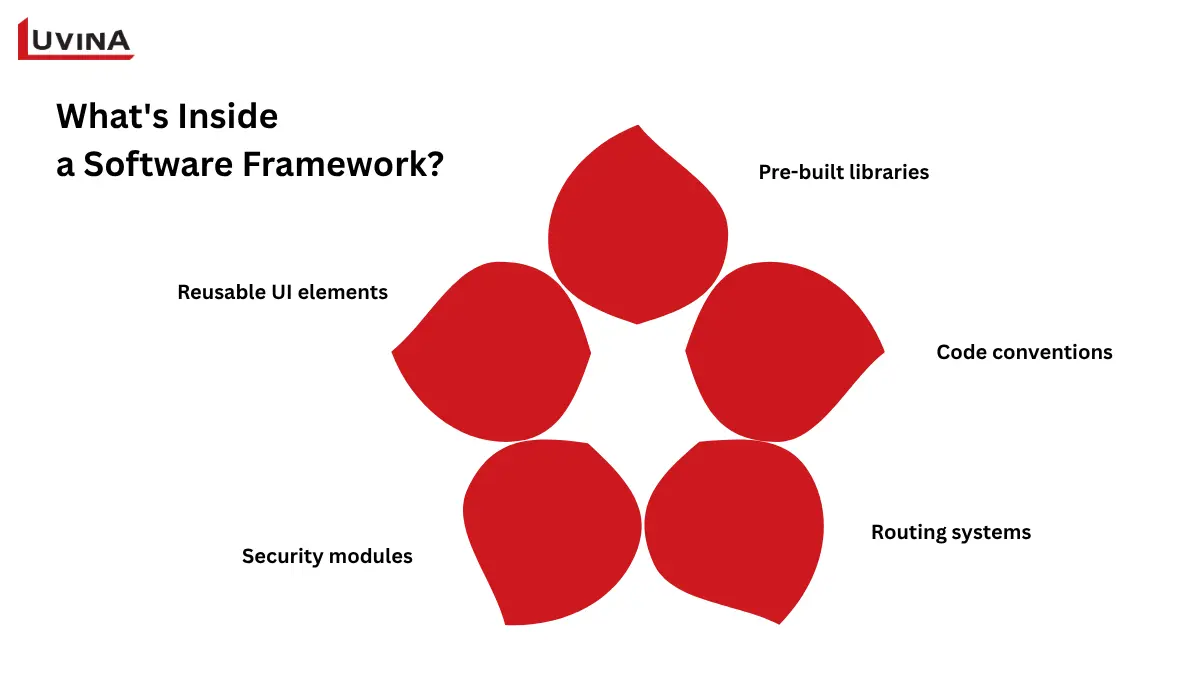
The five core components found inside most software frameworks
- Pre-built libraries for common tasks like authentication and data handling
- Code conventions that define how files, folders, and modules are structured
- Routing systems that map URLs to specific functions or pages
- Security modules help reduce common threats like SQL injection or cross-site scripting
- Reusable UI elements for consistent front-end experiences
Before frameworks became mainstream, developers had to build authentication, routing, session handling, and security mechanisms from scratch.
Frameworks emerged to standardize these common tasks, improve maintainability, and accelerate software delivery. When everyone on a team follows the same framework, the codebase becomes predictable. And the risk of conflicting patterns across the project drops significantly.
How Does a Software Framework Work?
One of the best ways to understand what a software framework is to see how it actually controls the flow of your application. And that starts with one core principle.
The Inversion of Control Principle
Most developers are familiar with libraries. You call a library when you need it. You’re in control.
A software framework flips that dynamic entirely:
| Library | Framework | |
| Who’s in control? | Your code | The framework |
| How it’s used | You call it when needed | It calls your code at defined points |
| Flow direction | You decide the flow | The framework dictates the flow |
How libraries and frameworks differ in control flow
Think of it this way:
- With a library: You’re the director. You decide when to call the actors.
- With a framework: The framework is the director. It calls you when it’s your turn.
This concept is called Inversion of Control (IoC), and it’s the defining characteristic of any software framework.
A practical example: the MVC architecture
Most frameworks put Inversion of Control into practice through an architectural pattern called MVC (Model-View-Controller). It splits your application into three parts:
- Model: Handles data and business logic
- View: Displays information to the user
- Controller: Receives input and decides what happens next
Here’s where IoC shows up. You don’t manually wire these three parts together every time a request comes in. The framework does that for you. When a user submits a form, the framework automatically routes that request to the right controller, which talks to the model, then renders the correct view. You only write the logic for each piece. The framework decides when and how each piece gets called.
This is exactly why frameworks like Laravel, Django, and Spring all follow some version of MVC: it gives Inversion of Control a concrete, repeatable structure that developers can build on.
Framework vs. Library vs. Programming Language: What Is the Difference?
This is one of the most common points of confusion in software development. People often use these three terms interchangeably, but they serve completely different purposes. Knowing what a software framework is versus a library and a programming language helps you make better architectural decisions from day one.
| Framework | Library | Programming Language | |
| Purpose | Provides the full structure for an application | Provides specific, reusable functionality | Writes the logic and instructions |
| Control | Framework calls your code | Your code calls the library | Write everything from scratch |
| Size | Large, opinionated structure | Smaller, focused toolset | N/A, it’s the foundation itself |
| Flexibility | Less flexible, enforces conventions | More flexible, use as needed | Maximum, no constraints |
| Examples | Angular, Django, Spring | Axios, Lodash, NumPy | Python, JavaScript, Java |
Framework vs. Library vs. Programming Language: Side-by-Side Comparison
When to use each one
- Use a programming language to build absolutely anything from the ground up, with full control but the most development time.
- Use a library when you need a specific functionality without committing to a full structure, or when your project already has an established architecture.
- Use a framework when you’re building a full application from scratch and want built-in structure, conventions, and tools out of the box.
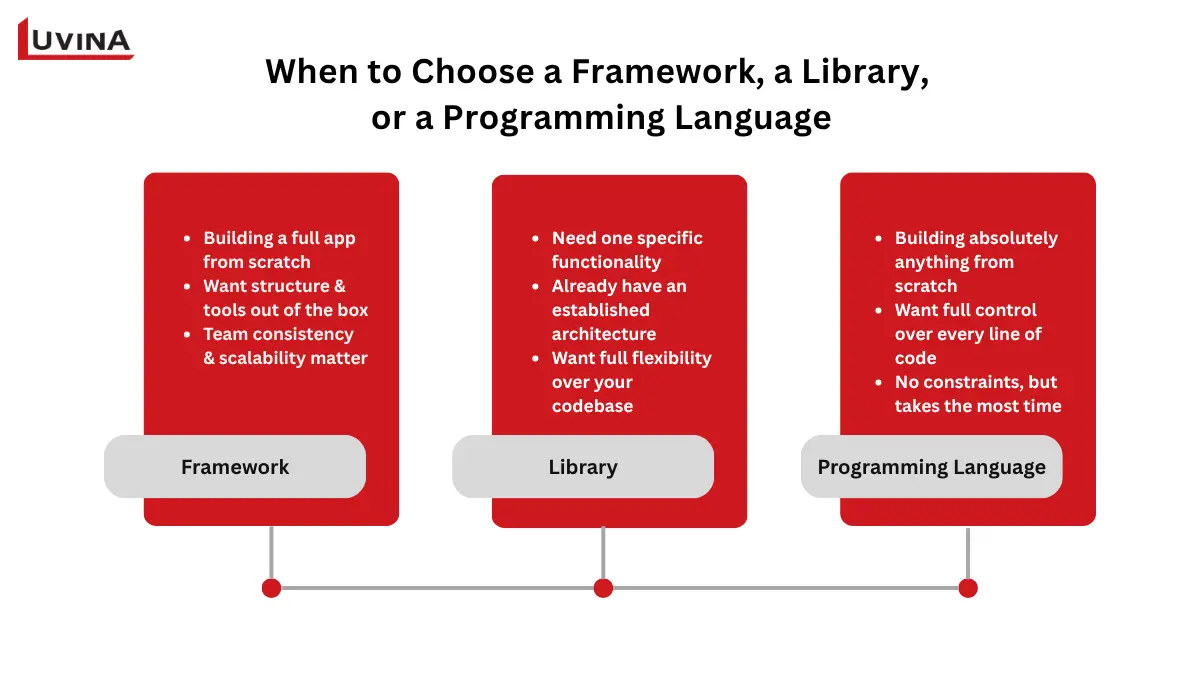
A quick comparison of when to choose a programming language, a library, or a framework for your project
React is technically a JavaScript library rather than a full framework because it focuses primarily on the UI layer. Frameworks such as Next.js, built using JavaScript and React together, provide a more complete application structure.
What Is a Framework in Software Engineering? Types and Categories
The term “framework” doesn’t mean the same thing in every context. Depending on who you ask, what a framework is in software engineering can refer to a web framework, a mobile framework, a testing tool, or even a project management methodology.
That’s why it helps to break them down by category.
Web Application Frameworks
Web frameworks are the most widely recognized type. They provide the structure for building everything from simple websites to complex enterprise applications.
Frontend Frameworks
Frontend frameworks handle the UI and interaction layer, essentially everything the user sees and clicks on.
| Framework | Language | Best known for |
| Angular | TypeScript | Large-scale enterprise apps |
| Vue.js | JavaScript | Lightweight, flexible UI building |
Popular frontend frameworks and their strengths
React is often grouped with frontend frameworks, but it is technically a library. It handles the UI layer but doesn’t enforce a full application structure the way Angular does.
Backend Frameworks
Backend frameworks manage server-side logic, databases, APIs, and business rules, essentially everything that happens behind the scenes.
| Framework | Language | Best known for |
| Django | Python | Fast development, built-in security |
| Laravel | PHP | Elegant syntax, rapid prototyping |
| Ruby on Rails | Ruby | Convention over configuration |
| Spring | Java | Enterprise-grade, highly scalable |
Popular backend frameworks and their strengths
Mobile Application Frameworks
Building a mobile app used to mean writing two separate codebases: one for iOS, one for Android. Cross-platform frameworks changed that.
With tools like React Native and Flutter, teams can write a single codebase that runs on both platforms. This is one of the most practical examples of software frameworks in the mobile context: a structure that lets you build once and deploy everywhere.
| Framework | Language | Best known for |
| React Native | JavaScript | Near-native performance, large community |
| Flutter | Dart | Beautiful UI, fast rendering engine |
Popular cross-platform mobile frameworks
Real-world examples
Both frameworks power some of the most widely used apps today:
- React Native: Facebook, Instagram, and Discord all run on React Native, proving it can handle large-scale, high-traffic applications
- Flutter: Google Pay, Alibaba, and BMW use Flutter for its smooth animations and consistent UI across devices
Why cross-platform saves more than just time
Based on Luvina’s experience working with cross-platform projects, this approach can cut development costs by 30–40% compared to native development, since only a single codebase is created for an app that works on both Android and iOS. Here’s why:
- One team handles both iOS and Android instead of two separate teams
- Shared codebase means fewer hours spent on duplicate features
- Faster release cycles across both platforms simultaneously
- Lower long-term maintenance costs
Testing Frameworks
Testing frameworks like Selenium, JUnit, Pytest, and Jest automate the quality assurance process, running hundreds of checks in minutes so your team doesn’t have to do it manually every time.
| Framework | Language | Best known for |
| Selenium | Java/Python/JS | Browser automation and UI testing |
| JUnit | Java | Unit testing for backend logic |
| Pytest | Python | Flexible, simple test writing |
| Jest | JavaScript | Fast unit and integration testing |
Popular testing frameworks by language
In modern software development, testing frameworks don’t run in isolation. They plug directly into CI/CD pipelines, meaning every time a developer pushes new code, tests run automatically. If something breaks, the pipeline catches it before it ever reaches production.
This is what makes testing frameworks a critical piece of what a software framework is in practice: not just writing code faster, but shipping it with confidence.
Data Science and Machine Learning Frameworks
AI adoption has accelerated significantly in 2025-2026, and so has the demand for frameworks that support it. Data science and machine learning frameworks give teams a structured foundation to build, train, and deploy AI models without starting from scratch.
| Framework | Best known for |
| TensorFlow | Large-scale model training, production deployment |
| PyTorch | Research-friendly, dynamic computation graphs |
| Scikit-learn | Classical ML algorithms are easy to prototype |
Established ML frameworks
Understanding what a software framework is in this context means recognizing that they don’t just provide code. They define how data flows, how models are structured, and how results are evaluated.
As large language models become central to modern products, a new category of frameworks has emerged specifically for AI/LLM application development:
- LangChain: Helps developers build applications powered by LLMs, connecting models to data sources, APIs, and memory systems
- LlamaIndex: Focuses on indexing and retrieving data for LLM applications, making it easier to build intelligent search and Q&A systems
These frameworks reflect where software development frameworks are heading: not just building apps, but building apps that think.
What Is an Agile Software Development Framework?
So far, we’ve covered technical frameworks: the code-level structures that shape how applications are built. But what is a software framework in the context of how teams actually work together? That’s where process frameworks come in.
| Technical Framework | Process Framework | |
| What it structures | Your codebase | Your team’s workflow |
| Examples | Django, React, Spring | Scrum, Kanban, SAFe |
| Used by | Developers | Entire development teams |
| Goal | Consistent, scalable code | Consistent, scalable delivery |
Technical framework vs. process framework
A process framework defines how a team plans, executes, and delivers software. It’s not code. It’s methodology. And for B2B software teams, getting this right is just as important as choosing the right technical stack.
What is an Agile software development framework?
Agile methodology in software engineering is an approach that breaks development into short, iterative cycles. Rather than planning everything up front, Agile teams adapt as they go, delivering working software faster and responding to change more effectively. Agile itself is not a framework but a mindset/principles.
The most common Agile philosophies include:
- Scrum: Organizes work into fixed sprints (often 1-4 weeks), with defined roles like Scrum Master and Product Owner
- Kanban: Visualizes workflow on a board, focusing on limiting work in progress and improving flow
- SAFe (Scaled Agile Framework): Scales Agile practices across large enterprises with multiple teams
- XP (Extreme Programming): Emphasizes technical excellence through practices like pair programming and test-driven development
Why process frameworks matter as much as technical ones
You can have the best tech stack in the world. But if your team doesn’t have a clear framework for how work gets planned, reviewed, and delivered, things fall apart.
Process frameworks reduce miscommunication, keep teams aligned, and ensure software reaches users consistently and on time. In that sense, they solve the same core problem as technical frameworks: removing ambiguity so teams can focus on what matters.
Benefits and Limitations of Using a Software Framework
Key Benefits
Understanding what a software framework is one thing. Knowing when and why to use one is another. Here are the key benefits that make frameworks a default choice for most development teams.
- Faster development: Frameworks cut repetitive boilerplate code, reducing development time
- Built-in best practices: Security protections, performance optimizations, and proven architectural patterns come baked in
- Community and ecosystem: Third-party plugins, active support forums, regular security patches, and a large hiring pool
- Consistency: Everyone follows the same conventions, making the codebase predictable and easier to maintain
Known Limitations
Frameworks come with real trade-offs. The same structure that speeds up development can also box you in when your project grows in unexpected directions. Before committing to one, it’s worth knowing where things can go wrong.
- Learning curve: Every framework has its own conventions, syntax, and structure to master before your team can move fast
- Opinionated structure: Most frameworks make decisions for you, which can become a constraint when your project has highly custom requirements
- Version dependency risk: When a framework releases a major update, existing code can break, and migrations can be costly
- Performance overhead: Some frameworks carry more weight than a simple project needs, adding unnecessary complexity and slower load times
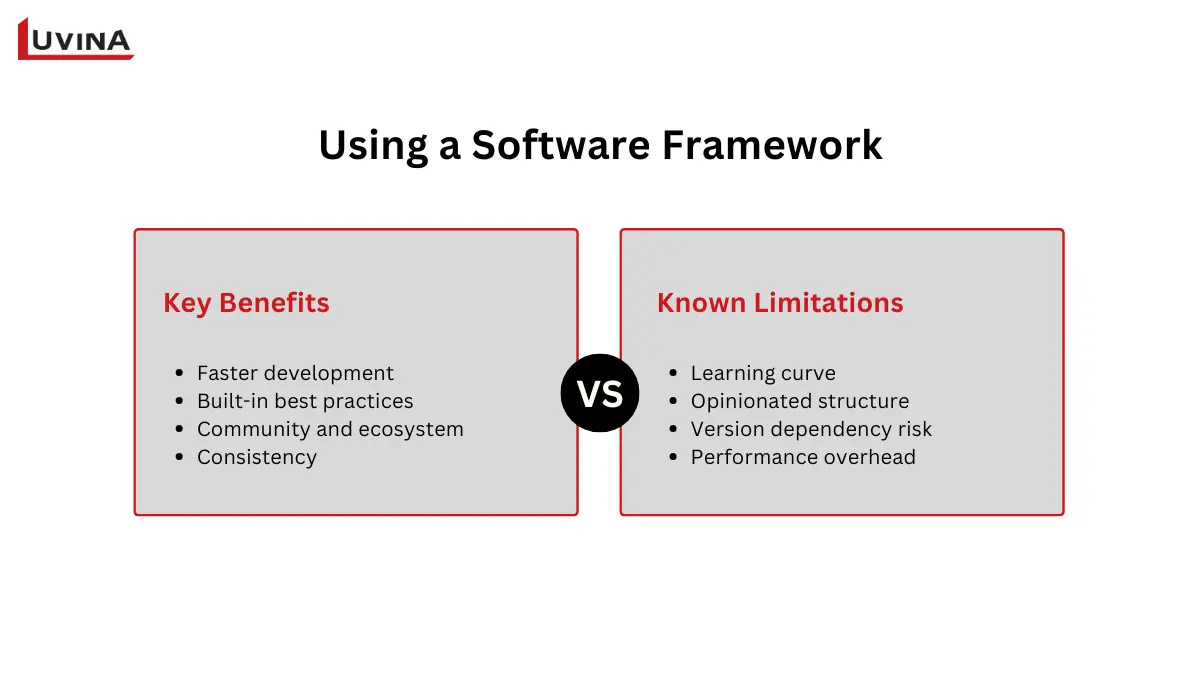
Key benefits and known limitations of using a software framework at a glance
How to Choose the Right Software Framework for Your Project
Knowing the definition of a software framework is only half the equation. The other half is choosing the right one. With hundreds of options available, the decision can feel overwhelming. But it doesn’t have to be. Start here.
| Project type | Recommended framework category |
| Web application (frontend) | Angular, Vue.js, React |
| Web application (backend) | Django, Laravel, Spring, Ruby on Rails |
| Mobile app (cross-platform) | React Native, Flutter |
| Machine learning / AI | TensorFlow, PyTorch, Scikit-learn |
| LLM / AI application | LangChain, LlamaIndex, AutoGen, CrewAI |
| Automated testing | Selenium, Jest, Pytest, JUnit |
Project type and recommended framework category
5 questions to ask before picking a software framework
Before committing to any software development framework, run through these five questions:
- What is the scale of the project? A lightweight framework suits a simple app. A large enterprise system needs something more structured and scalable.
- What does your team already know? The best framework is often the one your team can actually use well, not the most popular one on the market.
- How large is the community? A strong community means better documentation, more plugins, and faster answers when things break.
- What are the performance requirements? Some frameworks add overhead that’s fine for most projects, but becomes a bottleneck at scale.
- Who will maintain this long-term? A framework that’s hard to hire for or rarely updated becomes a liability down the road. Building a solid software maintenance strategy alongside your framework choice is just as important as the choice itself.
Red flags to watch out for
Choosing a framework in software engineering because it’s trending is one of the most common and costly mistakes teams make. Here’s what to avoid:
- Picking a framework because it’s popular on social media or GitHub stars, not because it fits your use case
- Ignoring your team’s existing expertise and forcing a steep learning curve under a tight deadline
- Overlooking the long-term support and update frequency of the framework
- Choosing a heavyweight framework for a simple project that needs speed and simplicity
The right software framework isn’t the most impressive one on the market. It’s the one that fits your team’s skills, matches your project’s complexity, and supports your long-term goals. A framework that ticks all three boxes will always outperform a trending one that doesn’t.
FAQs
1. What is a software framework?
A reusable, pre-built structure that provides a standardized foundation for building applications. Developers extend it to create their specific product without writing common functionality from scratch.
2. What is the difference between a software framework and a library?
Control. A library is a tool your code calls when needed. A framework calls your code and controls the overall flow (inversion of control).
3. What are the main types of software frameworks?
Web frameworks (frontend and backend), mobile frameworks, testing frameworks, and data science/ML frameworks. There are also process frameworks like Agile, Scrum, and SAFe.
4. What is an agile software development framework?
A process methodology that guides how teams plan, execute, and deliver software. Popular examples include Scrum, Kanban, SAFe, and XP.
5. What is a process framework in software engineering?
A structured approach that defines how a team works throughout the software development lifecycle, from requirements and design to testing and deployment.
Conclusion
Software frameworks are one of the most impactful decisions a development team makes. The right one accelerates development, enforces best practices, and keeps your codebase consistent as the project scales. But knowing what a software framework is just the starting point.
The real value comes from choosing the right one for your specific project type, team skills, and long-term goals. A framework that works brilliantly for one team can slow down another.
If you’re building a software product and want to make sure your technical foundation is set up for scale, Luvina’s software development team can help.
Resources
- https://en.wikipedia.org/wiki/Software_framework
- https://testquality.com/best-automation-testing-tools-for-ci-cd-pipelines-your-complete-2025-guide/
READY TO START A PROJECT?
Our experts are eager to explore your needs.

Read More From Us?
Sign up for our newsletter
Read More From Us?
Sign up for our newsletter