




Digital Transformation Framework: Key Models and How to Choose


An ERP upgrade, a CRM rollout, and an AI pilot may each have clear objectives, yet still compete for resources or operate without a shared direction.
A digital transformation framework helps organizations connect these initiatives to business goals, identify the capabilities they need, and establish how progress will be governed and measured. This guide explains what a framework does, compares four recognized models, and shows how to choose an approach that fits your business priorities and constraints.
What Is a Digital Transformation Framework
A digital transformation framework is a structure that guides how a company organizes, connects, and governs its digital initiatives to reach business goals. It covers objectives, capabilities, people, processes, technology, and governance. It also helps leaders answer four questions:
- What outcomes do we need?
- Which capabilities must we build?
- Who coordinates the work and owns the results?
- How will we measure success?
Without a shared framework, individual projects may meet their delivery targets without making sufficient progress towards the organization’s broader business goals.
A framework is not the plan itself. It still needs to become a plan, with resources and delivery decisions.
How a Framework Differs from Strategy, Roadmap, and Maturity Model
Four terms are often mixed up. Each answers a different question.
| Concept | Main question |
| Strategy | What are we transforming for, and what comes first? |
| Framework | Which elements must we organize, connect, and govern? |
| Roadmap | Which initiatives do we deliver, in what order and timeline? |
| Maturity model | Where are our capabilities today, and what is missing? |
Four planning concepts in digital transformation and the question each one answers
These tools work together. A digital transformation strategy sets the destination, and the framework gives the structure to reach it. A roadmap sequences the work, while a maturity model shows the starting point.
What Should a Digital Transformation Framework Cover
A framework only works if it covers the areas that decide whether an initiative delivers value. Five checks make a practical starting point. Use them to test any model, whether it is one of the four below or your own.
| Area | Check question |
| Business outcomes | What value do we want to create, and how will we measure it? |
| Customers and operations | Which customer experiences, processes, or ways of working need to change? |
| Technology and data | Do our systems, integrations, and data quality support the goals? |
| People and change | Which skills are missing, and how ready are teams for change? |
| Governance and measurement | Who decides, who is accountable, and how do we manage risk and track KPIs? |
Five areas to check in any framework
This is a working checklist for this guide, not a standard set of pillars shared by every model. Models stress different areas, so use it to spot what a model leaves out. Governance is worth settling early, because digital transformation risks such as security gaps or resistance inside teams need a named owner from the start.
Recognized Frameworks for Digital Transformation
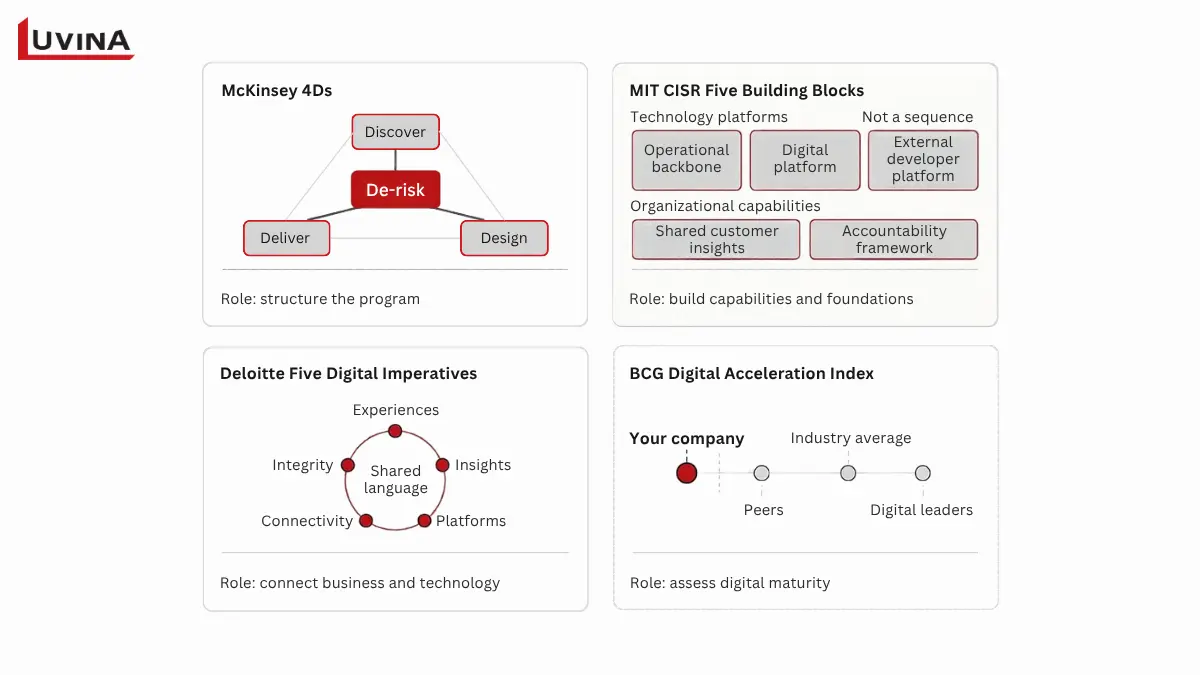
Four digital transformation models are covered below, all from recognized consulting and research sources. They work as digital transformation framework examples, but not all play the same role. Three of these shape how a company approaches change. BCG’s Digital Acceleration Index assesses where you stand.
McKinsey 4Ds
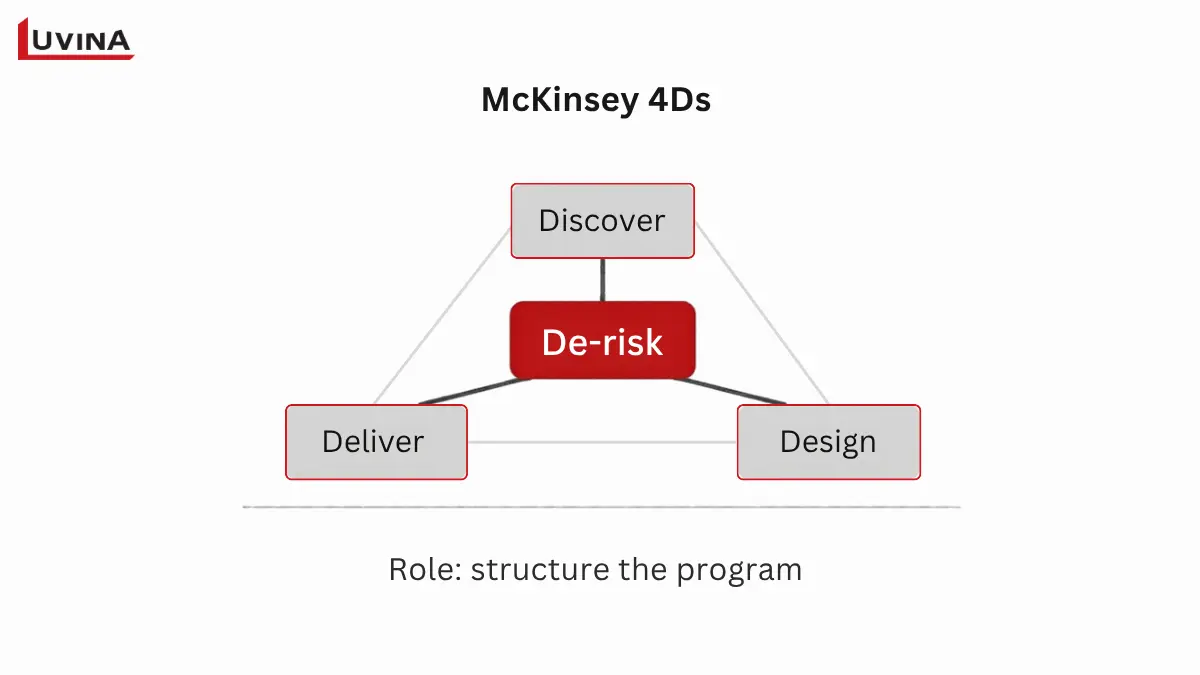
McKinsey’s Digital Reinvention (2017) frames transformation as a program that moves from ambition to delivery. Its focus is the program structure rather than the technology to buy. It breaks the work into four steps:
- Discover: set the digital ambition and build the business case from real insight.
- Design: prototype the new capabilities and customer journeys.
- Deliver: activate an ecosystem of partners to deliver at scale.
- De-risk: structure the program, resources, and commercial model to limit operational and financial risk.
Strength: It provides a structure for connecting digital ambition with solution design, delivery, and risk management.
Where it fits: It is worth considering when an organization has multiple digital initiatives but lacks a shared direction or a coordinated approach to execution.
Limitations: The model still needs to be translated into organization-specific governance, accountable owners, resource commitments, and measurable success criteria.
MIT CISR Five Building Blocks
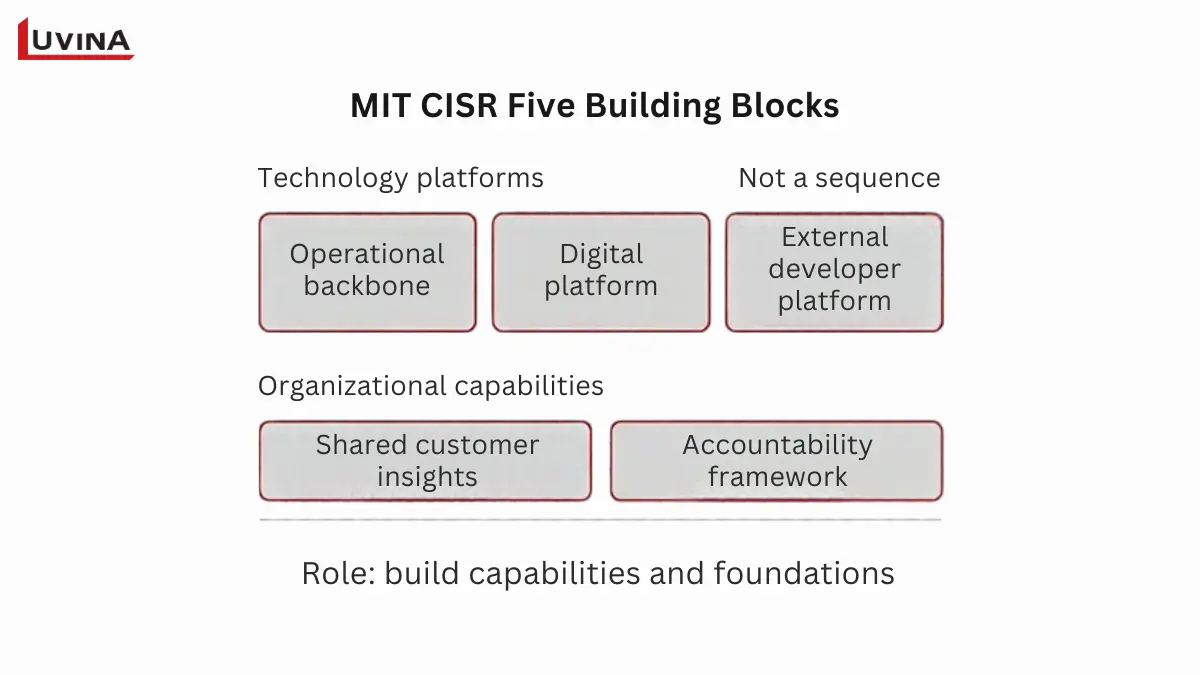
MIT CISR’s five building blocks, developed by Jeanne Ross and her co-authors, focus on the foundations needed to build and scale digital offerings. Three are technology platforms and two are organizational capabilities.
- Operational backbone: integrated and shared systems, processes, and data that support standardized, automated core business operations with greater efficiency, reliability, and transparency.
- Digital platform: a reusable collection of business, technology, and data components that companies can combine to develop new digital offerings and improve existing ones quickly.
- External developer platform: a platform that lets an ecosystem of partners contribute to and use the company’s digital components.
- Shared customer insights: what the company learns about what customers will buy.
- Accountability framework: clear ownership of each digital offering and component, plus coordination between teams.
Strength: it shows which capabilities to build, not just which technology to buy.
Where it fits: scattered systems and data, or a plan to grow digital services on a foundation that is not ready. ERP, CRM, and other enterprise systems typically sit in the backbone, and Luvina’s ERP development and consulting services cover the ERP part of that layer.
Limitations: The five building blocks are not a mandatory sequence. Organizations should identify their starting point based on their existing capabilities, digital offerings, and leadership priorities.
Deloitte Five Digital Imperatives
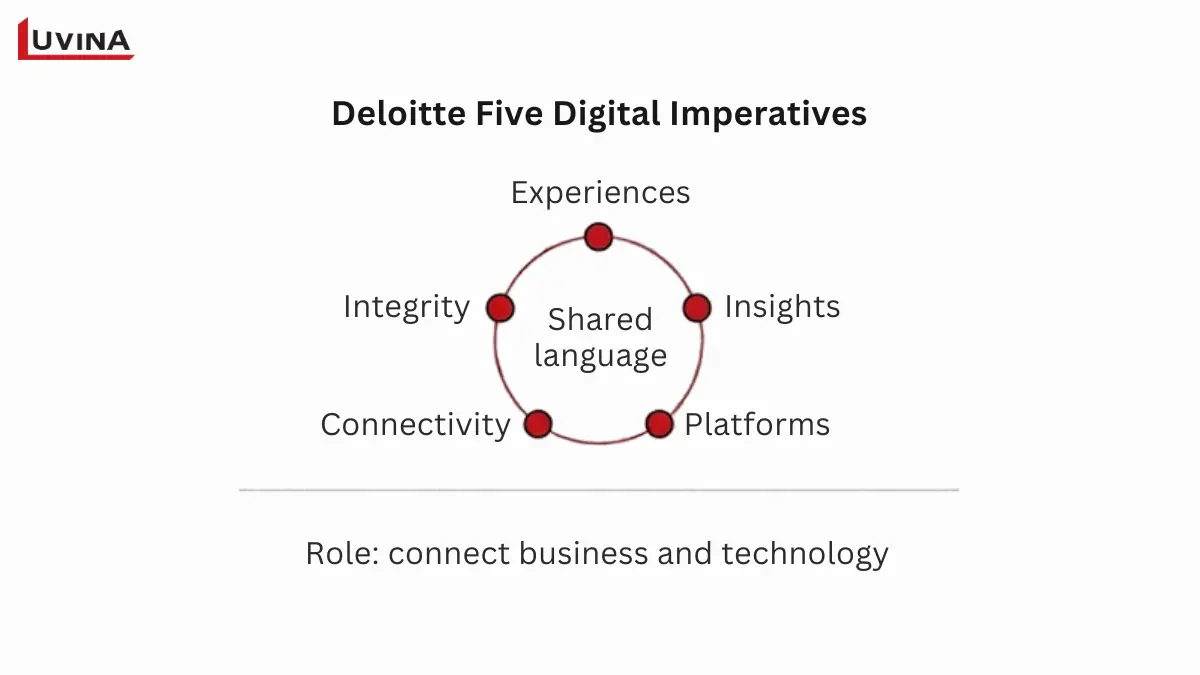
Deloitte introduced five digital imperatives in its 2021 research. leadership teams have a shared way to talk about strategy, technology, and operations. The model encourages organizations to connect technology decisions with business strategy, customer and employee experiences, data insights, and operational requirements. Deloitte describes the five imperatives as business outcomes that technology affects and enables.
- Experiences: improving interactions with customers, employees, and other stakeholders.
- Insights: the data, analysis, operating model, and workforce needed to support strategy.
- Platforms: how information is stored, processed, networked, and secured.
- Connectivity: how information flows between platforms, experiences, and insights, and across partner ecosystems.
- Integrity: purpose, resilience, security, and trust across business systems and processes.
Strength: it points teams to outcomes and capabilities before technology, and it puts security, resilience, and trust on the table.
Where it fits: departments with different priorities, or investment decisions led by technology rather than business goals.
Limitations: it does not set priorities, budgets, owners, or execution plan. Those need to be added.
BCG Digital Acceleration Index
BCG’s Digital Acceleration Index (DAI) is a questionnaire-based assessment of digital maturity. A company can compare its results with peers, industry average, and digital leaders, and see where capability gaps sit.
Companies typically use it at the start of a transformation, and BCG pairs it with deeper assessments of specific capabilities. For a broader view of how businesses progress, see this overview of digital transformation stages.
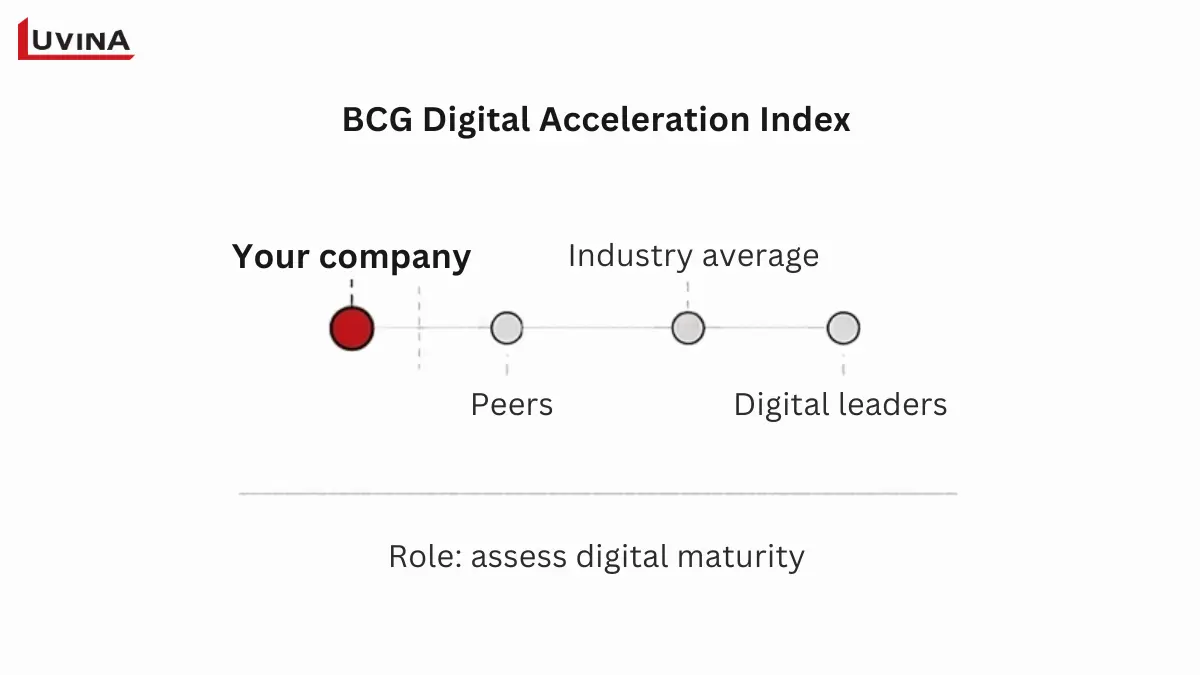
Strength: it gives a structured view of current capabilities, measured against peers, before any investment decision. BCG’s 2020 article on digital acceleration calls it an objective, fact-based view of the starting point, and pairs it with a more detailed inside-out assessment.
Where it fits: when the capability gaps are unclear, or when you need to see how you stand against comparable companies.
Limitations: DAI does not replace a framework for organizing and delivering the program. It shows where the gaps are, but not who closes them or in what order. BCG’s DAI is a diagnostic tool, so it works best alongside a model that covers how to organize and deliver the work, such as McKinsey 4Ds, MIT CISR or Deloitte’s imperatives.
Digital Transformation Frameworks Compared
The four models serve different purposes, so the right choice depends on the gap a business needs to address. The comparison below highlights their primary roles, situations where they are worth considering, and what teams may need to add before applying them.
| Model | Primary role | Worth considering when | Gaps to fill |
| McKinsey 4Ds | Structure a transformation programme | Initiatives lack shared direction or coordinated delivery | Governance, owners, resources and KPIs |
| MIT CISR Five Building Blocks | Identify digital foundations and capabilities to develop | Core systems or capabilities need strengthening to support digital offerings | Priorities and a roadmap based on current capabilities |
| Deloitte Five Digital Imperatives | Connect business outcomes with technology and operational capabilities | Teams need a shared view of business and technology priorities | Implementation plans, resources and accountability |
| BCG Digital Acceleration Index (DAI) | Assess digital maturity and capability gaps | The organization needs a clearer view of its current capabilities | A separate approach to prioritization and programme delivery |
Digital transformation framework examples compared
These models are not interchangeable, but they can complement one another. An organization could use a maturity assessment to identify capability gaps, a capability framework to determine what needs to be strengthened, and a programme framework to coordinate delivery.
The combination should depend on the decisions the organization needs to make. Using more than one model adds value only when each has a distinct purpose and contributes to clearer priorities, accountability, or execution.
How to Choose a Digital Transformation Framework
Choosing a digital transformation framework involves more than comparing models. Start with your business goals, assess your current capabilities, and select an approach your team can realistically apply.
Start with the Business Problem and Desired Outcomes
Before choosing a framework, define what the business needs to change. The objective may be to:
- Improve operations: Reduce manual work, processing time, or operating costs.
- Enhance customer experience: Make customer interactions more consistent and convenient.
- Develop digital services: Create new digital products, services, or revenue streams.
- Expand existing capabilities: Improve how systems, data, and teams support business growth.
Next, establish a baseline and measurable success criteria. For example, reducing order-processing time is a more actionable goal than simply aiming to “become more digital.” Assign an owner to track progress against the target.
Industry context can help organizations identify relevant transformation priorities. Review how comparable businesses are improving customer experiences, digitizing operations, and developing digital services. Use these observations to identify capability gaps and potential opportunities, rather than copying the investment priorities of industry leaders.
Benchmark organizations with similar business models, markets, and resource constraints, then define objectives that reflect your own business strategy.
Assess Current Capabilities and Constraints
Once the outcomes are clear, test whether the organization can reach them. Start from the five areas a framework should cover (business outcomes, customers and operations, technology and data, people and change, governance and measurement), then add the limits that decide how detailed it can be:
- Resources: budget, IT capacity, and delivery time.
- Change readiness: whether employees can adopt new processes and roles.
- Security and compliance: what the business must protect and meet.
- Continuity: which critical operations must keep running during the change.
If internal IT capacity is limited, external support can fill specific gaps. When evaluating digital transformation companies, look at their experience with your systems, their implementation and maintenance capabilities, and fit with your long-term needs.
Match the Framework to the Main Gap
Use the assessment to identify the problem the framework needs to address first:
- Program structure: Consider McKinsey 4Ds when multiple initiatives lack a shared direction or coordinated delivery approach.
- Digital capabilities and foundations: Consider MIT CISR’s Five Building Blocks when core systems, data, or the foundations for digital services need strengthening.
- Business and IT alignment: Consider Deloitte’s Five Digital Imperatives when teams struggle to agree on business outcomes and the capabilities needed to achieve them.
- Unclear capability gaps: Consider an assessment approach such as BCG’s Digital Acceleration Index to establish a clearer picture of current maturity.
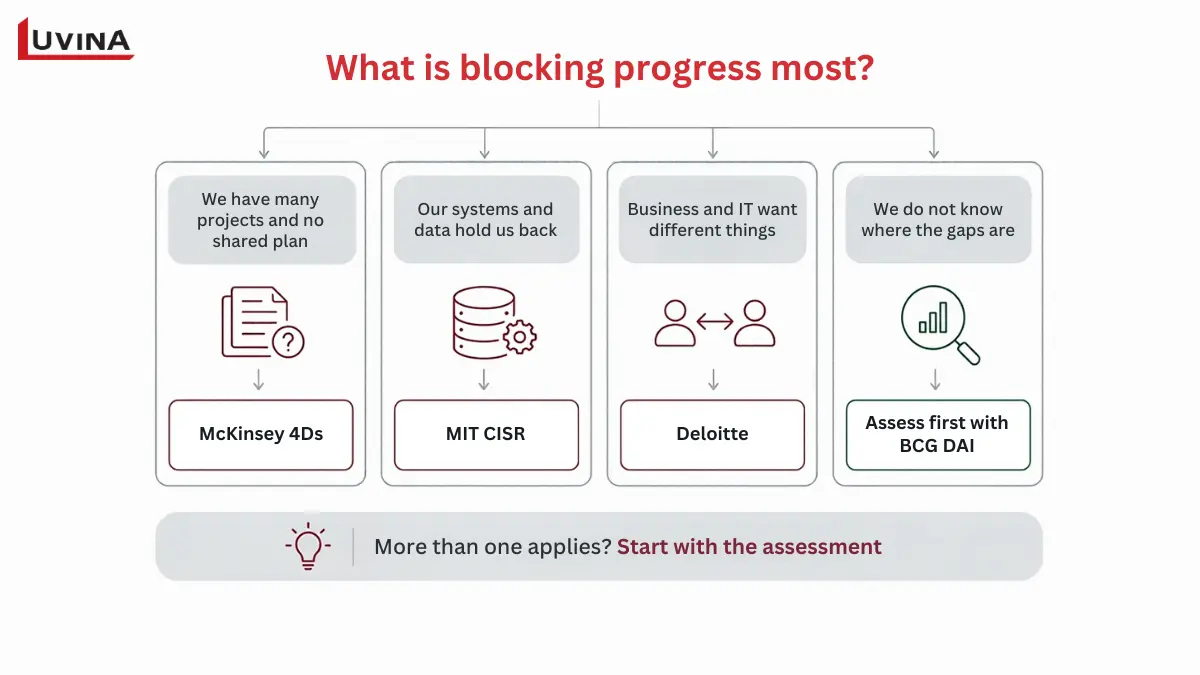
These are starting points, not fixed rules based on company size or industry. The appropriate choice depends on the business problem and what the initial assessment reveals.
Check Whether Your Team Can Apply It
Before adopting a framework, make sure the team can turn it into practical outputs: a defined business objective, an assessment of the main capability gaps, a prioritized set of initiatives, accountable owners, and measurable success criteria. If these outputs remain unclear, simplify the approach before adding more models or governance processes.
Clarify:
- Who owns the framework and makes investment decisions?
- Who is responsible for delivering initiatives and measuring results?
- Is sufficient data available to assess progress?
- Can the team allocate the time, skills, and budget required?
- What concrete outputs should the framework produce?
Smaller businesses can simplify documentation and focus on fewer priorities, but should retain clear goals, accountability, and measurable outcomes.
Combine Models with Clear Roles
A single model may not cover every need. An organization could assess its current capabilities, use a capability framework to identify what needs to change, and apply a program framework to coordinate delivery.
If combining models, define the role of each one and the decisions it supports. Avoid duplicating assessments or creating overlapping processes. The aim is to establish a coherent approach that turns business priorities into clear initiatives, accountable owners, and measurable results.
Applying Framework Thinking to a Real Business Case
The conditions behind a framework of choice are easier to see in a real system. This example starts with a Luvina case study, then applies the selection logic from above.
A Real Situation: Beato’s E-Commerce and ERP Systems
Beato is an online flower and gift retailer operating in several markets, including Singapore and Vietnam. Its e-commerce store runs on WordPress, with sales data synchronized to an Odoo ERP system. The previous vendor was slow to resolve bugs and performance issues. Beato also lacked direct control over its source code, hosting, and technical documentation, had no in-house IT team, and was approaching a peak sales season.
In October 2024, Luvina took over system maintenance, IT support, and helpdesk services. According to Luvina’s e-commerce and ERP maintenance case study, the handover took five days with no downtime, and IT support costs fell by 50%. These results relate to this specific engagement; the case study does not state that Beato adopted any digital transformation framework.
How Framework Thinking Can Guide Priorities
Based on the challenges described, MIT CISR’s Five Building Blocks offers a useful lens for examining the operational backbone and accountability needed to support reliable digital services. This is an analytical interpretation of the case, not a framework that Beato or Luvina is reported to have adopted.
The immediate priorities would be to stabilize WordPress–Odoo integration, document the technical environment, and clarify system ownership. Once these foundations are reliable, the business could evaluate further improvements such as multilingual support, additional currencies, or new payment integrations.
Potential KPIs include incident resolution time, data synchronization reliability, and downtime during peak trading periods. Actual priorities and targets would depend on Beato’s operational requirements and available resources.
Teams in a similar position can look at Luvina’s retail and e-commerce software development services.
FAQs
Is There One Best Digital Transformation Framework?
No. The right approach depends on the business problem, existing capabilities, and implementation of constraints. Some models help structure transformation programmes, others focus on the capabilities needed to support digital services, and assessment tools such as BCG’s Digital Acceleration Index help identify maturity gaps.
Can a Small Business Use These Frameworks?
Yes. Small businesses can adapt these frameworks to their resources and needs without adopting every component. A practical starting point is to define a measurable goal, identify the main capability gap, select a few priorities, assign an owner to each initiative, and track progress using relevant KPIs. The process should remain simple enough to support decisions rather than create unnecessary administration.
Can You Combine Digital Transformation Frameworks?
Yes, provided each framework has a distinct role. One can help assess current capabilities, while another supports planning or program delivery. Before combining them, clarify how each contributes to decision-making and avoid duplicating processes or responsibilities. The aim is a coherent approach that helps the organization move from assessment to action.
Conclusion
The right digital transformation framework depends on your business priorities, current capabilities, and ability to deliver change. The goal is not to adopt a model for its own sake, but to turn business objectives into clear priorities, accountable initiatives, and measurable outcomes.
Luvina can help assess your existing systems, identify technical constraints, and translate transformation priorities into a practical implementation plan.
Resources
https://www.mckinsey.com/capabilities/tech-and-ai/our-insights/digital-reinvention
https://mitsloan.mit.edu/ideas-made-to-matter/5-building-blocks-digital-transformation
https://www.deloitte.com/global/en/issues/digital/a-new-language-for-digital-transformation.html
https://www.bcg.com/publications/2020/how-to-successfully-accelerate-digital-transformation
https://www.bcg.com/publications/2021/digital-acceleration-index
https://www.bcg.com/capabilities/digital-technology-data/digital-maturity
READY TO START A PROJECT?
Our experts are eager to explore your needs.

Read More From Us?
Sign up for our newsletter
Read More From Us?
Sign up for our newsletter