




Luvina’s Gen AI Usage Policy: How We Use AI Responsibly at Work


A coding assistant used to suggest the next line. Now it can read a whole repository and run commands on its own. For a CIO or CTO handing code to an outside team, that raises a plain question: where does our code go when your developers use AI?
The concern is no longer just whether AI makes development faster. It is whether its use is properly governed. A Gartner survey of more than 2,000 CIOs and technology leaders (Q2 2026) found that 71% expect to deploy agentic AI within 12 months, but only 21% have governance for it in place. When your own rules lag behind, the vendor’s rules carry more weight.
So, do we use AI on your code? Yes, but only within defined limits. We use approved tools on company accounts and require client consent before using AI on a project. If a client or project requires AI-free development, we respect that too.
Why We Wrote a Gen AI Usage Policy
A Gen AI usage policy sets which AI tools staff may use, what data may go into them, who approves each use, and what happens when something goes wrong.
We wrote ours because the applications of generative AI now sit inside everyday software work, from drafting tests to explaining legacy code. Speed is the draw. Trust decides whether clients let us use it on their projects, so the two have to move together.
Clients usually worry about three things:
- Source code or access keys ending up in a prompt
- Personal data reaching a tool it should never touch
- AI use that breaks the terms of their contract
Banning AI outright would slow every project and push people toward tools nobody approved. On the other hand, leaving AI use unrestricted would put your data at risk. Our policy sits between the two: clear limits, and someone accountable for them.
Our Principles and What They Mean for Your Data
Four principles hold the policy together. Each one comes with something you can check.
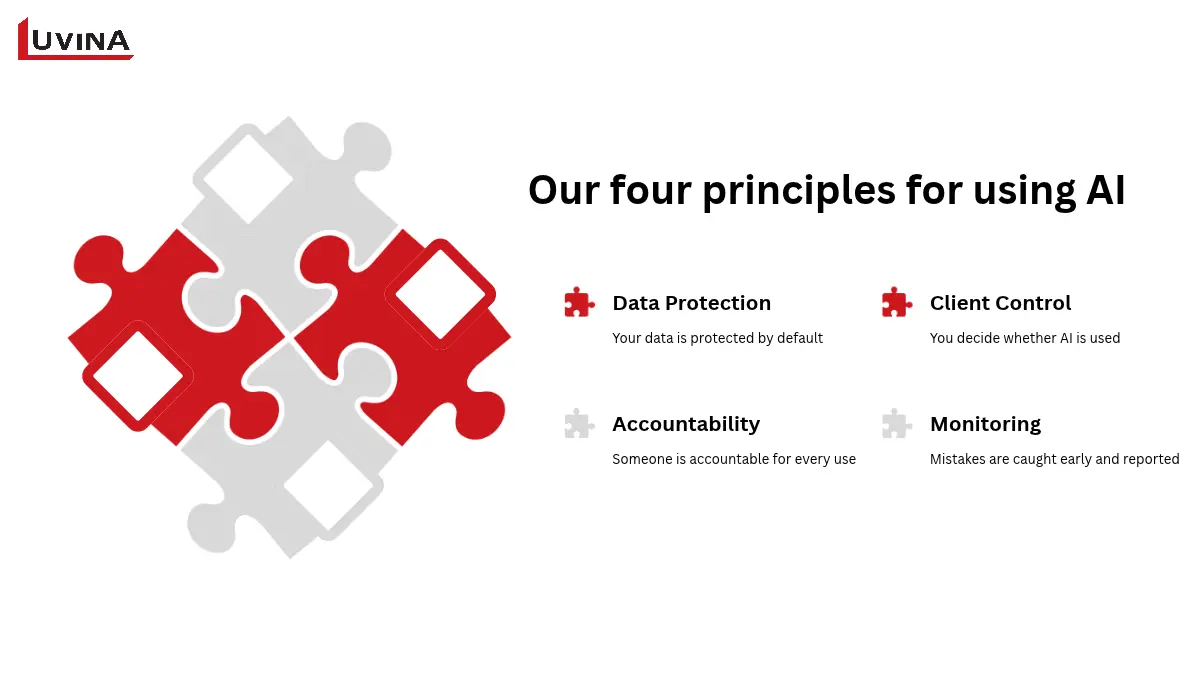
Your data is protected by default
Our people use only AI tools we have approved, on company devices and company accounts. We choose tools that let us switch off model training on our data, and we configure them that way. At closing, we revoke access, request deletion of project data where the tool allows it and keep a record of the request and the result. Access keys and personal data stay out of prompts, and when a task needs sensitive material, we mask it first. For how we secure systems more broadly, see our IT security services.
You decide whether AI is used
Two rules come first:
- We do not use AI on your project until you agree. The agreement is recorded in the contract or a written request.
- If your contract bans AI, your project gets none.
Beyond that, every project falls into one of three tiers. If a project fits more than one, the strictest tier applies.
| Tier | When it applies | What AI use is allowed |
| Prohibited | Highly sensitive data, or a contract that rules out AI | None |
| Restricted | Sensitive data, and you allow AI | Self-hosted tools or enterprise tenants covered by a data processing agreement, with masking and monitoring |
| Conditional | Ordinary projects with no sensitive data | Approved tools on company accounts, under the rules above |
AI usage allowed at each project tier
Someone is accountable for every use
Every use of AI is registered, reviewed and approved before anyone starts. Our information security team owns the policy and signs it off. Before anyone gets access to an AI tool, they complete training, pass a test and sign a commitment that covers client data.
Mistakes are caught early and reported
AI activity is logged, so we can show you what happened if you ask. We review the logs on a regular schedule, not only after a problem. If something does go wrong, a defined incident process starts, and we tell you within the terms of your contract.
What It Looks Like in a Real Project
Say a logistics client hires us to build an internal B2B ordering portal. It holds no personal data, so the project sits in the Conditional tier. Here is what that client would see from start to finish.
| Stage | What you see | What we do |
| Before kickoff | We ask whether AI may be used on your project, and for what. Your answer goes into the contract. | Classify the project, register the planned AI use and get it approved. Every team member finishes AI training first. |
| During | AI use stays inside the scope you agreed. | Run approved tools on company accounts, mask sensitive data and log AI activity. |
| At closing | Team access to AI tools is withdrawn, and we send you a record of each deletion request and its result. | Revoke the accounts, request deletion of project data where the tool allows it and keep a record of each request and result. |
What a client sees at each stage of a project where AI is used
Projects change as they go. Say the client later asks us to connect the portal to customer records. We review the project again before that data reaches any AI tool, and because it now holds personal data, it moves up to the Restricted tier. The stricter rules apply from that point on.
How Our Usage Policy Connects to Recognized Frameworks
We did not write our Gen AI usage policy in isolation. The references below shaped it or sit alongside it. They are reference points, not certifications.
Reference points behind our Gen AI usage policy, and what each is used for.
| Reference | How we use it |
| OWASP Top 10 for LLM Applications 2025 | The source of our AI risk list |
| IMDA Model AI Governance Framework for Generative AI (30 May 2024) | A reference for governance practice |
| Vietnam’s Law on Personal Data Protection (No. 91/2025/QH15), plus the data laws of our clients’ markets, such as Japan’s APPI | Legal context, not legal advice |
Developers now use coding agents that run commands and call other tools, which adds risks of its own. IMDA’s Model AI Governance Framework for Agentic AI (v1.5, May 2026) addresses them. Teams deploying agents themselves can start with our AI agent readiness checklist.
Seven Questions to Ask Any Vendor About AI
Picking a vendor is about the engagement model as much as the AI rules. If you are still working out which type of IT outsourcing fits, put these seven questions to every vendor on the shortlist.
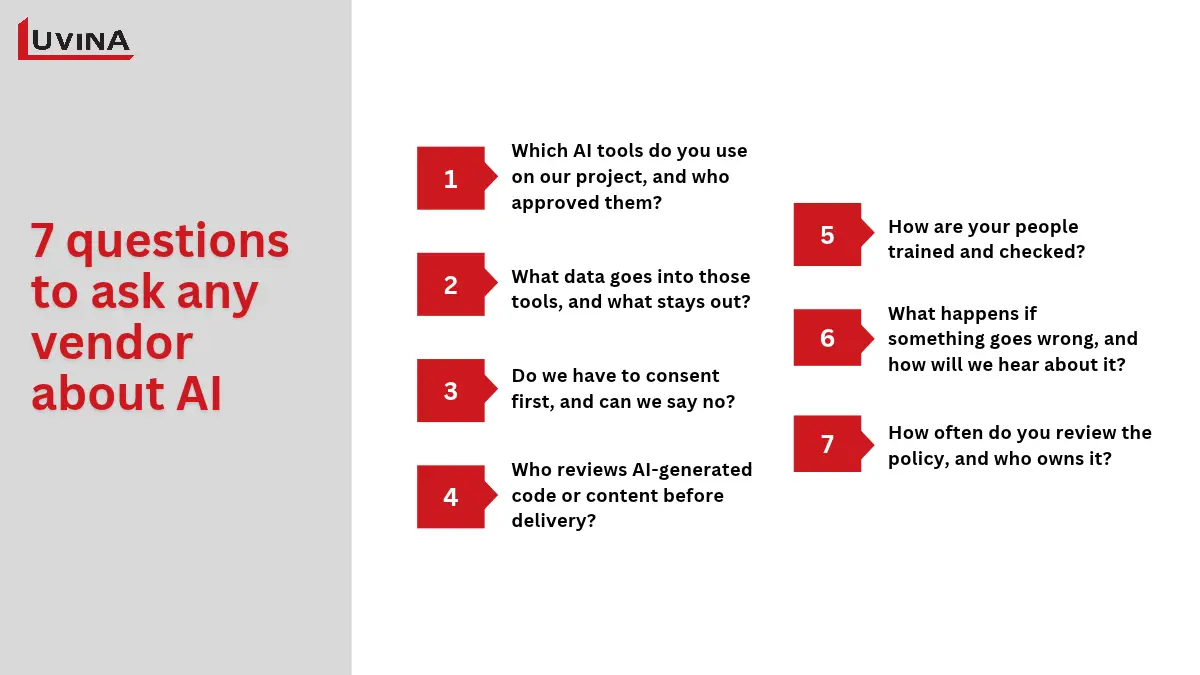
| Question | How Luvina answers |
| 1. Which AI tools do you use on our project, and who approved them? | Only tools that pass fixed criteria, re-checked monthly. An approver signs off each use before work begins. |
| 2. What data goes into those tools, and what stays out? | Data is classified first. Keys and personal data stay out, and sensitive material is masked. |
| 3. Do we have to consent first, and can we say no? | Yes. No consent, no AI. A contract ban means none on your project. |
| 4. Who reviews AI-generated code or content before delivery? | Two layers of checks: the project manager first, then the project’s information security team. Company-wide issues go to the head of information security. |
| 5. How are your people trained and checked? | Training, a test and a signed commitment before access, then yearly refreshers. |
| 6. What happens if something goes wrong, and how will we hear about it? | Logged activity, a set incident process, and notice as your contract requires. |
| 7. How often do you review the policy, and who owns it? | Our information security team owns it. Reviewed monthly for three months, then every six months or after major changes. |
Luvina’s answers to seven vendor AI questions
Our answers are in the table above, and any vendor you shortlist should be able to answer them just as plainly.
What We Are Still Learning
AI tools and risks continue to change, so a policy cannot remain static. We review our approved tools, monitor emerging risks and update our controls as needed. Our goal is to make sure the rules protecting client code and data remain relevant as the technology evolves.
Our policy, version 0.1, took effect on 11 September 2026. Its development has shaped three important practices:
- Tool approval is never permanent. Vendors change their terms and features often, so a tool that passed once has to keep passing.
- No single tool covers every control. Tools differ in what they offer, so some of our controls sit around them, on our own devices and network.
- Agents need their own rules. A coding agent acts, it does not only answer. So we added controls built for agents: a person approves commands that change things, and agents work in limited environments.
Conclusion
Using Gen AI fast is easy. Doing it in a way clients can trust is the hard part, and that takes a policy with an owner, rules people follow and answers you can check.
At Luvina, we believe the value of AI lies not in how much we use it, but in how intelligently and responsibly we apply it. We combine AI-enabled engineering with human oversight, data protection and clear governance to help clients move forward with confidence.
Because choosing a technology partner today is not just about finding a team that knows how to use AI. It is about finding one you can trust to use it wisely.
Looking for a technology partner that puts both AI innovation and your data security first? Talk to us about how we approach AI in software development and what that means for your project.
READY TO START A PROJECT?
Our experts are eager to explore your needs.

Read More From Us?
Sign up for our newsletter
Read More From Us?
Sign up for our newsletter