




Component-Based Software Engineering: An Overview


Modern software systems are increasingly built, scaled, and maintained using component-based software engineering (CBSE). Large technology-driven companies like Netflix can release frequent updates with minimal downtime because their systems are built from independent, reusable components rather than a single monolithic application.
Written for corporate executives, product owners, and decision-makers forming long-term technology plans, this article will show what component-based methods actually imply, their advantages and disadvantages, actual applications, and their contrast to object-oriented models.
What Is Component-Based Software Engineering?
Component-based software engineering is an approach to software development where systems are built by combining reusable software components instead of rewriting everything from scratch. Each component performs a specific function and exposes a clear interface, allowing it to be developed, tested, replaced, or upgraded independently without affecting the entire system.
Particularly useful for companies trying to speed up development cycles and raise software quality is component-based software engineering. It aids in:
– Better system modularity and control
– Improved reliability and maintainability
– Easier debugging, updates, and long-term scalability
Source:
https://www.geeksforgeeks.org/software-engineering/component-based-software-engineering
Software Components in Software Engineering
In practice, component-based software engineering systems are organized into distinct layers, each containing specific types of software components with clear responsibilities. Software components in CBSE typically span UI, application logic, integration, and infrastructure layers, each with clearly defined responsibilities.
The following is a summary of the most often used software component types actually encountered:
| Technical layer | Component type | Description | Examples |
| Presentation (UI) | Themes | Define visual style and layout without affecting core logic. | Seasonal website themes, UI skins |
| Controls | UI elements that enable user interaction and input. | Buttons, text fields, sliders, and menus | |
| Widgets | Reusable UI components are commonly applied in component-based software engineering to deliver focused features. | Weather widgets, calendars, social embeds | |
| UI framework connectors | Manage data flow between UI components and application logic. | React Context, Redux, Angular Routing | |
| Application logic | Modules | Core building blocks that encapsulate business logic in component-based software engineering architectures. | Source modules, runtime modules |
| Libraries | Reusable code collections for common logic and utilities. | Charting, date, animation libraries | |
| Plugins | Add-ons that extend system features without changing core code. | CMS plugins, browser extensions | |
| Integration | APIs | Interfaces that enable communication between systems or components. | Payment APIs, map APIs |
| Integration connectors | Components that connect and synchronize external systems. | Cloud, API, data connectors | |
| Infrastructure and services | Services | Integration-focused components are widely used in component-based software engineering to synchronize systems. | Web services, microservices |
| Frameworks | Structural foundations and tools for building applications. | Web, mobile, game frameworks |
Common Types of Software Components in CBSE
Source:
https://www.linkedin.com/pulse/types-software-components-examples-sunny-yadav-ducaf
Component-Based vs Object-Oriented Software Engineering
Though both object-oriented design and component-based software engineering seek to simplify complexity, they arrange software in quite different ways and result in different benefits in reuse, deployment, and system evolution.
Where data and behavior are intimately linked, object-oriented software engineering structures systems around classes and objects. Inheritance and composition define reuse mostly at the class level; object lifecycles are usually controlled by the programming language runtime. For somewhat stable systems with little change, this method fits well.
Building systems from bigger, independent components that interact via straightforward interfaces is component-based software engineering. Dependencies are lightly coupled; parts can be updated or changed separately; deployment can occur at the component level. Because components are loosely coupled and independently deployable, CBSE is better suited for systems that require frequent change, scalability, and long-term evolution.
The table below summarizes the core differences between the 2 approaches:
| Aspect | Object-oriented software engineering | Component-based software engineering |
| Granularity | Focuses on classes and objects | Focuses on larger, self-contained components |
| Reusability | Reuse mainly at the class level | Reuse across systems and projects |
| Dependency management | Inheritance and composition | Interfaces and contracts |
| Lifecycle management | Managed by the language runtime | Components have independent lifecycles |
| Deployment | Typically deployed as a whole system | Components can be deployed separately |
| System evolution | Better for stable systems | Better for flexible, evolving systems |
A brief comparison of component-based software engineering and object-oriented software engineering
Which one to use?
– Object-oriented software engineering: Best for smaller or fairly steady systems when changes are small and managed within a single code base.
– Component-based software engineering: Best for systems needing to scale, change, and integrate throughout time, especially when independent deployment and team freedom are crucial.
While both paradigms are still relevant today, component-based design provides a stronger foundation for systems that must scale and evolve. In addition, many of today’s architectures leverage both paradigms; object-oriented is used inside components, and a component-based paradigm is used at the system level.
Source: https://knowledgewala.com/name-the-differences-between-object-oriented-and-component-based-design/
Benefits of Component-Based Software Engineering
For companies needing to create affordable, scalable, and adaptable systems, component-based software engineering provides actual benefits. This approach depends on modular building blocks that may evolve independently rather than on software as a strongly coupled unit. The main advantages of this paradigm that explain why many contemporary systems choose it are listed below:
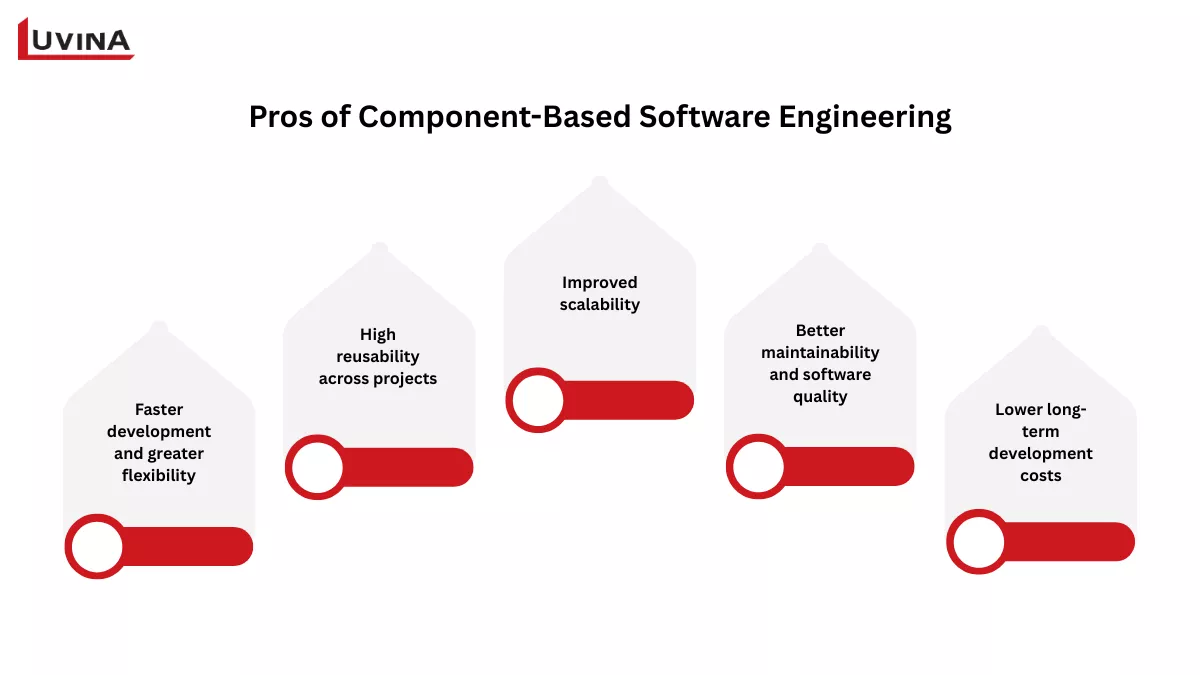
This approach has its own distinct benefits
Faster development and greater flexibility
Independent components allow teams to work in parallel, significantly reducing development time. New features can be added or modified without impacting the entire system.
High reusability across projects
Well-designed software components in software engineering can be repurposed in other projects or programs. By depending on proven parts, reuse reduces repeating work, lowering the risk of defects, and guarantees constant operation and user experience across systems.
Improved scalability
By adding, deleting, or refining particular components, systems developed with component-based software engineering naturally scale. Load-heavy or business-critical components can be isolated and scaled separately, therefore avoiding significant architectural alterations.
Better maintainability and software quality
Testing, debugging, and maintenance become simpler with smaller, self-contained parts. Specific components cause problems, therefore lowering regression risks and improving long-term maintenance predictability as systems develop.
Lower long-term development costs
Organizations save development and maintenance effort over time by building systems from reusable components. This method lets smaller teams provide more value and progressively develop a component library that lowers future project costs.
Limitations of Component-Based Software Engineering
Although component-based software engineering provides obvious advantages, it also presents difficulties that early teams must prepare for. These constraints could lower system complexity and efficiency if the appropriate governance, tools, and architectural discipline are not present.
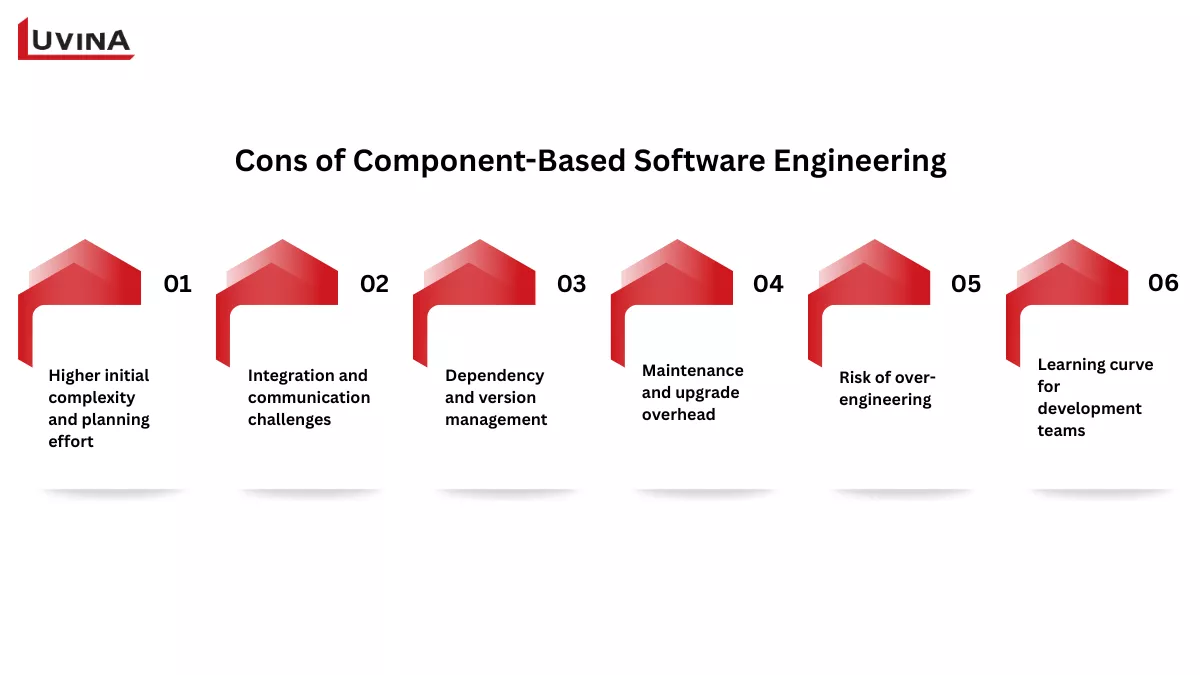
The challenges encountered during implementation are unavoidable
Higher initial complexity and planning effort
Designing reusable components demands from the beginning precise definitions of interfaces, duties, and dependencies. This initial work may seem heavy relative to more basic, monolithic techniques and can impede early growth.
Integration and runtime challenges
Integrating independently developed components can be complex, especially when they need to communicate at runtime. Differences in communication protocols, data formats, or interface contracts may lead to integration friction, increasing coordination effort, and the risk of runtime failures during component interaction.
Dependency and version management
As component-based systems evolve, managing dependencies and component versions becomes increasingly difficult. Changes or upgrades in one component can impact dependent components, making backward compatibility, version alignment, and controlled release management critical in component-based software engineering environments.
Maintenance and upgrade overhead
To be dependable and current, reusable parts need continuous upkeep. Maintaining documented, updated, and consistent component libraries across projects calls for ongoing work and strict governance.
Risk of over-engineering
Trying to increase modularity, groups may divide functionality into far too many little parts. This might raise cognitive load, complicate system design, and decrease total productivity.
Learning curve for development teams
Teams new to component-based software engineering may need time to adapt to ideas like loose coupling, interface contracts, and component lifecycle management, which can temporarily impede productivity.
Source: https://fabbuilder.com/blogs/what-is-component-based-architecture-benefits-examples-use-cases/
Use cases of CBSE
CBSE is most effective in scenarios where systems must evolve, scale independently, or integrate across multiple platforms. The most often used cases in which this method shows its worth are listed below.
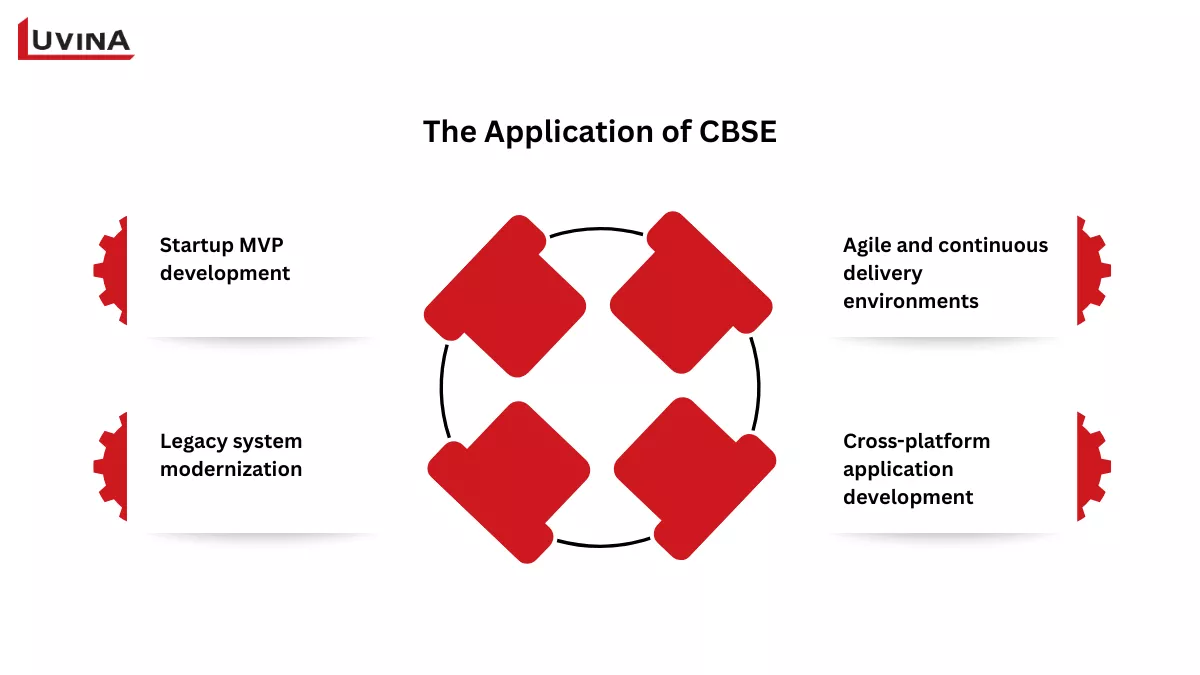
Some common use cases of this approach
Startup MVP development
CBSE helps new businesses quickly develop by gathering ready-to-use parts rather than constructing everything from scratch. This allows one to cut time-to-market while still maintaining the architecture flexible enough to enable future development and function enlargement.
Legacy system modernization
CBSE is frequently used by businesses to refactor or progressively replace monolithic legacy systems. Large systems can be converted into modular designs that are simpler to maintain, integrate, and develop without disturbing core activities by using component-based software engineering.
Agile and continuous delivery environments
Agile teams working on constant integration and delivery find CBSE suitable. By restricting the effect of changes to certain components of the system, independent components enable teams to work in parallel, publish updates more frequently, and lower deployment risks.
Cross-platform application development
Component-based software engineering encourages component reuse throughout contexts while developing solutions for web and mobile platforms. Shared components save replicated development work while helping to provide consistent functionality and user experience.
Source:
https://fabbuilder.com/blogs/what-is-component-based-architecture-benefits-examples-use-cases
How Luvina Applies Component-Based Principles in Software Engineering Projects?
Component-based principles are used as a realistic basis for creating scalable, maintainable, and fast-to-market software systems at Luvina. Luvina applies component-based principles by defining reusable core components early and deploying them consistently across projects to reduce development time and maintain architectural flexibility.
Using pre-built, modular components, including authentication flows, dashboards, integrations, and API connectors, Luvina also speeds delivery. These pre-configured components cut development cycles while yet fitting perfectly into more complex system designs. Teams can launch new capabilities or upgrades with little interruption using modular deployment and update procedures.
By continuously adopting component-based software engineering ideas across its projects, Luvina allows companies to create quicker, expand with assurance, and preserve enterprise-grade stability over time.
FAQ
1. What is component-based software engineering?
Component-based software engineering is an approach that builds software systems from reusable, independent components with clearly defined interfaces.
2. How does CBSE support scalability?
Independent components can be deployed, updated, or scaled separately without affecting the entire system.
3. What challenges should teams expect with CBSE?
Common challenges include integration complexity, dependency management, and controlling component versions.
4. Is CBSE suitable for all projects?
CBSE works best for medium to large systems that require long-term scalability and frequent updates, but may be excessive for very small or short-term projects.
Conclusion
Component-based software engineering provides a structured way to build scalable, maintainable software systems using reusable components. When applied correctly, it helps organizations manage complexity, accelerate development, and adapt to long-term change.
Using these ideas in actual software engineering projects, Luvina enables companies to transform component-based concepts into ready-for-production, usable solutions. Contact Luvina if you are looking to update your software systems or are investigating component-based architecture for customized advice and technical support!
Resources
- https://www.geeksforgeeks.org/software-engineering/component-based-software-engineering/
- https://www.linkedin.com/pulse/types-software-components-examples-sunny-yadav-ducaf/
- https://knowledgewala.com/name-the-differences-between-object-oriented-and-component-based-design/
- https://fabbuilder.com/blogs/what-is-component-based-architecture-benefits-examples-use-cases/
READY TO START A PROJECT?
Our experts are eager to explore your needs.


Read More From Us?
Sign up for our newsletter
Read More From Us?
Sign up for our newsletter